
ᐅ Subfloor Construction Without Screed for Solid Wood Planks – Experiences
Created on: 9 Nov 2020 19:04
P
pagoni2020
My current plan is to have a standard concrete slab under the house; additional insulation is still possible.
Based on my experience with a house that has a basement, I had planned to lay a membrane on the raw subfloor (this time without a basement) as a moisture barrier. On top of that, I would install a joist or cross beam structure with loose-fill insulation in between (cork, perlite, hemp-light clay loose-fill; this is also what the contractor recommended).
I recently consulted a specialist company for these types of insulation materials, and they raised some concerns that the membrane on the raw subfloor might prevent moisture—potentially settling from indoor air in the worst case, through the wooden floorboards and insulation—from properly draining downward because of the membrane.
Their advice was to lay the joists directly on the membrane to protect the wood from direct contact with concrete and moisture, and to place the insulation directly on the raw subfloor instead.
In my opinion, however, this approach might carry the risk that residual moisture could rise from below into the insulation area, just reversing the problem.
One possible solution could be to use foam glass gravel when the concrete slab is first poured; however, I am not sure if my general contractor will implement this or if it actually makes sense.
I thought I had this issue figured out, but since there is no basement under the living areas in this build, it is making me reconsider. Ultimately, I want to avoid screed specifically because of moisture concerns.
Does anyone have more detailed experience or knowledge about this?
@Steffi33, you have a construction like this; could you share your exact setup (membrane, insulation, etc.)? Do you have a basement? What type of concrete slab do you have? What joist height did you use? Sorry for all the questions.
Based on my experience with a house that has a basement, I had planned to lay a membrane on the raw subfloor (this time without a basement) as a moisture barrier. On top of that, I would install a joist or cross beam structure with loose-fill insulation in between (cork, perlite, hemp-light clay loose-fill; this is also what the contractor recommended).
I recently consulted a specialist company for these types of insulation materials, and they raised some concerns that the membrane on the raw subfloor might prevent moisture—potentially settling from indoor air in the worst case, through the wooden floorboards and insulation—from properly draining downward because of the membrane.
Their advice was to lay the joists directly on the membrane to protect the wood from direct contact with concrete and moisture, and to place the insulation directly on the raw subfloor instead.
In my opinion, however, this approach might carry the risk that residual moisture could rise from below into the insulation area, just reversing the problem.
One possible solution could be to use foam glass gravel when the concrete slab is first poured; however, I am not sure if my general contractor will implement this or if it actually makes sense.
I thought I had this issue figured out, but since there is no basement under the living areas in this build, it is making me reconsider. Ultimately, I want to avoid screed specifically because of moisture concerns.
Does anyone have more detailed experience or knowledge about this?
@Steffi33, you have a construction like this; could you share your exact setup (membrane, insulation, etc.)? Do you have a basement? What type of concrete slab do you have? What joist height did you use? Sorry for all the questions.
No, you’re not missing anything. The choice of system mostly depends on the installer or your supplier. I would go with whatever your floor layer is most familiar with and has contacts for.
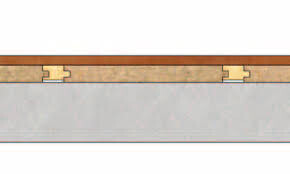
The advantage of the Steico system, as you mentioned, is that it offers battens for 6cm (2.4 inches) thick insulation boards. This means the studs are 55mm (2.2 inches) thick, which is more common to screw into compared to the 35mm (1.4 inches) of the Gutex system.
The advantage of the Steico system, as you mentioned, is that it offers battens for 6cm (2.4 inches) thick insulation boards. This means the studs are 55mm (2.2 inches) thick, which is more common to screw into compared to the 35mm (1.4 inches) of the Gutex system.
P
pagoni202011 Nov 2020 14:31HarvSpec schrieb:
No, you’re not overlooking anything. The choice of system usually depends on the installer or supplier. I would go with whichever one your flooring contractor is most familiar with and has good contacts for. …then I guess that’s me 😀, so I’ll probably go with the 6cm (2.4 inch) model from the two providers; Gutex only offers the 4cm (1.6 inch) option.
Many thanks for your helpful tip!!
P
pagoni202011 Nov 2020 14:57HarvSpec schrieb:
Sure.
I would contact Steico again regarding the planned construction. As you mentioned at the beginning, you do need a vapor retarder on the raw concrete. Of course, I’ve already clarified that with them. They don’t have any specific recommendation, just a barrier against rising moisture from the usual suspects like Bauder, etc.
It will still take some time until installation, but in any case, I have the topic clear for myself now and can finalize the last details before installation.
Thanks again.
pagoni2020 schrieb:
🤨 🤨 🤨
I think I’ve found it.
@HarvSpec gave me the right tip. Now I just have to choose between the different suppliers, but I like the system. Steico, Schneider-Holz Floor_140, or Gutex.
Just now, floorboards screwed directly onto the wood
Whoever climbs will eventually fall. Considering what she and her best friend climb or play on, I’m not surprised nothing worse has happened yet. Our neighbor has often said, "Today I mixed some plaster, just as a precaution."
Great that you found what you were looking for.
When is your project starting?