
Good morning,
I have the following questions:
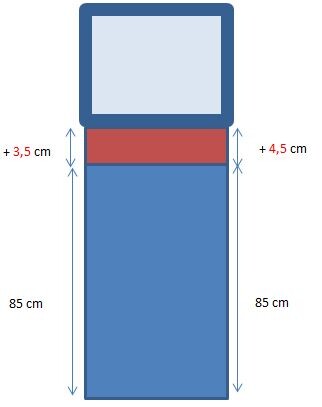
1. Would there already be a construction defect if a general contractor/building company installs a kitchen window in a turnkey single-family house in such a way that, on the inside directly below the window frame—where an interior windowsill or kitchen countertop could theoretically be installed—there are different heights (3.5cm (1.4 inches) on the left and 4.5cm (1.8 inches) on the right) causing a tilt, meaning that a windowsill or countertop could only be installed slightly slanted? I am referring to the area from the bottom edge of the window frame (inside) to the interior wall or parapet end—the area where, for example, the kitchen countertop could be built up to under the window.
(I have attached a sketch; it concerns the red-marked area, which represents the "surface" below a window, roughly the interior windowsill.)
2. What does the specification "parapet height 1.00m (3.3 feet)" mean, which is sometimes noted next to windows in floor plans? From where (bottom edge of the window frame or start of the window sash?) to where (finished floor level? screed floor level?) is this measured (inside/outside)?
3. Assuming the screed floor has already been installed in the house: when measuring, the client discovers that the current room height from the screed floor to the ceiling is 2.47m (8.1 feet) in all rooms, still without tiles or laminate installed, whereas the floor plans specify a "clear room height: 2.50m (8.2 feet)" for all rooms. Would this be considered a defect?
I know these are specific questions. Unfortunately, I could not find answers through online research. Therefore, I would be very glad if someone here could assess the situation, even if only for part of the questions! Thanks in advance.
I have the following questions:
1. Would there already be a construction defect if a general contractor/building company installs a kitchen window in a turnkey single-family house in such a way that, on the inside directly below the window frame—where an interior windowsill or kitchen countertop could theoretically be installed—there are different heights (3.5cm (1.4 inches) on the left and 4.5cm (1.8 inches) on the right) causing a tilt, meaning that a windowsill or countertop could only be installed slightly slanted? I am referring to the area from the bottom edge of the window frame (inside) to the interior wall or parapet end—the area where, for example, the kitchen countertop could be built up to under the window.
(I have attached a sketch; it concerns the red-marked area, which represents the "surface" below a window, roughly the interior windowsill.)
2. What does the specification "parapet height 1.00m (3.3 feet)" mean, which is sometimes noted next to windows in floor plans? From where (bottom edge of the window frame or start of the window sash?) to where (finished floor level? screed floor level?) is this measured (inside/outside)?
3. Assuming the screed floor has already been installed in the house: when measuring, the client discovers that the current room height from the screed floor to the ceiling is 2.47m (8.1 feet) in all rooms, still without tiles or laminate installed, whereas the floor plans specify a "clear room height: 2.50m (8.2 feet)" for all rooms. Would this be considered a defect?
I know these are specific questions. Unfortunately, I could not find answers through online research. Therefore, I would be very glad if someone here could assess the situation, even if only for part of the questions! Thanks in advance.
ypg schrieb:
then you have 3 cm (1.2 inches) more againThat would then be the next very serious defect 😱Thank you for the responses!
Regarding points 1 and 2)
The window sill (I hope I’m describing this correctly), meaning the interior kitchen wall up to the "window ledge," is actually not horizontal. This is confirmed by using a spirit level. This is because one side of the window (left) measured from the ledge starts at 3.5cm (1.4 inches) height, while the other side (right) begins at 4cm (1.6 inches). Standard countertops have a thickness of 4cm (1.6 inches). This means that the countertop theoretically needs to be adjusted. For every other window on the ground floor in the other rooms, the height on both sides is about 4 to 4.2cm (1.6 to 1.7 inches). Only this particular kitchen window, which is crucial, differs.
Even though not every angle in the photo allows a clear assessment: the spirit level reading can be seen on site as shown in the photo, but only at this window.
Regarding point 3)
The "clear ceiling height" presumably applies at the time of the final inspection/house handover, not only after 3 years, right? Otherwise, any construction company could claim that the screed might still change and therefore no defect exists, even if the room height is 2.39m (7 ft 10 in).
I understand that the builder can no longer change the room heights. I’m just wondering what this means in practice, for example if a defect exists and if I could withhold a portion of the final payment because the room height built does not match the 2.50m (8 ft 2 in) stated on the floor plan.
The same ultimately applies to the window if a defect is present. In my opinion, a defect could only exist if the corresponding “unevenness” is considered a defect.

Regarding points 1 and 2)
The window sill (I hope I’m describing this correctly), meaning the interior kitchen wall up to the "window ledge," is actually not horizontal. This is confirmed by using a spirit level. This is because one side of the window (left) measured from the ledge starts at 3.5cm (1.4 inches) height, while the other side (right) begins at 4cm (1.6 inches). Standard countertops have a thickness of 4cm (1.6 inches). This means that the countertop theoretically needs to be adjusted. For every other window on the ground floor in the other rooms, the height on both sides is about 4 to 4.2cm (1.6 to 1.7 inches). Only this particular kitchen window, which is crucial, differs.
Even though not every angle in the photo allows a clear assessment: the spirit level reading can be seen on site as shown in the photo, but only at this window.
Regarding point 3)
The "clear ceiling height" presumably applies at the time of the final inspection/house handover, not only after 3 years, right? Otherwise, any construction company could claim that the screed might still change and therefore no defect exists, even if the room height is 2.39m (7 ft 10 in).
I understand that the builder can no longer change the room heights. I’m just wondering what this means in practice, for example if a defect exists and if I could withhold a portion of the final payment because the room height built does not match the 2.50m (8 ft 2 in) stated on the floor plan.
The same ultimately applies to the window if a defect is present. In my opinion, a defect could only exist if the corresponding “unevenness” is considered a defect.
user281 schrieb:
The sill (I hope I’m describing it correctly), by that I mean the kitchen interior wall up to the “window sill inside” is actually not horizontal; if you place a level against it, it will show this. You’re talking about an unfinished window recess. Again: this will be evened out...
user281 schrieb:
This means that the countertop theoretically needs to be adjusted. ... this adjustment will be compensated with adhesive mortar, silicone, or something similar. This is a normal procedure.
user281 schrieb:
For every other window on the ground floor in the other rooms, the height on both sides is about 4 to 4.2cm (1.6 to 1.7 inches). That may be the case, but it doesn’t matter.
Ok, thanks again for all your responses; I really appreciate it!
Windows:
Does this mean that the kitchen fitter is responsible for this and the homebuilder does not have to make this "adjustment"? Does anyone happen to know where the building regulations for window reveal construction might be found? Presumably, a homebuilder would not build one side with a 1cm (0.4 inch) gap and the other side under the window frame with 5cm (2 inches), then say that the kitchen fitter will compensate for it.
Addition regarding ceiling height:
From my research, DIN 18202 ("Tolerances in Building Construction") might be relevant, as it specifies tolerance ranges for floor plans and elevations concerning story heights, etc.
It states the following maximum deviations apply:
In floor plans: 1–3 m (3.3–10 ft) height: max. 12mm (0.5 inch)
In elevations: 1–3 m (3.3–10 ft) height: max. 16mm (0.6 inch)
Currently, the distance from the screed floor to the raw ceiling is already only about 2.47cm (1 inch), and with tiles approximately 2.45cm (1 inch). In the floor plan, which was also part of the building permit application and the construction schedule file (building authority), where the architect also signed, a clear ceiling height of 2.50m (8 ft 2 in) in the ground floor is specified.
As a layperson, my understanding is that from the 2.50m (8 ft 2 in) ceiling height, a tolerance of 12mm (0.5 inch) or 16mm (0.6 inch) is allowed. Even measuring from the screed, this value has been significantly undercut. Am I correct in understanding this, or am I missing something?
Windows:
Does this mean that the kitchen fitter is responsible for this and the homebuilder does not have to make this "adjustment"? Does anyone happen to know where the building regulations for window reveal construction might be found? Presumably, a homebuilder would not build one side with a 1cm (0.4 inch) gap and the other side under the window frame with 5cm (2 inches), then say that the kitchen fitter will compensate for it.
Addition regarding ceiling height:
From my research, DIN 18202 ("Tolerances in Building Construction") might be relevant, as it specifies tolerance ranges for floor plans and elevations concerning story heights, etc.
It states the following maximum deviations apply:
In floor plans: 1–3 m (3.3–10 ft) height: max. 12mm (0.5 inch)
In elevations: 1–3 m (3.3–10 ft) height: max. 16mm (0.6 inch)
Currently, the distance from the screed floor to the raw ceiling is already only about 2.47cm (1 inch), and with tiles approximately 2.45cm (1 inch). In the floor plan, which was also part of the building permit application and the construction schedule file (building authority), where the architect also signed, a clear ceiling height of 2.50m (8 ft 2 in) in the ground floor is specified.
As a layperson, my understanding is that from the 2.50m (8 ft 2 in) ceiling height, a tolerance of 12mm (0.5 inch) or 16mm (0.6 inch) is allowed. Even measuring from the screed, this value has been significantly undercut. Am I correct in understanding this, or am I missing something?
user281 schrieb:
As a layperson, this means that out of the 2.50m (8 feet 2 inches), a tolerance of 12mm (0.5 inches) or 16mm (0.6 inches) is allowed. Even if measurements were taken from the screed, this value would be well under the limit. Am I understanding this correctly, or am I mistaken? I already mentioned this in post 2. If you ask questions here, you should also try to read the answers.
S
sascha-t4-le11 Nov 2020 08:11Maybe you first need to understand how a window sill is installed. The window must definitely be installed level. Mortar is applied to the wall, the window sill is placed on top, and then pushed 1-2 cm (0.4-0.8 inches) under the window frame. The gap between the window frame and the window sill is 0 mm. You can tell that if the wall was a bit uneven, it is now leveled out by installing the window sill. I think it would be similar with a countertop.
Regarding ceiling height: I don’t want to encourage anything negative, but I don’t share the same opinion as most here. A 5 cm (2 inches) reduction in clear ceiling height would be a significant shortcoming for me. How courts would view this, I cannot say, as I have no experience with that. Ceiling height gives the room a certain sense of spaciousness, in the truest sense of the word.
Regarding ceiling height: I don’t want to encourage anything negative, but I don’t share the same opinion as most here. A 5 cm (2 inches) reduction in clear ceiling height would be a significant shortcoming for me. How courts would view this, I cannot say, as I have no experience with that. Ceiling height gives the room a certain sense of spaciousness, in the truest sense of the word.
Similar topics