
Good morning,
I have the following questions:
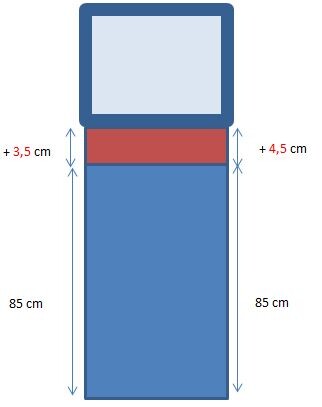
1. Would there already be a construction defect if a general contractor/building company installs a kitchen window in a turnkey single-family house in such a way that, on the inside directly below the window frame—where an interior windowsill or kitchen countertop could theoretically be installed—there are different heights (3.5cm (1.4 inches) on the left and 4.5cm (1.8 inches) on the right) causing a tilt, meaning that a windowsill or countertop could only be installed slightly slanted? I am referring to the area from the bottom edge of the window frame (inside) to the interior wall or parapet end—the area where, for example, the kitchen countertop could be built up to under the window.
(I have attached a sketch; it concerns the red-marked area, which represents the "surface" below a window, roughly the interior windowsill.)
2. What does the specification "parapet height 1.00m (3.3 feet)" mean, which is sometimes noted next to windows in floor plans? From where (bottom edge of the window frame or start of the window sash?) to where (finished floor level? screed floor level?) is this measured (inside/outside)?
3. Assuming the screed floor has already been installed in the house: when measuring, the client discovers that the current room height from the screed floor to the ceiling is 2.47m (8.1 feet) in all rooms, still without tiles or laminate installed, whereas the floor plans specify a "clear room height: 2.50m (8.2 feet)" for all rooms. Would this be considered a defect?
I know these are specific questions. Unfortunately, I could not find answers through online research. Therefore, I would be very glad if someone here could assess the situation, even if only for part of the questions! Thanks in advance.
I have the following questions:
1. Would there already be a construction defect if a general contractor/building company installs a kitchen window in a turnkey single-family house in such a way that, on the inside directly below the window frame—where an interior windowsill or kitchen countertop could theoretically be installed—there are different heights (3.5cm (1.4 inches) on the left and 4.5cm (1.8 inches) on the right) causing a tilt, meaning that a windowsill or countertop could only be installed slightly slanted? I am referring to the area from the bottom edge of the window frame (inside) to the interior wall or parapet end—the area where, for example, the kitchen countertop could be built up to under the window.
(I have attached a sketch; it concerns the red-marked area, which represents the "surface" below a window, roughly the interior windowsill.)
2. What does the specification "parapet height 1.00m (3.3 feet)" mean, which is sometimes noted next to windows in floor plans? From where (bottom edge of the window frame or start of the window sash?) to where (finished floor level? screed floor level?) is this measured (inside/outside)?
3. Assuming the screed floor has already been installed in the house: when measuring, the client discovers that the current room height from the screed floor to the ceiling is 2.47m (8.1 feet) in all rooms, still without tiles or laminate installed, whereas the floor plans specify a "clear room height: 2.50m (8.2 feet)" for all rooms. Would this be considered a defect?
I know these are specific questions. Unfortunately, I could not find answers through online research. Therefore, I would be very glad if someone here could assess the situation, even if only for part of the questions! Thanks in advance.
Regarding point 1)
Probably not, it also raises the question of how it could be out of level in the first place. Maybe a measuring error?
Regarding point 2)
In my opinion, the measurement should be taken from the finished floor level. However, many examples in this forum have shown that everyone sees it differently, and there is quite a variety.
Regarding point 3)
Yes, ceiling height may vary by about 1-2 cm (about 0.8 inches).
Probably not, it also raises the question of how it could be out of level in the first place. Maybe a measuring error?
Regarding point 2)
In my opinion, the measurement should be taken from the finished floor level. However, many examples in this forum have shown that everyone sees it differently, and there is quite a variety.
Regarding point 3)
Yes, ceiling height may vary by about 1-2 cm (about 0.8 inches).
Hello,
first of all, thank you for the reply.
1) Measured with a folding ruler and also checked using a spirit level (see photo). The construction company shouldn’t be able to simply install a slanted window interior as they please, right?
2) A quick question for clarification: According to the measurement from the screed floor (which will be tiled, so approx. +2cm (1 inch)), the distance to the window frame is 88.5cm (35 inches). To the window itself (bottom fixed window element, above that tilt-and-turn sash) it would be 95cm (37 inches). That means there would be 5cm (2 inches) missing, which puzzles me.
3) OK, right now there is already a 3cm (1 inch) difference even without the finished floor, since only the screed is in place and the shell ceiling (without plaster, wallpaper, etc.) exists. That means the clear room height will be approx. 245cm (8 ft), instead of the 2.50m (8 ft 2 in) specified on the floor plan. That could already be considered a defect, right?
first of all, thank you for the reply.
1) Measured with a folding ruler and also checked using a spirit level (see photo). The construction company shouldn’t be able to simply install a slanted window interior as they please, right?
2) A quick question for clarification: According to the measurement from the screed floor (which will be tiled, so approx. +2cm (1 inch)), the distance to the window frame is 88.5cm (35 inches). To the window itself (bottom fixed window element, above that tilt-and-turn sash) it would be 95cm (37 inches). That means there would be 5cm (2 inches) missing, which puzzles me.
3) OK, right now there is already a 3cm (1 inch) difference even without the finished floor, since only the screed is in place and the shell ceiling (without plaster, wallpaper, etc.) exists. That means the clear room height will be approx. 245cm (8 ft), instead of the 2.50m (8 ft 2 in) specified on the floor plan. That could already be considered a defect, right?

1) The window sill, countertop, or similar is already being installed level, so it doesn’t matter if it is uneven.
2) One interpretation of the parapet height is the fall height, so you would need to measure from the top of the finished floor to the top of the window frame.
3) Yes, that would be a defect, but not one that can be changed – which makes it difficult.
2) One interpretation of the parapet height is the fall height, so you would need to measure from the top of the finished floor to the top of the window frame.
3) Yes, that would be a defect, but not one that can be changed – which makes it difficult.
user281 schrieb:
But the construction company can’t just build the interior window reveals crookedly, can they? Interior window reveals aren’t built separately. They result from the masonry work.
user281 schrieb:
What causes the unevenness? What exactly is crooked? Is the window out of plumb? Or is the exterior wall somehow uneven? That doesn’t really matter since the window will be wedged in place. Later, the window sill will compensate for any “unevenness.”
user281 schrieb:
2. What does the note “brüstungshöhe 1,00m” mean, which is sometimes marked next to windows on floor plans? It’s a rough construction dimension: from the floor slab to the top of the window sill (but I’m not exactly sure).
user281 schrieb:
Window frame user281 schrieb:
Start of the window sash? That kind of detail doesn’t matter for the problem mentioned here; the mason or planner doesn’t really care whether you choose a window with a thick or thin jamb.
user281 schrieb:
Up to where is this measured (finished floor? screed floor?) (inside/outside)? ?
user281 schrieb:
Does this mean about 245cm (8 ft), instead of the 2.50m (8 ft 2½ in) room height specified in the floor plan? That could be considered a defect, right? I don’t think so. Over 3 years, the screed will settle, and then you’ll have about 3 cm (1¼ in) more again 😉
Similar topics