
Hello everyone,
we are currently planning our single-family house in Würzburg, and the building permit / planning permission application has been in process for about three weeks. Hopefully, we can start construction in October 2020:
- Plot size: 774 m² (8329 ft²), of which approximately 500 m² (5382 ft²) is buildable, due to about 27% sloping terrain facing south and the plot being somewhat irregular with a path on it.
- Solid construction house, 2 floors, footprint 11 x 15 m (36 x 49 ft). The basement is about two-thirds underground because of the slope.
- Roof pitch 23-30°, gable roof. Roof orientation southwest (or northeast, depending on perspective), so I calculate the southwest roof area as 6.24 m x 15 m = about 93.6 m² (assuming the 30° pitch).
- Household of 5 (2 adults, one ten-year-old child, and 2 babies), living area 214 m² (2303 ft²).
- Planned photovoltaic system with full coverage, air-to-water heat pump, underfloor heating, and central ventilation system with heat recovery. A ground source heat pump with trench collector is unfortunately not possible, as rock is expected everywhere at about 1-1.20 m (3-4 ft) depth.
Two days ago, I had a very interesting meeting with my architect and a solar technician on site.
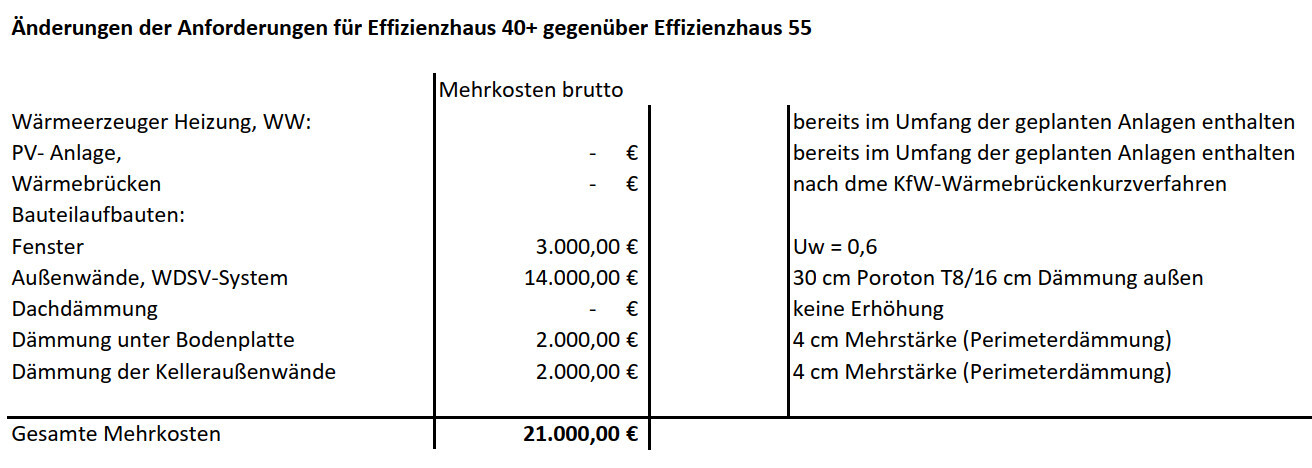
My architect calculated the additional costs for KfW 40 instead of KfW 55. For about €21,000, we can achieve KfW 40, which is less than he initially expected (he had estimated €50,000 and was originally reluctant to perform this calculation; I pushed for it). He has since changed his opinion and now recommends it. The solar technician said during the discussion that for our 5-person family and an estimated annual electricity consumption of 10 kilowatt (his estimate), a battery storage system would probably make sense anyway (as a layperson, I had previously thought a battery storage system would not be worthwhile). Since we already meet all requirements for 40+ except for the battery storage, reaching KfW 40+ would be possible directly.
This brings me to the following considerations:
Pros of 40+:
- €12,000 repayment bonus from the government in addition
- Lower heating costs, higher resale value
- Higher energy self-sufficiency through the battery storage
Cons of 40+:
- 30 cm (12 inches) thick (and somewhat harder) brick wall with external thermal insulation instead of the previously planned 40.5 cm (16 inches) thick (softer) brick wall with internal insulation
- €21,000 additional costs
- About €5,000 extra costs for the battery storage
But what do you think? 55 or 40+?
For completeness, here is the architect’s calculation:
we are currently planning our single-family house in Würzburg, and the building permit / planning permission application has been in process for about three weeks. Hopefully, we can start construction in October 2020:
- Plot size: 774 m² (8329 ft²), of which approximately 500 m² (5382 ft²) is buildable, due to about 27% sloping terrain facing south and the plot being somewhat irregular with a path on it.
- Solid construction house, 2 floors, footprint 11 x 15 m (36 x 49 ft). The basement is about two-thirds underground because of the slope.
- Roof pitch 23-30°, gable roof. Roof orientation southwest (or northeast, depending on perspective), so I calculate the southwest roof area as 6.24 m x 15 m = about 93.6 m² (assuming the 30° pitch).
- Household of 5 (2 adults, one ten-year-old child, and 2 babies), living area 214 m² (2303 ft²).
- Planned photovoltaic system with full coverage, air-to-water heat pump, underfloor heating, and central ventilation system with heat recovery. A ground source heat pump with trench collector is unfortunately not possible, as rock is expected everywhere at about 1-1.20 m (3-4 ft) depth.
Two days ago, I had a very interesting meeting with my architect and a solar technician on site.
My architect calculated the additional costs for KfW 40 instead of KfW 55. For about €21,000, we can achieve KfW 40, which is less than he initially expected (he had estimated €50,000 and was originally reluctant to perform this calculation; I pushed for it). He has since changed his opinion and now recommends it. The solar technician said during the discussion that for our 5-person family and an estimated annual electricity consumption of 10 kilowatt (his estimate), a battery storage system would probably make sense anyway (as a layperson, I had previously thought a battery storage system would not be worthwhile). Since we already meet all requirements for 40+ except for the battery storage, reaching KfW 40+ would be possible directly.
This brings me to the following considerations:
Pros of 40+:
- €12,000 repayment bonus from the government in addition
- Lower heating costs, higher resale value
- Higher energy self-sufficiency through the battery storage
Cons of 40+:
- 30 cm (12 inches) thick (and somewhat harder) brick wall with external thermal insulation instead of the previously planned 40.5 cm (16 inches) thick (softer) brick wall with internal insulation
- €21,000 additional costs
- About €5,000 extra costs for the battery storage
But what do you think? 55 or 40+?
For completeness, here is the architect’s calculation:

TraumvHaus schrieb:
[...]Regarding the ventilation system, there are probably 10,000 different opinions. If it’s a KfW 40 plus standard, then we’re clear that one will be installed.I don’t think so. In my initial research back then, I found significantly more support for a mechanical ventilation system with heat recovery at the KfW 55 level. Even two friends who are experts clearly recommended it. My builder doesn’t construct homes without it anymore, so the question eventually didn’t arise. I’m looking forward to good indoor air quality, especially during hay fever season.
KfW 40 was a simple calculation. Additional costs for the house/roof were about 10,000 euros (around $11,000) plus photovoltaic system plus battery storage, minus subsidies, minus saved energy costs. That didn’t convince me, especially since the saved energy costs didn’t seem to justify the effort.
N
nordbayer17 May 2020 11:17Nummer12 schrieb:
KfW40 was a straightforward calculation. Additional costs for the house/roof were, I believe, 10,000 + photovoltaic system + storage - subsidies - saved energy costs.Well, 10,000 would correspond to the current KFW 153 conditions. You basically get a better-insulated house at almost no extra cost. The only price is the lost space due to the thicker walls.Just for your information; we are going with KfW 55, mainly because we do not want external thermal insulation composite systems (ETICS / EIFS). Without that, it actually wouldn’t be possible in our case.
However, I consider a mechanical ventilation system with heat recovery to be essential, even with KfW 55, and especially with KfW 40!
However, I consider a mechanical ventilation system with heat recovery to be essential, even with KfW 55, and especially with KfW 40!
T
TraumvHaus18 May 2020 16:37Ikearegal schrieb:
For us, it will be KfW 55, mainly because we don’t want external thermal insulation composite systems (ETICS). Without that, it actually wouldn’t be possible in our case.Thanks for the feedback. At the moment, we are also leaning towards that—possibly with two residential units since our floor plan allows it. But we have an appointment with an energy consultant next week, so we’ll see what they recommend.P.S.: We are also building near Würzburg
M
MichaelH8224 Oct 2020 18:23Even though this topic is quite old and I was looking for something completely different, I got stuck here. I have to admit, though, that I only skimmed through everything.
Right at the beginning, one thing caught my attention:
As far as I know, the repayment grant is currently much higher for a KFW 40 Plus house and amounts to €30,000. Please correct me if this is no longer accurate.
Since I am planning a KFW 40 Plus myself, I had the idea to keep the battery storage as small as possible and have the roof as fully equipped as possible, in order to still qualify for the KFW bonus.
In my case, there is also a subsidy from the federal state if I install a battery storage system.
It has also been mentioned that for a new build, the costs for the air/heat pump + ventilation + etc. can be reimbursed up to 35% by BAFA.
And why was I here now? Actually, I was looking for an overview of the electricity consumption of a house with an air/heat pump and household appliances per month/year.
I wish you all a pleasant weekend!
Right at the beginning, one thing caught my attention:
Ikearegal schrieb:
This brings me to the following considerations:
Pros of 40+:
- €12,000 repayment grant from the government in addition
- Lower heating costs, higher resale value
- Higher degree of self-sufficiency due to the storage
As far as I know, the repayment grant is currently much higher for a KFW 40 Plus house and amounts to €30,000. Please correct me if this is no longer accurate.
Since I am planning a KFW 40 Plus myself, I had the idea to keep the battery storage as small as possible and have the roof as fully equipped as possible, in order to still qualify for the KFW bonus.
In my case, there is also a subsidy from the federal state if I install a battery storage system.
It has also been mentioned that for a new build, the costs for the air/heat pump + ventilation + etc. can be reimbursed up to 35% by BAFA.
And why was I here now? Actually, I was looking for an overview of the electricity consumption of a house with an air/heat pump and household appliances per month/year.
I wish you all a pleasant weekend!
P
pagoni202024 Oct 2020 18:58MichaelH82 schrieb:
And why was I here again? ...probably to build a maximum-subsidy house, if I understand correctly.
All these parameters, insulation standards, etc., have an impact on the finances and can play a role.
However, many of the measures involved also have a huge effect on comfort inside the house. An insulation standard set by a funding agency says nothing about that, even though that is precisely why you build a house.
From the private sector, I have heard that often things are funded that would not work on their own, while things that make sense or would work on their own are often not funded... because they don’t need funding.
For that reason, I keep suggesting to shift the focus a bit away from these predefined funding standards of the KfW and not to obsess over them too much, which unfortunately often happens, as can be partly read here.
First and foremost, it should be MY house and a nice home where I feel comfortable in my own way, funding or not. Living in a true passive house, for example, is a different experience, and I wouldn’t let a subsidy dictate the type of heating system or similar... I know a few examples in this regard...
Similar topics