
Hello everyone,
we are planning a prefabricated house using timber frame construction. It will have 180 sqm (1,937 sq ft) of living space with underfloor heating, and about 230 sqm (2,475 sq ft) of usable area.
So far, the offer included an air-to-water heat pump from Daikin (Altherma 3R, formerly Rotex HPSU compact Ultra).
Now it seems that this unit might not have enough capacity (?) and as an alternative (additional cost around 4,000) we have been offered a "Wolf heat pump CHC Monoblock 10/300-35".
The Daikin is available in the 4-9 kW version—would that really be insufficient for this size? And what do you think about this offer?
I have the energy-saving regulation heat protection certification and a renewable energy heat law document available, if any information from those is needed.
Thank you very much!
Best regards
we are planning a prefabricated house using timber frame construction. It will have 180 sqm (1,937 sq ft) of living space with underfloor heating, and about 230 sqm (2,475 sq ft) of usable area.
So far, the offer included an air-to-water heat pump from Daikin (Altherma 3R, formerly Rotex HPSU compact Ultra).
Now it seems that this unit might not have enough capacity (?) and as an alternative (additional cost around 4,000) we have been offered a "Wolf heat pump CHC Monoblock 10/300-35".
The Daikin is available in the 4-9 kW version—would that really be insufficient for this size? And what do you think about this offer?
I have the energy-saving regulation heat protection certification and a renewable energy heat law document available, if any information from those is needed.
Thank you very much!
Best regards
Daniel-Sp schrieb:
Isn't it required by the energy saving regulations that all rooms within the thermal envelope must be capable of being heated above a certain size?
Putting that aside, I agree with the previous posters. Heat flows from warm rooms to cold rooms, which increases the heating load of the warm rooms and results in a higher supply temperature. The heat pump then works less efficiently, making heating more expensive at the same room temperature. That is theoretical and definitely not the case in practice. I have enough experience myself. Especially in the basement, I would only heat as much as necessary, meaning the living spaces. Heating storage rooms would be nonsense, just like you don’t heat your pantry on the ground floor.
In an insulated basement, you always have around 18°C (64°F) year-round. During the winter months, your heated rooms will then be about 2 to 3°C (4 to 5°F) warmer.
We have implemented it this way, and it works really well!

In our financing plan, apart from the KFW subsidy, we haven't considered any other grants. So far, the general contractor always wanted an exorbitant surcharge for devices eligible for BAFA funding, which would almost completely negate the subsidy. Nevertheless, I entered a standard Daikin Altherma 3 R F into the annual performance factor calculator and, with a supply temperature of 33°C (91°F) and a return temperature of 28°C (82°F), and domestic hot water at 27% according to the KFW calculation, I arrived at an annual performance factor of 4.6.
To me, this means that on one hand, I need to push my heating technician even more to install the underfloor heating exactly as calculated. On the other hand, I could potentially offset any additional costs for wall heating and extra installation efforts through the BAFA grant and still have a decent leftover budget, or am I completely mistaken?
That’s pretty much what I had in mind. That it might be energetically questionable, well, yeah...
To me, this means that on one hand, I need to push my heating technician even more to install the underfloor heating exactly as calculated. On the other hand, I could potentially offset any additional costs for wall heating and extra installation efforts through the BAFA grant and still have a decent leftover budget, or am I completely mistaken?
Bookstar schrieb:
But in the insulated basement, you always have around 18 degrees Celsius (64°F) year-round. During the winter months, you'll then have about 2 to 3 degrees Celsius (4 to 5°F) more in your heated rooms.
We implemented it this way, and it's really great!
That’s pretty much what I had in mind. That it might be energetically questionable, well, yeah...
So, since one window has been removed in our living-dining room, we now require 45 watts less heating load. Therefore, I had the design updated and also worked on increasing the maximum pipe spacing. This is how it looks now.
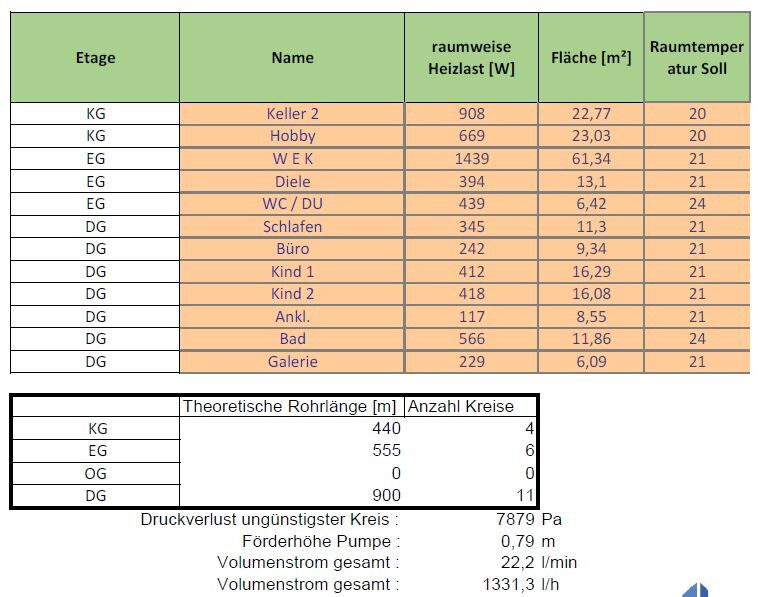
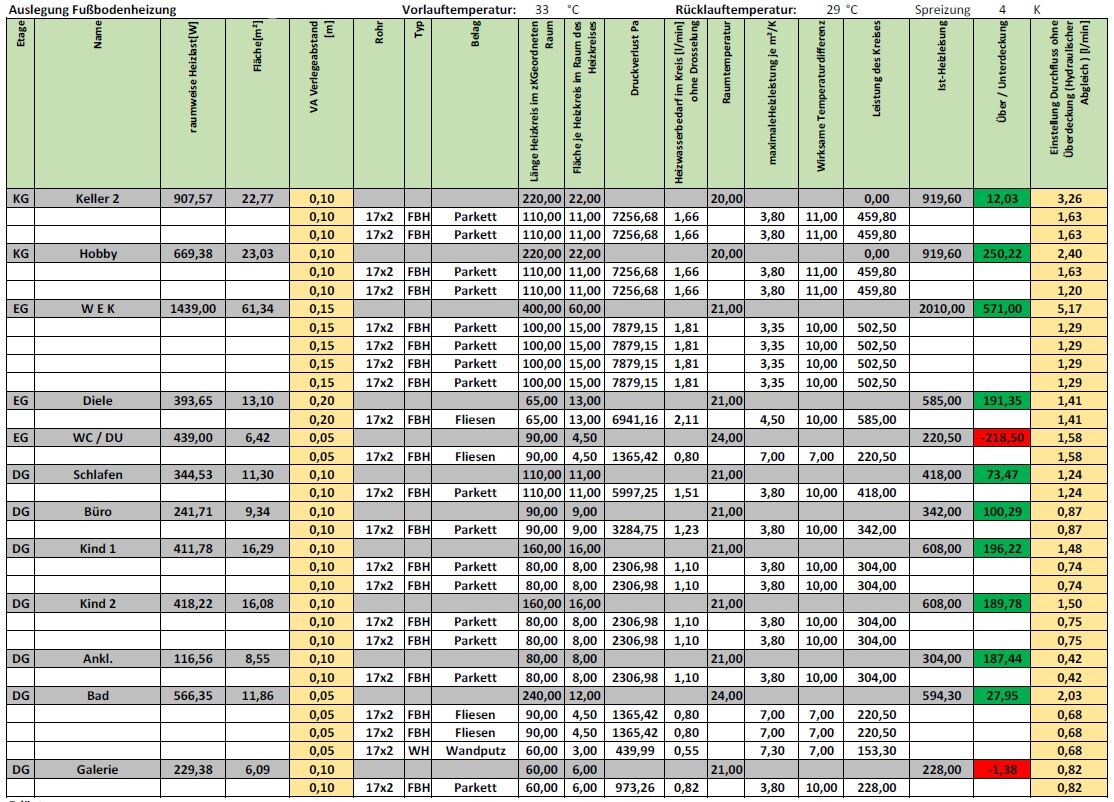
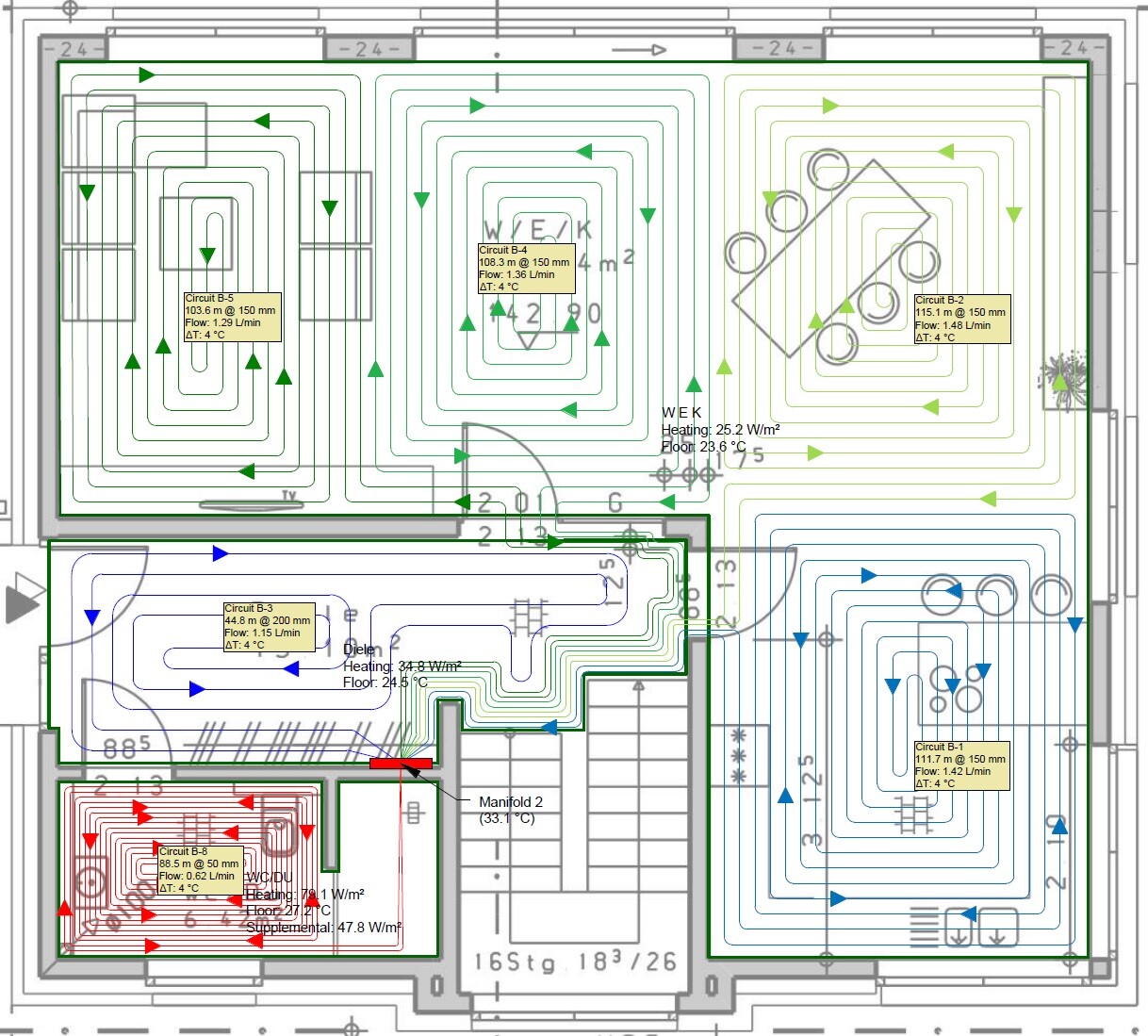
I see this as a concession to the heating installer, allowing for a much easier installation on the ground floor. Fewer heating circuits and significantly larger pipe spacing.
An important note from the engineering office was to definitely ensure compliance with the surface areas and pipe spacing on the upper floor. Especially the wall heating in the upper floor bathroom.
@Daniel-Sp you really know your stuff and you’re currently assisting @Alessandro. You’re also discussing pressure losses and pump flow rates. Does this look unusual here?
I hope that once construction starts soon and I can begin the hydraulic balancing, I’ll be as skilled as you. I already see myself spending weeks in winter optimizing the heating curve and flow rates.
I see this as a concession to the heating installer, allowing for a much easier installation on the ground floor. Fewer heating circuits and significantly larger pipe spacing.
An important note from the engineering office was to definitely ensure compliance with the surface areas and pipe spacing on the upper floor. Especially the wall heating in the upper floor bathroom.
@Daniel-Sp you really know your stuff and you’re currently assisting @Alessandro. You’re also discussing pressure losses and pump flow rates. Does this look unusual here?
I hope that once construction starts soon and I can begin the hydraulic balancing, I’ll be as skilled as you. I already see myself spending weeks in winter optimizing the heating curve and flow rates.
D
Daniel-Sp22 Oct 2020 20:25Some of the heating circuits seem a bit too long to me. Unfortunately, I can’t help you with the pressure drop. Up to 6000 Pa is definitely not a problem; you are only slightly above that. The question is whether the 5 cm (2 inches) clearance actually works well. Make sure to have a record of how many meters (feet) of pipe were actually installed in each heating circuit, as this is very important. Have you checked the heat pump’s datasheet to see if the nominal flow rate is being achieved?

It actually looks quite good... the excessively long loops over 100 meters (330 feet) are mostly in the basement, where warming them up is not really an issue, and the bedroom doesn’t need to be excessively warm anyway. Everything else up to 90 meters (295 feet) is within a good range. Above all, it’s good that there are no loops that are too short.
Daniel-Sp schrieb:
Some of the heating circuits seem a bit too long to me. Unfortunately, I can’t help you with the pressure drop. Up to 6000 Pa it’s definitely no problem, you’re just slightly above that. The question is whether the 5cm (2 inches) spacing really works that well. Make sure to get a record of how many meters of pipe are actually installed in each heating circuit, that’s very important. Have you checked the heat pump’s datasheet to see if the nominal flow rate is being met?Thanks for the feedback. We will have an appointment with the heating engineer soon. It will probably be a Daikin Altherma 3 R F, but I can’t find any datasheets for it. I will definitely request those from the heat pump specialist.
Regarding the pipe spacing, I am curious as well. I am somewhat confident; he said that between 5 and 8 cm (2 to 3 inches) is standard or at least not unusual for bathrooms.