
Hello and thank you for reading my post!
We are now at the beginning of our planning process. The house design is already somewhat advanced, and we are currently gathering quotes for earthworks and landscaping.
About our plot: It is more than 2000 sqm (21,500 sq ft) in size and is located on a slope. The slope itself has an elevation difference of about 19 meters (62 feet) from the road to the forest path above the property. In the middle of the plot, there are already some terraces and a small existing building. This building is currently only accessible via a footpath and a few stairs.
The house will be positioned roughly in the center of the slope, at about 9 to 9.5 meters (30 to 31 feet) above street level.
During the house planning, our architect also included a driveway to the new building. However, at its steepest section, the driveway would have a 25% gradient.
Driving a car up it seems possible, but walking up might be difficult, right?
We also wonder about the driveway surface. Gravel with grid reinforcement might be challenging on a 25% slope, and even paving would likely need to be fully mortar-set. Snow and ice could cause additional issues.
The driveway is currently planned as follows:
Section – Gradient – Elevation (above sea level)
So the driveway is currently 49 meters (161 feet) long with an average linear gradient of 19.4%.
The current plan (simplified) is attached. It shows two versions, but neither changes the slope significantly.
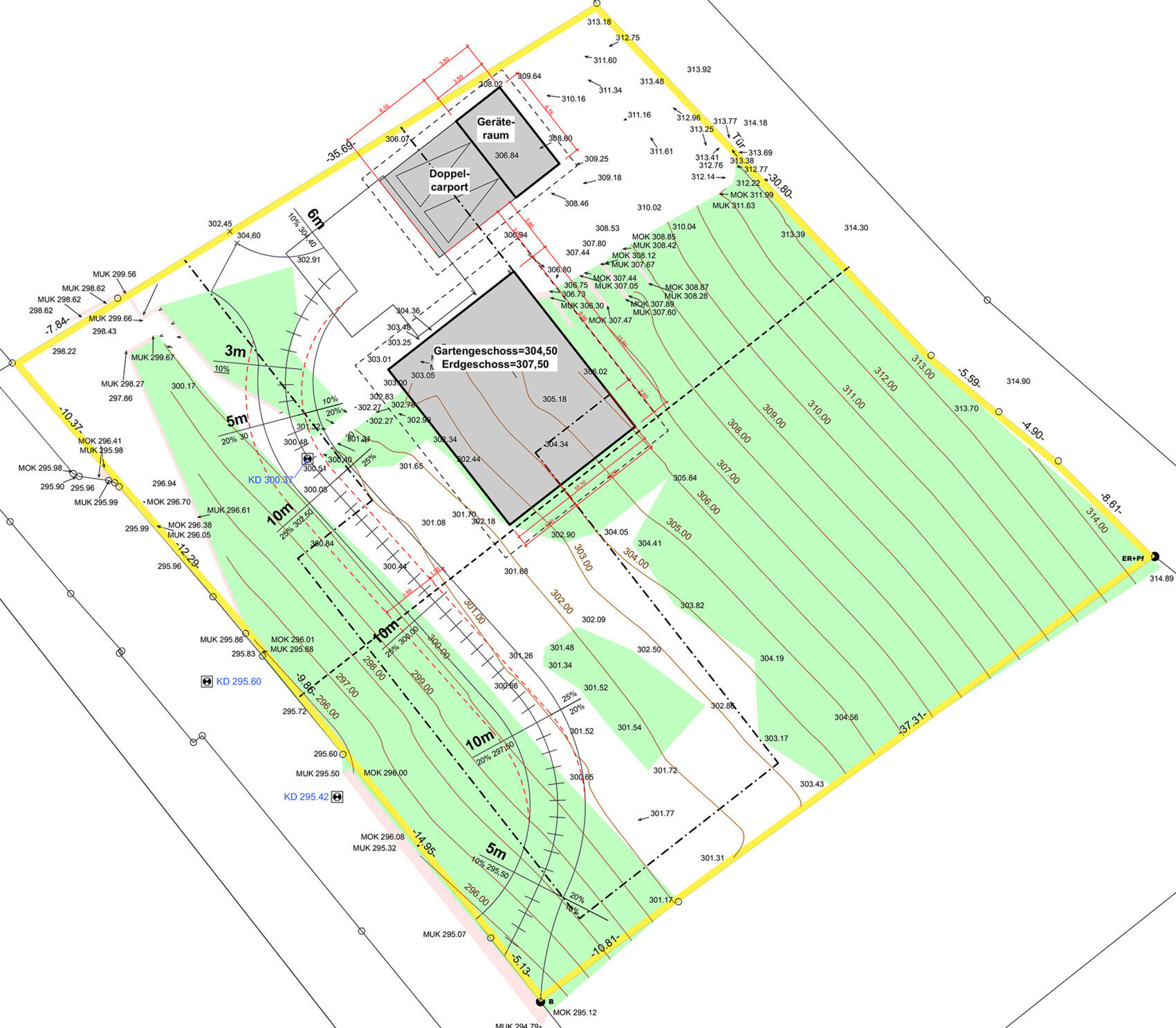
I have been trying for days to figure out how to route the driveway differently to reduce the steepness. If the start of the driveway is placed lower on the plot, more soil would have to be excavated, and the garden area would become smaller.
If the driveway is positioned higher up, closer to the road (no longer parallel to it), it would become longer, but significant fill and retaining measures would be needed there.
Maybe it would be enough to make the curves tighter and allow the driveway to rise more quickly? Or would that again cause problems for vehicle access?
The garage/carport could also be positioned somewhat lower, but it must be inside the building area (indicated by the dotted line). That would make access to the construction site or later deliveries to the house more difficult. In the future, climbing stairs will also be challenging for us as we get older if the driveway has more steps.
Does anyone have any good ideas or suggestions on what we could do?
We are now at the beginning of our planning process. The house design is already somewhat advanced, and we are currently gathering quotes for earthworks and landscaping.
About our plot: It is more than 2000 sqm (21,500 sq ft) in size and is located on a slope. The slope itself has an elevation difference of about 19 meters (62 feet) from the road to the forest path above the property. In the middle of the plot, there are already some terraces and a small existing building. This building is currently only accessible via a footpath and a few stairs.
The house will be positioned roughly in the center of the slope, at about 9 to 9.5 meters (30 to 31 feet) above street level.
During the house planning, our architect also included a driveway to the new building. However, at its steepest section, the driveway would have a 25% gradient.
Driving a car up it seems possible, but walking up might be difficult, right?
We also wonder about the driveway surface. Gravel with grid reinforcement might be challenging on a 25% slope, and even paving would likely need to be fully mortar-set. Snow and ice could cause additional issues.
The driveway is currently planned as follows:
Section – Gradient – Elevation (above sea level)
- 0 m – 0% – 295 m (967 ft)
- 5 m – 10% – 295.5 m (969 ft)
- 10 m – 20% – 297.5 m (976 ft)
- 10 m – 25% – 300 m (984 ft)
- 10 m – 25% – 302.5 m (993 ft)
- 5 m – 20% – 303.5 m (996 ft)
- 3 m – 10% – 303.8 m (997 ft)
- 6 m – 10% – 304.4 m (999 ft)
So the driveway is currently 49 meters (161 feet) long with an average linear gradient of 19.4%.
The current plan (simplified) is attached. It shows two versions, but neither changes the slope significantly.
I have been trying for days to figure out how to route the driveway differently to reduce the steepness. If the start of the driveway is placed lower on the plot, more soil would have to be excavated, and the garden area would become smaller.
If the driveway is positioned higher up, closer to the road (no longer parallel to it), it would become longer, but significant fill and retaining measures would be needed there.
Maybe it would be enough to make the curves tighter and allow the driveway to rise more quickly? Or would that again cause problems for vehicle access?
The garage/carport could also be positioned somewhat lower, but it must be inside the building area (indicated by the dotted line). That would make access to the construction site or later deliveries to the house more difficult. In the future, climbing stairs will also be challenging for us as we get older if the driveway has more steps.
Does anyone have any good ideas or suggestions on what we could do?
H
hampshire13 Oct 2020 23:43I haven’t built the freight elevator yet, but I have arranged for an assistant who can manage it even in winter.
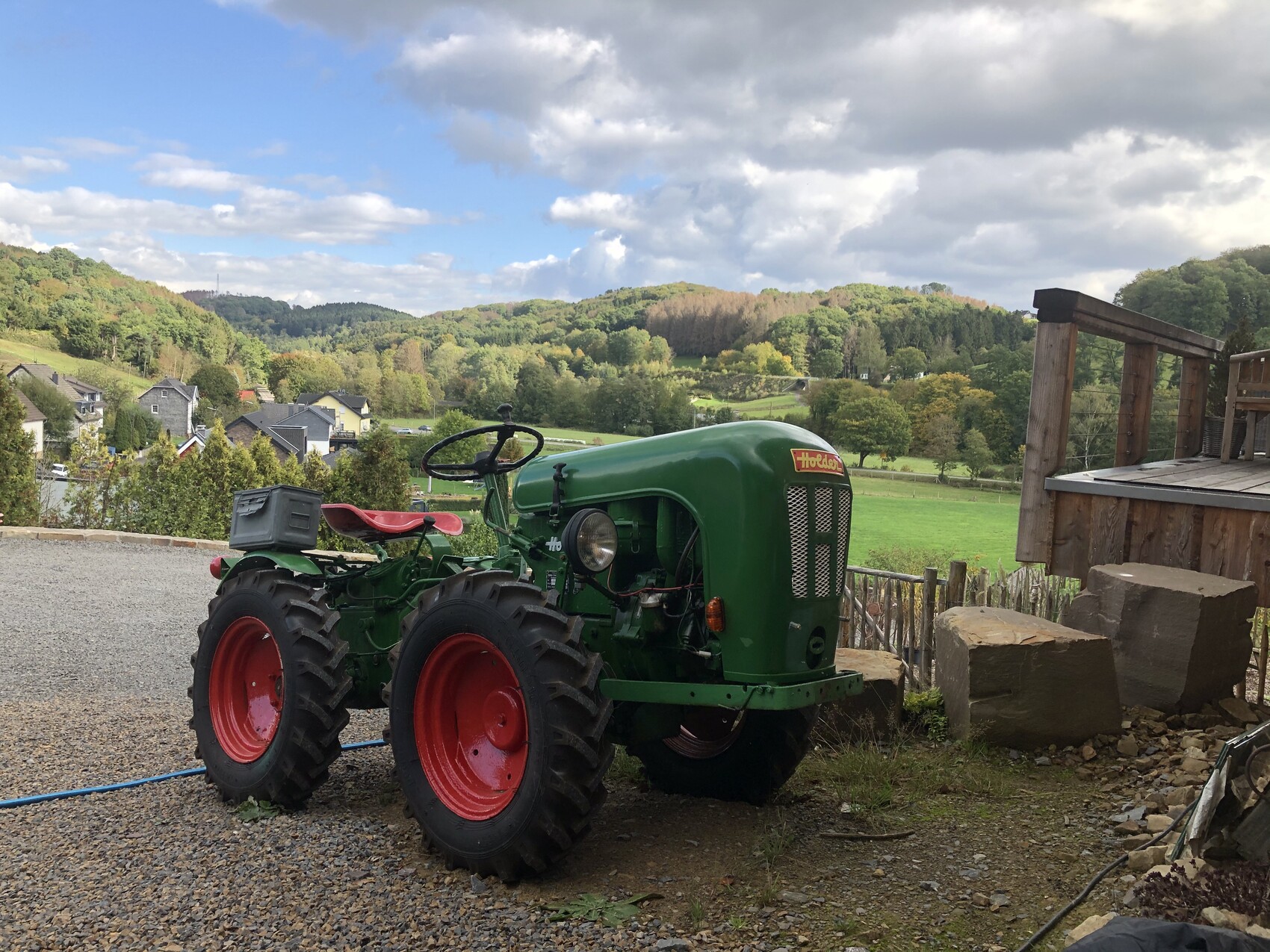

That is a ride-on freight elevator.
https://www.instagram.com/11antgmxde/
https://www.linkedin.com/company/bauen-jetzt/
https://www.instagram.com/11antgmxde/
https://www.linkedin.com/company/bauen-jetzt/
haydee schrieb:
Well, clearing snow and spreading salt is no fun. Just ask my tailbone.
You also have a long driveway. It replaces the gym. It’s definitely not quick to clear.
Just don’t make the curves too tight. Behind our house, cars often slide off on the fairly steep curve or end up parked against the wall or guardrail, and this isn’t a narrow street.
How are the winters where you are? You only mentioned Bavaria.
@Escroda’s suggestion has a point. The driveway will cost a lot. Will you be happy with it during the winter months? The property is in Lower Franconia. The landscape gardener is local and has already said that it can snow there sometimes. However, the neighbor grows exotic plants and cacti that apparently even stay outside during winter.
But I don’t want to rely on the winter hardiness of my future neighbor’s cacti for my own luck.
Yes, the driveway won’t be cheap, but a three-sided earth-retaining garage with a 3–4 meter (10–13 feet) thick layer of soil on top also sounds quite expensive. Maybe a compromise between the two would be a solution? Driveway halfway up and a garage there that is built into the slope but not covered by earth. That way, the staircase up to the house wouldn’t be too long either (if the driveway were easy to walk on).
hampshire schrieb:
I haven’t built the freight elevator yet, but I got a helper who can manage even in winter.
[ATTACH alt="B4D5F0DA-40C6-4BBE-B4D6-225218982D90.jpeg"]52335[/ATTACH] That would certainly be an option! @hampshire, how did you solve your driveway? I’ve found some pictures and the project really looks quite similar. Does your driveway reach all the way to the house? How long is it and how steep is the maximum slope?
Would you build it the same way again?
Information is slowly coming in. However, there are still some uncertainties.
The site plan shows a garden level and a ground floor. I assume the height references refer to the top edge of the finished floor. This means that the garden level is already 2.30m (7.5 feet) above the existing terrain on the valley side. Does "basement level" mean an additional floor, or how is this height difference supposed to be managed?
That would be more than four floor heights! What exactly is meant by roof edge (eaves, ridge)? What does the development plan specify?
What does this mean in absolute numbers? How low can the top edge of the finished floor of the lowest level be without restricting the desired view?
Well then:
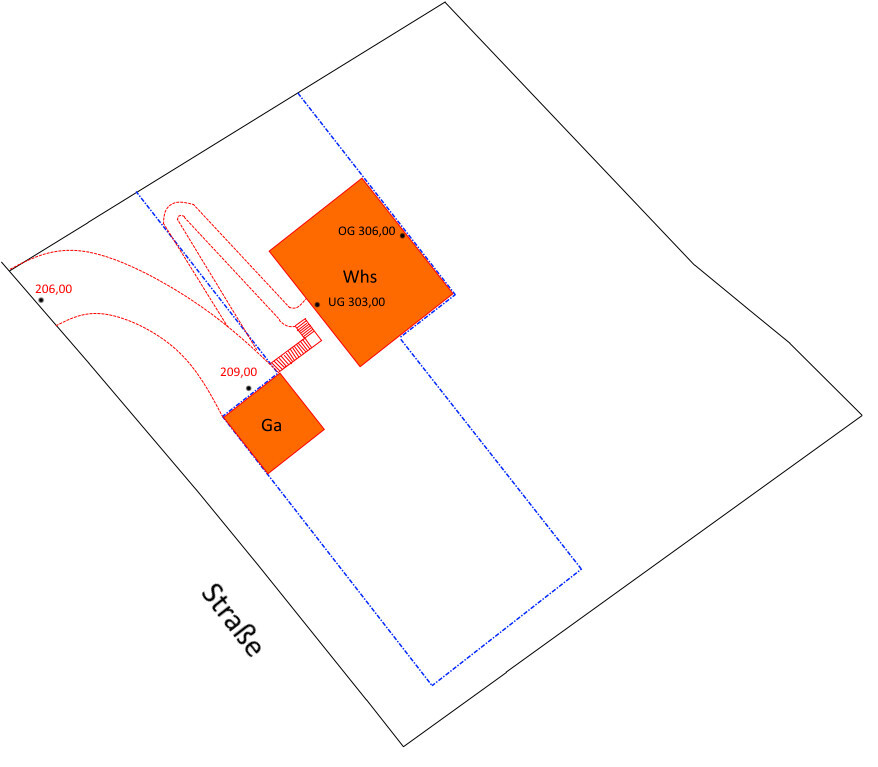
It’s not barrier-free, but my maximum slope limit of 15% is adhered to.
Well, exaggerating might make it clearer, but in reality it would be a maximum of 2m (6.5 feet). However, with the new proposal, the garage fits nicely into the terrain, with 1.5 sides underground and no more soil coverage above.
Floor plans and elevations would be helpful to understand where the entrance is supposed to be. Also the street width to assess the driveway angle. And the date of the development plan to estimate possibilities for exemptions. Plus the planning drawings from the development plan. Also the textual regulations. And the reasoning. And... oh right, Christmas is still a long way off?
_pexed_ schrieb:
Basement level on a slope
The site plan shows a garden level and a ground floor. I assume the height references refer to the top edge of the finished floor. This means that the garden level is already 2.30m (7.5 feet) above the existing terrain on the valley side. Does "basement level" mean an additional floor, or how is this height difference supposed to be managed?
_pexed_ schrieb:
max. 13m (42.7 feet) foundation slab to roof edge
That would be more than four floor heights! What exactly is meant by roof edge (eaves, ridge)? What does the development plan specify?
_pexed_ schrieb:
The house should not be built too low
What does this mean in absolute numbers? How low can the top edge of the finished floor of the lowest level be without restricting the desired view?
_pexed_ schrieb:
What we can also imagine well is a staircase and access path next to the driveway
Well then:
It’s not barrier-free, but my maximum slope limit of 15% is adhered to.
_pexed_ schrieb:
covered with a 3-4 meter (10-13 feet) thick layer of soil above
Well, exaggerating might make it clearer, but in reality it would be a maximum of 2m (6.5 feet). However, with the new proposal, the garage fits nicely into the terrain, with 1.5 sides underground and no more soil coverage above.
Floor plans and elevations would be helpful to understand where the entrance is supposed to be. Also the street width to assess the driveway angle. And the date of the development plan to estimate possibilities for exemptions. Plus the planning drawings from the development plan. Also the textual regulations. And the reasoning. And... oh right, Christmas is still a long way off?
S
sichtbeton8214 Oct 2020 11:03Sloped lots. By now, I really love them.
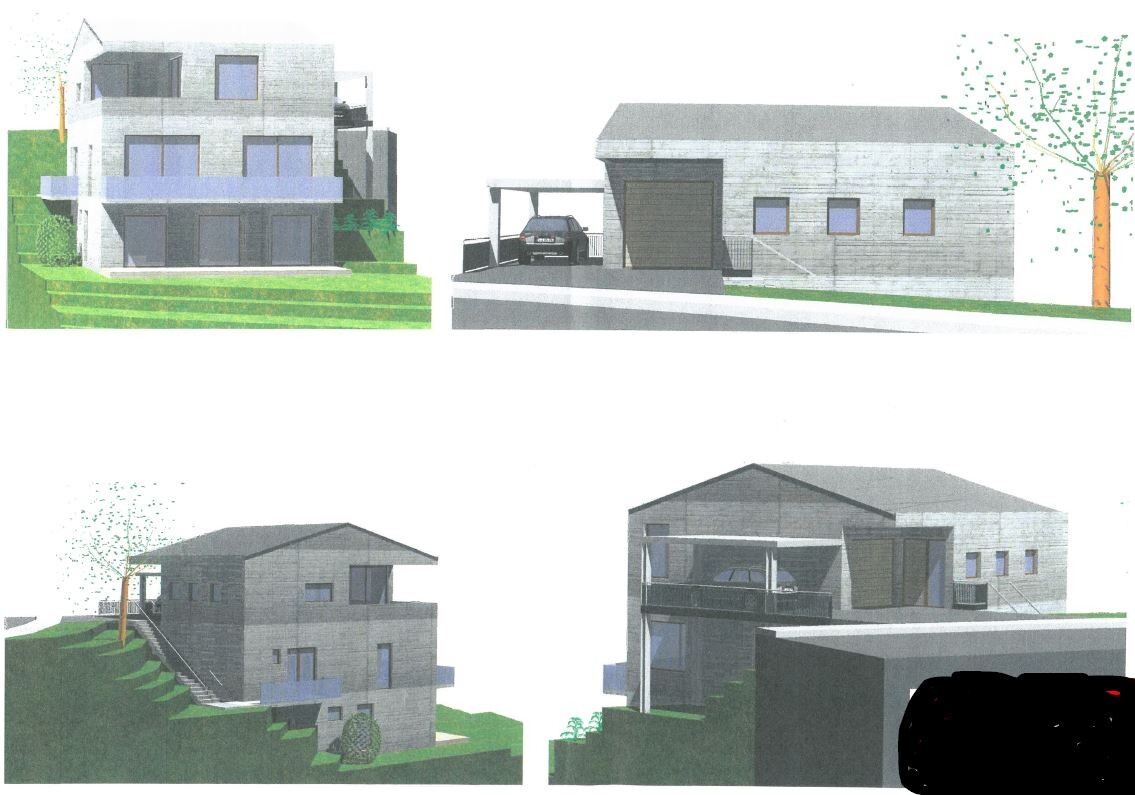 I'll just share this image. This was an alternative design from our side. It might be an option for you.

If the garage is not planned as a exposed concrete structure, definitely plan for an all-wheel-drive vehicle!
In winter, it will definitely get tough. A snow-covered footpath might still seem romantic at a holiday home, but for everyday use, it becomes annoying. You'll need to find a good solution. With appropriate earthworks, it can be managed, but as mentioned before, it will be costly.
In winter, it will definitely get tough. A snow-covered footpath might still seem romantic at a holiday home, but for everyday use, it becomes annoying. You'll need to find a good solution. With appropriate earthworks, it can be managed, but as mentioned before, it will be costly.
Similar topics