
Hello and thank you for reading my post!
We are now at the beginning of our planning process. The house design is already somewhat advanced, and we are currently gathering quotes for earthworks and landscaping.
About our plot: It is more than 2000 sqm (21,500 sq ft) in size and is located on a slope. The slope itself has an elevation difference of about 19 meters (62 feet) from the road to the forest path above the property. In the middle of the plot, there are already some terraces and a small existing building. This building is currently only accessible via a footpath and a few stairs.
The house will be positioned roughly in the center of the slope, at about 9 to 9.5 meters (30 to 31 feet) above street level.
During the house planning, our architect also included a driveway to the new building. However, at its steepest section, the driveway would have a 25% gradient.
Driving a car up it seems possible, but walking up might be difficult, right?
We also wonder about the driveway surface. Gravel with grid reinforcement might be challenging on a 25% slope, and even paving would likely need to be fully mortar-set. Snow and ice could cause additional issues.
The driveway is currently planned as follows:
Section – Gradient – Elevation (above sea level)
So the driveway is currently 49 meters (161 feet) long with an average linear gradient of 19.4%.
The current plan (simplified) is attached. It shows two versions, but neither changes the slope significantly.
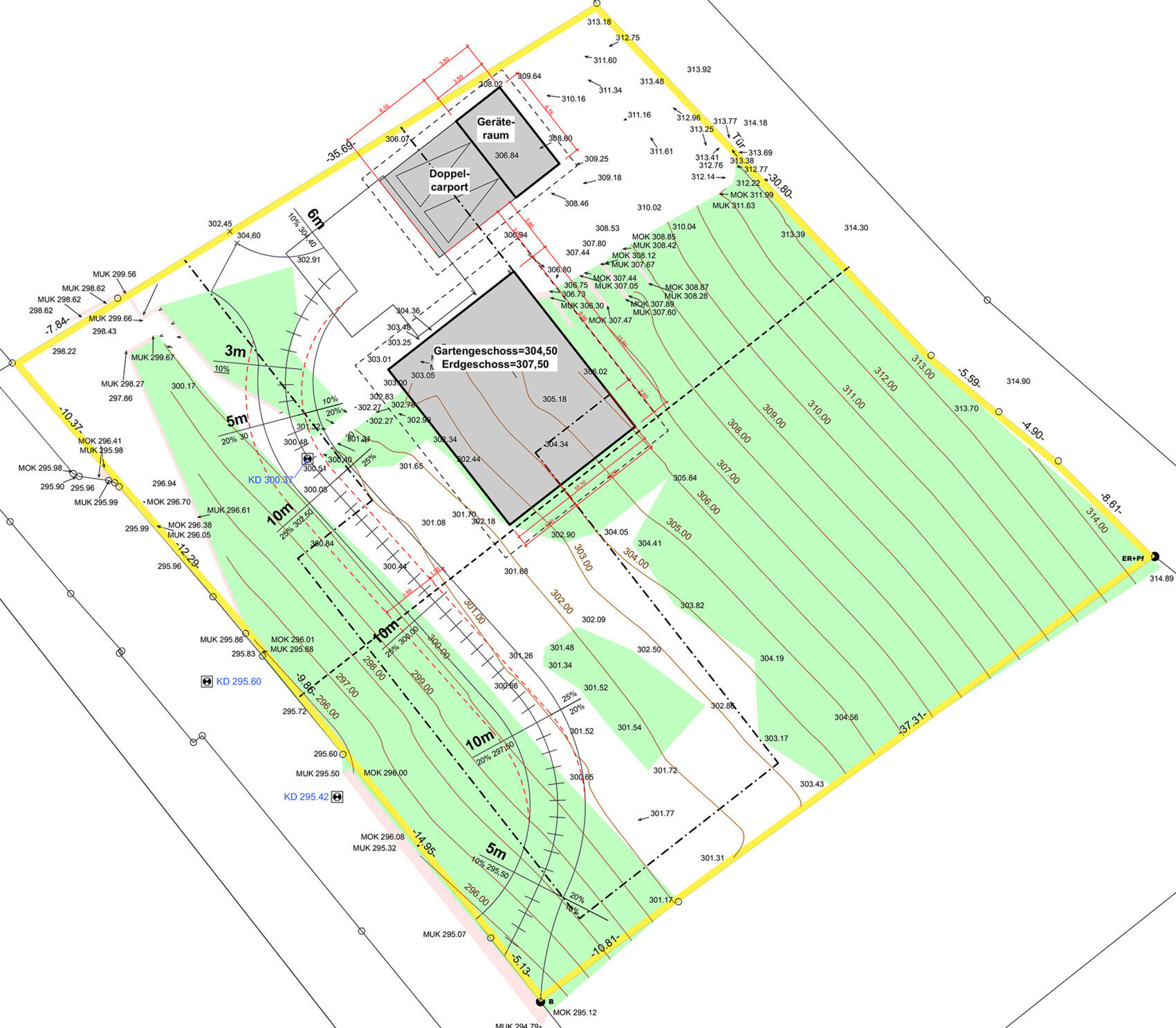
I have been trying for days to figure out how to route the driveway differently to reduce the steepness. If the start of the driveway is placed lower on the plot, more soil would have to be excavated, and the garden area would become smaller.
If the driveway is positioned higher up, closer to the road (no longer parallel to it), it would become longer, but significant fill and retaining measures would be needed there.
Maybe it would be enough to make the curves tighter and allow the driveway to rise more quickly? Or would that again cause problems for vehicle access?
The garage/carport could also be positioned somewhat lower, but it must be inside the building area (indicated by the dotted line). That would make access to the construction site or later deliveries to the house more difficult. In the future, climbing stairs will also be challenging for us as we get older if the driveway has more steps.
Does anyone have any good ideas or suggestions on what we could do?
We are now at the beginning of our planning process. The house design is already somewhat advanced, and we are currently gathering quotes for earthworks and landscaping.
About our plot: It is more than 2000 sqm (21,500 sq ft) in size and is located on a slope. The slope itself has an elevation difference of about 19 meters (62 feet) from the road to the forest path above the property. In the middle of the plot, there are already some terraces and a small existing building. This building is currently only accessible via a footpath and a few stairs.
The house will be positioned roughly in the center of the slope, at about 9 to 9.5 meters (30 to 31 feet) above street level.
During the house planning, our architect also included a driveway to the new building. However, at its steepest section, the driveway would have a 25% gradient.
Driving a car up it seems possible, but walking up might be difficult, right?
We also wonder about the driveway surface. Gravel with grid reinforcement might be challenging on a 25% slope, and even paving would likely need to be fully mortar-set. Snow and ice could cause additional issues.
The driveway is currently planned as follows:
Section – Gradient – Elevation (above sea level)
- 0 m – 0% – 295 m (967 ft)
- 5 m – 10% – 295.5 m (969 ft)
- 10 m – 20% – 297.5 m (976 ft)
- 10 m – 25% – 300 m (984 ft)
- 10 m – 25% – 302.5 m (993 ft)
- 5 m – 20% – 303.5 m (996 ft)
- 3 m – 10% – 303.8 m (997 ft)
- 6 m – 10% – 304.4 m (999 ft)
So the driveway is currently 49 meters (161 feet) long with an average linear gradient of 19.4%.
The current plan (simplified) is attached. It shows two versions, but neither changes the slope significantly.
I have been trying for days to figure out how to route the driveway differently to reduce the steepness. If the start of the driveway is placed lower on the plot, more soil would have to be excavated, and the garden area would become smaller.
If the driveway is positioned higher up, closer to the road (no longer parallel to it), it would become longer, but significant fill and retaining measures would be needed there.
Maybe it would be enough to make the curves tighter and allow the driveway to rise more quickly? Or would that again cause problems for vehicle access?
The garage/carport could also be positioned somewhat lower, but it must be inside the building area (indicated by the dotted line). That would make access to the construction site or later deliveries to the house more difficult. In the future, climbing stairs will also be challenging for us as we get older if the driveway has more steps.
Does anyone have any good ideas or suggestions on what we could do?
_pexed_ schrieb:
The current building envelope, closer to the street, is practically right on a steeper slope The contour lines indicate something different. According to them, the house should be placed as far south as possible, as the height difference there would only be 2m (6.5 feet) instead of the currently planned 3.5m (11.5 feet).
_pexed_ schrieb:
However, this would mean the house is very, very deep underground (4-5 meters below ground level) Yep.
_pexed_ schrieb:
This would mean everything would have to be brought up to the house via stairs. Yep. Or by freight elevator. But that’s just how it is in the mountains.
_pexed_ schrieb:
The view from there is truly amazing... The house itself will have a garden level (touching the northeast slope) and a ground floor, fitting perfectly into the site. I kept the house as planned, only moved it 3m (10 feet) toward the street, so it sits about 1m (3 feet) lower. I’m not sure if that significantly reduces the view.
_pexed_ schrieb:
Placing the house further downhill wouldn’t make much sense either, because then we’d have more garden uphill towards the forest and northeast, which would be hard to use. The garden in the southwest would also be difficult to use, since the driveway is currently planned there.
But as I said, far too much information is missing. A completed questionnaire from the pinned first post would be very helpful.
Thank you for the responses!
Unfortunately, the plan can be a bit misleading, as the measurements in the green area were not taken in great detail.
The fairly straight line that separates the green area from the white plateau is currently a fence.
Behind it (toward the street), there is a drop of about 1 meter (3 feet) quite steeply, followed by another plateau that then slopes steeply down toward the street.
One section along the street is already secured with a retaining wall (heavy-duty wall). This might need to be adjusted slightly for the driveway.
As requested, here is a summary of the key points:
Plot size: approx. 2000 sqm (0.5 acres)
Slope: Yes, from southwest to northeast, about 20 m (65 feet) rise over 50 m (165 feet) – not a uniform slope
Site coverage ratio: 0.4
Floor area ratio: 1.2
Building envelope, building line, and boundary: see plan (first page)
Surrounding development: northwest is built up (lower, as the slope differs there), northeast is forest, southeast is still undeveloped, southwest is street and houses behind it; house height there should not exceed 10 m (33 feet) due to the mountainside
Number of parking spaces: sufficient for two cars
Number of floors: 2 (basement embedded in slope, ground floor above; an additional finished attic is allowed)
Roof type: flat roof
Architectural style: modern – driveway, garden, etc. can also have a somewhat rustic touch
Orientation: south (southwest)
Maximum heights/limits: max. 13 m (43 feet) from slab to roof edge
Additional requirements: garage/carports must be within the building envelope
Our requirements are that the view remains unobstructed. For this reason, the house should not be positioned too low, and we would also prefer not to build too close to the street.
The southwest and southeast sides of the house are likely to feature a terrace, with the garden located toward the southeast. Between the house and the street, there will be landscaping (bushes and possibly a few small trees).
This greenery already exists and will, as far as earthworks allow, be preserved according to the landscape gardener (also to help stabilize the slope further).
Are the 30% slopes at your parents’ and in-laws’ places still drivable by car in winter? What surface material was chosen there?
What we can also imagine is adding a staircase and a footpath alongside the driveway (perhaps partly as slope retention). That way, the driveway would only need to accommodate cars.
Unfortunately, the plan can be a bit misleading, as the measurements in the green area were not taken in great detail.
The fairly straight line that separates the green area from the white plateau is currently a fence.
Behind it (toward the street), there is a drop of about 1 meter (3 feet) quite steeply, followed by another plateau that then slopes steeply down toward the street.
One section along the street is already secured with a retaining wall (heavy-duty wall). This might need to be adjusted slightly for the driveway.
As requested, here is a summary of the key points:
Plot size: approx. 2000 sqm (0.5 acres)
Slope: Yes, from southwest to northeast, about 20 m (65 feet) rise over 50 m (165 feet) – not a uniform slope
Site coverage ratio: 0.4
Floor area ratio: 1.2
Building envelope, building line, and boundary: see plan (first page)
Surrounding development: northwest is built up (lower, as the slope differs there), northeast is forest, southeast is still undeveloped, southwest is street and houses behind it; house height there should not exceed 10 m (33 feet) due to the mountainside
Number of parking spaces: sufficient for two cars
Number of floors: 2 (basement embedded in slope, ground floor above; an additional finished attic is allowed)
Roof type: flat roof
Architectural style: modern – driveway, garden, etc. can also have a somewhat rustic touch
Orientation: south (southwest)
Maximum heights/limits: max. 13 m (43 feet) from slab to roof edge
Additional requirements: garage/carports must be within the building envelope
Our requirements are that the view remains unobstructed. For this reason, the house should not be positioned too low, and we would also prefer not to build too close to the street.
The southwest and southeast sides of the house are likely to feature a terrace, with the garden located toward the southeast. Between the house and the street, there will be landscaping (bushes and possibly a few small trees).
This greenery already exists and will, as far as earthworks allow, be preserved according to the landscape gardener (also to help stabilize the slope further).
haydee schrieb:
I don’t know anyone with such a long driveway. We have plenty of slopes here. Flat lots are rare.
We have 15%, which is more than okay.
My parents have almost 30% and my in-laws a bit over 30%. It's short and steep. In winter, you best just sit down and slide down; high heels are the worst.
Maybe consider separating the garage and the pathway. The car stays down below, you take the stairs, and for carrying stuff, there’s a driveway that can be used by hand truck, wheelbarrow, or car – whichever suits you.
@hampshire, haven’t you thought about a freight elevator?
Are the 30% slopes at your parents’ and in-laws’ places still drivable by car in winter? What surface material was chosen there?
What we can also imagine is adding a staircase and a footpath alongside the driveway (perhaps partly as slope retention). That way, the driveway would only need to accommodate cars.
N
Nice-Nofret13 Oct 2020 18:46So, I lived for 20 years on a road with a 20% slope; and NO, it is not passable in snow and ice early in the morning. Some people install heating cables in the road. But winters are getting milder anyway.
Thanks for the responses!
As long as the driveway is walkable after clearing and spreading grit, that’s already a good sign. I was worried that self-clearing and spreading on 25% of the area would be impossible.
What kind of surface does the driveway have? Gravel or paving?
Maybe someone has an idea on how to avoid reaching that 25%.
Does anyone have experience with how tight a curve should be to still be comfortably drivable with a normal car? I know that according to road construction regulations, a radius of 12.5 meters (41 feet) is required, but since I don’t plan to drive a bendy bus or a semi-trailer truck on the driveway, a smaller radius should be possible, right?
That way, a few more meters (feet) of length could be added to the driveway.
haydee schrieb:
Without spreading grit, the driveway is neither drivable nor walkable at my in-laws’ or my parents’ place.
As long as the driveway is walkable after clearing and spreading grit, that’s already a good sign. I was worried that self-clearing and spreading on 25% of the area would be impossible.
What kind of surface does the driveway have? Gravel or paving?
Maybe someone has an idea on how to avoid reaching that 25%.
Does anyone have experience with how tight a curve should be to still be comfortably drivable with a normal car? I know that according to road construction regulations, a radius of 12.5 meters (41 feet) is required, but since I don’t plan to drive a bendy bus or a semi-trailer truck on the driveway, a smaller radius should be possible, right?
That way, a few more meters (feet) of length could be added to the driveway.
Well, clearing snow and spreading salt is not fun. Just ask my tailbone.
You also have a long driveway. It replaces the gym. It definitely doesn’t mean a quick clearing.
Just make sure the curves aren’t too tight. Behind our house, cars often slide off the fairly steep curve or end up parked against the retaining wall or guardrail, and this isn’t a narrow road.
How are the winters where you are? You only mentioned Bavaria.
@Escroda’s suggestion has some merit. The driveway will cost a lot. Are you sure you’ll be happy with it during the winter months?
You also have a long driveway. It replaces the gym. It definitely doesn’t mean a quick clearing.
Just make sure the curves aren’t too tight. Behind our house, cars often slide off the fairly steep curve or end up parked against the retaining wall or guardrail, and this isn’t a narrow road.
How are the winters where you are? You only mentioned Bavaria.
@Escroda’s suggestion has some merit. The driveway will cost a lot. Are you sure you’ll be happy with it during the winter months?
Similar topics