
Hello and thank you for reading my post!
We are now at the beginning of our planning process. The house design is already somewhat advanced, and we are currently gathering quotes for earthworks and landscaping.
About our plot: It is more than 2000 sqm (21,500 sq ft) in size and is located on a slope. The slope itself has an elevation difference of about 19 meters (62 feet) from the road to the forest path above the property. In the middle of the plot, there are already some terraces and a small existing building. This building is currently only accessible via a footpath and a few stairs.
The house will be positioned roughly in the center of the slope, at about 9 to 9.5 meters (30 to 31 feet) above street level.
During the house planning, our architect also included a driveway to the new building. However, at its steepest section, the driveway would have a 25% gradient.
Driving a car up it seems possible, but walking up might be difficult, right?
We also wonder about the driveway surface. Gravel with grid reinforcement might be challenging on a 25% slope, and even paving would likely need to be fully mortar-set. Snow and ice could cause additional issues.
The driveway is currently planned as follows:
Section – Gradient – Elevation (above sea level)
So the driveway is currently 49 meters (161 feet) long with an average linear gradient of 19.4%.
The current plan (simplified) is attached. It shows two versions, but neither changes the slope significantly.
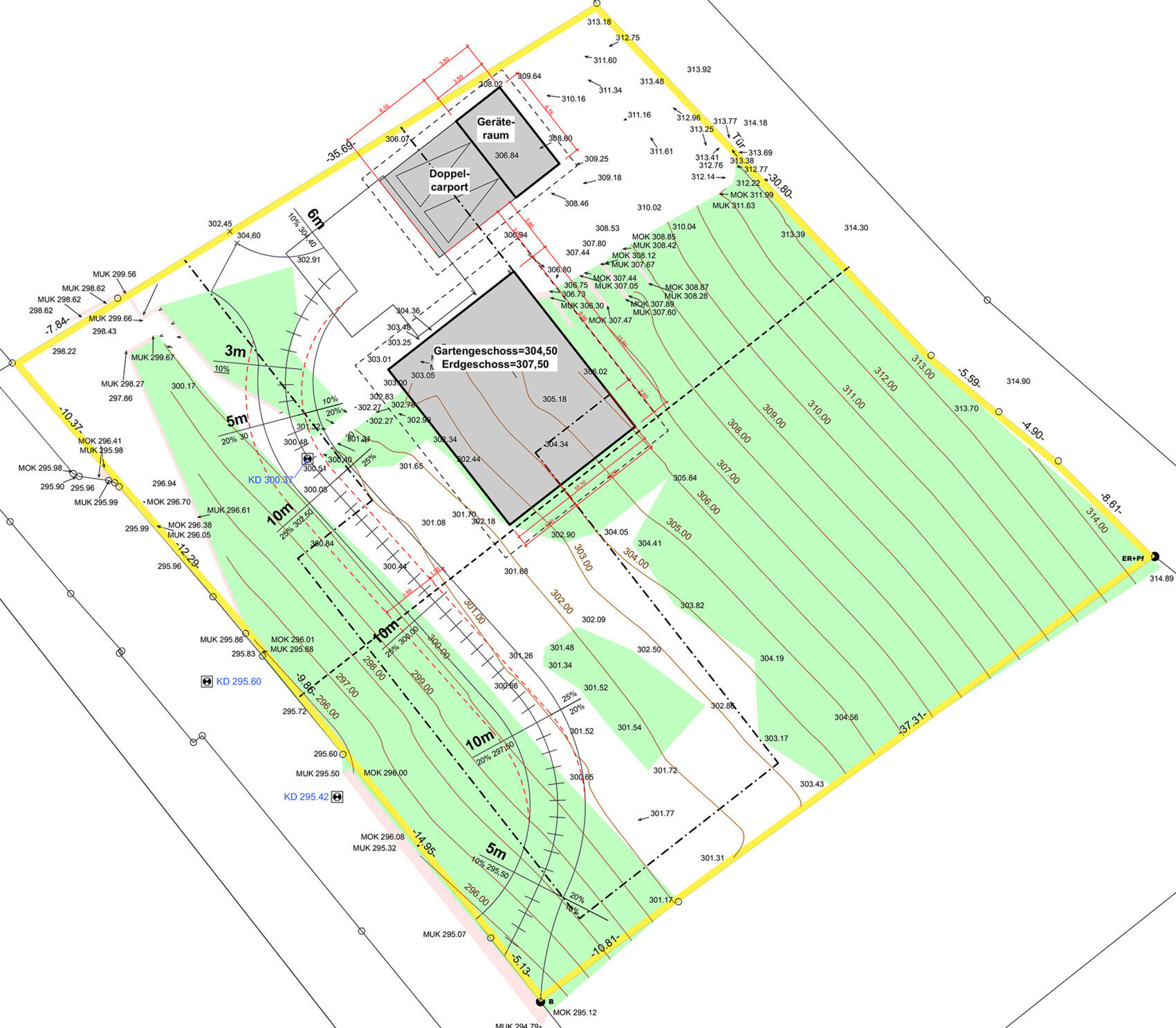
I have been trying for days to figure out how to route the driveway differently to reduce the steepness. If the start of the driveway is placed lower on the plot, more soil would have to be excavated, and the garden area would become smaller.
If the driveway is positioned higher up, closer to the road (no longer parallel to it), it would become longer, but significant fill and retaining measures would be needed there.
Maybe it would be enough to make the curves tighter and allow the driveway to rise more quickly? Or would that again cause problems for vehicle access?
The garage/carport could also be positioned somewhat lower, but it must be inside the building area (indicated by the dotted line). That would make access to the construction site or later deliveries to the house more difficult. In the future, climbing stairs will also be challenging for us as we get older if the driveway has more steps.
Does anyone have any good ideas or suggestions on what we could do?
We are now at the beginning of our planning process. The house design is already somewhat advanced, and we are currently gathering quotes for earthworks and landscaping.
About our plot: It is more than 2000 sqm (21,500 sq ft) in size and is located on a slope. The slope itself has an elevation difference of about 19 meters (62 feet) from the road to the forest path above the property. In the middle of the plot, there are already some terraces and a small existing building. This building is currently only accessible via a footpath and a few stairs.
The house will be positioned roughly in the center of the slope, at about 9 to 9.5 meters (30 to 31 feet) above street level.
During the house planning, our architect also included a driveway to the new building. However, at its steepest section, the driveway would have a 25% gradient.
Driving a car up it seems possible, but walking up might be difficult, right?
We also wonder about the driveway surface. Gravel with grid reinforcement might be challenging on a 25% slope, and even paving would likely need to be fully mortar-set. Snow and ice could cause additional issues.
The driveway is currently planned as follows:
Section – Gradient – Elevation (above sea level)
- 0 m – 0% – 295 m (967 ft)
- 5 m – 10% – 295.5 m (969 ft)
- 10 m – 20% – 297.5 m (976 ft)
- 10 m – 25% – 300 m (984 ft)
- 10 m – 25% – 302.5 m (993 ft)
- 5 m – 20% – 303.5 m (996 ft)
- 3 m – 10% – 303.8 m (997 ft)
- 6 m – 10% – 304.4 m (999 ft)
So the driveway is currently 49 meters (161 feet) long with an average linear gradient of 19.4%.
The current plan (simplified) is attached. It shows two versions, but neither changes the slope significantly.
I have been trying for days to figure out how to route the driveway differently to reduce the steepness. If the start of the driveway is placed lower on the plot, more soil would have to be excavated, and the garden area would become smaller.
If the driveway is positioned higher up, closer to the road (no longer parallel to it), it would become longer, but significant fill and retaining measures would be needed there.
Maybe it would be enough to make the curves tighter and allow the driveway to rise more quickly? Or would that again cause problems for vehicle access?
The garage/carport could also be positioned somewhat lower, but it must be inside the building area (indicated by the dotted line). That would make access to the construction site or later deliveries to the house more difficult. In the future, climbing stairs will also be challenging for us as we get older if the driveway has more steps.
Does anyone have any good ideas or suggestions on what we could do?

_pexed_ schrieb:
Does anyone here perhaps have a good idea of what could be done? I think you can get some help here. @hampshire has a similar situation and is quite active here.
https://www.instagram.com/11antgmxde/
https://www.linkedin.com/company/bauen-jetzt/
It is walkable and drivable as planned. However, it is not very comfortable and best navigated with flat shoes. It could be difficult in winter. Regardless of the garage location, you need a driveway to the house for deliveries.
I would keep the garage there. Bite the bullet and make the slope a bit more even. Plan a parking space at the bottom for ice and snow, with the driveway surfaced only with gravel, not too fine. This way, it remains grippy in icy conditions.
I would keep the garage there. Bite the bullet and make the slope a bit more even. Plan a parking space at the bottom for ice and snow, with the driveway surfaced only with gravel, not too fine. This way, it remains grippy in icy conditions.
_pexed_ schrieb:
but walking up will be difficult, right? Anything over 15% becomes difficult.
_pexed_ schrieb:
two different versions Is the red dashed line supposed to represent one version? If the margin is that tight, there’s nothing to discuss.
_pexed_ schrieb:
however, the carport/garage must be within the building envelope (dotted line) It isn’t now, and even the house significantly crosses the building boundary.
_pexed_ schrieb:
As you get older, it will of course become difficult if we had more stairs here. Then you move to a senior-friendly apartment with an elevator.
_pexed_ schrieb:
Does anyone have a good idea of what could be done? Then you need to share more details with the forum about how this plan came about. What are the requirements? What constraints were there? Without knowing the details, I would have approached it like this off the cuff:
Escroda schrieb:
Anything over 15% becomes difficult.
Is the red dashed line supposed to be a version? If the margin is that tight, there’s nothing to discuss.
It isn’t now, and even the house exceeds the building boundary significantly.
Then you move into a senior-friendly apartment with an elevator.
Then you’ll have to tell the forum more about how this planning even came about. What are the requirements? Where were the constraints? Without knowing the details, I would have done it like this on the spot:
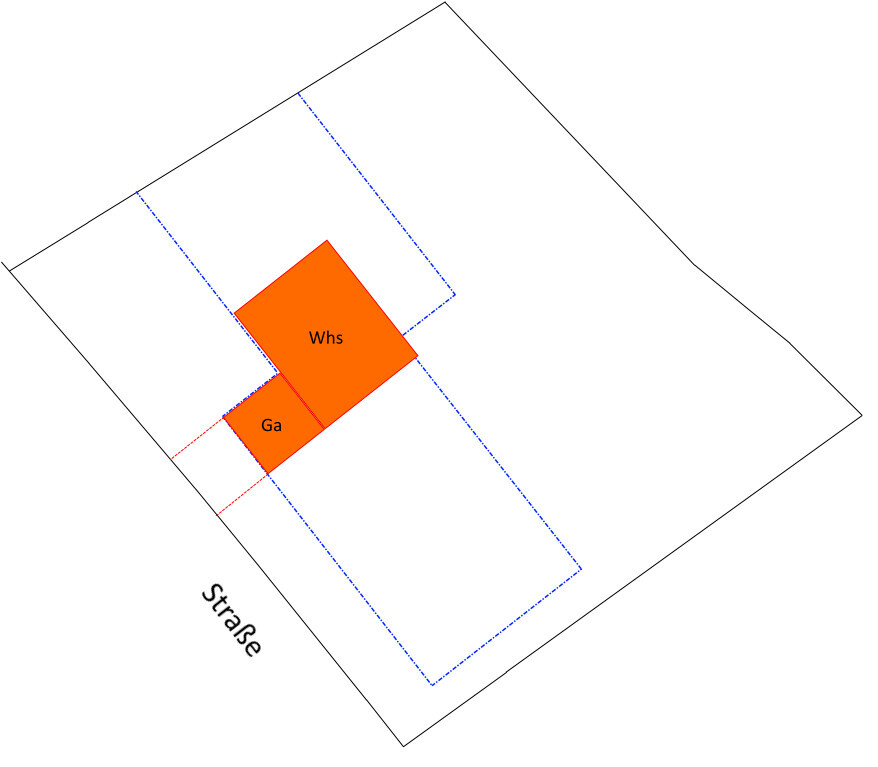
Thank you very much for the answers!
Yes, the current carport and storage room (which very likely won’t be implemented as is), as well as the house itself, are currently outside the building boundary. The building boundary has an unusual offset on the plot, probably because it was once divided. We want to try to shift the house more toward the center to gain more space from the neighbor and generally more room for the garage/carport. It would also make more sense due to the topography of the plot (the current building zone, closer to the street, is practically on a steeper slope).
We hope to discuss this with the municipality and the building authority.
Thank you for the plan. Placing the garage down there is an idea, but it would be very, very deep underground (4–5 meters (13–16 feet) below ground level) if we want it to be accessible directly from the street without a steep incline. Unfortunately, that wouldn’t solve the house’s accessibility issue. Everything would still have to be carried up stairs to the house.
Regarding how the plan came about:
The location where the new house will stand still has an old building. The view from there is truly stunning, so the architect wanted to position the house there. There is already a natural offset in the slope at that point. The house itself will have a garden-level floor (north-east side against the slope) and a ground floor, fitting perfectly into the site.
Positioning the house lower down wouldn’t make as much sense because then we would have more garden area uphill toward the forest and northeast, which would be hard to use.
I don’t know anyone with such a long driveway; we have plenty of slopes here. Flat plots are hard to come by.
We have a 15% incline, which is more than acceptable.
My parents have nearly 30%, and my in-laws just over 30%. Straightforward and steep. In winter, it’s best to sit down and slide down; high heels are a nightmare.
Maybe consider separating the garage access path. The car stays at the bottom, you take the stairs, and for transporting things, there could be a driveway—whether for a hand truck, wheelbarrow, or car is up to you.
@hampshire, didn’t you even consider a freight elevator?
We have a 15% incline, which is more than acceptable.
My parents have nearly 30%, and my in-laws just over 30%. Straightforward and steep. In winter, it’s best to sit down and slide down; high heels are a nightmare.
Maybe consider separating the garage access path. The car stays at the bottom, you take the stairs, and for transporting things, there could be a driveway—whether for a hand truck, wheelbarrow, or car is up to you.
@hampshire, didn’t you even consider a freight elevator?
Similar topics