
ᐅ Floor Plan Optimization for Urban Villa + Considerations for Land Elevation
Created on: 31 Jan 2020 13:29
S
Shiny86
Plot size 492 sqm (5293 sq ft)
Slope yes
Site coverage ratio?
Floor area ratio?
Building envelope, building line, and boundary?
Boundary development?
Number of parking spaces 2
Number of floors 2
Roof type Pyramid roof, 25 degrees
Architectural style Modern urban villa
Orientation Main entrance facing north
Maximum heights/limits
Additional requirements?
Clients’ Requirements
Style, roof type, building type
Modern urban villa with pyramid roof, 25 degrees
Basement, floors 2 full floors without basement
Number of occupants 4
Open kitchen, kitchen island
Number of parking spaces 8-10
Garage
House design
Who designed it?
-Architect
What do you particularly like? Why?
Large living area, master bathroom
What don’t you like? Why?
Utility room quite small and master bedroom small, children’s room somewhat too large
Why is the design as it is now?
The architect implemented the corresponding wishes
What do you think is especially good or bad about it?
Good: large living area
I am uncertain about the half-height window sizes and the swing direction of the doors
What is the most important/basic question about the floor plan summarized in 130 characters?
What do you think about the floor plans?
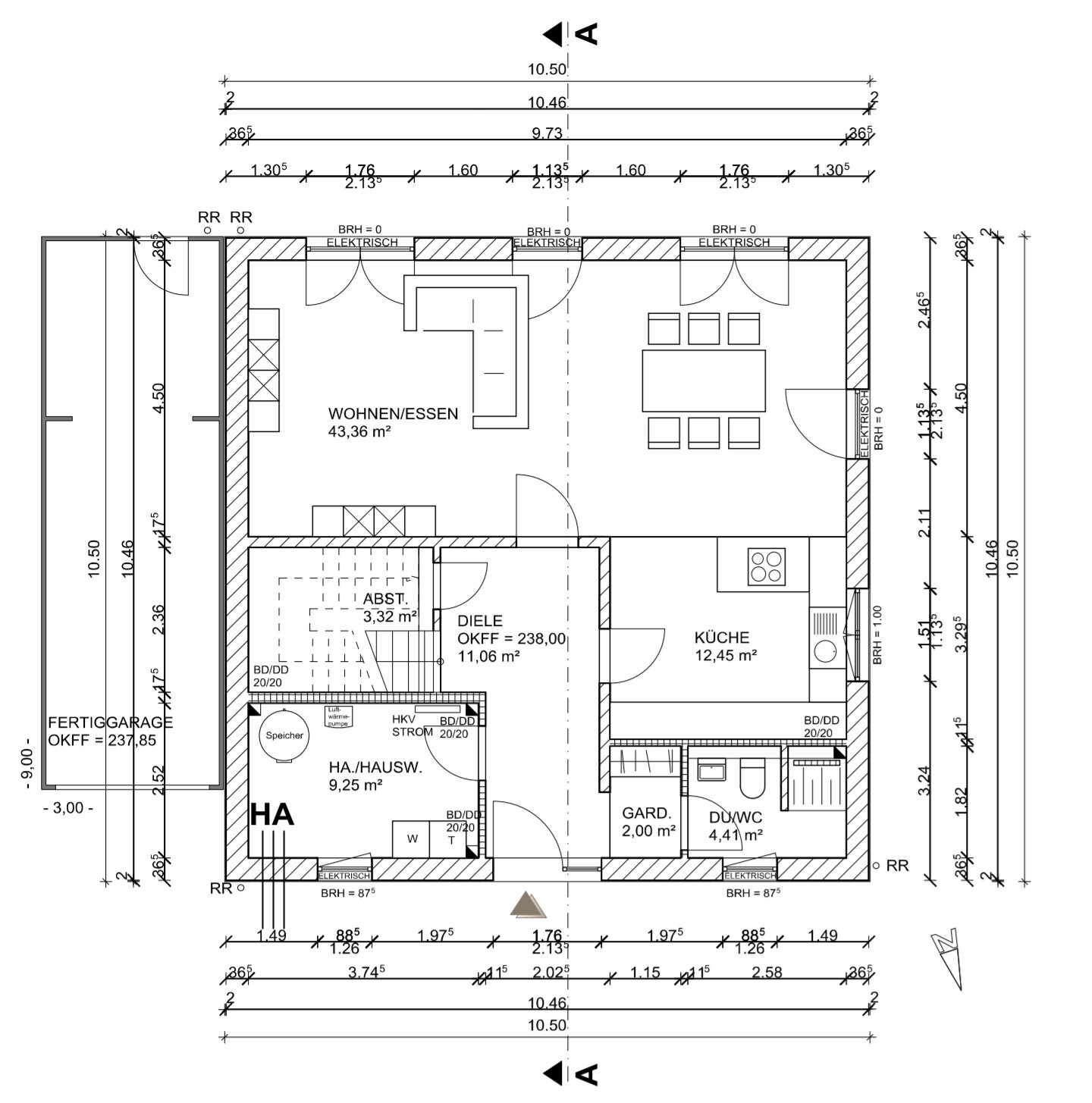
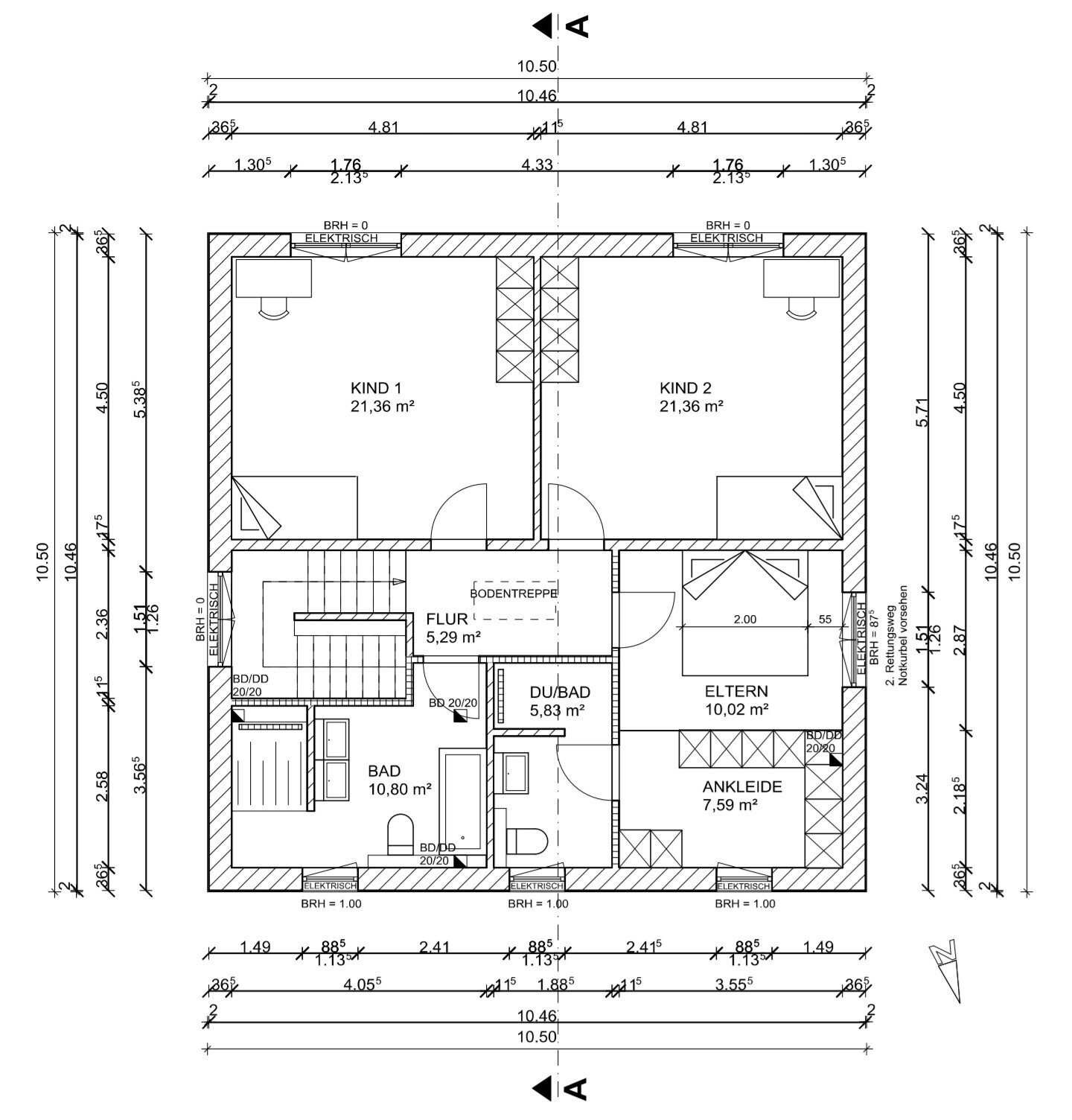
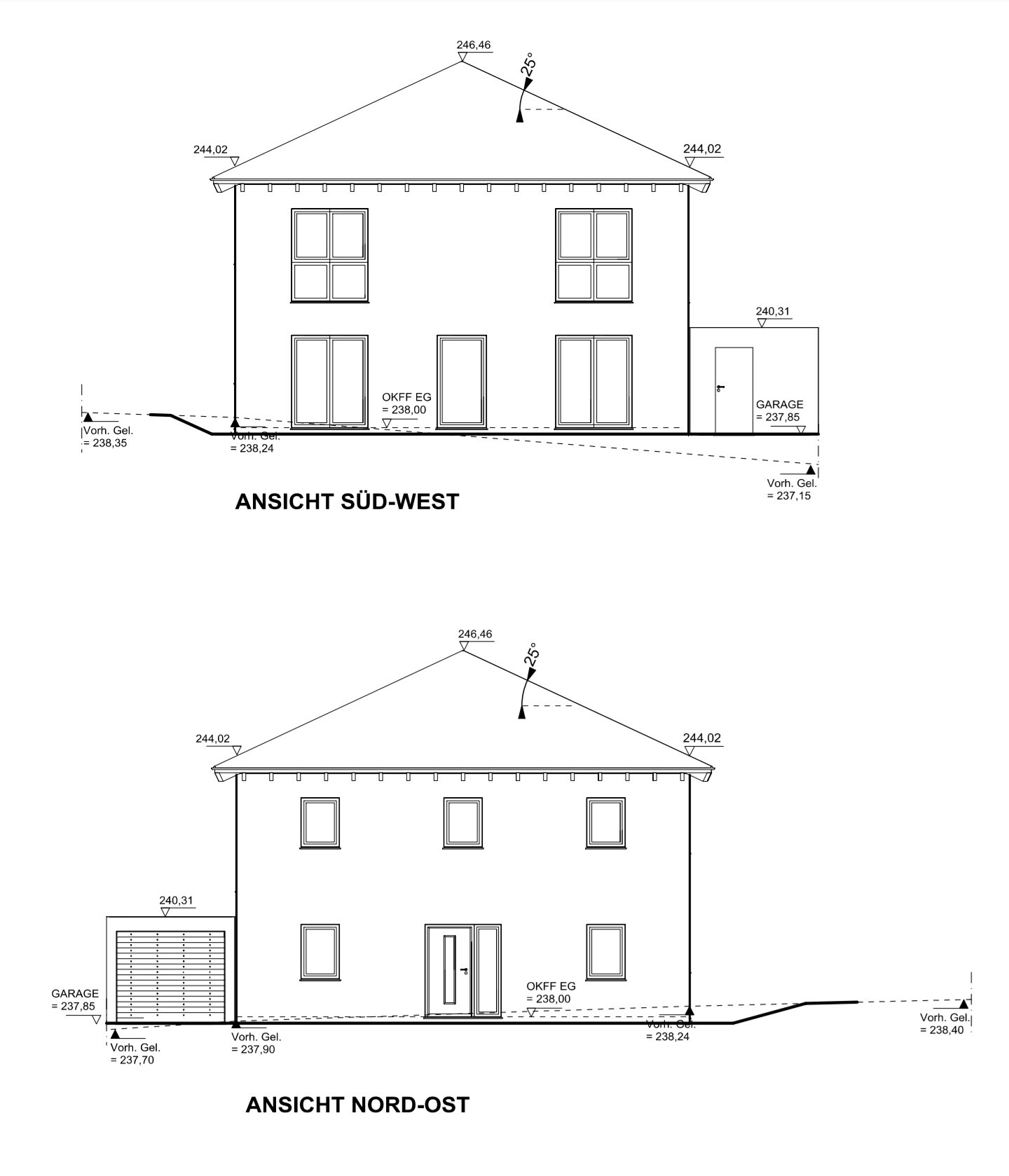
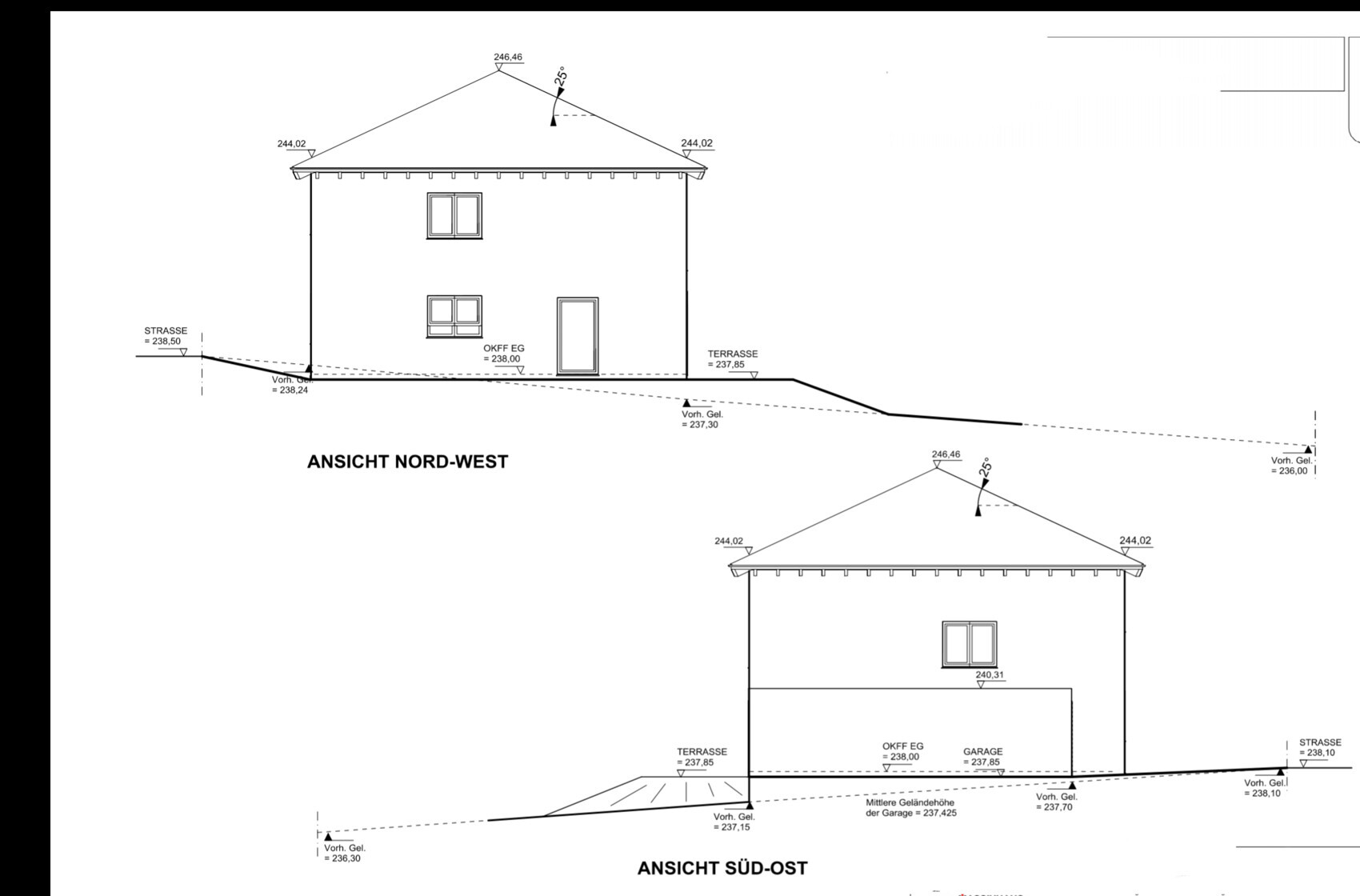
Slope yes
Site coverage ratio?
Floor area ratio?
Building envelope, building line, and boundary?
Boundary development?
Number of parking spaces 2
Number of floors 2
Roof type Pyramid roof, 25 degrees
Architectural style Modern urban villa
Orientation Main entrance facing north
Maximum heights/limits
Additional requirements?
Clients’ Requirements
Style, roof type, building type
Modern urban villa with pyramid roof, 25 degrees
Basement, floors 2 full floors without basement
Number of occupants 4
Open kitchen, kitchen island
Number of parking spaces 8-10
Garage
House design
Who designed it?
-Architect
What do you particularly like? Why?
Large living area, master bathroom
What don’t you like? Why?
Utility room quite small and master bedroom small, children’s room somewhat too large
Why is the design as it is now?
The architect implemented the corresponding wishes
What do you think is especially good or bad about it?
Good: large living area
I am uncertain about the half-height window sizes and the swing direction of the doors
What is the most important/basic question about the floor plan summarized in 130 characters?
- Where could it still be optimized? Would you recommend different window dimensions or sill heights?
- What do you think is poor or what would you do differently?
- A partition wall will be added in the walk-in closet. That would theoretically allow watching TV from the bed. I am considering a lightweight wall. I plan to place a 211cm (83 inches) Pax combination wardrobe in the closet. The closet is planned with a raw width of 218cm (86 inches). Do you think 218cm is enough for the Pax once the walls are plastered, or how wide should the rough dimensions preferably be?
- Is the hallway on the ground floor too narrow?
- Would you raise the ground level? The house would be 40cm (16 inches) below street level. If I build a terrace into the garden, it would be about 1m (3 ft) difference. You could raise only the house level, resulting in approximately 1.6m (5 ft) difference between terrace and garden. I don’t know anyone living below street level. Raising the garden would probably not be allowed without permits, and affected neighbors likely wouldn’t agree. On the sides of the house adjacent to neighbors, raising is permitted only up to certain limits. I am overwhelmed with the decision.
- Do you have any ideas for arranging the sofa differently and placing the TV sensibly? My husband doesn’t want the sofa back facing a window. I still need to get used to placing the sofa in the middle of the room.
- Is the kitchen size sufficient for a nice kitchen with an island?
What do you think about the floor plans?

Do young people these days no longer learn to use search functions at all (even though the local one here is unfortunately very poor)? – The main thread on this topic is https://www.hausbau-forum.de/threads/lan-dosen-setzen-noch-zeitgemaess-wlan-drahtlos-ist-die-zukunft.33656/
You probably mean the access point, of which you should have several throughout the house. The access point is the nearest “wireless tower” for your devices and is best connected to the “router” by cable. It should have an unobstructed wireless “line of sight” to the devices. Any attenuation caused by obstacles or interference means the transmission power on all sides will be unnecessarily increased. So if you want to turn your house into a microwave oven, place your access points directly behind obstacles.
You should position your access points on walls or ceilings. On ceilings, they are discreet like smoke detectors, or you can place them on shelves, which is why LAN outlets near the ceiling are recommended — see the detailed explanations in the linked thread above.
What you call the “router” is typically located in the utility room (HAR) and isn’t really a router itself but contains one or its function. It’s called an IAD (Internet Access Device), and your provider will refer to it as “Fritzbox Cable,” “Homebox,” “Speedport,” or some other branded device. Although it often has small antennas attached, you probably don’t want to sit in the utility room with your tablet – so usually, one or two additional access points per floor are installed and connected via LAN to the IAD. Practical locations for access points include positions in wall lamps in the living-dining area or smoke detector mounts above stair exits. For more details, see the linked thread above.
https://www.instagram.com/11antgmxde/
https://www.linkedin.com/company/bauen-jetzt/
Shiny86 schrieb:
Where should you actually place the Wi-Fi router?
I don't want to have it visible anywhere.
You probably mean the access point, of which you should have several throughout the house. The access point is the nearest “wireless tower” for your devices and is best connected to the “router” by cable. It should have an unobstructed wireless “line of sight” to the devices. Any attenuation caused by obstacles or interference means the transmission power on all sides will be unnecessarily increased. So if you want to turn your house into a microwave oven, place your access points directly behind obstacles.
You should position your access points on walls or ceilings. On ceilings, they are discreet like smoke detectors, or you can place them on shelves, which is why LAN outlets near the ceiling are recommended — see the detailed explanations in the linked thread above.
What you call the “router” is typically located in the utility room (HAR) and isn’t really a router itself but contains one or its function. It’s called an IAD (Internet Access Device), and your provider will refer to it as “Fritzbox Cable,” “Homebox,” “Speedport,” or some other branded device. Although it often has small antennas attached, you probably don’t want to sit in the utility room with your tablet – so usually, one or two additional access points per floor are installed and connected via LAN to the IAD. Practical locations for access points include positions in wall lamps in the living-dining area or smoke detector mounts above stair exits. For more details, see the linked thread above.
https://www.instagram.com/11antgmxde/
https://www.linkedin.com/company/bauen-jetzt/

I just asked my husband again why we have power outlets for the access points when it’s possible to operate them without. This might have already been mentioned in the other thread—I didn’t go through all the pages. On one hand, it’s because we already have the appropriate devices for that. On the other hand, he says that the power supplied through the LAN cable isn’t enough and that this can reduce the transmission power. @Shiny86 You still have some time to find the best solution for your situation.
11ant schrieb:
It’s better to discuss underground empty conduits well before the electrician even steps on site. Installing an awning in an energy-saving regulation house with external thermal insulation composite system (ETICS) and a cable entry that doesn’t compromise the blower door test is no easy task that Uncle Horst can just fix while Bernd sets up the grill. You really do ask refreshingly honest questions But at least I’m asking the questions before construction starts.
Regarding empty conduits/cables to the garden shed, the builder said I should only discuss that when dealing with the electrician about electrical work.
Something or a lot will probably go wrong anyway. That’s why I’m making the effort upfront. In the end, I might still end up without electricity in the garden shed. But I can live with that.
I cannot live without an awning, though.
Two awning suppliers said the awning will only be installed once the house is finished. It will probably be fixed to the partition wall.
What does an awning have to do with structural engineering? Structural considerations only relate to energy values, right?
An awning can be retrofitted after the house is built, can’t it? The blower door test would already have been done by then.
What’s the issue with considering an awning during new construction? It’s just about cable preparation for the motor, right? Why would it affect the energy values?
Should an awning be planned after construction, or must the cable preparation already be done during the building phase? Awning installation can be retrofitted, after all.
I’m a bit confused about this.
Pinky0301 schrieb:
I asked my husband again why we have power outlets for the access points when it’s also possible without them. [...] that the LAN cable alone doesn’t supply enough power and that this can reduce the transmission strength. Access points require not only a connection to the router but also power. This can basically be provided via Power over Ethernet, meaning the power is supplied through the LAN cable. However, Gigabit Ethernet already uses all four cable pairs for data transmission. But that’s a complex topic.
Shiny86 schrieb:
Regarding empty conduits/cables to the garden shed, the builder said I should only discuss that once the electrician is involved with the electrical work. If the electrician wants to mark on the structural walls where outlets should go, that naturally happens long after the concrete slab is finished, but the empty conduit running towards the garden shed should be installed underneath the slab—see https://www.hausbau-forum.de/threads/kabel-durch-leerrohr-einziehen.35184/
Shiny86 schrieb:
Two awning suppliers said the awning will be installed only once the house is standing. It will probably be mounted in the cavity wall.
What does the awning have to do with structural engineering? When it comes to structural engineering, isn’t it only about energy values? The awning requires a solid anchoring point in the wall; you can’t just stick it on the external insulation system (ETICS) like a small hook for a kitchen towel. If the awning is motorized, a cable must run through the exterior wall to it, and that cable entry should be airtight. I don’t understand how you jumped from blower door testing to structural engineers. For medium-weight items like satellite dishes on ETICS, there are special mounting systems—whether similar systems exist for awnings, like “isolation baskets” or something, I don’t know. I find awnings rather old-fashioned, so I’m not really interested in them.
https://www.instagram.com/11antgmxde/
https://www.linkedin.com/company/bauen-jetzt/
Similar topics