
ᐅ Should the hydraulic balancing and individual room control be deactivated?
Created on: 6 Oct 2020 12:15
G
Golfi90
Hello everyone!
Since the heating season is slowly but surely starting again, I would like to begin adjusting our heating system (Viessmann Vitodens 200W 13 kW).
We built to KFW 55 standard with underfloor heating.
I keep reading about the hydraulic balancing. I would like to check and possibly readjust it!
Our heating technician was very committed… but not much more than that! That’s why I want to check everything myself.
How do I readjust the hydraulic balancing?
I set all room thermostats to full power (room temperature to 30°C (86°F) for example) and then check the “sight glasses” on the manifold to bring all flows to the same level, or am I misunderstanding something?
Since we have a weather-compensated system, does that affect anything?
If the balancing is correctly adjusted, what should I do next?
I would like to deactivate the ERR (electric radiator valves). How do I do that? Can I simply unplug the motors? Would they then be fully open?
If the ERR is deactivated (whatever the procedure), how do I then regulate the room temperature? Only by adjusting the flow or return water temperature of the heating system?
I would like to keep the weather-compensated control (is that possible?). Then I guess I would have to adjust the rest theoretically via the heating curve, right? How does that work?
It would be great if some experts here could offer me a bit of guidance.
Since the heating season is slowly but surely starting again, I would like to begin adjusting our heating system (Viessmann Vitodens 200W 13 kW).
We built to KFW 55 standard with underfloor heating.
I keep reading about the hydraulic balancing. I would like to check and possibly readjust it!
Our heating technician was very committed… but not much more than that! That’s why I want to check everything myself.
How do I readjust the hydraulic balancing?
I set all room thermostats to full power (room temperature to 30°C (86°F) for example) and then check the “sight glasses” on the manifold to bring all flows to the same level, or am I misunderstanding something?
Since we have a weather-compensated system, does that affect anything?
If the balancing is correctly adjusted, what should I do next?
I would like to deactivate the ERR (electric radiator valves). How do I do that? Can I simply unplug the motors? Would they then be fully open?
If the ERR is deactivated (whatever the procedure), how do I then regulate the room temperature? Only by adjusting the flow or return water temperature of the heating system?
I would like to keep the weather-compensated control (is that possible?). Then I guess I would have to adjust the rest theoretically via the heating curve, right? How does that work?
It would be great if some experts here could offer me a bit of guidance.

Basically, write down all the current values.
Then shut down all electric resistance (err) heaters.
Deactivate any supplementary heating systems.
Lower the heating curve on the main heating system until it gets cold, which will probably happen first in the bathroom.
Currently, a setting around 30/24/0 will likely be sufficient.
Then reduce the flow rate on the Tacos (balancing valves) until the desired temperatures are reached in the rooms.
Be careful, as multiple heating circuits may serve a single room.
Check this process daily to exclude solar heat gain.
Make sure not to go below the minimum flow rate of the heating system, which is specified in the technical datasheet.
If you have enough flow, you can reduce the power of the heating circulation pump.
This is roughly how to proceed.
If things are stable, record the return temperature over time—after 2 minutes, it should not yet have reached the supply temperature, etc.
Try to increase the supply-return temperature differential to achieve higher heat output.
Then shut down all electric resistance (err) heaters.
Deactivate any supplementary heating systems.
Lower the heating curve on the main heating system until it gets cold, which will probably happen first in the bathroom.
Currently, a setting around 30/24/0 will likely be sufficient.
Then reduce the flow rate on the Tacos (balancing valves) until the desired temperatures are reached in the rooms.
Be careful, as multiple heating circuits may serve a single room.
Check this process daily to exclude solar heat gain.
Make sure not to go below the minimum flow rate of the heating system, which is specified in the technical datasheet.
If you have enough flow, you can reduce the power of the heating circulation pump.
This is roughly how to proceed.
If things are stable, record the return temperature over time—after 2 minutes, it should not yet have reached the supply temperature, etc.
Try to increase the supply-return temperature differential to achieve higher heat output.
Golfi90 schrieb:
Can I just unplug the motors? Will they then be fully open? Usually it’s labeled; NC means normally closed when there is no power, so you need to lift them. Until recently, I also just had the controllers turned fully up because I wasn’t sure.
Golfi90 schrieb:
If the ERR is deactivated (however that works...), how do I then control the room temperature? Not at all. I haven’t adjusted it in months.
Golfi90 schrieb:
I would like to keep the weather-compensated control (is that possible?!). What else should that be than a heating curve that says, for example, at 10°C (50°F) the return temperature must be 25°C (77°F)?
But 13 kW is quite a lot, though normal for a gas heating system?

Oh, another one here. I think we should soon start a support group or an FAQ for this.
Quite a few things have already been said.
But my advice to you: don’t touch it (yet) and wait until it gets cooler. Right now, the temperatures outside are still going up and down, and adjusting it back and forth will cause more harm than good.
Quite a few things have already been said.
But my advice to you: don’t touch it (yet) and wait until it gets cooler. Right now, the temperatures outside are still going up and down, and adjusting it back and forth will cause more harm than good.
Golfi90 schrieb:Well, usually these are standard in new builds nowadays. We have assumed that here. Just as a side note.
Since we have a weather-controlled system, does that matter?
Golfi90 schrieb:It’s best if you just remove them completely.
I would like to disable the ERR. How do I do that? Can I just unplug the motors? Will they then be fully open?
Golfi90 schrieb:Actually, not at all, because the boiler manages that for you. Once everything is set up correctly, you will have steady temperatures in the rooms, more or less the exact degrees you set. The temperatures are determined by adjusting the flow rate, but be very careful here and only make minimal adjustments. A full turn of the valve can sometimes be way too much. So first leave everything as it is without the actuators and monitor it for a few days. But wait a week or two longer — it’s still too warm outside.
If the ERR is disabled (however that works...) how do I then control the room temperature? Only through the supply (or return?!) temperature of the heating system?
tomtom79 schrieb:Yes, it is, but it also modulates down, just like a heat pump. Just not as far down... and it doesn’t need to.
But 13 kW is quite a lot — is that normal for a gas heater?
tomtom79 schrieb:I’m with you on that, haven’t touched mine in 8 years.
Not at all — I haven’t touched mine for months.
S
Stefan8906 Oct 2020 14:03I have the same condensing boiler, and the heating technician left all settings at default. I then adjusted the heating curve myself. However, I haven’t been able to test it yet due to the lack of sufficiently warm temperatures.
I also noticed that the boiler cycles on and off too frequently. To monitor this better, I installed on-wire sensors on the supply and return lines. Here is a snippet from March this year.
The problem is probably that the heating system does not know the current heat demand. Perhaps I could also lock the boiler (potential contact or similar) with my own logic?
I definitely still need to carry out the hydraulic balancing.
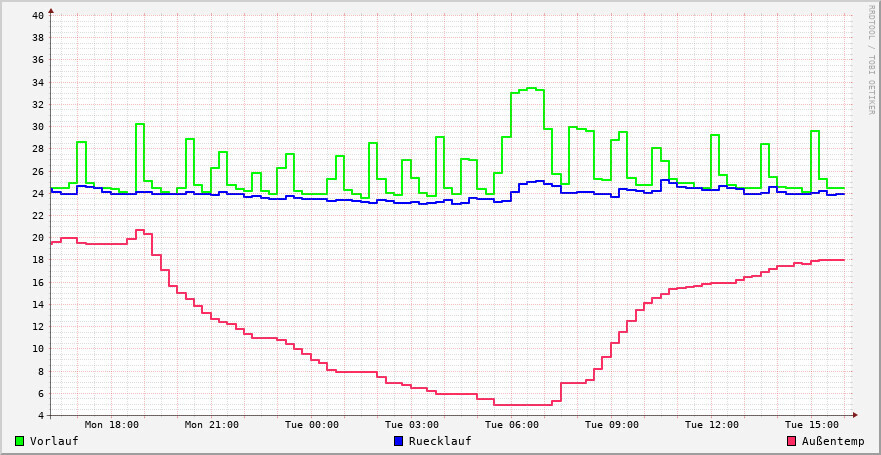
I also noticed that the boiler cycles on and off too frequently. To monitor this better, I installed on-wire sensors on the supply and return lines. Here is a snippet from March this year.
The problem is probably that the heating system does not know the current heat demand. Perhaps I could also lock the boiler (potential contact or similar) with my own logic?
I definitely still need to carry out the hydraulic balancing.

Mycraft schrieb:
Actually, not at all, because the boiler does that for you. Once everything is set correctly, you will have consistent temperatures in the rooms. Maybe a little more or less by a few degrees, exactly as you have set it. The desired temperatures are adjusted based on the flow rate, but be very careful here and only make minimal adjustments. One full turn can sometimes be far too much. So initially, leave everything as is without touching the actuators and observe the system for a few days. But wait another week or two. It’s still too warm outside. That said, what works in cold weather doesn’t necessarily work during transitional seasons.
My standard slope setting was 0.3.
I also started adjusting it in autumn and managed to get it right. But in winter, it was way too warm. So I lowered the heating curve until it was balanced again. In spring, it got too cold again. I then reduced it to 0.2 and adjusted the offset slightly. By the following year, it worked out, and I completely deactivated the ERR. I think my wife cursed me that year ops: because I forbade her from adjusting the remaining ERR.
In my opinion, this is a process of fine-tuning, and no heating technician can do this for you.
Similar topics