
ᐅ Main Pipeline Layout – Wastewater Drainage and Elevation Planning
Created on: 24 Sep 2020 19:39
T
Tolentino
Hello dear forum members,
I have now received a preliminary draft of the detailed construction plan. This will be adjusted again after the structural engineering calculations are completed, if necessary, and then finalized. Until then, I have time to consider whether everything makes sense as it is.
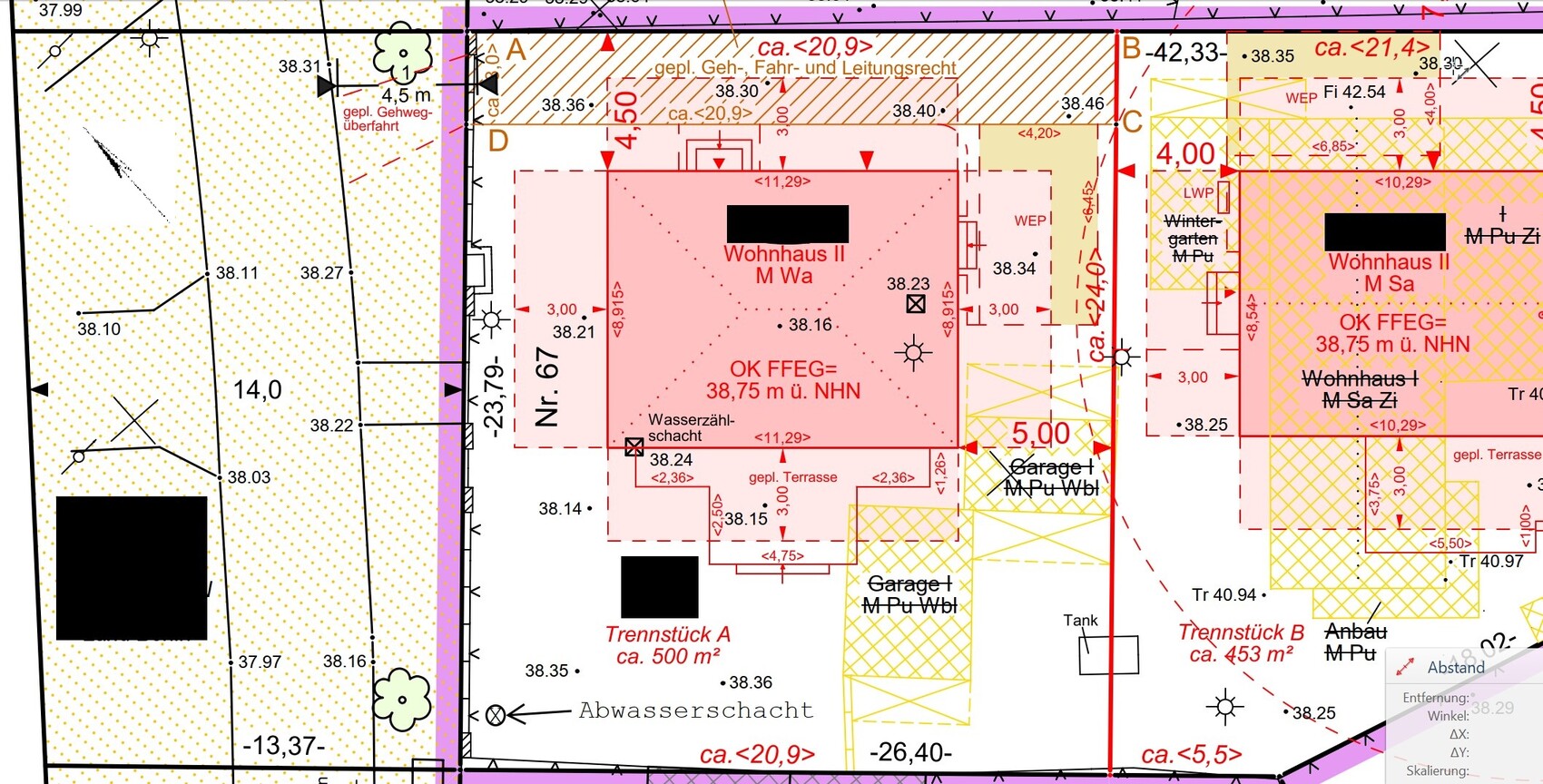
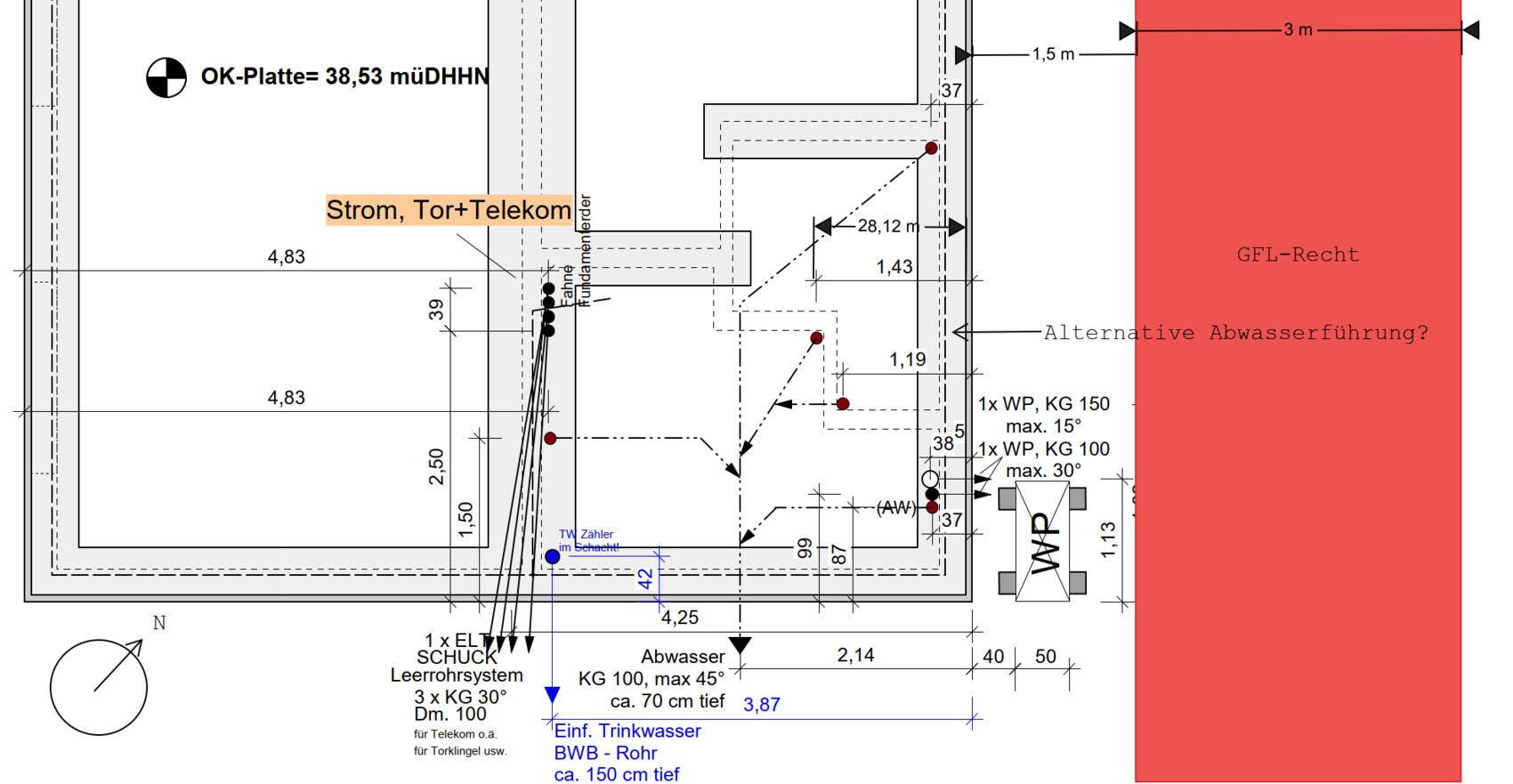
Below you can see first a site plan (from the building permit / planning permission) and a section from the draft ground drainage plan by the construction manager. Please note that the plans have different orientations, but I have added the north arrows anew in each case. In the ground drainage plan, I have marked the natural ground level (GFL) as an orange rectangle.
As you can see, the draft proposes that the wastewater pipes be combined and routed downward on the plan — that is, towards the neighboring property at the back, away from the street. This would require me to make one more directional change. The construction manager’s reasoning was that pipes should always be routed under the foundation slab on the shortest possible path because they are inaccessible afterward. That makes sense. However, looking at where the pipes come down elsewhere, is this really the average shortest route? There are more drainage pipes lying closer to the GFL strip; only the kitchen drain would be further away. Considering the longer pipe run for the main line and the additional required direction change, wouldn’t it be more sensible to route it to the right side of the plan (in the ground drainage plan) or upwards in the site plan?
The second topic is the height of the wastewater pipe. Here, the outlet height from the foundation slab is set at approximately 70 cm (28 inches) — I still need to confirm with respect to which height this refers; I assume the foundation slab’s top or underside. This is generally a standard height for wastewater pipes, but since the intended pipe route runs along the GFL, which also serves as the shared driveway for my neighbor and me, meaning it is a trafficked area, it is recommended to place the pipe deeper — from what I gather, about 150 cm (59 inches). Should I inform the general contractor about this now, or is it possible to add another step before the GFL? Especially because the existing wastewater shaft (see the west corner on the site plan) is to be used, and the pipe will have to cover a good distance of about 40 m (130 feet) to get there, the question about the actually necessary minimum height is important. The wastewater shaft is roughly 1.8 m (71 inches) deep. So, this roughly matches, but only if I can start on my preferred side of the house. If I have to go around the house, I would reach the shaft too low.
Do you have any ideas, suggestions, or remarks?
Thanks and best regards
Tolentino
I have now received a preliminary draft of the detailed construction plan. This will be adjusted again after the structural engineering calculations are completed, if necessary, and then finalized. Until then, I have time to consider whether everything makes sense as it is.
Below you can see first a site plan (from the building permit / planning permission) and a section from the draft ground drainage plan by the construction manager. Please note that the plans have different orientations, but I have added the north arrows anew in each case. In the ground drainage plan, I have marked the natural ground level (GFL) as an orange rectangle.
As you can see, the draft proposes that the wastewater pipes be combined and routed downward on the plan — that is, towards the neighboring property at the back, away from the street. This would require me to make one more directional change. The construction manager’s reasoning was that pipes should always be routed under the foundation slab on the shortest possible path because they are inaccessible afterward. That makes sense. However, looking at where the pipes come down elsewhere, is this really the average shortest route? There are more drainage pipes lying closer to the GFL strip; only the kitchen drain would be further away. Considering the longer pipe run for the main line and the additional required direction change, wouldn’t it be more sensible to route it to the right side of the plan (in the ground drainage plan) or upwards in the site plan?
The second topic is the height of the wastewater pipe. Here, the outlet height from the foundation slab is set at approximately 70 cm (28 inches) — I still need to confirm with respect to which height this refers; I assume the foundation slab’s top or underside. This is generally a standard height for wastewater pipes, but since the intended pipe route runs along the GFL, which also serves as the shared driveway for my neighbor and me, meaning it is a trafficked area, it is recommended to place the pipe deeper — from what I gather, about 150 cm (59 inches). Should I inform the general contractor about this now, or is it possible to add another step before the GFL? Especially because the existing wastewater shaft (see the west corner on the site plan) is to be used, and the pipe will have to cover a good distance of about 40 m (130 feet) to get there, the question about the actually necessary minimum height is important. The wastewater shaft is roughly 1.8 m (71 inches) deep. So, this roughly matches, but only if I can start on my preferred side of the house. If I have to go around the house, I would reach the shaft too low.
Do you have any ideas, suggestions, or remarks?
Thanks and best regards
Tolentino

Ok, electricity and drinking water supply might take quite some time. Yes, the one pit is probably for him.
Maybe I can still convince him, we’ll see.
Thanks in advance.
Are there any tips here regarding pipes in the ground floor level (GFL) that is regularly driven over?
Thanks and best regards
Tolentino
Maybe I can still convince him, we’ll see.
Thanks in advance.
Are there any tips here regarding pipes in the ground floor level (GFL) that is regularly driven over?
Thanks and best regards
Tolentino

If the ground level also serves as the construction access road, lay the pipes deep enough, not under a driving lane, but in a trench. Prepare the construction access road foundation deep enough for the paving, 8cm (3 inches) paving stones (now passable for 10-ton vehicles).

Tolentino schrieb:
Here is the complete basic pipeline plan again. But unfortunately, the core issue remains in the lower right corner of the image, the wastewater shaft mentioned in the upper left corner, with no indication of the route leading there, and isolated pipe diameter specifications without any suggested routing of these pipes. This leaves me lacking essential information for following the logic :-(
https://www.instagram.com/11antgmxde/
https://www.linkedin.com/company/bauen-jetzt/
@11ant: The details are in the text, although I was already advised to keep it brief.
I’ll try again with a drawing on the site plan.
Dark blue: This shows the route of the wastewater pipe planned by me and my neighbor to the inspection chamber, based on the existing ground level strip and to save on excavation costs (only one trench!).
Dark red: The construction manager’s plan with plumbing, aiming to keep it as short as possible under the slab.
Light blue: My proposed alternative to save a change of direction and about 5m (16 feet).
Green: The wastewater pipe I have planned for the neighbor (just a reminder that something is still planned there, his utility room is in the corner, but I have no design drawings from the construction company for his project).
1. Is my alternative better, worse, or does it not matter?
2. Is this wise at all, or should we simply install a new inspection chamber closer to the ground level? Connection costs are about 3,500 EUR (excluding the chamber and additional excavation work).
3. What should be especially considered if the wastewater pipe (and other utilities) have to be placed under the driveway on the ground level strip?
@Nida35a: Thanks in advance for your feedback. The construction access road is supposed to run there as well, although we planned to handle all the utility work only after the shell construction phase, hoping that no heavy vehicles will need to use it then.
My concern is more about the long-term load from repeated driving of two passenger cars.
Thanks and best regards
Tolentino
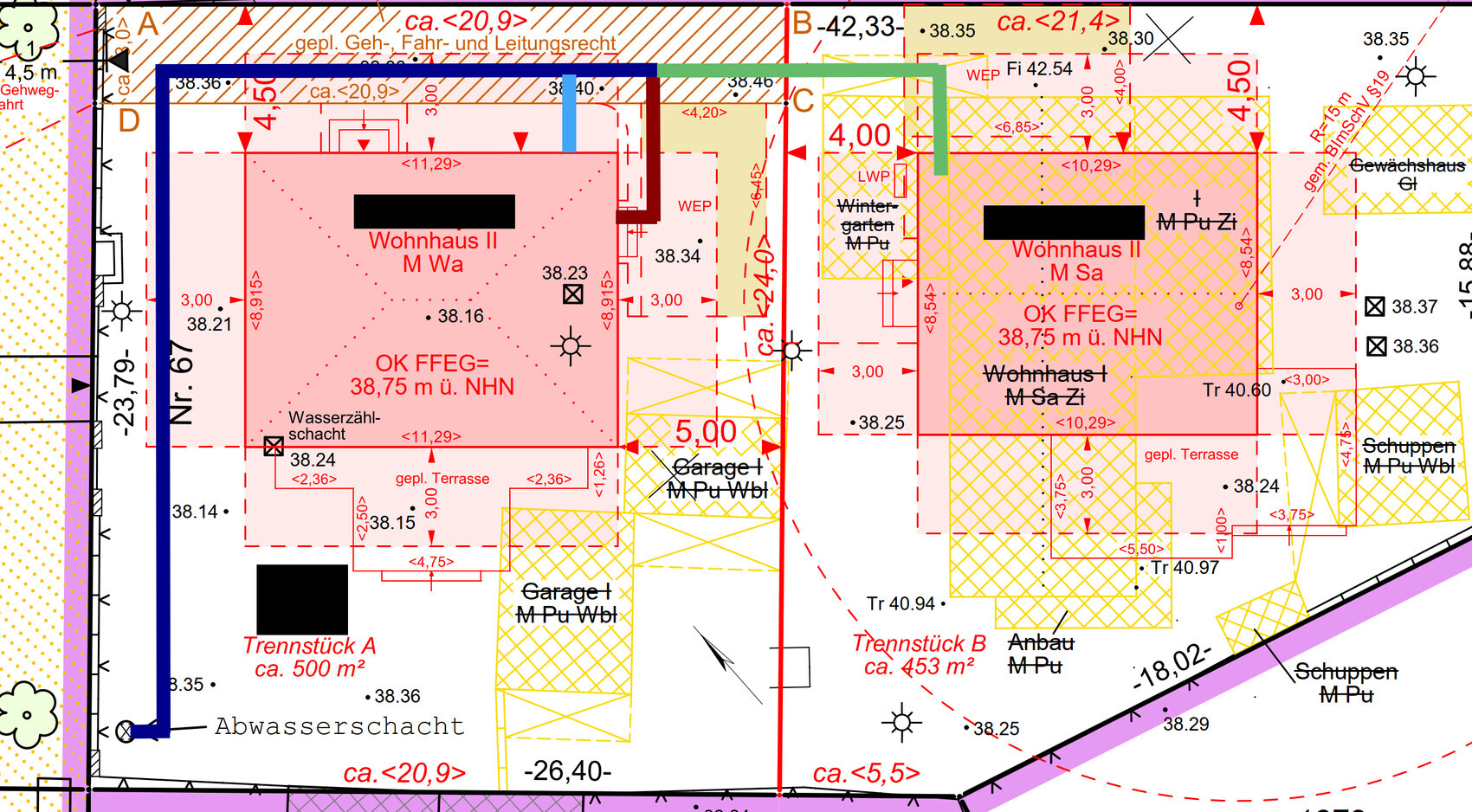
I’ll try again with a drawing on the site plan.
Dark blue: This shows the route of the wastewater pipe planned by me and my neighbor to the inspection chamber, based on the existing ground level strip and to save on excavation costs (only one trench!).
Dark red: The construction manager’s plan with plumbing, aiming to keep it as short as possible under the slab.
Light blue: My proposed alternative to save a change of direction and about 5m (16 feet).
Green: The wastewater pipe I have planned for the neighbor (just a reminder that something is still planned there, his utility room is in the corner, but I have no design drawings from the construction company for his project).
1. Is my alternative better, worse, or does it not matter?
2. Is this wise at all, or should we simply install a new inspection chamber closer to the ground level? Connection costs are about 3,500 EUR (excluding the chamber and additional excavation work).
3. What should be especially considered if the wastewater pipe (and other utilities) have to be placed under the driveway on the ground level strip?
@Nida35a: Thanks in advance for your feedback. The construction access road is supposed to run there as well, although we planned to handle all the utility work only after the shell construction phase, hoping that no heavy vehicles will need to use it then.
My concern is more about the long-term load from repeated driving of two passenger cars.
Thanks and best regards
Tolentino
"Light blue" appeals to me the most because the pipeline is shorter and has one less change of direction. Unfortunately, we do not know the terrain elevations or the manhole heights, so there is no reason to position the manhole closer to the GFL strip. However, if it were moved to the spot marked "D" on the drawing, the pipeline on your property would be about 17 meters (55 feet) shorter. The slope over this distance is crucial for me concerning my concerns about how difficult maintenance might be.
https://www.instagram.com/11antgmxde/
https://www.linkedin.com/company/bauen-jetzt/
https://www.instagram.com/11antgmxde/
https://www.linkedin.com/company/bauen-jetzt/
For better neighbor relations, install a new shaft if the super neighbor uses the old one.
Use the light blue version with fewer bends.
Make sure to use DN125/150 (5/6 inches) for the shared pipe, no 90-degree bends—use 3 x 30-degree or 2 x 45-degree bends instead.
Inspection openings should be made from a T-piece with 45-degree angles, a 1m (3.3 ft) pipe extending upwards, and a closure cap.
Our driveway has a permanent load capacity of 10 tons for vans/cars.
Use the light blue version with fewer bends.
Make sure to use DN125/150 (5/6 inches) for the shared pipe, no 90-degree bends—use 3 x 30-degree or 2 x 45-degree bends instead.
Inspection openings should be made from a T-piece with 45-degree angles, a 1m (3.3 ft) pipe extending upwards, and a closure cap.
Our driveway has a permanent load capacity of 10 tons for vans/cars.
Similar topics