
ᐅ A basement exterior wall built as a dowel timber construction (wood and concrete)
Created on: 25 Sep 2020 20:30
G
grasmücke
Hello,
I have a question for the community that’s been on my mind. We are planning a house using dowel wood construction with cellulose insulation. Since the plot has a slight slope, we have included a basement apartment in the plans.
To achieve better indoor climate, the builder suggested making the mostly open south-facing basement exterior wall out of dowel wood (like the house itself). The other three exterior walls will be made of 20 cm (8 inches) thick reinforced concrete and insulated from the outside with 14 cm (5.5 inches) of expanded polystyrene and from the inside with 6 cm (2.5 inches).
As I’m not a fan of expanded polystyrene or similar materials (especially indoors), I proposed calcium silicate boards as interior insulation for the basement apartment. According to the builder, this would be possible only if the 11 m (36 feet) long south-facing basement exterior wall is built as a dowel wood structure, because calcium silicate boards have a poor U-value.
At first, I liked the idea of having less concrete and expanded polystyrene in the house. However, some acquaintances later shared concerns that such a construction might not be stable and that it’s better not to combine wood and concrete walls. Additionally, there is a particular risk during heavy rain that water could penetrate the wall. An employee from a competitor company also commented on this and mentioned some structural issues.
Has anyone already implemented such a concept? Or knows someone who has? Or is there an architect or expert here who can advise if this approach is okay or if it’s better to avoid it?
Thanks in advance
Best regards
Sergey
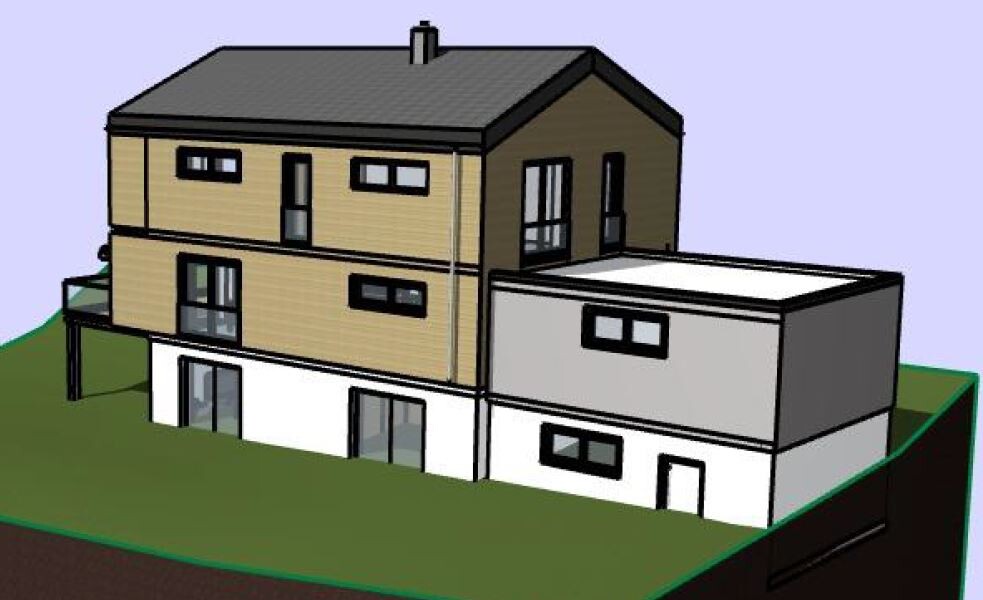
I have a question for the community that’s been on my mind. We are planning a house using dowel wood construction with cellulose insulation. Since the plot has a slight slope, we have included a basement apartment in the plans.
To achieve better indoor climate, the builder suggested making the mostly open south-facing basement exterior wall out of dowel wood (like the house itself). The other three exterior walls will be made of 20 cm (8 inches) thick reinforced concrete and insulated from the outside with 14 cm (5.5 inches) of expanded polystyrene and from the inside with 6 cm (2.5 inches).
As I’m not a fan of expanded polystyrene or similar materials (especially indoors), I proposed calcium silicate boards as interior insulation for the basement apartment. According to the builder, this would be possible only if the 11 m (36 feet) long south-facing basement exterior wall is built as a dowel wood structure, because calcium silicate boards have a poor U-value.
At first, I liked the idea of having less concrete and expanded polystyrene in the house. However, some acquaintances later shared concerns that such a construction might not be stable and that it’s better not to combine wood and concrete walls. Additionally, there is a particular risk during heavy rain that water could penetrate the wall. An employee from a competitor company also commented on this and mentioned some structural issues.
Has anyone already implemented such a concept? Or knows someone who has? Or is there an architect or expert here who can advise if this approach is okay or if it’s better to avoid it?
Thanks in advance
Best regards
Sergey
G
grasmücke27 Sep 2020 21:13haydee schrieb:
We have a basement level used as living space. We need the concrete wall as a retaining wall. Either the basement wall, as needed, cast in concrete, or a retaining wall with at least 1 meter (3 feet) distance from the house in front. With solid wood on three sides plus a thick retaining wall and floor slab, it worked. The reinforcement was intense. However, we have a 13-meter (43 feet) slope behind the house.So, if I understood you correctly, you only have the basement wall, which is in direct contact with the soil (on the slope side), made of concrete with insulation on both sides. The rest of the basement was constructed from solid wood (I assume timber logs). Am I right? Are the interior walls and the ceiling also made of wood?Insulation on both sides was necessary to prevent condensation. Since the architect, plasterer, concrete contractor, and expert all agreed, I assume it is required.The first company also didn’t understand when I raised my eyebrows about internal insulation. Apparently, it is common practice nowadays. Or is it because of your 13-meter (43 feet) slope?G
grasmücke28 Sep 2020 08:50haydee schrieb:
No, the slope height has nothing to do with the insulation. The reasoning was to avoid condensation.
The interior walls and ceiling are made of wood. Everything is covered. I don’t like the exposed wooden box look. Sounds interesting. When did you build? Have you noticed any advantages or disadvantages compared to a concrete ceiling and exterior/interior walls?
Move-in was in 2018.
I cannot notice any difference. Neither is any wall colder nor do you feel anything unusual in the rooms, which have at most one concrete wall.
Regarding the ceiling, there is not just one ceiling and one ceiling construction.
Don’t argue if the general contractor (GC) doesn’t do it that way; just accept it. There is probably a reason. Don’t reject concrete outright either. An ecological, pollutant-free house does not exist.
I cannot notice any difference. Neither is any wall colder nor do you feel anything unusual in the rooms, which have at most one concrete wall.
Regarding the ceiling, there is not just one ceiling and one ceiling construction.
Don’t argue if the general contractor (GC) doesn’t do it that way; just accept it. There is probably a reason. Don’t reject concrete outright either. An ecological, pollutant-free house does not exist.
grasmücke schrieb:
I asked the same question to the construction company. They told me they can’t use insulation that is too thick on the exterior because they are installing a wooden ceiling in the basement. It won’t work if the wooden ceiling extends too far outward with 20cm (8 inches) thick exterior insulation (I hope I understood that correctly). I understand; that reasoning seems plausible when installing a wooden ceiling in the basement. In that case, I would either follow the company’s recommendation or alternatively consider a clear two-part construction approach:
All basement walls including the basement ceiling constructed as solid masonry, then a wooden structure above. Of course, this is a change that should be carefully considered and might even require a different builder. I fully agree with haydee—it’s better not to impose anything on the construction company regarding such fundamental issues.
This forum certainly can’t provide definitive guidance, only food for thought. Too many factors unknown to the forum come into play here.
G
grasmücke29 Sep 2020 18:33haydee schrieb:
We moved in 2018.
I can’t notice any difference. None of the walls feel colder, nor do the rooms feel different, although the rooms have a maximum of one concrete wall.
Regarding the ceiling, there isn’t just one type of ceiling or ceiling structure.
Don’t twist things—if the general contractor doesn’t do it that way, accept it as is. There’s probably a reason. Don’t reject concrete either. An ecological, pollutant-free house doesn’t exist. Does a wooden ceiling have worse sound insulation than a concrete ceiling? Or does it not matter if the insulation is the same?
I really have nothing against concrete. I just want the best solution for the best price. But I don’t want to be disappointed after 30 years if the wooden wall needs repairs or something similar.
Similar topics