
ᐅ A basement exterior wall built as a dowel timber construction (wood and concrete)
Created on: 25 Sep 2020 20:30
G
grasmückeG
grasmücke25 Sep 2020 20:30Hello,
I have a question for the community that’s been on my mind. We are planning a house using dowel wood construction with cellulose insulation. Since the plot has a slight slope, we have included a basement apartment in the plans.
To achieve better indoor climate, the builder suggested making the mostly open south-facing basement exterior wall out of dowel wood (like the house itself). The other three exterior walls will be made of 20 cm (8 inches) thick reinforced concrete and insulated from the outside with 14 cm (5.5 inches) of expanded polystyrene and from the inside with 6 cm (2.5 inches).
As I’m not a fan of expanded polystyrene or similar materials (especially indoors), I proposed calcium silicate boards as interior insulation for the basement apartment. According to the builder, this would be possible only if the 11 m (36 feet) long south-facing basement exterior wall is built as a dowel wood structure, because calcium silicate boards have a poor U-value.
At first, I liked the idea of having less concrete and expanded polystyrene in the house. However, some acquaintances later shared concerns that such a construction might not be stable and that it’s better not to combine wood and concrete walls. Additionally, there is a particular risk during heavy rain that water could penetrate the wall. An employee from a competitor company also commented on this and mentioned some structural issues.
Has anyone already implemented such a concept? Or knows someone who has? Or is there an architect or expert here who can advise if this approach is okay or if it’s better to avoid it?
Thanks in advance
Best regards
Sergey
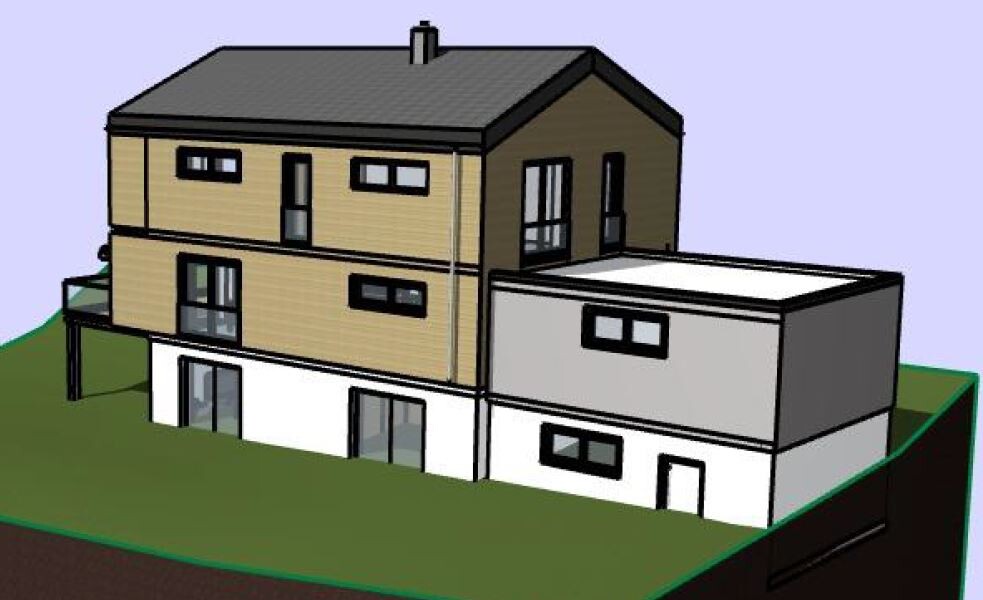
I have a question for the community that’s been on my mind. We are planning a house using dowel wood construction with cellulose insulation. Since the plot has a slight slope, we have included a basement apartment in the plans.
To achieve better indoor climate, the builder suggested making the mostly open south-facing basement exterior wall out of dowel wood (like the house itself). The other three exterior walls will be made of 20 cm (8 inches) thick reinforced concrete and insulated from the outside with 14 cm (5.5 inches) of expanded polystyrene and from the inside with 6 cm (2.5 inches).
As I’m not a fan of expanded polystyrene or similar materials (especially indoors), I proposed calcium silicate boards as interior insulation for the basement apartment. According to the builder, this would be possible only if the 11 m (36 feet) long south-facing basement exterior wall is built as a dowel wood structure, because calcium silicate boards have a poor U-value.
At first, I liked the idea of having less concrete and expanded polystyrene in the house. However, some acquaintances later shared concerns that such a construction might not be stable and that it’s better not to combine wood and concrete walls. Additionally, there is a particular risk during heavy rain that water could penetrate the wall. An employee from a competitor company also commented on this and mentioned some structural issues.
Has anyone already implemented such a concept? Or knows someone who has? Or is there an architect or expert here who can advise if this approach is okay or if it’s better to avoid it?
Thanks in advance
Best regards
Sergey
What speaks against applying external insulation to the concrete walls, for example 20cm (8 inches), to completely avoid interior insulation? Has this alternative already been calculated?
Better insulation of the basement floor might also compensate for some shortcomings of the walls, if necessary. Ultimately, it is a calculation task regarding the thermal insulation values of the different building components of the house, including the U-values of the windows.
What overall energy standard should the house achieve?
Calcium silicate boards are a good solution for retrofitting insulation in existing buildings when external insulation is difficult. For a new build, I would avoid interior insulation of solid walls. Besides possible health considerations, there are other reasons: when the entire concrete exterior walls of the basement are part of the thermal envelope, the house cools down or heats up more slowly, meaning it reacts more gradually to temperature changes—which, in my opinion, is quite beneficial. And practically speaking: shelves and similar fixtures can be more easily mounted on the walls without interior insulation.
Better insulation of the basement floor might also compensate for some shortcomings of the walls, if necessary. Ultimately, it is a calculation task regarding the thermal insulation values of the different building components of the house, including the U-values of the windows.
What overall energy standard should the house achieve?
Calcium silicate boards are a good solution for retrofitting insulation in existing buildings when external insulation is difficult. For a new build, I would avoid interior insulation of solid walls. Besides possible health considerations, there are other reasons: when the entire concrete exterior walls of the basement are part of the thermal envelope, the house cools down or heats up more slowly, meaning it reacts more gradually to temperature changes—which, in my opinion, is quite beneficial. And practically speaking: shelves and similar fixtures can be more easily mounted on the walls without interior insulation.
G
grasmücke27 Sep 2020 20:27Thanks BobRoss, see inline:
I asked the construction company the same question. They told me they are not allowed to use too thick exterior insulation because they build a wooden ceiling in the basement. And it won’t work if the wooden ceiling protrudes too far outwards with 20cm (8 inches) thick exterior insulation (I hope I understood that correctly). This differs greatly from their standard, and they would not want to try building it that way.
40+
For me, calcium silicate boards would be a solution to avoid using polystyrene in the living area if we end up building our house with the company using a basement with wooden exterior walls and wooden ceiling.
I also don’t like interior insulation and this worries me the most. Just as much as wooden exterior walls in the basement. That’s why I need the community’s opinion.
I actually wanted the south exterior wall in the basement to be wooden because it has much better values regarding phase shift—19.3 (wood) versus 12.2 (concrete) hours. So theoretically, it should be cooler in the basement during the summer with the wood wall.
If there is interior insulation, then drywall will be installed on top.
BobRoss schrieb:
What speaks against insulating the concrete walls from the outside with, for example, 20cm (8 inches), to completely avoid interior insulation? Has this alternative already been calculated?
Better insulation of the basement floor might also compensate for some deficit in the walls, if necessary. In the end, this is a calculation task regarding the thermal insulation values of the building components, including the windows’ U-values.
I asked the construction company the same question. They told me they are not allowed to use too thick exterior insulation because they build a wooden ceiling in the basement. And it won’t work if the wooden ceiling protrudes too far outwards with 20cm (8 inches) thick exterior insulation (I hope I understood that correctly). This differs greatly from their standard, and they would not want to try building it that way.
What overall energy standard should the house achieve?
40+
Calcium silicate boards are a good solution for retrofitting insulation in existing buildings when exterior insulation is difficult.
For me, calcium silicate boards would be a solution to avoid using polystyrene in the living area if we end up building our house with the company using a basement with wooden exterior walls and wooden ceiling.
For a new build, I would avoid interior insulation of solid walls. Besides potential health-related reasons, there are other considerations: if the entire concrete exterior walls of the basement are part of the thermal envelope, the house will also cool down or heat up more slowly—in other words, it reacts more slowly to temperature changes—which I consider quite positive.
I also don’t like interior insulation and this worries me the most. Just as much as wooden exterior walls in the basement. That’s why I need the community’s opinion.
I actually wanted the south exterior wall in the basement to be wooden because it has much better values regarding phase shift—19.3 (wood) versus 12.2 (concrete) hours. So theoretically, it should be cooler in the basement during the summer with the wood wall.
And practically speaking: shelves, etc., are easier to fix to the walls without interior insulation.
If there is interior insulation, then drywall will be installed on top.
G
grasmücke27 Sep 2020 20:41haydee schrieb:
Are you planning a timber frame structure?Thanks, haydee, we are planning a wooden house. One company offers solid dowel laminated timber walls with cellulose insulation in the cavities. The other offers a timber frame structure with wood chip insulation. The features are quite similar. However, the second is about 10% more expensive.
The first company provides an exterior basement wall and basement ceiling, as well as all interior walls (!) made of wood but with interior insulation made of expanded polystyrene (EPS).
The second company is more conservative and did not speak very positively about the first company’s solution. Not only regarding the interior insulation (I was already aware of its disadvantages), but also about the timber wall and wood ceiling. They said it is not reliable in the long term and cannot be compared to a full concrete basement.
Every manufacturer advised against that, as did the structural engineer.
We now have a concrete wall on the hillside side, insulation on the inside and outside, and the rest is solid wood. Did you also want a basement wall made of wood? Did the structural engineer give any specific reasons why it is not advisable?
Why couldn’t you avoid interior insulation?
We have a basement level used as living space. We need the concrete wall as a retaining wall. Either the basement, concrete where necessary, or a retaining wall with at least 1 meter (3 feet) distance from the house in front. Using solid wood on three sides, together with a thick retaining wall and base slab, made it possible. The reinforcement was a challenge. However, we still have a 13-meter (43-foot) slope behind the house.
Insulation on both sides was necessary to prevent condensation. Since the architect, plasterer, concrete contractor, and expert all agreed, I assume it is required.
Insulation on both sides was necessary to prevent condensation. Since the architect, plasterer, concrete contractor, and expert all agreed, I assume it is required.
Similar topics