
Hello!
Apparently, our floor plan, as we originally wanted it, is causing some practical issues.
We are planning a prefab house (9.42 x 9.42 meters (31 x 31 feet)) with a gable roof, knee wall height 1.60 meters (5 ft 3 in), and roof pitch of 25 degrees. At our request, the entrance is planned on the eaves side on the north.
We are actually happy with the ground floor. Our main priorities on the ground floor were an open living-dining area, a guest/workroom, and a guest toilet with shower. The utility room has a window that is located under the carport.
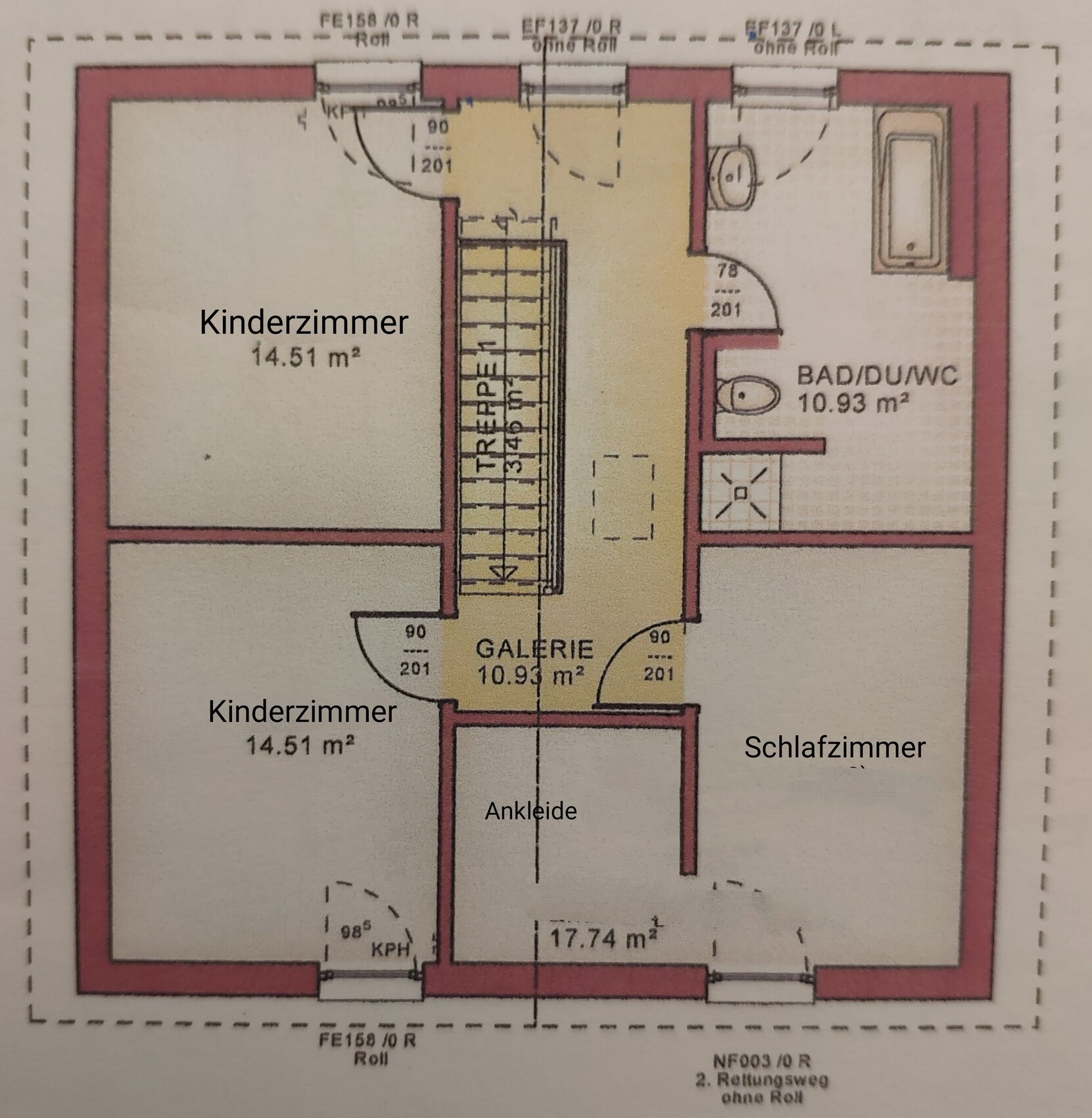
Now about the upper floor, which I like but is causing problems:
1. The door of the north-facing children's room opens against the window. Should it open into the room? Or open outward into the hallway, like the bedroom door is planned (why is it like that there…)?
2. The window in the master bedroom on the upper floor (south side) is planned without a roller blind. This is because a distance of 2.05 meters (6 ft 9 in) to the side wall with the roof slope must be maintained for a roller blind. In the current plan (open walk-in closet) the window could still be moved slightly. However, I wanted to close off the wall to the walk-in closet so that it is accessible from the hallway. According to my calculations, to fit the window there, the walk-in closet would have to be reduced by about 70 cm (28 inches), which is hardly possible.
Do you have any ideas for redesigns that could help us here?
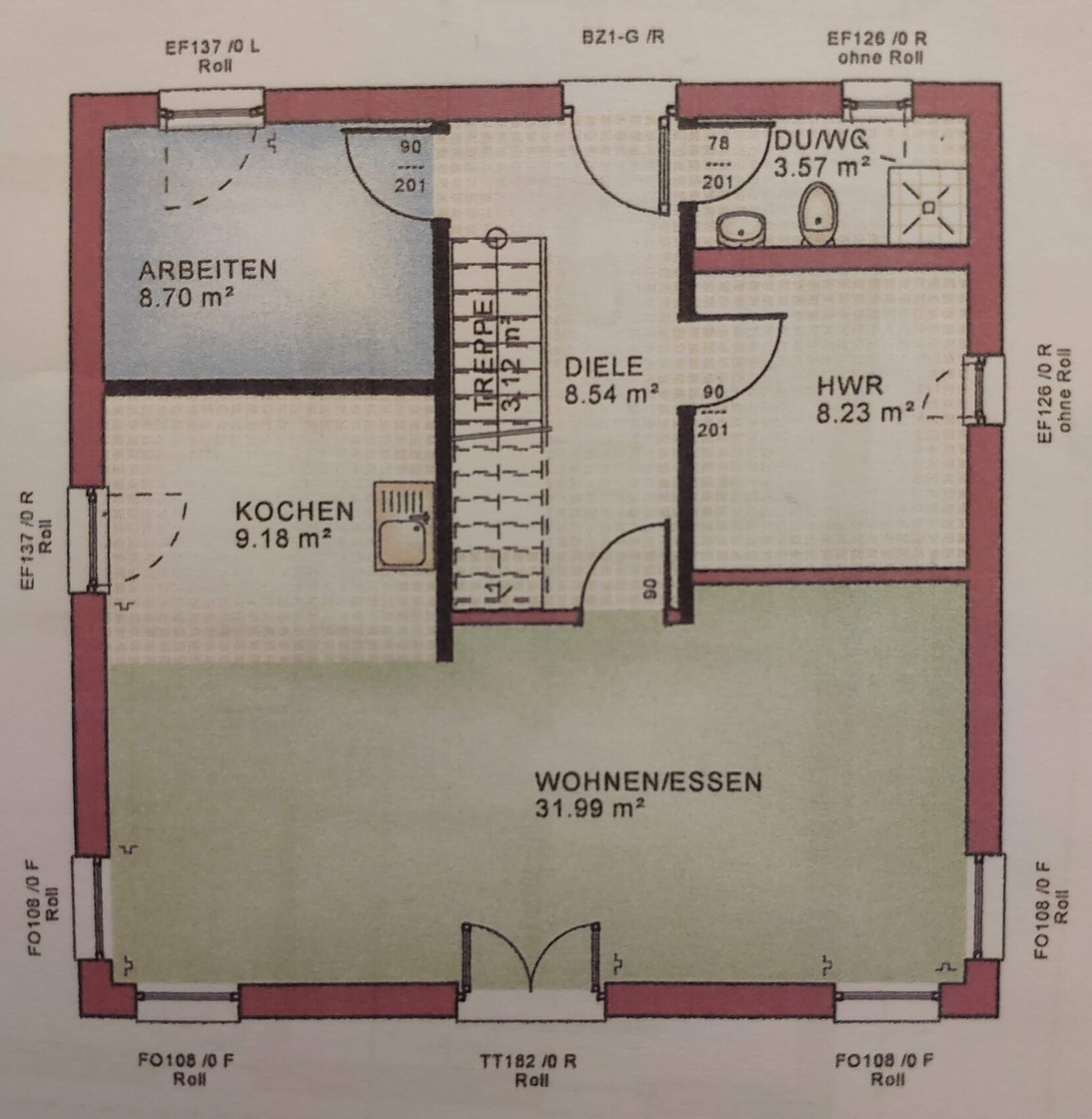
Apparently, our floor plan, as we originally wanted it, is causing some practical issues.
We are planning a prefab house (9.42 x 9.42 meters (31 x 31 feet)) with a gable roof, knee wall height 1.60 meters (5 ft 3 in), and roof pitch of 25 degrees. At our request, the entrance is planned on the eaves side on the north.
We are actually happy with the ground floor. Our main priorities on the ground floor were an open living-dining area, a guest/workroom, and a guest toilet with shower. The utility room has a window that is located under the carport.
Now about the upper floor, which I like but is causing problems:
1. The door of the north-facing children's room opens against the window. Should it open into the room? Or open outward into the hallway, like the bedroom door is planned (why is it like that there…)?
2. The window in the master bedroom on the upper floor (south side) is planned without a roller blind. This is because a distance of 2.05 meters (6 ft 9 in) to the side wall with the roof slope must be maintained for a roller blind. In the current plan (open walk-in closet) the window could still be moved slightly. However, I wanted to close off the wall to the walk-in closet so that it is accessible from the hallway. According to my calculations, to fit the window there, the walk-in closet would have to be reduced by about 70 cm (28 inches), which is hardly possible.
Do you have any ideas for redesigns that could help us here?
I get the feeling that @ypg is tired of the “uninformed” questions, which is why the answers are a bit sharp at the moment. On one hand, that’s understandable because the most basic, pinned posts are often not read, and people keep asking the same questions.
But actually, the forum is meant for “newcomers” to learn from experienced users, and naturally, they don’t know everything yet. Otherwise, the forum would be somewhat redundant, in my opinion...
Don’t take it too personally, @LuiseRadiese — the tone here can be quite direct.
An air-to-air heat pump makes sense in a passive house; otherwise, an air-to-water system is preferable. It looks like you might not have a very competent general contractor (GC) by your side.
The questionnaire is quite sparsely filled out, and the cost estimate is completely missing.
A site plan would also be helpful.
You will get a lot of input here if you provide the information and join the discussion.
But actually, the forum is meant for “newcomers” to learn from experienced users, and naturally, they don’t know everything yet. Otherwise, the forum would be somewhat redundant, in my opinion...
Don’t take it too personally, @LuiseRadiese — the tone here can be quite direct.
An air-to-air heat pump makes sense in a passive house; otherwise, an air-to-water system is preferable. It looks like you might not have a very competent general contractor (GC) by your side.
The questionnaire is quite sparsely filled out, and the cost estimate is completely missing.
A site plan would also be helpful.
You will get a lot of input here if you provide the information and join the discussion.
L
LuiseRadiese21 Sep 2020 11:03Tamstar schrieb:
I get the feeling that @ypg is tired of dealing with "uninformed" questions, which is why the answers are a bit blunt at the moment. On one hand, it's understandable because the most basic, pinned posts are often not read and the same information has to be provided over and over again.
But the forum is really meant for "newcomers" to learn from experienced users and to not know everything yet, otherwise the forum would be somewhat pointless, in my opinion...
Don’t take it too personally, @LuiseRadiese, it’s just that things can be quite direct here.
An air-to-air heat pump is suitable for a passive house, otherwise air-to-water is preferable. It looks like you might have a general contractor who is not very competent on your side.
The questionnaire is quite sparsely filled out, the calculations are completely missing.
A site plan would also be helpful.
You will get a lot of input here if you provide the information and participate in the discussion. Thank you, that helps me understand better. I filled in what I knew offhand. I didn’t realize I needed to have details about the heating system ready in order to get advice on the floor plan. It might also be true that I am somewhat naive and uninformed on other building-related topics, including heating, but initially, I did not feel the need for advice on those.
I assumed that we had entrusted this to professionals. Maybe that is frowned upon or even a mistake, but I just can’t do it myself. Sorry!
L
LuiseRadiese21 Sep 2020 11:09haydee schrieb:
This means the house is on level ground and the garden slopes downward.
For information about the heat pump, please check the technical section.Yes, that is the plan.
As mentioned, this forum exists exactly for you to gather information, and since you are here, the first step is already done.
Many houses are built, but probably only a small fraction address anything beyond basic floor plan design. Why would they? When I buy a car, to exaggerate a bit, I mainly look at how it looks, how fast it can go, and what its fuel consumption is, then compare prices and place an order. I don’t check whether it has a specific cylinder head or brake pad type. There will be enthusiasts like that, just as here there are those who plan every ventilation duct themselves or spend months adjusting the heating system, but most people don’t do that.
You don’t need to have all the heating system data on hand! But your general contractor (GC) should know better. That’s the sad part... you rely on the “professional” because, ideally, that is their job, yet they don’t advise you properly, completely, or in your best interest.
You don’t need to apologize for that.
However, knowing your budget is important because you can get into serious trouble if you haven’t thoroughly examined your building specification and your GC has given you advice on those details similar to how they handled the floor plan or heating system.
Even more so because you have a sloping lot, and that can lead to high costs!
Many houses are built, but probably only a small fraction address anything beyond basic floor plan design. Why would they? When I buy a car, to exaggerate a bit, I mainly look at how it looks, how fast it can go, and what its fuel consumption is, then compare prices and place an order. I don’t check whether it has a specific cylinder head or brake pad type. There will be enthusiasts like that, just as here there are those who plan every ventilation duct themselves or spend months adjusting the heating system, but most people don’t do that.
You don’t need to have all the heating system data on hand! But your general contractor (GC) should know better. That’s the sad part... you rely on the “professional” because, ideally, that is their job, yet they don’t advise you properly, completely, or in your best interest.
You don’t need to apologize for that.
However, knowing your budget is important because you can get into serious trouble if you haven’t thoroughly examined your building specification and your GC has given you advice on those details similar to how they handled the floor plan or heating system.
Even more so because you have a sloping lot, and that can lead to high costs!
Similar topics