
Hello everyone,
We are currently having a Luxhaus (timber frame construction) built and had our shell inspection last week. An independent master carpenter pointed out to me that the staples used to attach the vapor retarder (I assume it is a vapor retarder and not a vapor barrier since it is a PVC foil) at the transition to the attic should have been sealed with airtight tape for better airtightness. (Currently, they are not sealed).
By the way: The attic of the pitched roof is located outside of the insulated area.
At Luxhaus, this is not seen as a problem, and they referred us to the blower door test. If there were actual leaks, they said the blower door test would detect them. They also mentioned that taping over the staples would make them uncompetitive.
After some research on the blower door test, I have come to the conclusion that it is not necessarily a definitive confirmation that there are no leaks. For one thing, the test can be performed by anyone without special certification, and also meeting the KfW (Kreditanstalt für Wiederaufbau) limit values offers no guarantee that there are no leaks due to construction defects.
What are your thoughts on this?
Best regards,
Anton
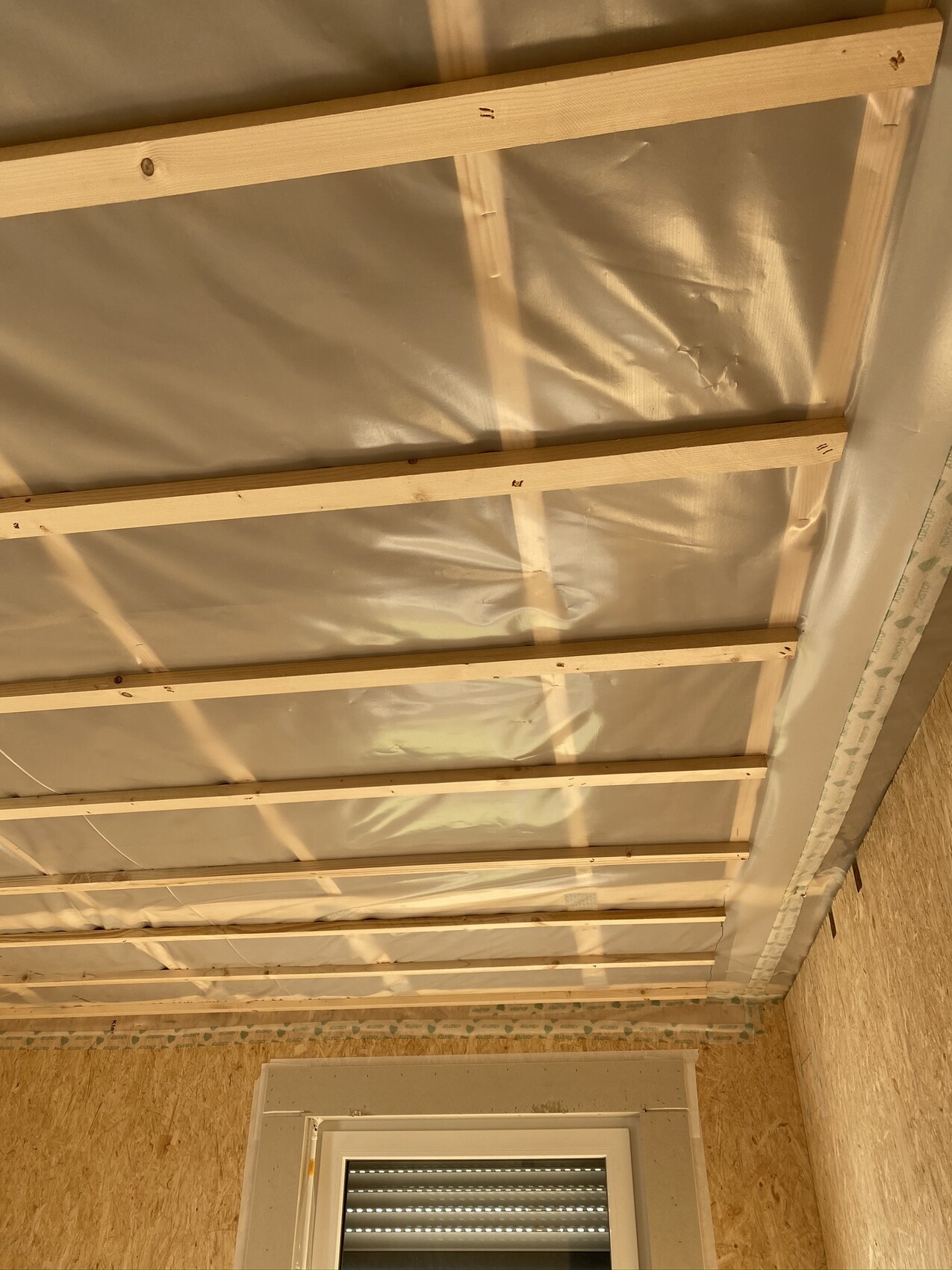
We are currently having a Luxhaus (timber frame construction) built and had our shell inspection last week. An independent master carpenter pointed out to me that the staples used to attach the vapor retarder (I assume it is a vapor retarder and not a vapor barrier since it is a PVC foil) at the transition to the attic should have been sealed with airtight tape for better airtightness. (Currently, they are not sealed).
By the way: The attic of the pitched roof is located outside of the insulated area.
At Luxhaus, this is not seen as a problem, and they referred us to the blower door test. If there were actual leaks, they said the blower door test would detect them. They also mentioned that taping over the staples would make them uncompetitive.
After some research on the blower door test, I have come to the conclusion that it is not necessarily a definitive confirmation that there are no leaks. For one thing, the test can be performed by anyone without special certification, and also meeting the KfW (Kreditanstalt für Wiederaufbau) limit values offers no guarantee that there are no leaks due to construction defects.
What are your thoughts on this?
Best regards,
Anton

Once the blower door test is passed, that's sufficient. The house then has the required airtightness. Being completely airtight is not better but worse, and requires a controlled mechanical ventilation system.
If the staples are flush with the membrane, that is good. If they are too deep, piercing the membrane, that is bad and considered a construction defect.
If the staples are flush with the membrane, that is good. If they are too deep, piercing the membrane, that is bad and considered a construction defect.
Nida35a schrieb:
Once the blower door test is passed, consider it done. The house then has the required airtightness. Completely airtight is not better but worse and requires a controlled mechanical ventilation system.
If the staples are flush with the membrane, that’s good; if they penetrate too deeply and pierce the membrane, that’s bad and a construction defect. Unfortunately, that is incorrect. Passing a blower door test does not guarantee the absence of leaks. It is possible that a single leak can damage your roof, even if the blower door test results are excellent. However, in this case, I do not see that.
Bookstar schrieb:
Unfortunately, that is incorrect. Passing a blower door test does not guarantee the absence of leaks. It is possible that a single leak could damage your roof, even if the blower door test results are excellent. However, I don’t think that applies in this case. The blower door test only shows that the total amount of leaks is below an acceptable threshold.
In this case, it means the membranes are not perforated like Swiss cheese.
For our house, this test was not carried out at the homeowner’s request.
K
knalltüte13 Sep 2020 22:43If you have any doubts and some time, it would be easy to do this yourself with a roll of Sicrall tape.
Similar topics