
Hello,
We had our house built in 2015. Of course, we ran into a lot of problems and ended up doing most of the work ourselves so that we could at least move in by 2017. At the end of 2019, our family grew with the arrival of two girls. Now the topic comes up: my home office will soon have to make way for a second children’s bedroom so that one of the girls can have her own room. The attic definitely has potential to create my new workspace. It is already insulated and the sloped ceilings are covered with OSB boards, over which I want to install ceiling panels. I think this looks better than painting the OSB boards, which gave us problems in the lower rooms.
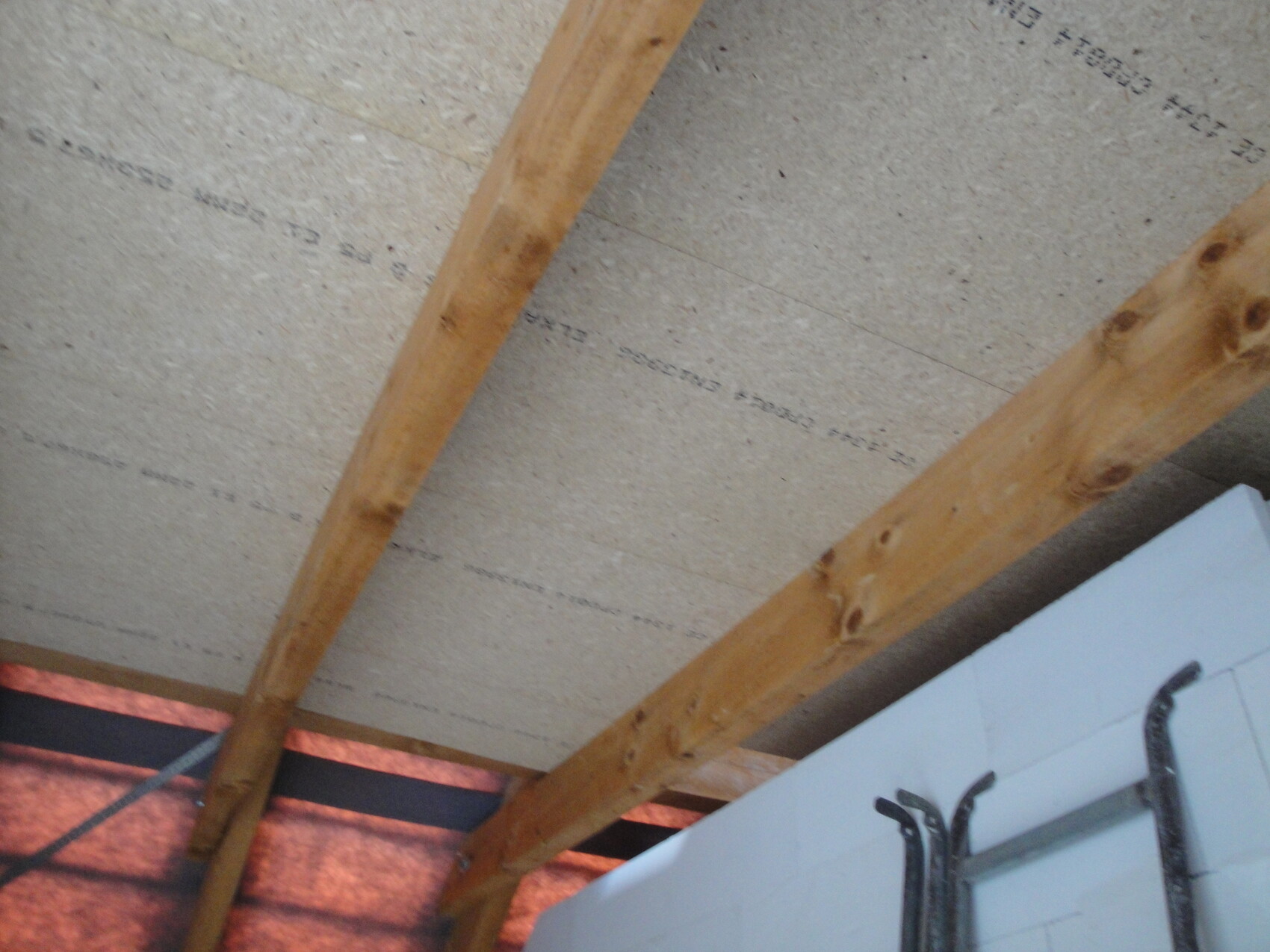
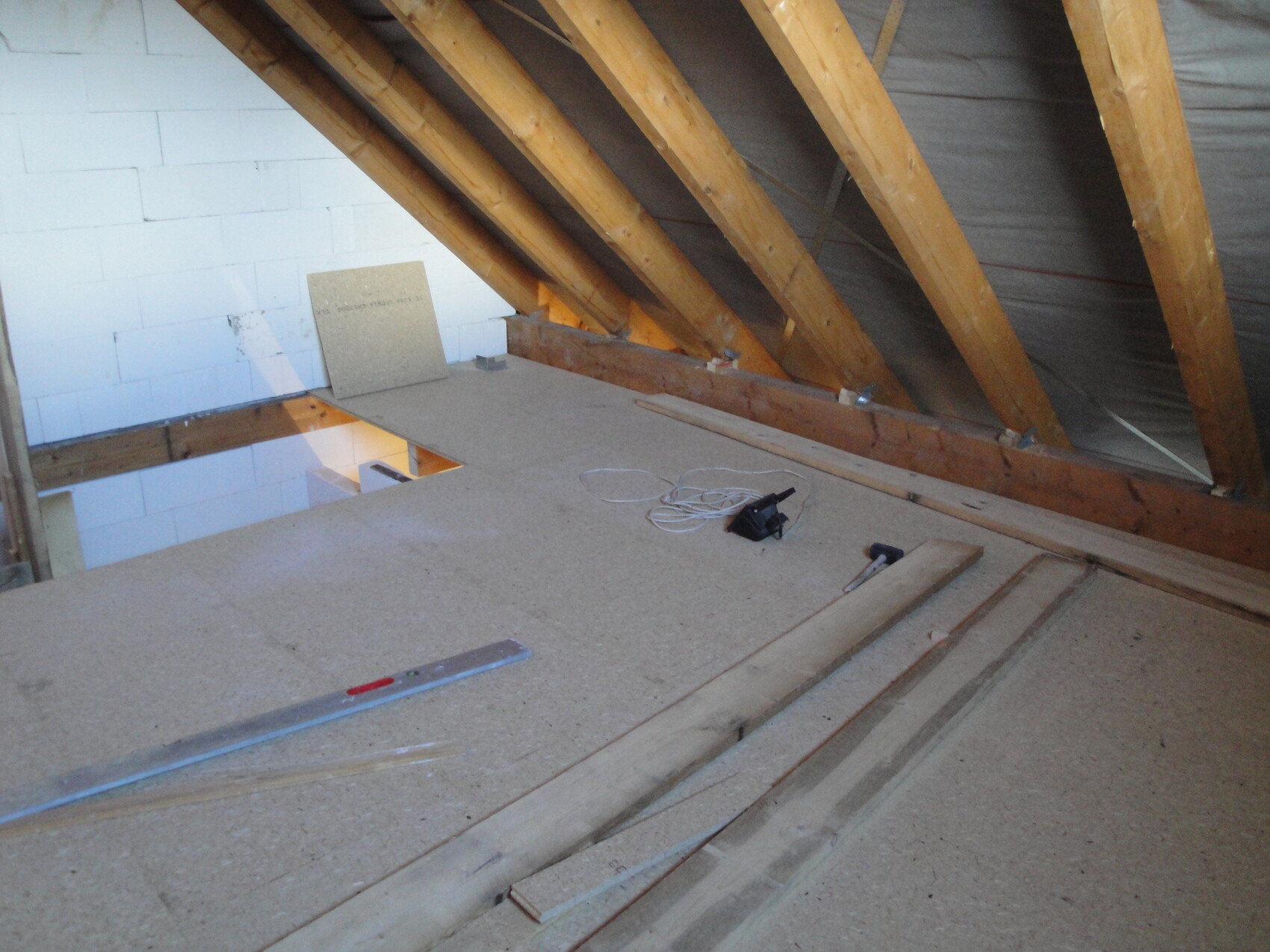
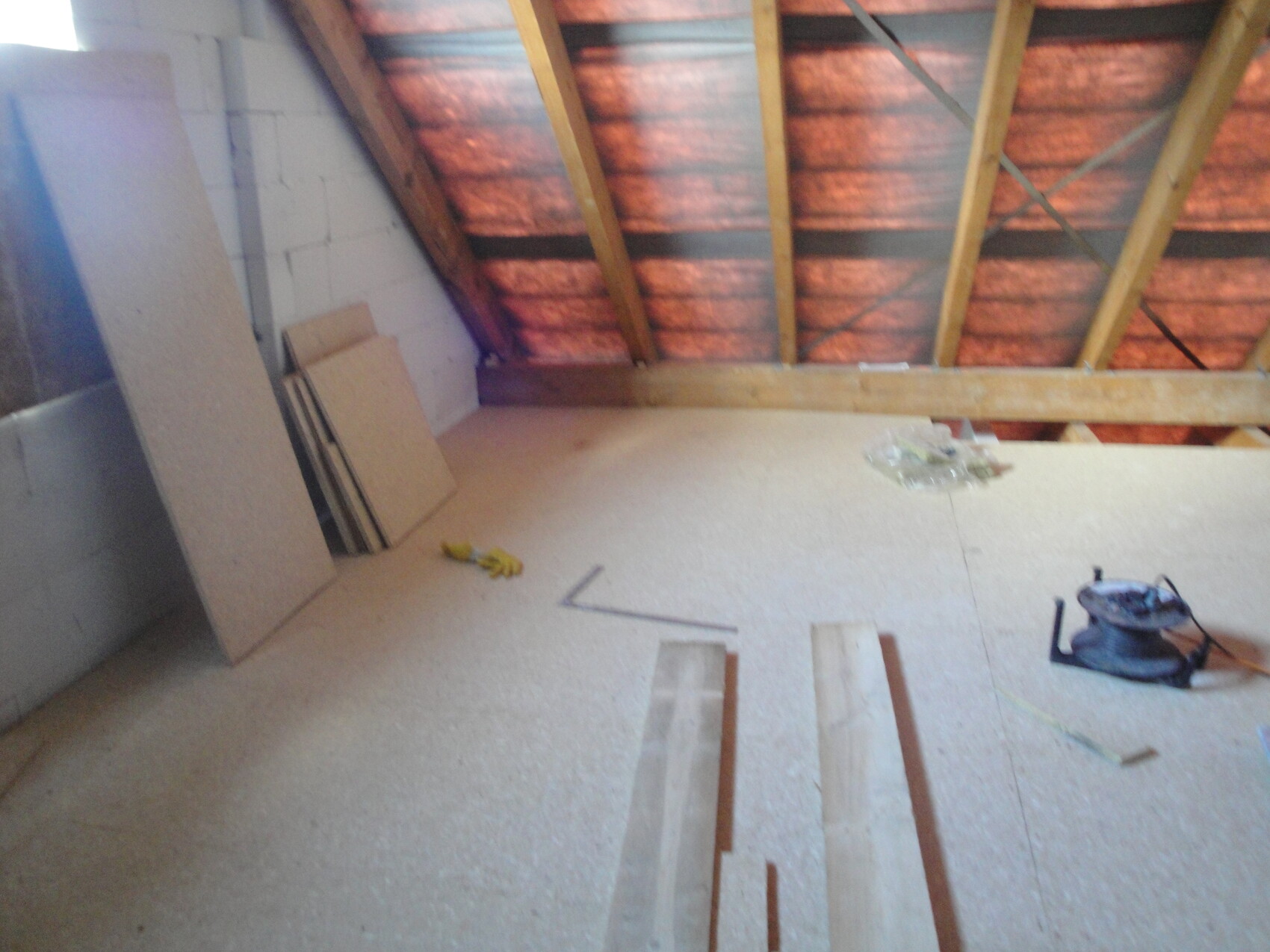
My biggest problem, and the reason I’m asking for your advice, is the attic floor. It is constructed with insulation between the joists and then thick chipboard panels on top. I think this is not sufficient because the floor has waves, meaning it is uneven. My question: Can I add a leveling compound over these chipboard panels and then install dry screed panels to lay laminate flooring on top, or would that be too much weight? I only have photos showing the joists from below before the insulation was installed between them, which might help. I can also measure the joist thickness if needed. It’s important for me to avoid causing structural problems or ending up “one floor lower” if the load is too much.
Maybe you can help me with this.
Best regards and thanks in advance,
Roady89
We had our house built in 2015. Of course, we ran into a lot of problems and ended up doing most of the work ourselves so that we could at least move in by 2017. At the end of 2019, our family grew with the arrival of two girls. Now the topic comes up: my home office will soon have to make way for a second children’s bedroom so that one of the girls can have her own room. The attic definitely has potential to create my new workspace. It is already insulated and the sloped ceilings are covered with OSB boards, over which I want to install ceiling panels. I think this looks better than painting the OSB boards, which gave us problems in the lower rooms.
My biggest problem, and the reason I’m asking for your advice, is the attic floor. It is constructed with insulation between the joists and then thick chipboard panels on top. I think this is not sufficient because the floor has waves, meaning it is uneven. My question: Can I add a leveling compound over these chipboard panels and then install dry screed panels to lay laminate flooring on top, or would that be too much weight? I only have photos showing the joists from below before the insulation was installed between them, which might help. I can also measure the joist thickness if needed. It’s important for me to avoid causing structural problems or ending up “one floor lower” if the load is too much.
Maybe you can help me with this.
Best regards and thanks in advance,
Roady89

bauenmk2020 schrieb:
Tongue-and-groove boards thicker than 19mm (0.75 inches). We have 19mm (0.75 inches), which is good for storing boxes, cartons, etc. But for heavier furniture or people, I would go for at least 22mm (0.87 inches).
I would install frame members underneath the tongue-and-groove boards at intervals of less than 50cm (20 inches).
You can initially build a test section of about 1m by the length of the tongue-and-groove boards in meters (equal to test flooring area in square meters) to check if it flexes too much.
A question about the picture:
This is an unheated cold roof, right? I had looked it up and I would definitely go with 22mm (0.87 inches) as well. Using frame members is a great idea since the joists are a bit far apart—I’m not sure exactly how far, but you can see it in the pictures.
About the cold roof—if I understand correctly, there is no flooring installed in the attic, and there is only a radiator that isn’t used, at least not as long as it serves as a storage area.
If you’re asking whether the roof is insulated: yes, there is an external underlay membrane, then insulation wool between the rafters, and on the inside it’s sealed with a vapor barrier foil. For cladding, we used OSB boards with a thickness of 12mm (0.47 inches).
 bauenmk202012 Sep 2020 17:36
Okay, that works for the attic. The important thing is that warm, moist air coming from below (living area) will likely cool down in the attic, which reduces the air’s capacity to hold moisture and causes water to condense. This water can then cause building damage. Therefore, the additional space should also be heated or measures should be taken to ensure that the dew point is not reached.
Is the attic accessible via a fixed staircase or a retractable ladder?
Is the attic accessible via a fixed staircase or a retractable ladder?
bauenmk2020 schrieb:
Okay, that fits well for the attic. The important point is that warm, humid air coming from below (living space) will likely cool down in the attic, which reduces the air’s capacity to hold moisture and causes water to condense. This water can then cause structural damage. Therefore, the additional space should also be heated, or measures should be taken to ensure the dew point is not dropped below.
Can the attic be accessed by a fixed staircase or by a pull-down ladder?Yes, we already said that when it gets colder, we will turn on the heating there as well... The attic is accessed normally via a fixed staircase.
T
T_im_Norden12 Sep 2020 17:41Do I understand this correctly:
The ceiling to the attic is insulated, has a vapor retarder, and OSB boards.
The roof is insulated and also has another vapor retarder and OSB boards?
So, two layers of vapor retarder/barrier?
The ceiling to the attic is insulated, has a vapor retarder, and OSB boards.
The roof is insulated and also has another vapor retarder and OSB boards?
So, two layers of vapor retarder/barrier?
T_im_Norden schrieb:
Do I understand this correctly:
The ceiling to the attic is insulated, has a vapor barrier and OSB.
The roof is insulated and also has a vapor barrier and OSB?
So, two vapor barriers/seals? Yes, exactly. As I said, we really had a bad experience with that useless construction company. It definitely could have been handled much better.
Roady89 schrieb:
Yes, as I said, we really got badly let down by that nonsense construction company. This could definitely have been handled much better.I also have to mention that the rooms under the attic have sloped ceilings (knee wall height 1.5 meters (5 feet)), and the slopes were insulated with a vapor barrier applied. I didn’t understand this and reacted too late when they extended the vapor barrier membrane from the slope into the ceiling instead of pulling it all the way up to the ridge. ♂️
Similar topics