
Dear community,
We have purchased a partially basemented bungalow with a flat roof located on a hillside in our favorite city and now want to renovate it. It is not a prefab house but was originally custom-designed by an architect for the owners. We are now seeking advice or criteria to help decide on the insulation of the facade (the roof was newly insulated and laminated in 1999).
When researching this topic, we often read that, due to the risk of mold, one should avoid full exterior insulation using ETICS (external thermal insulation composite system) on the entire facade and instead limit insulation to the basement ceiling or room ceiling. A builder friend advised insulating everything possible if you also plan to replace windows and roller shutters. What are your opinions on these two approaches? Perhaps someone can share their own experiences or projects. We would greatly appreciate any help!
Thank you very much, Tobi
We have purchased a partially basemented bungalow with a flat roof located on a hillside in our favorite city and now want to renovate it. It is not a prefab house but was originally custom-designed by an architect for the owners. We are now seeking advice or criteria to help decide on the insulation of the facade (the roof was newly insulated and laminated in 1999).
When researching this topic, we often read that, due to the risk of mold, one should avoid full exterior insulation using ETICS (external thermal insulation composite system) on the entire facade and instead limit insulation to the basement ceiling or room ceiling. A builder friend advised insulating everything possible if you also plan to replace windows and roller shutters. What are your opinions on these two approaches? Perhaps someone can share their own experiences or projects. We would greatly appreciate any help!
Thank you very much, Tobi
N
nordanney16 Aug 2020 21:56Labmann schrieb:
You often read that due to the risk of mold, it is better to avoid applying external insulation to the entire facade. ... and yet some still believe that.
Labmann schrieb:
A builder friend advised to insulate everything possible, especially if you plan to replace windows and shutters. The question is, what is your goal? Old windows are real energy wasters. Insulating the basement ceiling, for example, is quite simple and inexpensive to do yourself (attaching PUR aluminum-laminated insulation with a thermal conductivity rating of 0.023 W/(m·K) is straightforward – 10cm (4 inches) thickness is a good target if the ceiling height allows).
Labmann schrieb:
The roof was insulated and foil-covered in 1999. Well insulated? How?
Labmann schrieb:
Limiting to the interior ceiling. Looks great. Using calcium silicate boards makes it a real bargain too. But why would you do that?
Labmann schrieb:
What do you think about these two viewpoints? Do everything. I think that’s a good approach if your budget allows. For a KfW 55 level (a German energy-efficient standard), there’s even a 40% funding grant for the measures (I’m planning this myself right now, otherwise it’s at least 20%). You’ll have a house meeting the latest standards (although your roof probably causes significant heat loss, mathematically speaking).
Insulating only the basement ceiling and interior corners is nonsense! Definitely do the basement ceiling insulation along with windows and the front door. That already helps a lot. If you can afford external insulation, I would definitely recommend doing it (or hiring someone to do it). The improved appearance alone, plus the energy savings, make it worthwhile. For a bungalow, the amount of work involved is very low.
Thanks for the response! First of all, our goal is to improve the current energy efficiency. Not necessarily to perfect it to high-end standards, but to make improvements. Of course, we don’t have unlimited funds, so we want to find a balanced approach to bring this 1960s house, with its now 60-year-old building structure, into an adequately “improved” condition that will hopefully be satisfactory until retirement without the need for further extensive renovations.
In other words, we don’t need a top-of-the-line result, but we want to live in a future-oriented, modern way.
It seems you’re not very enthusiastic about the calcium silicate boards. You mentioned that exterior insulation only provides “a little energy savings.” I thought it was basically “the” method for becoming more energy efficient, and that interior insulation can never achieve what exterior insulation makes possible. If it’s only “a little,” then maybe it could be left out considering our goals...
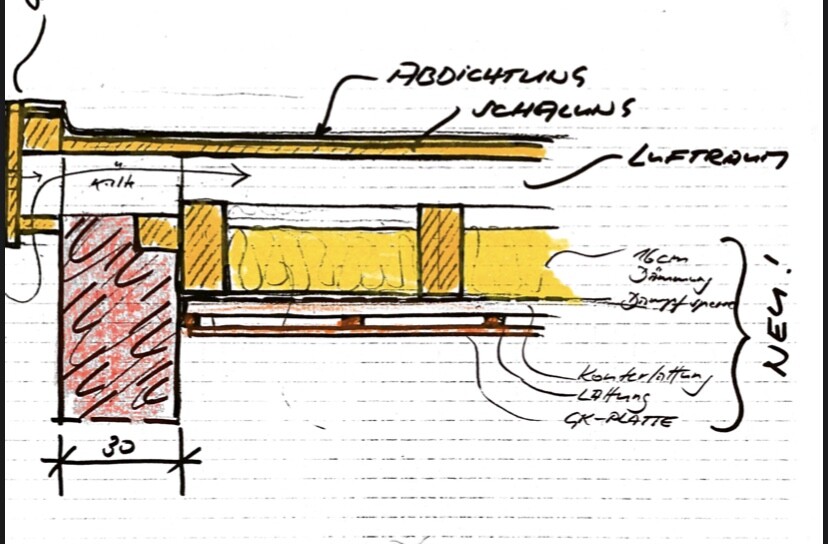
Regarding the roof: cross-section drawing is attached.
Looking forward to more input!
In other words, we don’t need a top-of-the-line result, but we want to live in a future-oriented, modern way.
It seems you’re not very enthusiastic about the calcium silicate boards. You mentioned that exterior insulation only provides “a little energy savings.” I thought it was basically “the” method for becoming more energy efficient, and that interior insulation can never achieve what exterior insulation makes possible. If it’s only “a little,” then maybe it could be left out considering our goals...
Regarding the roof: cross-section drawing is attached.
Looking forward to more input!
N
nordanney17 Aug 2020 06:51Labmann schrieb:
They don’t seem very enthusiastic about the calcium silicate boards,That is always the last option, since interior insulation a) always requires very careful calculation, b) needs very precise installation, c) reduces living space, and d) costs several times more per square meter (€) compared to exterior insulation. It is mostly used only in cases of moisture problems inside the building or for houses where exterior insulation is not possible (e.g., due to building permit / planning permission restrictions or historic preservation).Labmann schrieb:
You mention “only a little energy savings” with exterior insulation. I thought it was basically “the” method to become more energy-efficient, and interior insulation can never achieve what exterior insulation can.Interior insulation can be just as effective as exterior insulation. However, when budget is limited, it is usually not the preferred option. The cost-effectiveness is much better with measures like upgrading windows, insulating basement ceilings, and insulating the top floor ceiling. The exact savings have to be calculated, but energy renovations generally start with the measures I mentioned, not with exterior insulation.I cannot judge what difference 16cm (6 inches) of insulation in the roof makes, as it depends on the material used (thermal conductivity value, WLG).
Definitely consult an energy consultant (which is supported by KfW funding) and not only the builder (whose assessment often focuses on the property). This way, you can also receive financial support, making the renovation more attractive.
Similar topics