
ᐅ Exotic combination: wood pellets plus exhaust air heat pump?
Created on: 31 Jul 2020 21:44
R
RockyFranco
Hello,
First of all, thank you for providing a platform for questions like this.
I have the following issue that I’m trying to solve and hope to get some tips from the experts here.
I’m interested in a house but haven’t bought it yet.
- Viebrockhaus, so-called 3-liter house, haha. Built in 2000
- Very good quality in terms of bathrooms, floors, and materials
- Two upper floors totaling 200sqm (2,150 sq ft) with a mansard roof and a fully finished basement including an office of about 90sqm (970 sq ft)
- Now here’s the thing, hold on to your hats: the electricity bills are easily around 400€ per month, and depending on the year they use between 10,000–12,000 kWh annually. All electric, mind you. For two people!
- Radiators throughout the house. No underfloor heating! Two fireplaces, but their chimneys are located exactly opposite the technical room. They do have flaps to the hallway as well.
- Heating system: 2 x exhaust air heat pumps, Nibe Fighter 600 or 610, for the living area and one Nibe Fighter 315 for the basement/office.
- Central exhaust ventilation system from relevant rooms, with decentralized air supply openings in every room.
Clearly, the system is so inefficient that it probably runs on electric heating cartridges 90% of the time. Plus, the ventilation has to be on; otherwise, there is no efficiency at all.
I want to reduce these high costs. I’ve read that you can tweak the system with timers and turning ventilation mostly off, or trick the temperature sensors, etc. But I think all that is neither effective nor practical.
IDEA:
- Since there is LOTS of space in the technical room in the basement, including a large storage area, I’m considering installing a suitable wood pellet boiler. The chimney draft is external. The appearance doesn’t bother me.
- Combined with a modern exhaust air heat pump like the Nibe F135, which would only run occasionally.
To keep the ventilation going—I’m afraid of mold otherwise—the house was very dry and didn’t feel stuffy.
The viewing was on a 35°C (95°F) day, so it was blazing hot inside, obviously because warm air is drawn in.
What do you think about this, or is it nonsense? Would solar thermal for hot water be better? I have also thought about keeping the old Nibe just to run the ventilation function. What I don’t want is to break up 200sqm (2,150 sq ft) of flooring to install underfloor heating.
That rules out oil/gas/air-source/geothermal heat pumps.
I have also considered photovoltaic panels to cover the huge electricity costs, but that would be like casting pearls before swine and still wouldn’t be enough.
Maybe someone here has another tip.
THANK YOU VERY MUCH!
Frank
First of all, thank you for providing a platform for questions like this.
I have the following issue that I’m trying to solve and hope to get some tips from the experts here.
I’m interested in a house but haven’t bought it yet.
- Viebrockhaus, so-called 3-liter house, haha. Built in 2000
- Very good quality in terms of bathrooms, floors, and materials
- Two upper floors totaling 200sqm (2,150 sq ft) with a mansard roof and a fully finished basement including an office of about 90sqm (970 sq ft)
- Now here’s the thing, hold on to your hats: the electricity bills are easily around 400€ per month, and depending on the year they use between 10,000–12,000 kWh annually. All electric, mind you. For two people!
- Radiators throughout the house. No underfloor heating! Two fireplaces, but their chimneys are located exactly opposite the technical room. They do have flaps to the hallway as well.
- Heating system: 2 x exhaust air heat pumps, Nibe Fighter 600 or 610, for the living area and one Nibe Fighter 315 for the basement/office.
- Central exhaust ventilation system from relevant rooms, with decentralized air supply openings in every room.
Clearly, the system is so inefficient that it probably runs on electric heating cartridges 90% of the time. Plus, the ventilation has to be on; otherwise, there is no efficiency at all.
I want to reduce these high costs. I’ve read that you can tweak the system with timers and turning ventilation mostly off, or trick the temperature sensors, etc. But I think all that is neither effective nor practical.
IDEA:
- Since there is LOTS of space in the technical room in the basement, including a large storage area, I’m considering installing a suitable wood pellet boiler. The chimney draft is external. The appearance doesn’t bother me.
- Combined with a modern exhaust air heat pump like the Nibe F135, which would only run occasionally.
To keep the ventilation going—I’m afraid of mold otherwise—the house was very dry and didn’t feel stuffy.
The viewing was on a 35°C (95°F) day, so it was blazing hot inside, obviously because warm air is drawn in.
What do you think about this, or is it nonsense? Would solar thermal for hot water be better? I have also thought about keeping the old Nibe just to run the ventilation function. What I don’t want is to break up 200sqm (2,150 sq ft) of flooring to install underfloor heating.
That rules out oil/gas/air-source/geothermal heat pumps.
I have also considered photovoltaic panels to cover the huge electricity costs, but that would be like casting pearls before swine and still wouldn’t be enough.
Maybe someone here has another tip.
THANK YOU VERY MUCH!
Frank

RockyFranco schrieb:
[...] Is a Viebrockhaus a type of solid prefabricated house? Like segments on the lower floor? My focus is on the upper floor, reportedly timber frame construction with brick cladding on the outside. The roof structure, exterior, and interior all look very high quality. I’ve rarely seen such good condition for a building of this age.
The only issue is that there is almost no information about the wall construction online, hardly any photos. How thick is the brick cladding, how thick is the insulation? (Any harmful substances?!) What about the interior paneling? Nearby, in 2019, a one-and-a-half-story house was built with Viebrockhaus – the ground floor inner layer is made of aerated concrete blocks, followed by insulation, then an outer layer of brick. The upper floor, roof, and dormer are wood construction, partly brick-clad. Inside, only a few walls (utility room) are masonry; most are drywall partitions. They apparently delivered clean workmanship, and it makes a good impression. Considering the many wood and drywall components, there seems to be quite a fuss around the celebrated "solid" construction method.
R
RockyFranco2 Aug 2020 23:20calculated by the planner back then.
heat transfer area 230 sqm (2475 sq ft) volume 222 km (138 miles)
annual heating energy demand 4015 kWh/year
calculated insulation attached
actually billed in electricity_heat (i.e., heating + hot water)
basement with 70 sqm (750 sq ft) uses 3000 kWh
living area with 200 sqm (2150 sq ft) uses 10,100 kWh
enormous.
ok, we actually don’t want to heat the basement anymore. At most, run the ventilation system there, should be feasible with a timer switch.
residential ventilation likewise with a timer or manually activated if bathroom is damp or wet. Otherwise off.
then gas + solar thermal for hot water is probably cheapest
or wood pellet + solar thermal for hot water
or ground source heat pump + solar thermal for hot water
the main thing is I don’t want mold in the house.
I think in 20-25 years the three kids will have moved out. The investment should be amortized after 20 years.
taking into account current subsidies and rising electricity prices, maybe even sooner
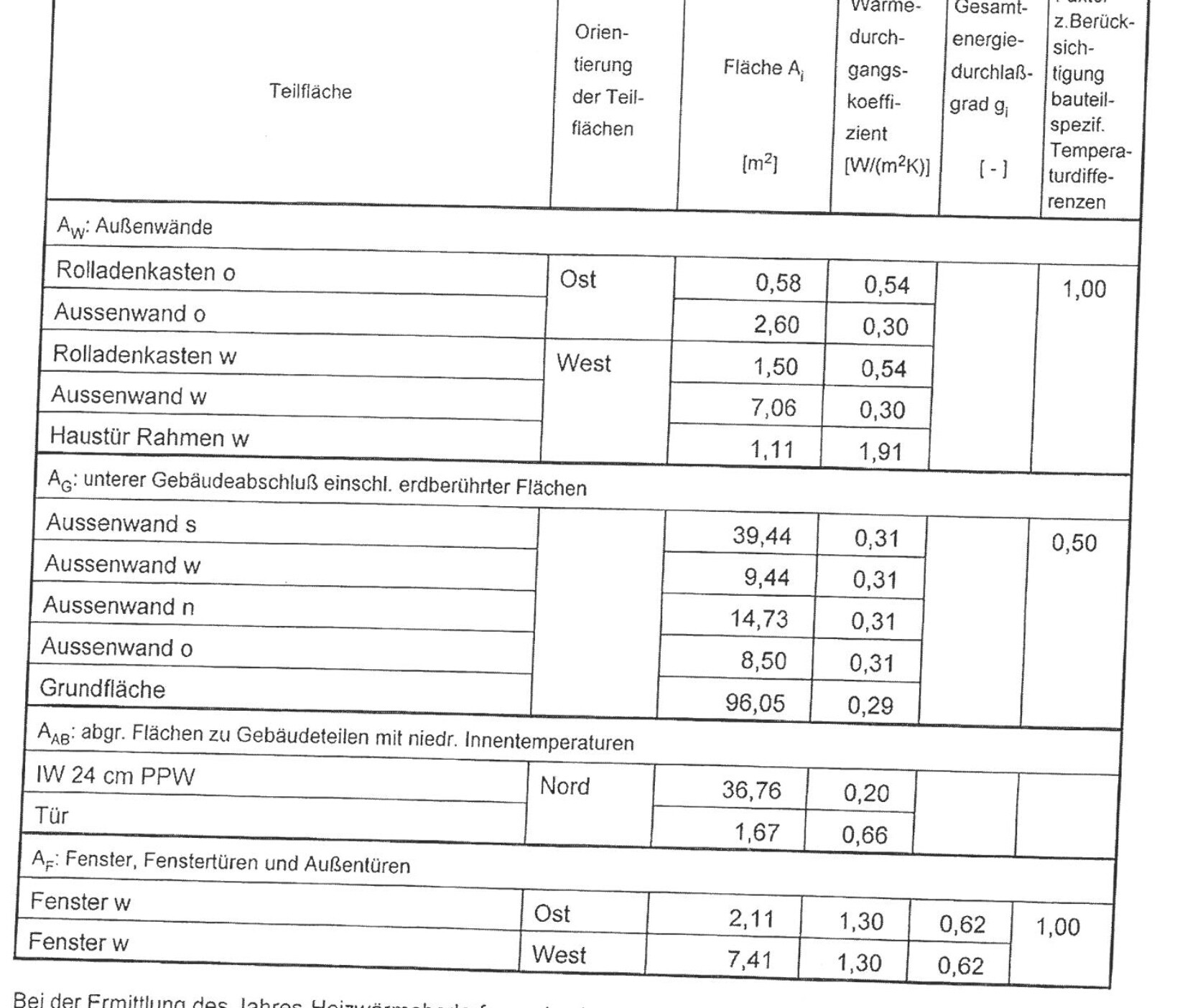
heat transfer area 230 sqm (2475 sq ft) volume 222 km (138 miles)
annual heating energy demand 4015 kWh/year
calculated insulation attached
actually billed in electricity_heat (i.e., heating + hot water)
basement with 70 sqm (750 sq ft) uses 3000 kWh
living area with 200 sqm (2150 sq ft) uses 10,100 kWh
enormous.
ok, we actually don’t want to heat the basement anymore. At most, run the ventilation system there, should be feasible with a timer switch.
residential ventilation likewise with a timer or manually activated if bathroom is damp or wet. Otherwise off.
then gas + solar thermal for hot water is probably cheapest
or wood pellet + solar thermal for hot water
or ground source heat pump + solar thermal for hot water
the main thing is I don’t want mold in the house.
I think in 20-25 years the three kids will have moved out. The investment should be amortized after 20 years.
taking into account current subsidies and rising electricity prices, maybe even sooner
T
T_im_Norden3 Aug 2020 06:45This is a bit too specific for me now. I would suggest posting your questions in the other forum marked in red to get some help there.
Are the values the pure electricity consumption of the system?
Are the values the pure electricity consumption of the system?
RockyFranco schrieb:
Actual consumption calculated for electricity and heat (i.e., heating and hot water)
Basement with 70 m² (750 sq ft) using 3000 kWh
Living area with 200 m² (2150 sq ft) using 10,100 kWhOh dear, even with a new heating system, the heating costs will be high.
Perhaps better insulation could be achieved through insulating the attic floor or other measures to reduce energy demand.
T
T_im_Norden3 Aug 2020 08:03The high costs are likely due to the concept of exhaust air heat recovery and the associated supply air openings for all rooms in the external walls. This usually works with passive houses but not with a "3-liter" house, which probably corresponds more to a KfW 70 standard.
Tassimat schrieb:
Oh dear, even with a new heating system, high heating costs will occur.
Maybe better insulation could be achieved through attic floor insulation or other measures to reduce energy demand.Honestly, I don’t see that here. The annual energy demand of 13,000 kWh is actually very low and comparable to new build standards.
Similar topics