
I am currently focusing a lot on kitchen planning.
I am considering an integrated automatic coffee machine.
Do you have one, and would you choose it again?
Can you recommend a specific model or share tips on what to look out for?
And the most important question: how is maintenance and cleaning handled?
For example, does it need to be removed once a year for servicing?
I am considering an integrated automatic coffee machine.
Do you have one, and would you choose it again?
Can you recommend a specific model or share tips on what to look out for?
And the most important question: how is maintenance and cleaning handled?
For example, does it need to be removed once a year for servicing?

hampshire schrieb:
It has to stay warm Does it have to stay warm for you specifically, or is it common practice to keep the machine turned on?
I'm also considering switching from a super-automatic machine to an espresso machine with a portafilter, but I’m worried that making coffee will become too time-consuming.
Pinky0301 schrieb:
Does it need to stay warm for you, or is it common to keep the machine switched on?
I’m also considering switching from a fully automatic machine to an espresso machine, but I’m worried that making coffee might become too time-consuming. Most machines take about 10 minutes to reach the right temperature.
In our case, the machine is connected to a timer switch and turns on automatically in the morning.
It depends on the machine.
There are small machines that have a relatively short heat-up time, usually single-boiler systems. The downside is that you can’t prepare espresso and milk foam at the same time.
My Rocket has a dual-boiler system with an E61 group head. It often takes 30 to 40 minutes for everything to really reach the correct temperature.
These machines are actually designed for continuous use. I also removed the jumper for the standby automatic function because I got fed up with it shutting off after 1.5 hours.
Regarding all the mess: I got a funnel from Tidaka that I place on the portafilter before grinding. This way, almost no coffee grounds spill around.
For me, the portafilter espresso machine is a good fit. I especially don’t understand the extra effort in cleaning compared to a fully automatic machine. I rinse the portafilter after each use, clean the shower screen, and occasionally wipe it with a cloth. This routine has become so natural that it just flows easily.
Looking back at the cleaning routines with our old fully automatic coffee machine, this is really quite manageable. The big advantage of a portafilter machine is that no coffee grounds or oils remain inside the machine itself, which prevents mold problems from occurring. Additionally, there are cleaning intervals for both the machine and the grinder.
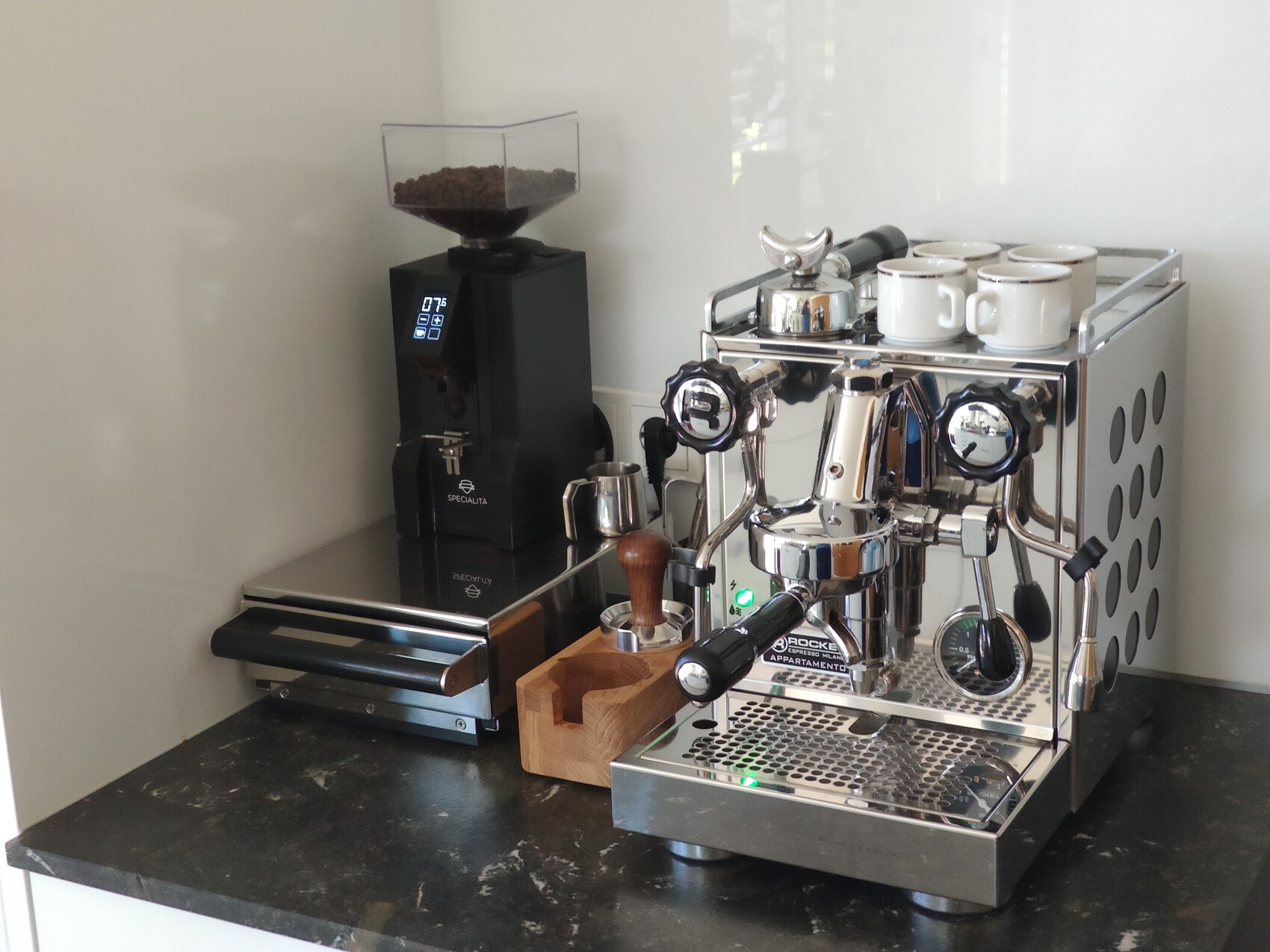
There are small machines that have a relatively short heat-up time, usually single-boiler systems. The downside is that you can’t prepare espresso and milk foam at the same time.
My Rocket has a dual-boiler system with an E61 group head. It often takes 30 to 40 minutes for everything to really reach the correct temperature.
These machines are actually designed for continuous use. I also removed the jumper for the standby automatic function because I got fed up with it shutting off after 1.5 hours.
Regarding all the mess: I got a funnel from Tidaka that I place on the portafilter before grinding. This way, almost no coffee grounds spill around.
For me, the portafilter espresso machine is a good fit. I especially don’t understand the extra effort in cleaning compared to a fully automatic machine. I rinse the portafilter after each use, clean the shower screen, and occasionally wipe it with a cloth. This routine has become so natural that it just flows easily.
Looking back at the cleaning routines with our old fully automatic coffee machine, this is really quite manageable. The big advantage of a portafilter machine is that no coffee grounds or oils remain inside the machine itself, which prevents mold problems from occurring. Additionally, there are cleaning intervals for both the machine and the grinder.
K
knalltüte30 Jul 2020 08:31my approach: every 5 years or so, I buy a refurbished machine in better condition (this has worked well for about 25 years!). At the office, we now have a fairly high turnover. At home, I usually had a similar or the same machine, which is currently broken (and I don’t need one at the moment). But as usual, I would buy a machine like that again. I prefer machines that are often around 15 years old the most.
This one was a real eye-catcher, so I couldn’t say no. It also simply matched our office fridge (a red Bosch retro-style fridge).
(I have finally found a local dealer who repairs the machines — a retiree who has the time and enjoys doing it)
The cleaning effort each week is about 15 minutes (we only have real coffee drinkers here, no mixed drinks = no milk!)
In my opinion, an integrated automatic machine is only suitable for "clean" kitchens. That can work, but it doesn’t make it better or cheaper — it certainly comes with all the disadvantages mentioned before: higher cost, less variety meaning you can’t buy the better machines, and cleaning effort.
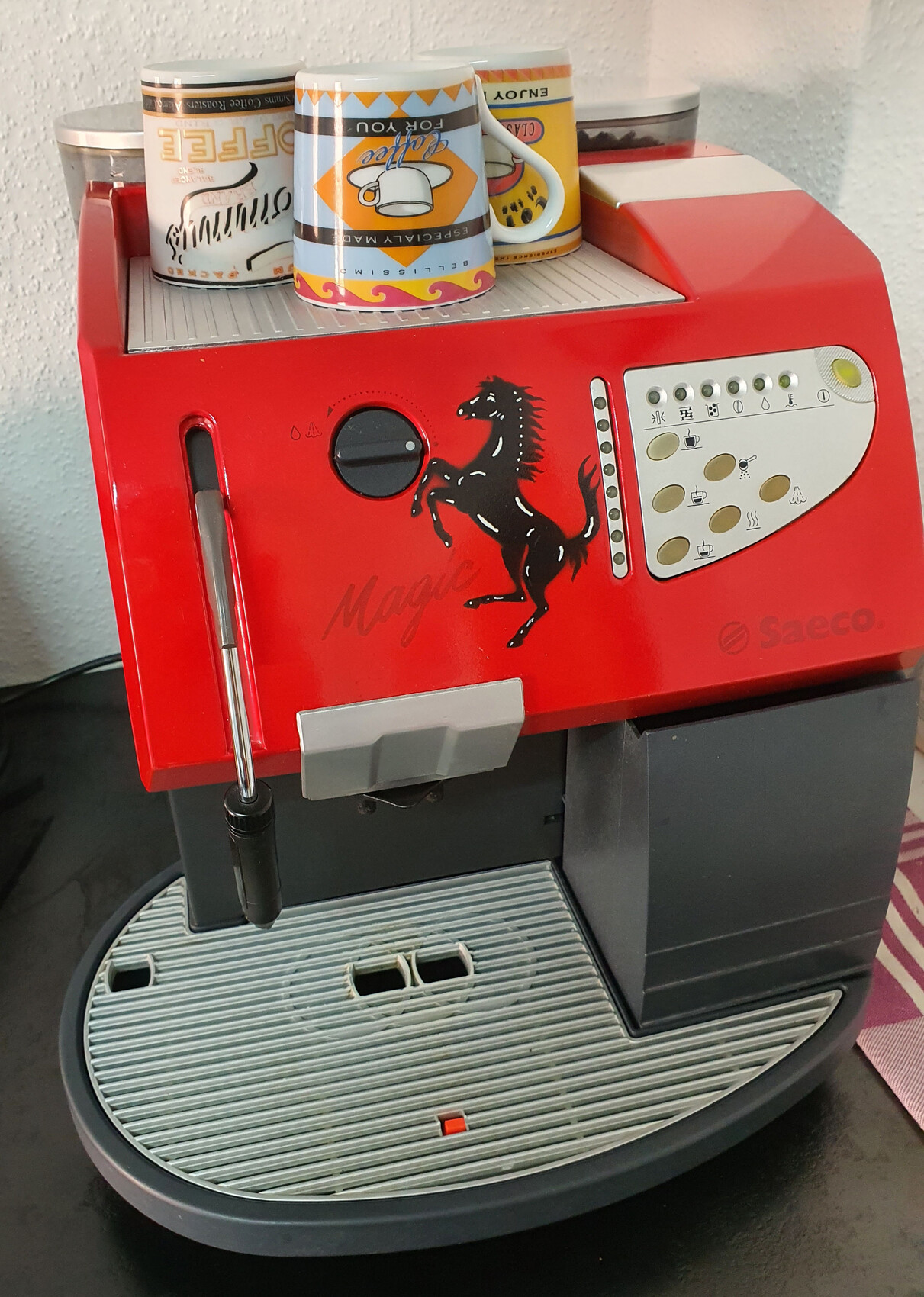
This one was a real eye-catcher, so I couldn’t say no. It also simply matched our office fridge (a red Bosch retro-style fridge).
(I have finally found a local dealer who repairs the machines — a retiree who has the time and enjoys doing it)
The cleaning effort each week is about 15 minutes (we only have real coffee drinkers here, no mixed drinks = no milk!)
In my opinion, an integrated automatic machine is only suitable for "clean" kitchens. That can work, but it doesn’t make it better or cheaper — it certainly comes with all the disadvantages mentioned before: higher cost, less variety meaning you can’t buy the better machines, and cleaning effort.
We have a Gaggenau built-in appliance installed in a tall cabinet. I really like it. Since we don’t have much countertop space anyway, that was the main reason for choosing a built-in unit.
Spare parts and construction are similar to Siemens appliances. For cleaning and refilling, the appliance is pulled out using a drawer. Prices are actually quite high—about three times those of otherwise identical freestanding machines, but this applies to all manufacturers. Production volumes are much smaller, and customers are willing to pay a premium, so this is taken advantage of.
As an alternative, like with my parents, the appliance can be installed in a tall cabinet, hidden behind a roller shutter. Another option is a lift fitting for wall cabinets (front panel folds up). This way, the more affordable freestanding machines fit in, while maintaining a tidy look without taking up countertop space.
Spare parts and construction are similar to Siemens appliances. For cleaning and refilling, the appliance is pulled out using a drawer. Prices are actually quite high—about three times those of otherwise identical freestanding machines, but this applies to all manufacturers. Production volumes are much smaller, and customers are willing to pay a premium, so this is taken advantage of.
As an alternative, like with my parents, the appliance can be installed in a tall cabinet, hidden behind a roller shutter. Another option is a lift fitting for wall cabinets (front panel folds up). This way, the more affordable freestanding machines fit in, while maintaining a tidy look without taking up countertop space.
C
chand198630 Jul 2020 09:13I would suggest that for those who prefer black coffee, a manual filter brewer is sufficient, and the combination of bean, grind size, and water here provides an enjoyable experience at a low cost. And it still tastes good even after two hours in a thermos.
*duckandrun*
No, actually it would have to be a machine, and for the best taste, an espresso machine with a portafilter.
*duckandrun*
No, actually it would have to be a machine, and for the best taste, an espresso machine with a portafilter.
Similar topics