
Hello everyone,
we recently received the first draft of our house from the architect and would appreciate any optimizations, suggestions, and opinions. Overall, the design already matches our ideas quite well. But first, here is the completed questionnaire.
Development Plan / Restrictions
Plot size 856 sqm (already owned/purchased)
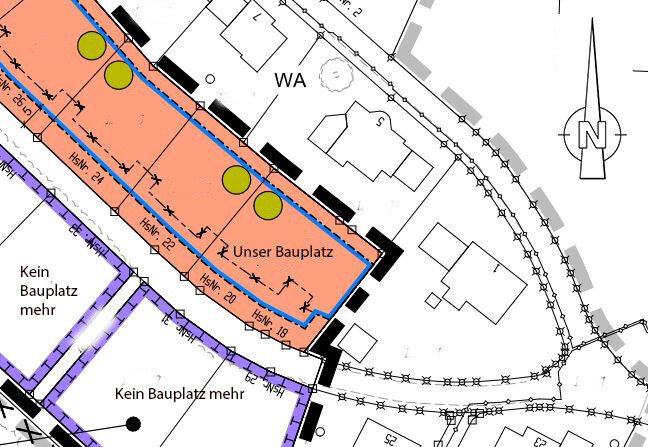
Slope Yes, rising from southwest to northeast. On the west side the slope is about 8 m (26 ft) over 30 m (98 ft), on the east side about 6 m (20 ft) over 30 m (98 ft). Unfortunately, the street slopes downward.
Site coverage ratio 0.35
Floor area ratio 0.7
Building envelope, building line and boundary Marked in the development plan (blue line)
Setback distances According to Art. 6 BayBO
Number of parking spaces 2
Number of storeys 2
Roof type No requirements/restrictions
Architectural style No requirements/restrictions
Orientation Street facing southwest
Maximum heights/limits Maximum ridge height of 9 m (30 ft) above upper edge [OK]
Other requirements
Client Requirements
Architectural style, roof type, building type Modern, flat roof or single-pitch roof
Basement, storeys No basement, two full storeys
Number of occupants, ages Currently 2; man 31, woman 28. Children planned
Space requirement on ground floor and upper floor About 180 sqm (1938 sq ft) of living space intended. No fixed division between basement/ground floor (practical layout)
Office: family use or home office? Home office
Guest bedrooms per year Not relevant
Open or closed layout Open
Conservative or modern construction Modern
Open kitchen, kitchen island Open, with kitchen island
Number of dining seats 6–8
Fireplace Yes
Music/sound wall Not necessary
Balcony, roof terrace Large terrace
Garage, carport Double garage
Utility garden, greenhouse Not necessary
Other wishes/special features/daily routine, also explanations why something should or should not be included
House design
Designed by:
- Architect
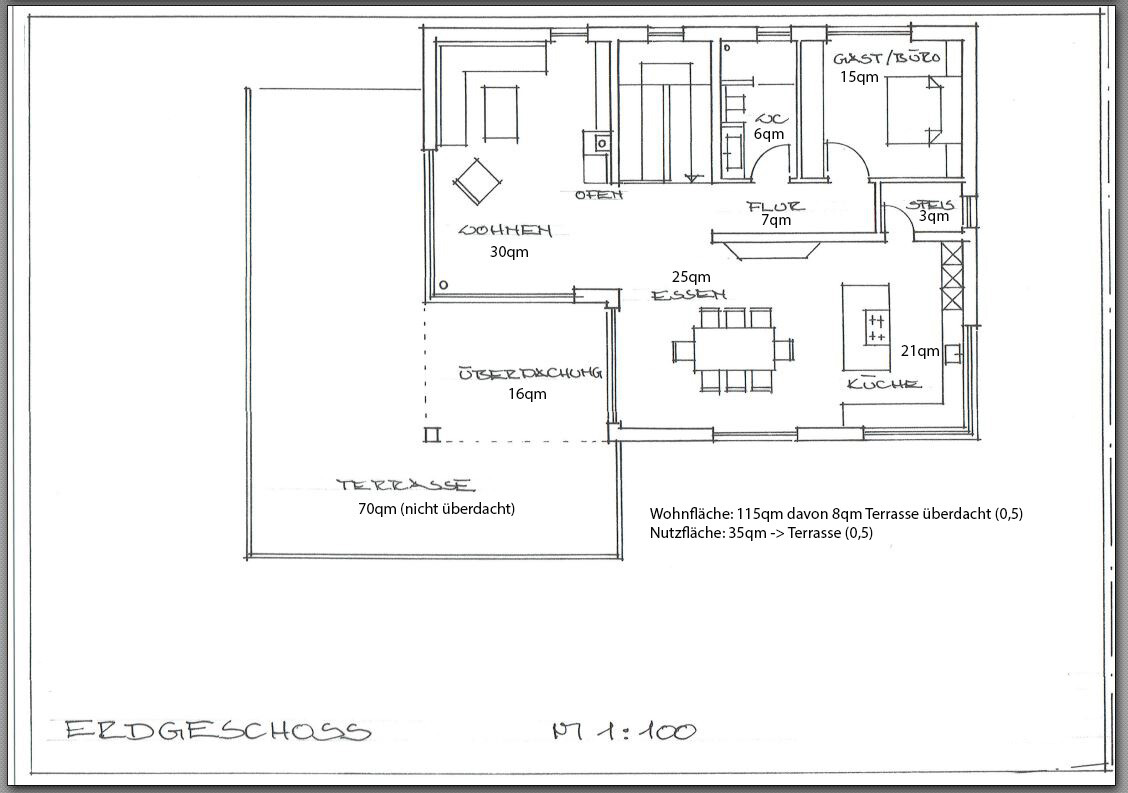
What do you particularly like? Why? Open living/dining area and open kitchen with island, large partly covered terrace (maybe a bit too big), large floor-to-ceiling windows facing south
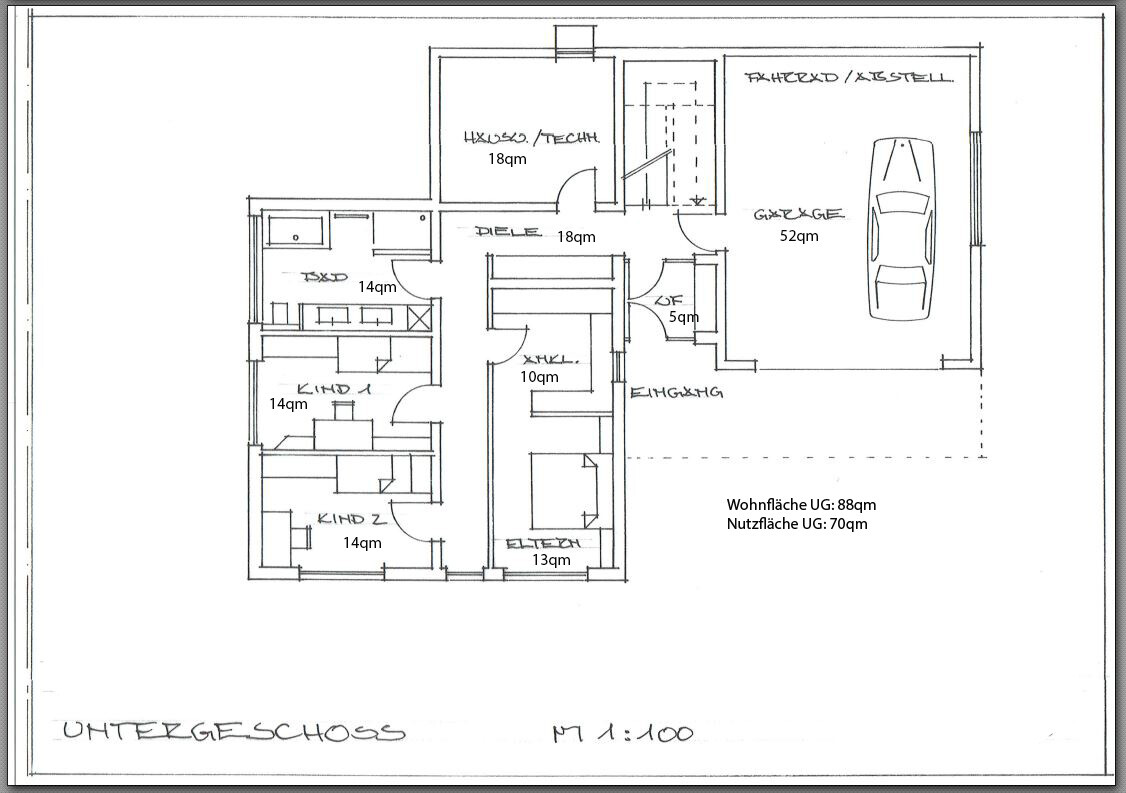
What don’t you like? Why? Slightly too large and costs too high. Long corridor in the basement ("tube-like"). Children’s rooms possibly a bit small. WC on ground floor somewhat small.
Price estimate according to architect/planner: €470,000 excluding additional building costs and land
Personal price ceiling for the house, including fittings: about €500,000–550,000
Preferred heating system: Air-to-water heat pump with underfloor heating
If you had to give up something, which details/expansions
– could you give up: Change from flat roof to single-pitch roof -> saves about €10,000? Smaller living area
– could you not give up: Large terrace, open and modern style, walk-in closet
Why does the design look like it does now? Fritsch
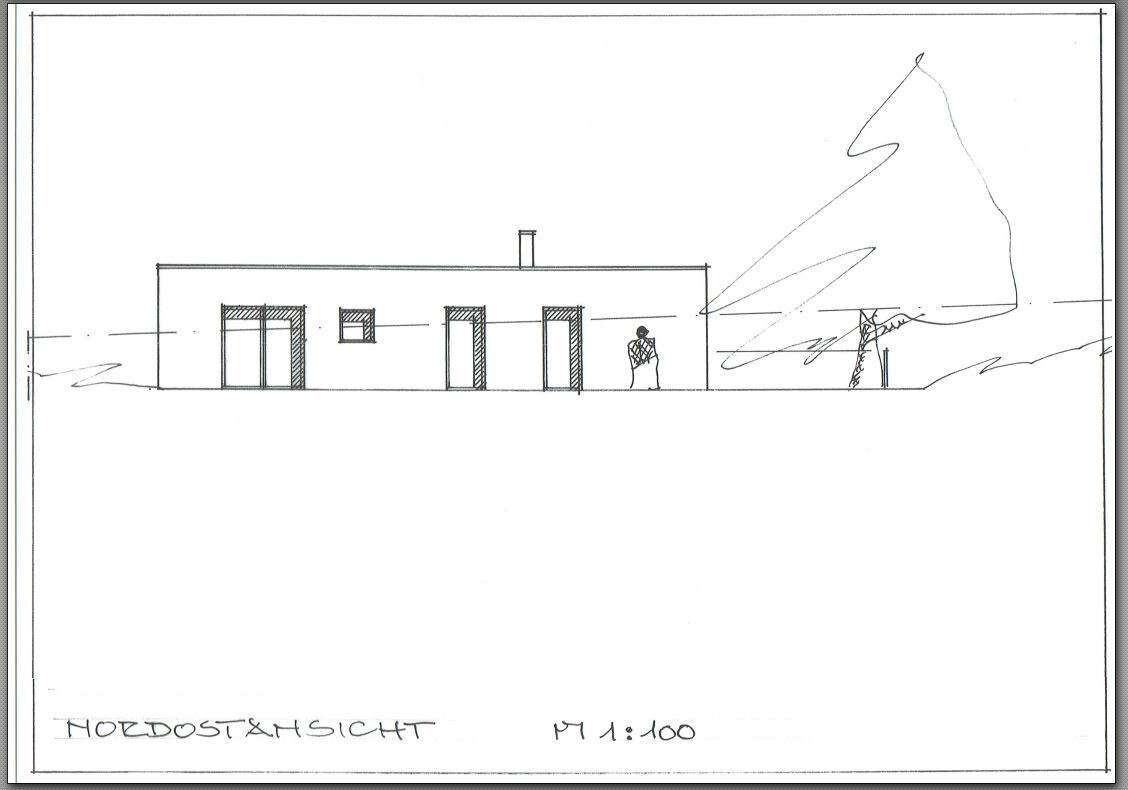
The architect implemented the requirements well based on images. The modern style, large windows, large terrace, and the ground floor overhang above the basement creating a covered entrance area are all liked.
What is the most important/basic question about the floor plan in 130 characters?
Thank you in advance for your support.
Have a nice evening.
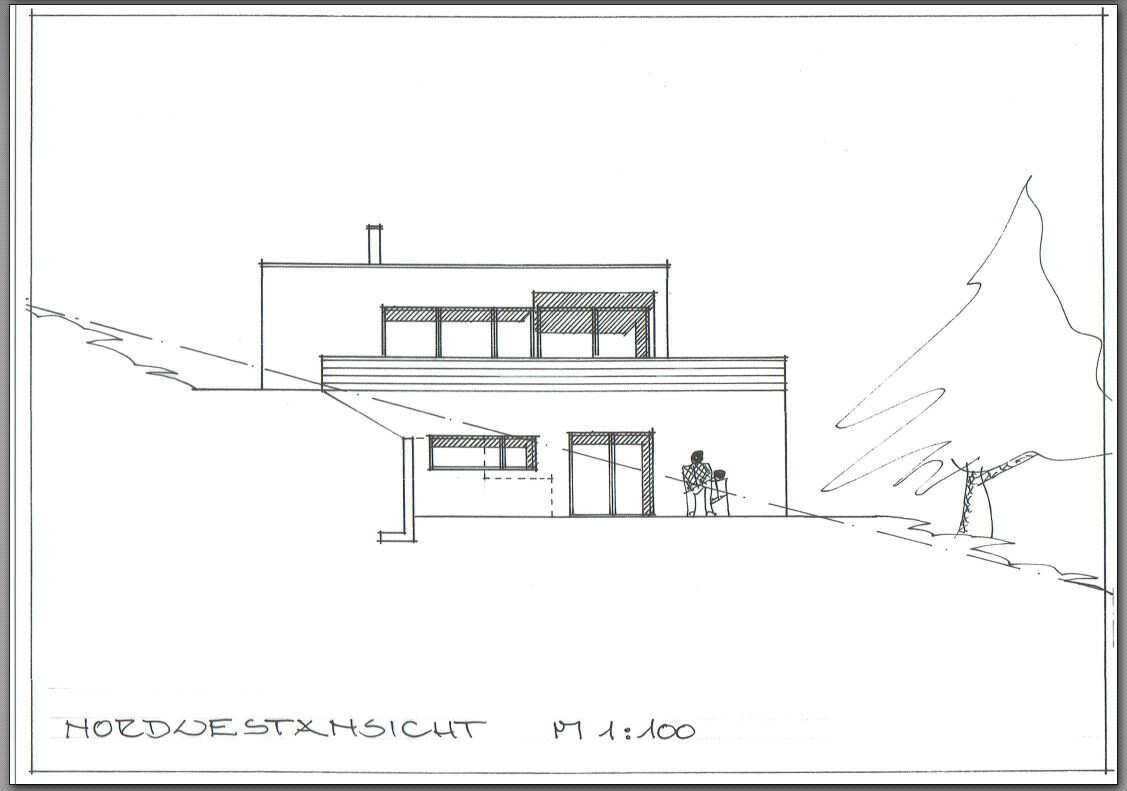
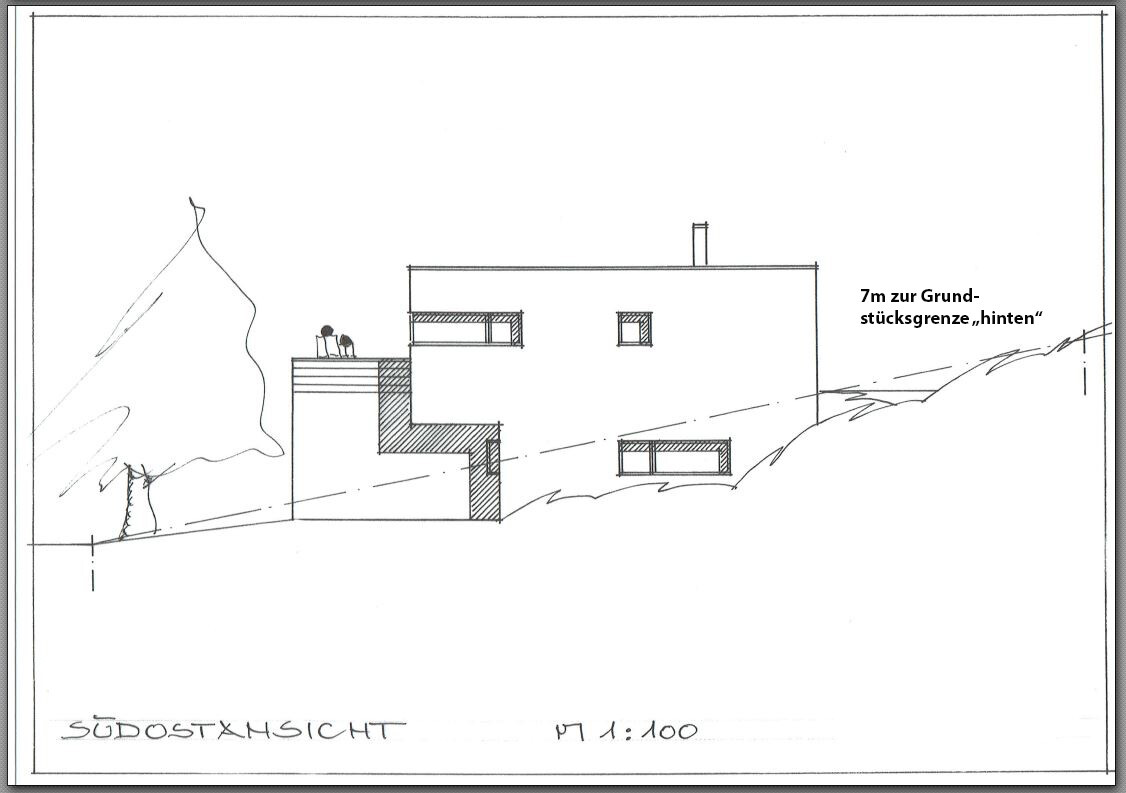
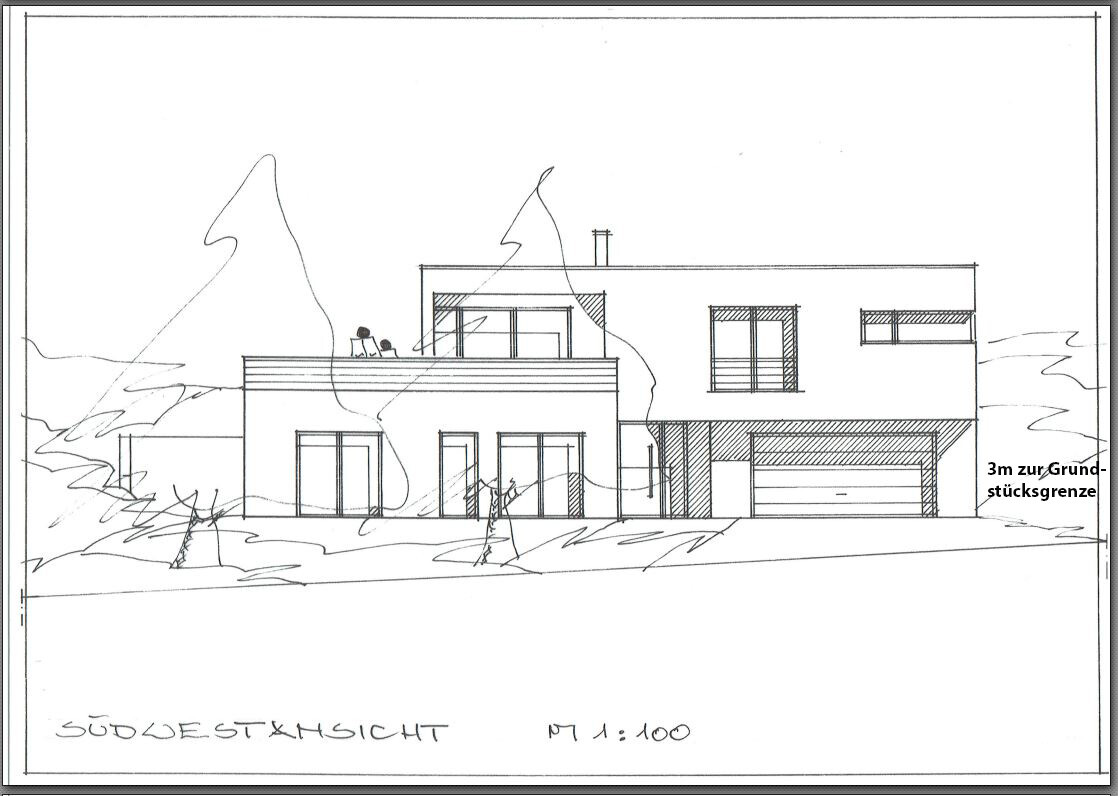
we recently received the first draft of our house from the architect and would appreciate any optimizations, suggestions, and opinions. Overall, the design already matches our ideas quite well. But first, here is the completed questionnaire.
Development Plan / Restrictions
Plot size 856 sqm (already owned/purchased)
Slope Yes, rising from southwest to northeast. On the west side the slope is about 8 m (26 ft) over 30 m (98 ft), on the east side about 6 m (20 ft) over 30 m (98 ft). Unfortunately, the street slopes downward.
Site coverage ratio 0.35
Floor area ratio 0.7
Building envelope, building line and boundary Marked in the development plan (blue line)
Setback distances According to Art. 6 BayBO
Number of parking spaces 2
Number of storeys 2
Roof type No requirements/restrictions
Architectural style No requirements/restrictions
Orientation Street facing southwest
Maximum heights/limits Maximum ridge height of 9 m (30 ft) above upper edge [OK]
Other requirements
Client Requirements
Architectural style, roof type, building type Modern, flat roof or single-pitch roof
Basement, storeys No basement, two full storeys
Number of occupants, ages Currently 2; man 31, woman 28. Children planned
Space requirement on ground floor and upper floor About 180 sqm (1938 sq ft) of living space intended. No fixed division between basement/ground floor (practical layout)
Office: family use or home office? Home office
Guest bedrooms per year Not relevant
Open or closed layout Open
Conservative or modern construction Modern
Open kitchen, kitchen island Open, with kitchen island
Number of dining seats 6–8
Fireplace Yes
Music/sound wall Not necessary
Balcony, roof terrace Large terrace
Garage, carport Double garage
Utility garden, greenhouse Not necessary
Other wishes/special features/daily routine, also explanations why something should or should not be included
House design
Designed by:
- Architect
What do you particularly like? Why? Open living/dining area and open kitchen with island, large partly covered terrace (maybe a bit too big), large floor-to-ceiling windows facing south
What don’t you like? Why? Slightly too large and costs too high. Long corridor in the basement ("tube-like"). Children’s rooms possibly a bit small. WC on ground floor somewhat small.
Price estimate according to architect/planner: €470,000 excluding additional building costs and land
Personal price ceiling for the house, including fittings: about €500,000–550,000
Preferred heating system: Air-to-water heat pump with underfloor heating
If you had to give up something, which details/expansions
– could you give up: Change from flat roof to single-pitch roof -> saves about €10,000? Smaller living area
– could you not give up: Large terrace, open and modern style, walk-in closet
Why does the design look like it does now? Fritsch
The architect implemented the requirements well based on images. The modern style, large windows, large terrace, and the ground floor overhang above the basement creating a covered entrance area are all liked.
What is the most important/basic question about the floor plan in 130 characters?
- How can we reduce the floor plan size? The architect suggests only minor changes at the front on the ground floor to keep proportions.
- We are also considering swapping the bedroom with the office and keeping the children’s rooms in the basement for later peace from partying teenagers. Or placing the bedroom and another room on the ground floor for early years with children nearby and swapping with the office later. Or leaving it as is and maybe swapping bedroom and office later.
- Does anyone have experience with terraces above living rooms? Are they watertight? We are considering having the terrace slightly overlap the ground floor as a roof—would that be too dark?
- Any suggestions for changing the basement corridor? It would be nice to have a side exit at the end of the corridor.
- Any other general optimization suggestions? What do you dislike or do differently?
Thank you in advance for your support.
Have a nice evening.

I’m not sure whether this should be expressed in watts, kelvin, or joules, but basically, each degree kelvin can be considered almost equivalent. In other words, the greater the temperature difference between the installation room and the inside of the cabinet, the more energy is required to maintain it. This energy, in turn, warms up the installation room and everything in it. It doesn’t really affect things like pasta bags, vacuum cleaner bags, or returnable bottles. For typical pantry foods, it’s actually the constant temperature that matters more than the absolute temperature. That is then the real issue: that the device amplifies temperature fluctuations.
https://www.instagram.com/11antgmxde/
https://www.linkedin.com/company/bauen-jetzt/
https://www.instagram.com/11antgmxde/
https://www.linkedin.com/company/bauen-jetzt/

11ant schrieb:
This means that the greater the temperature difference between the installation room and the inside of the cabinet, the harder it is to maintain it.I visited two different "kitchen specialists," and both told me that refrigerators today are so well insulated that it doesn’t matter whether they are placed in direct sunlight or right next to the oven. Is that not practical in reality?
@Pinky0301 Yes, in that case you would need the pantry in the basement, and even there, a classic potato cellar with single-digit temperatures is probably no longer available.
Pinky0301 schrieb:
You have to let go of the idea that you can keep foods requiring cool temperatures fresh in a pantry in a modern house (for example, vegetables).A traditional pantry is not meant for foods that need to be kept cool, but rather for those that require stable conditions. The laws of physics still apply in houses built according to current energy-saving regulations. However, since the modern version of the pantry is mainly used differently (often as a storage space for bulk purchases) and placed differently (depending on what space is left rather than facing north), this change has effectively already taken place. annab377 schrieb:
I visited two different "kitchen houses" and both told me that refrigerators today are so well insulated that it doesn’t matter if they stand in the sun or right next to the oven. Is that not really true in practice?This is, like much half-knowledge from salespeople, simultaneously true and boldly misleading: yes, the insulation is good. But no, better insulation doesn’t simply mean the heat transfer is reduced proportionally — rather, it slows the transfer and causes it to be phase-shifted relative to fluctuations in the surrounding environment. Physics is still not something for simple-minded assumptions — though in this forum, many still imagine aerated concrete like a sumo wrestler that sound cannot get past.https://www.instagram.com/11antgmxde/
https://www.linkedin.com/company/bauen-jetzt/
I think a shed roof ruins the overall look and doesn’t match the rest.
If changes to the appearance are allowed, I would try to plan the garage under the terrace and living areas stacked above each other, without any offsets. I could imagine that this might result in similar cost savings as the shed roof and perhaps preserve the appearance a bit better.
The structural engineering can completely blow your budget. For us, the retaining wall/hillside house wall and foundation slab had to be designed very robustly, with a lot of reinforcement. In addition, the floor between the levels had to be much stronger. That was a five-figure expense.
The landscaping depends on what you want. You have an 8m (26 ft) height difference. That doesn’t disappear because of the house. Every level you add has to be supported. And 90cm (35 inches) here or 60cm (24 inches) there also adds up in costs.
If changes to the appearance are allowed, I would try to plan the garage under the terrace and living areas stacked above each other, without any offsets. I could imagine that this might result in similar cost savings as the shed roof and perhaps preserve the appearance a bit better.
The structural engineering can completely blow your budget. For us, the retaining wall/hillside house wall and foundation slab had to be designed very robustly, with a lot of reinforcement. In addition, the floor between the levels had to be much stronger. That was a five-figure expense.
The landscaping depends on what you want. You have an 8m (26 ft) height difference. That doesn’t disappear because of the house. Every level you add has to be supported. And 90cm (35 inches) here or 60cm (24 inches) there also adds up in costs.
haydee schrieb:
I think a mono-pitched roof ruins the look and doesn’t suit the rest.What kind exactly: equal slope steeper, equal, or less than the hill / facing uphill / downhill / or across the slope; single-pitched (mono-pitched) or double-pitched (broken gable, also called "mono-pitched")?https://www.instagram.com/11antgmxde/
https://www.linkedin.com/company/bauen-jetzt/
Similar topics