
ᐅ New Single-Family Home Built to KfW55 Standard – Which Heating System to Choose?
Created on: 19 Jul 2020 12:19
T
Traube348
Hello everyone,
I have read many articles and would now like to benefit from the extensive knowledge of the members here.
A brief overview of my building project:
- Single-family house with approximately 160sqm (1,722 sq ft) of living space
- No basement, 2 full floors with an unfinished attic
- Relatively large window areas and an open-plan design with a staircase in the living area
- Underfloor heating throughout the house with tile flooring
- KfW 55 standard with timber frame construction
- A wood-burning stove will be installed
Unfortunately, I have little experience in this area and rely on recommendations from others regarding heating.
On the ground floor, we have a utility room of 8sqm (86 sq ft) where we would like to accommodate all the technical equipment.
The builder recommends installing a central ventilation system, which we would like to do.
Now to my question:
There is a gas connection in our building area, and a friend told me we should definitely heat with a gas boiler. To meet the KfW standard, according to the energy consultant, we still need to install 9sqm (97 sq ft) of solar panels on the roof.
A heating engineer friend advises: choose an air-to-water heat pump – split system Weishaupt LS 8-BREK – so you can avoid the solar requirement.
I have requested quotes for both options from different heating engineers, and they come out roughly the same in price.
Since I have heard many statements opposing air-to-water heat pumps, I tend to prefer gas.
However, the main challenge is the limited space in the utility room. In addition to the heating system, the two-flue fireplace, and the ventilation system, the electrical control cabinet as well as the washing machine and dryer are also planned to be located there.
Is there anyone who has faced a similar space issue?
What would you recommend?
Thank you very much in advance for your help.
I have read many articles and would now like to benefit from the extensive knowledge of the members here.
A brief overview of my building project:
- Single-family house with approximately 160sqm (1,722 sq ft) of living space
- No basement, 2 full floors with an unfinished attic
- Relatively large window areas and an open-plan design with a staircase in the living area
- Underfloor heating throughout the house with tile flooring
- KfW 55 standard with timber frame construction
- A wood-burning stove will be installed
Unfortunately, I have little experience in this area and rely on recommendations from others regarding heating.
On the ground floor, we have a utility room of 8sqm (86 sq ft) where we would like to accommodate all the technical equipment.
The builder recommends installing a central ventilation system, which we would like to do.
Now to my question:
There is a gas connection in our building area, and a friend told me we should definitely heat with a gas boiler. To meet the KfW standard, according to the energy consultant, we still need to install 9sqm (97 sq ft) of solar panels on the roof.
A heating engineer friend advises: choose an air-to-water heat pump – split system Weishaupt LS 8-BREK – so you can avoid the solar requirement.
I have requested quotes for both options from different heating engineers, and they come out roughly the same in price.
Since I have heard many statements opposing air-to-water heat pumps, I tend to prefer gas.
However, the main challenge is the limited space in the utility room. In addition to the heating system, the two-flue fireplace, and the ventilation system, the electrical control cabinet as well as the washing machine and dryer are also planned to be located there.
Is there anyone who has faced a similar space issue?
What would you recommend?
Thank you very much in advance for your help.
N
nordanney23 Jul 2020 09:46Bookstar schrieb:
Annual average is rather 60 euros per month. That is now in the optimized state. Before handover from the builder, we were at an annual average of about 100 euros per month.Then your heating design is simply terrible. Sorry for the blunt words. The consumption is a complete disaster.
I currently have similar costs per square meter in my apartment from the 1960s with standard radiators.

Then there’s the bathtub size and whether a rain shower is installed. No joke, you notice everything—for example, if you have a 300-liter (79-gallon) buffer and your rain shower has a flow rate of 20 liters per minute (5.3 gallons per minute), you need to recharge the buffer twice a day. Or 4 people who each shower for 10 minutes every day.
The same applies to how the 24°C (75°F) in the bathroom is achieved—whether through pipe spacing or a higher flow temperature from the heat pump.
If your heating technician comes with basic settings, or if customer service only makes rough adjustments, you will notice it in your wallet.
That’s why it’s important to understand what really matters yourself.
For example, I have now reduced the circulation to a minimum; heat loss in the storage tank has dropped to about 6 degrees Celsius (11°F) over 12 hours. Previously, it was 6 degrees Celsius (11°F) in just 6 hours.
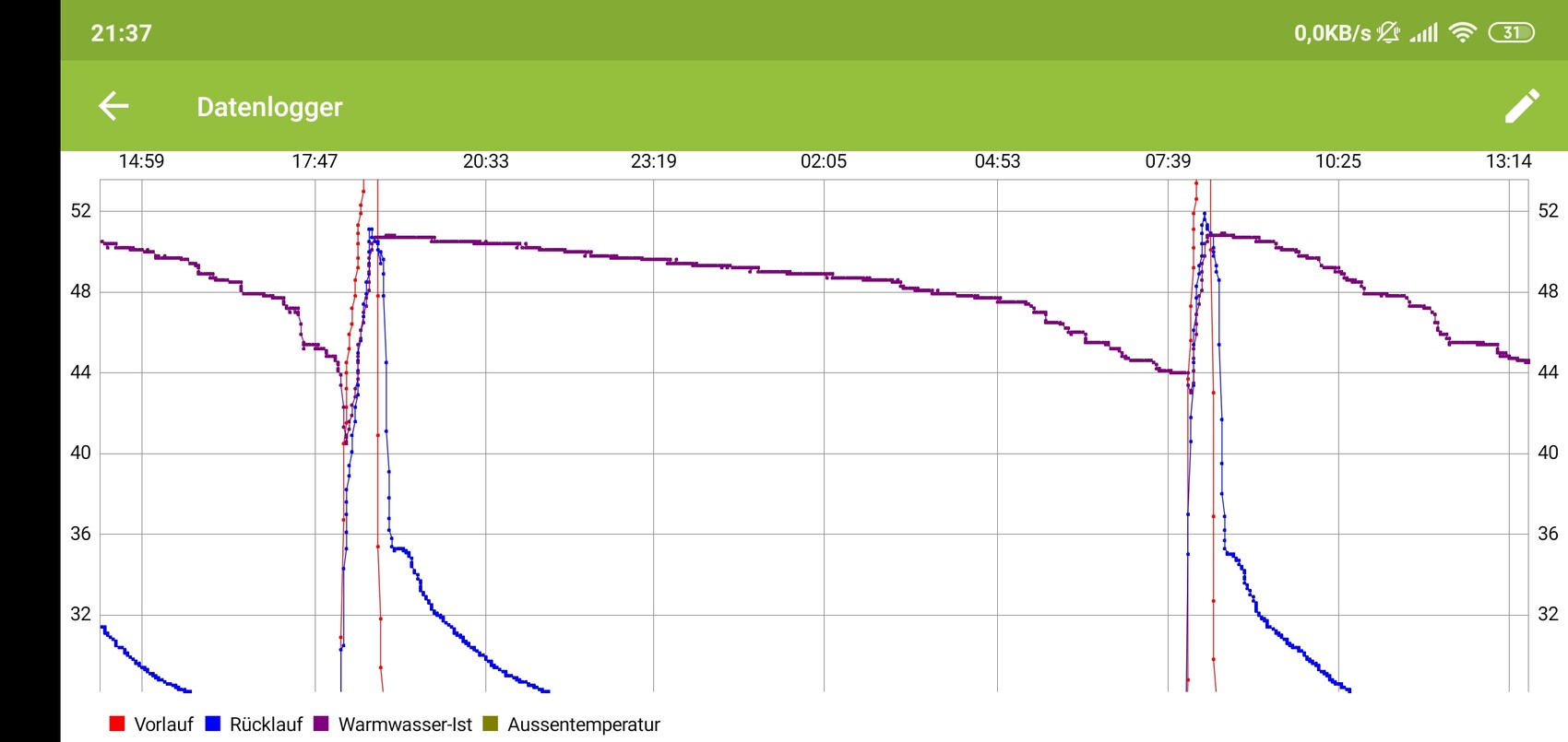
Especially with the help of this forum. But I think there is still more potential, though this is enough for now.
The same applies to how the 24°C (75°F) in the bathroom is achieved—whether through pipe spacing or a higher flow temperature from the heat pump.
If your heating technician comes with basic settings, or if customer service only makes rough adjustments, you will notice it in your wallet.
That’s why it’s important to understand what really matters yourself.
For example, I have now reduced the circulation to a minimum; heat loss in the storage tank has dropped to about 6 degrees Celsius (11°F) over 12 hours. Previously, it was 6 degrees Celsius (11°F) in just 6 hours.
Especially with the help of this forum. But I think there is still more potential, though this is enough for now.
nordanney schrieb:
Then your heating system design is simply terrible. Sorry for the harsh words.
The consumption is an absolute disaster.
I currently have similar costs per square meter in my 1960s apartment with standard radiators. He has over 180m2 (1,940 sq ft) and a basement, so please don’t compare it now to a 140m2 (1,510 sq ft) house—that was about 40 euros and completely normal.

@DaSch17
In addition to everything already mentioned, keep in mind that every extra degree of room temperature in winter directly impacts your wallet. Manufacturers usually provide consumption values only for the common standard temperatures of 19, 21, or 22°C (66, 70, or 72°F). Sorry, but that is not warm enough for everyone during winter. The supposed "savings" from turning down or not heating certain rooms actually have the opposite effect since the surrounding heated rooms then have to compensate and warm those unheated spaces as well (because it is a heated building envelope). For example, installing electric underfloor heating in bathrooms (in a non-passive house) is not a good idea unless there is also a conventional underfloor heating system underneath providing base heat.
Hot water consumption has already been mentioned. Here, every liter (0.26 gallons) counts. It is best to install as much heat recovery as possible in this area as well.
There is no doubt that heat pumps are a great technology—if the house, location, and user behavior are suitable.
In addition to everything already mentioned, keep in mind that every extra degree of room temperature in winter directly impacts your wallet. Manufacturers usually provide consumption values only for the common standard temperatures of 19, 21, or 22°C (66, 70, or 72°F). Sorry, but that is not warm enough for everyone during winter. The supposed "savings" from turning down or not heating certain rooms actually have the opposite effect since the surrounding heated rooms then have to compensate and warm those unheated spaces as well (because it is a heated building envelope). For example, installing electric underfloor heating in bathrooms (in a non-passive house) is not a good idea unless there is also a conventional underfloor heating system underneath providing base heat.
Hot water consumption has already been mentioned. Here, every liter (0.26 gallons) counts. It is best to install as much heat recovery as possible in this area as well.
There is no doubt that heat pumps are a great technology—if the house, location, and user behavior are suitable.
DaSch17 schrieb:
How much electricity does an air-to-water heat pump typically consume per year on average?
Would 3,000 kWh p.a. be realistic? How can this be calculated?
*KfW 40-Plus, 180 m² (1,940 sq ft) living space, fireplace, underfloor heating, controlled ventilation system, constant 21-22°C (70-72°F) in all rooms, bathroom (total 21 m² (230 sq ft)) at 23-24°C (73-75°F)
I understand that this depends on the manufacturer/model among other things. But there should be some sort of "rule of thumb" for this, right?It depends less on the specific heat pump installed and more on the house, the user, and the settings. But 3,000 kWh can be realistic if the house, the user, and the system design are well matched.
T
T_im_Norden23 Jul 2020 10:47DaSch17 schrieb:
Short is always relative...
Compared to a conventional underfloor heating system, the shorter response time is accurate, though. Well, yes and no, because you still need to deliver the same amount of heat to the room and have the same supply temperatures as with a regular underfloor heating system.
Since an electric underfloor heating system usually has little or no screed covering, the distance the heat needs to travel back is shorter and it heats up only a small thermal mass (screed).
As a result, a room cools down faster when the system is off, and the heat is transferred to the room faster when it is on.
I cannot say how much faster it actually is, but in my opinion, due to the low supply temperatures, the difference is probably not that significant.
Similar topics