
ᐅ Floor Plan for a 200 sqm Urban Villa – Are Our Requirements Feasible?
Created on: 13 Jul 2020 14:14
E
ECE-2021
Hello everyone,
I’m a bit overwhelmed with our floor plan and keep running into the same problems...
The main issue is probably how to integrate a straight staircase from the ground floor to the upper floor, and how we would have to modify or extend the hallway to fit such a staircase without "breaking up" the other rooms.
Development plan / Restrictions
Plot size: 1005 m² (0.25 acres)
Slope: no
Site coverage ratio: according to neighboring developments
Floor area ratio: according to neighboring developments
Building envelope, building line, and boundary: according to neighboring developments
Edge development: no
Number of parking spaces: double / large garage planned
Number of stories: 2
Roof type: hipped roof
Style: urban villa
Orientation: street facing northeast, plot extends sideways toward west-northwest, garden planned all around southwest / west-northwest
Client requirements
Style, roof type, building type: urban villa with hipped roof
Basement, floors: basement + ground floor + upper floor
Number of occupants, ages: 2 adults + young child (3)
Office: home office?
Closed architecture
Closed kitchen, kitchen island
Fireplace
Balcony
Garage
House design
Who designed the plan:
- Option 1: planner from a construction company (not yet an architect)
- Option 2: do-it-yourself
What do you particularly like? Why?
Overall, the floor plan is good and was implemented largely according to our ideas.
What do you dislike? Why?
We would prefer a straight staircase. According to a staircase calculator tool, it would require a length of 3.70 m (12 ft).
From research, this might be rather uncomfortable and therefore unrealistic.
We would be willing to extend the hallway for the straight staircase if necessary.
Symmetry, especially in the front view of the house, is very important to us, so we want to keep the type of front door as is.
The awkward corner in the upper hallway is not very appealing (bedroom / office).
Furthermore, the hallway window was initially placed in the child’s bedroom, but that will be changed so there is natural light in the upper floor hallway.
I’m also wondering if the chimney flue on the upper floor can still be routed freely, possibly offset within the ceiling/floor. Or does it have to go straight up from the ground floor fireplace? Because then it would end up right in the middle of the upper floor hallway.
If you have to give up something, which details or fittings could you do without?
- Could you compromise on: I’m open to suggestions for now
- Cannot compromise on: ideally the straight staircase
What do you think makes it particularly good or bad?
See differences between our design and the construction company’s plan
- straight staircase instead of quarter-turn
- kitchen recessed
- window in the hallway instead of in the child’s room
- ideally no hallway obstruction on the upper floor
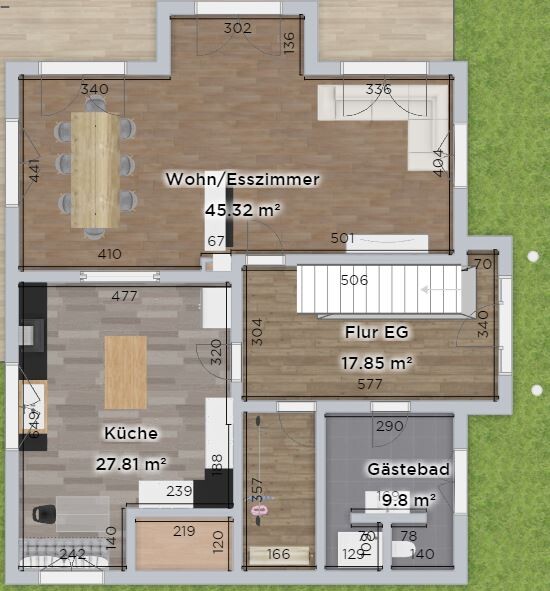
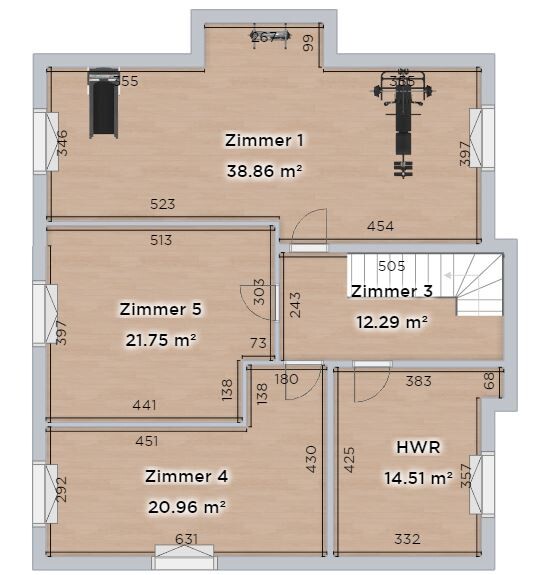
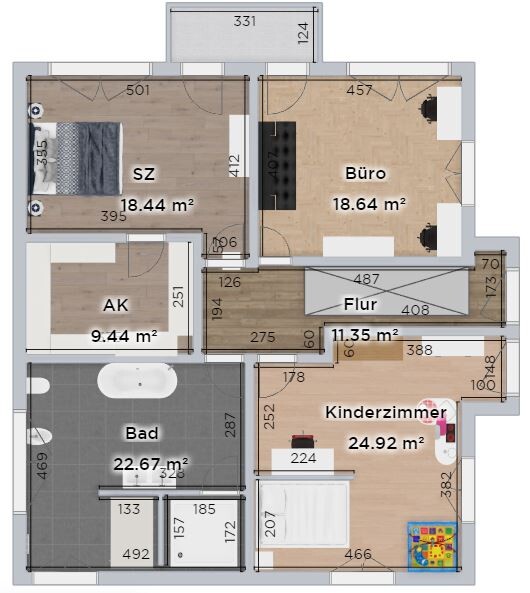
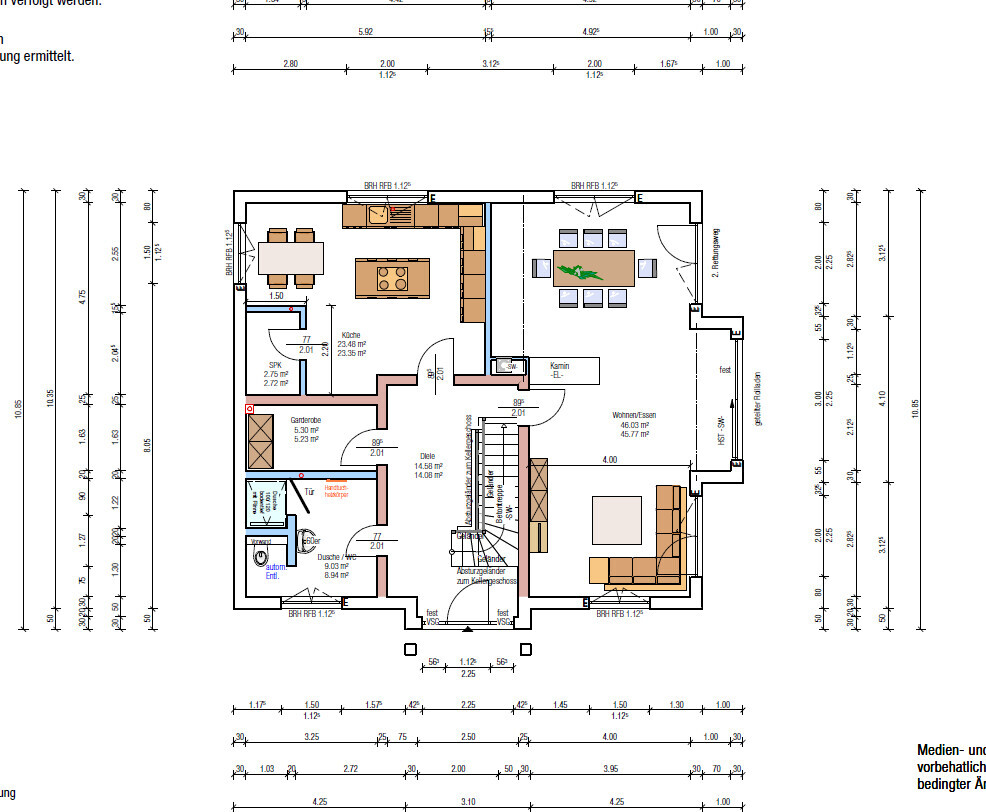
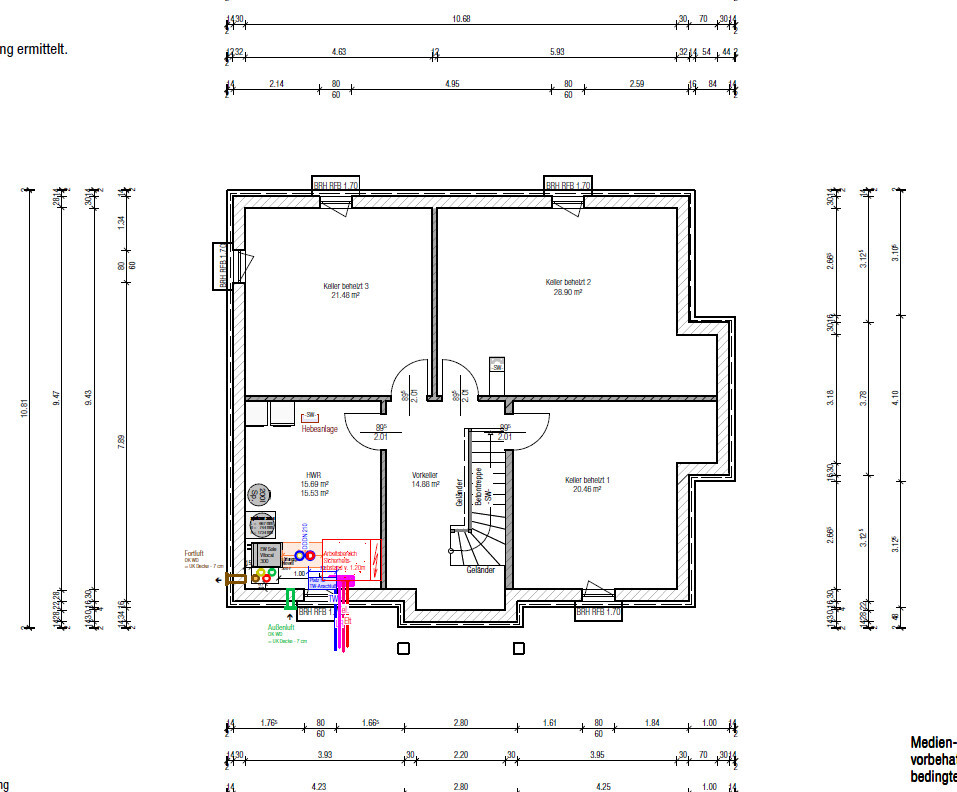
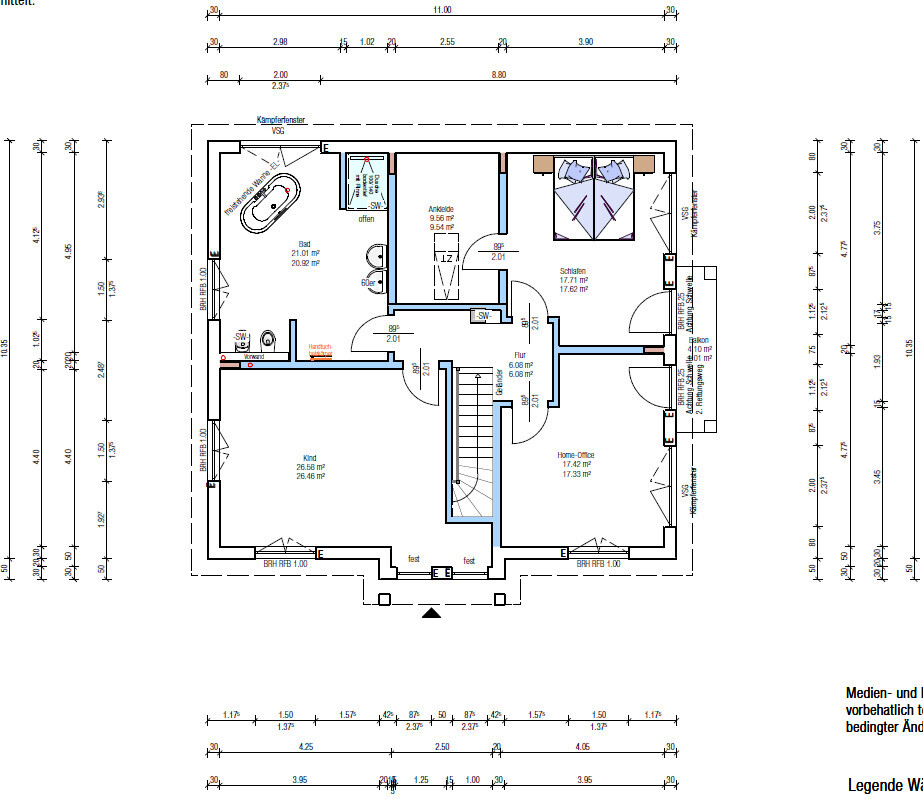
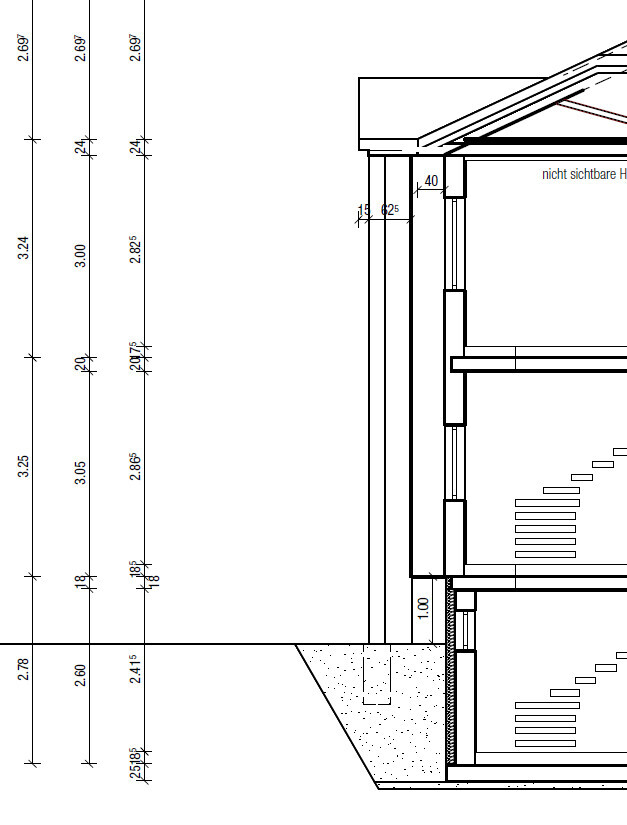
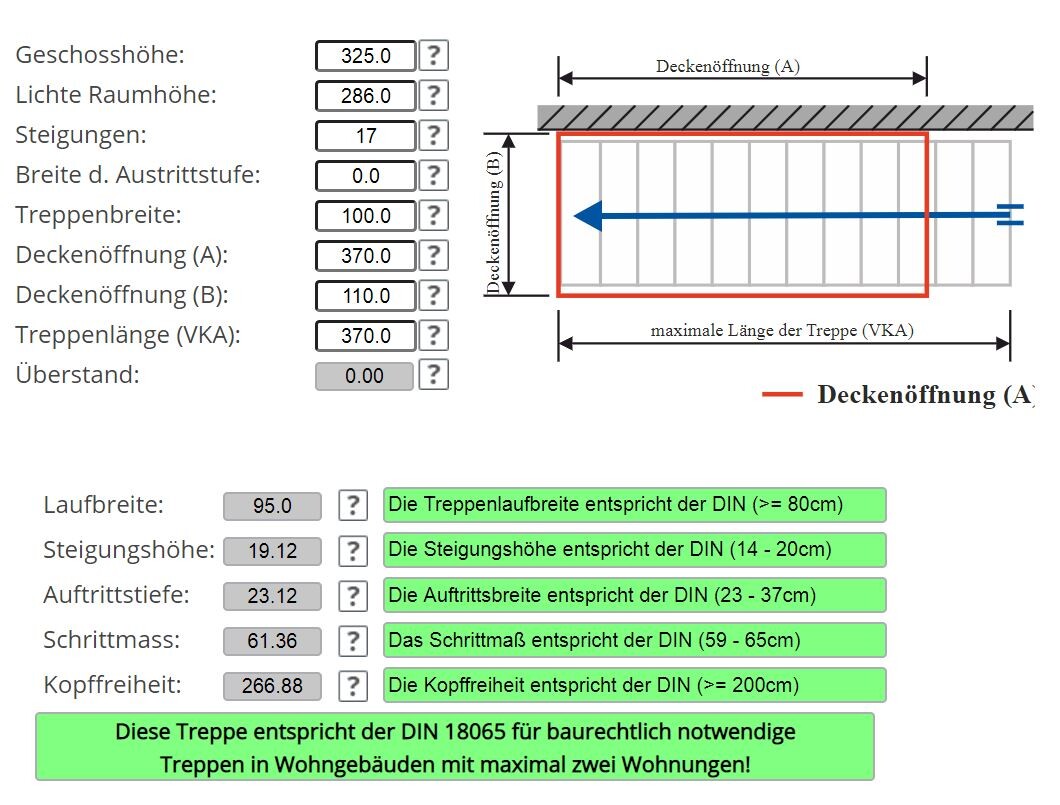
I’m a bit overwhelmed with our floor plan and keep running into the same problems...
The main issue is probably how to integrate a straight staircase from the ground floor to the upper floor, and how we would have to modify or extend the hallway to fit such a staircase without "breaking up" the other rooms.
Development plan / Restrictions
Plot size: 1005 m² (0.25 acres)
Slope: no
Site coverage ratio: according to neighboring developments
Floor area ratio: according to neighboring developments
Building envelope, building line, and boundary: according to neighboring developments
Edge development: no
Number of parking spaces: double / large garage planned
Number of stories: 2
Roof type: hipped roof
Style: urban villa
Orientation: street facing northeast, plot extends sideways toward west-northwest, garden planned all around southwest / west-northwest
Client requirements
Style, roof type, building type: urban villa with hipped roof
Basement, floors: basement + ground floor + upper floor
Number of occupants, ages: 2 adults + young child (3)
Office: home office?
Closed architecture
Closed kitchen, kitchen island
Fireplace
Balcony
Garage
House design
Who designed the plan:
- Option 1: planner from a construction company (not yet an architect)
- Option 2: do-it-yourself
What do you particularly like? Why?
Overall, the floor plan is good and was implemented largely according to our ideas.
What do you dislike? Why?
We would prefer a straight staircase. According to a staircase calculator tool, it would require a length of 3.70 m (12 ft).
From research, this might be rather uncomfortable and therefore unrealistic.
We would be willing to extend the hallway for the straight staircase if necessary.
Symmetry, especially in the front view of the house, is very important to us, so we want to keep the type of front door as is.
The awkward corner in the upper hallway is not very appealing (bedroom / office).
Furthermore, the hallway window was initially placed in the child’s bedroom, but that will be changed so there is natural light in the upper floor hallway.
I’m also wondering if the chimney flue on the upper floor can still be routed freely, possibly offset within the ceiling/floor. Or does it have to go straight up from the ground floor fireplace? Because then it would end up right in the middle of the upper floor hallway.
If you have to give up something, which details or fittings could you do without?
- Could you compromise on: I’m open to suggestions for now
- Cannot compromise on: ideally the straight staircase
What do you think makes it particularly good or bad?
See differences between our design and the construction company’s plan
- straight staircase instead of quarter-turn
- kitchen recessed
- window in the hallway instead of in the child’s room
- ideally no hallway obstruction on the upper floor
P
pagoni202014 Jul 2020 09:46Tolentino schrieb:
Of course, that also means a corresponding investment. Others buy their entire kitchen for that amount.
But I agree, even recirculating range hoods (including more affordable ones) have become quite effective nowadays. We have a Miele, highly rated by Stiftung Warentest, and it removes everything it should; costs €500 (about $540). Of course, you can always pay more for something different, better, or faster....
Certainly, the downdraft hood, which is quite a bit cheaper, is probably similarly effective. The lift has to be paid for. Based on the size and ceiling height, I assume that the original poster is not going for the showroom kitchen from the brochure with a recirculation hood for 70 euros.
P
pagoni202014 Jul 2020 09:51haydee schrieb:
Please don’t criticize my luxury. I stand by my IKEA wardrobe and tube TV.We silently sympathize with you!
Modern homes usually have a recirculation hood (or downdraft extractor, or other types) installed. It doesn’t make sense to build a highly airtight house with an excellent blower door test result and then drill a hole in the wall for an exhaust hood.
With a fireplace, it is also necessary to ensure pressure equalization, because modern hoods draw a significant amount of air, creating negative pressure inside the house (since the air is expelled outside with exhaust hoods). If the fireplace door is then opened, this can cause problems. Therefore, it is required to install a system that automatically opens a small window or similar when the exhaust hood is turned on to prevent negative pressure when combining an exhaust hood with an open fire.
We don’t have an open fireplace, but we still chose recirculation because the first argument made sense to us: there’s no point in sealing the house tightly only to create a hole again.
We have a downdraft extractor and find it very comfortable (especially my husband, who no longer bumps his head as he used to with our old hood). Overall, this is a decision that depends on the kitchen layout. For now, you should simply decide roughly whether you want an exhaust or recirculation system.
For the reasons mentioned above, I recommend a recirculation system, no matter if the unit is installed above the cooktop, beside it, or rises up in front of it.
With a fireplace, it is also necessary to ensure pressure equalization, because modern hoods draw a significant amount of air, creating negative pressure inside the house (since the air is expelled outside with exhaust hoods). If the fireplace door is then opened, this can cause problems. Therefore, it is required to install a system that automatically opens a small window or similar when the exhaust hood is turned on to prevent negative pressure when combining an exhaust hood with an open fire.
We don’t have an open fireplace, but we still chose recirculation because the first argument made sense to us: there’s no point in sealing the house tightly only to create a hole again.
We have a downdraft extractor and find it very comfortable (especially my husband, who no longer bumps his head as he used to with our old hood). Overall, this is a decision that depends on the kitchen layout. For now, you should simply decide roughly whether you want an exhaust or recirculation system.
For the reasons mentioned above, I recommend a recirculation system, no matter if the unit is installed above the cooktop, beside it, or rises up in front of it.
pagoni2020 schrieb:
We silently sympathize with you!Why? I am not suffering. What works is not simply replaced.Similar topics