
ᐅ Floor Plan for a 200 sqm Urban Villa – Are Our Requirements Feasible?
Created on: 13 Jul 2020 14:14
E
ECE-2021
Hello everyone,
I’m a bit overwhelmed with our floor plan and keep running into the same problems...
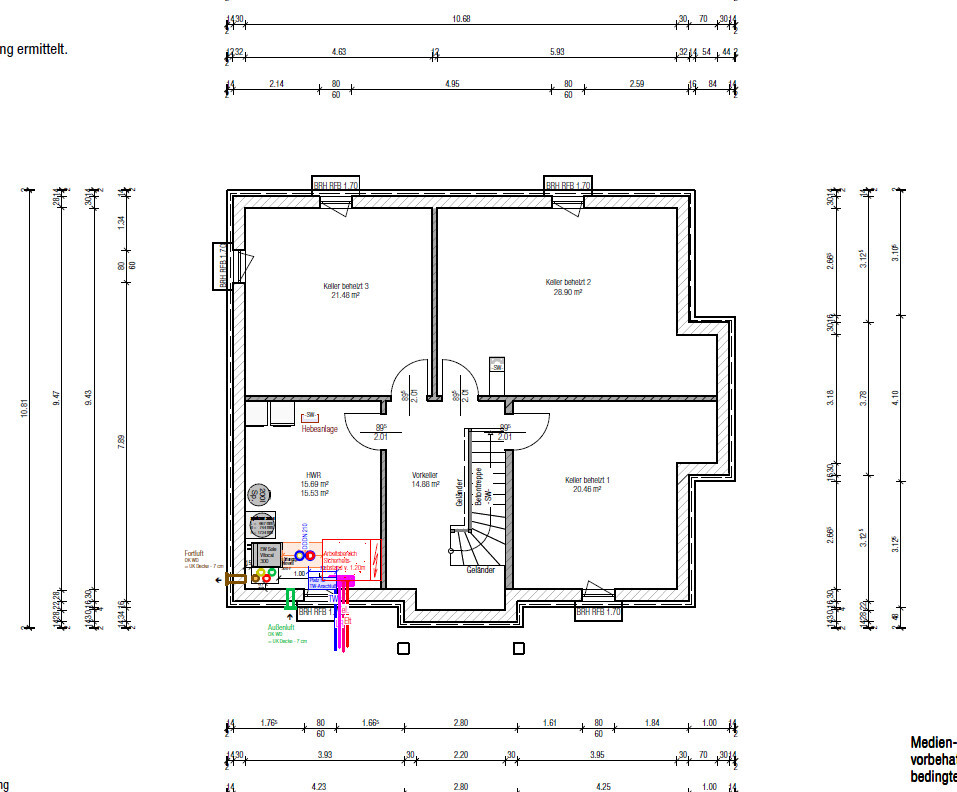
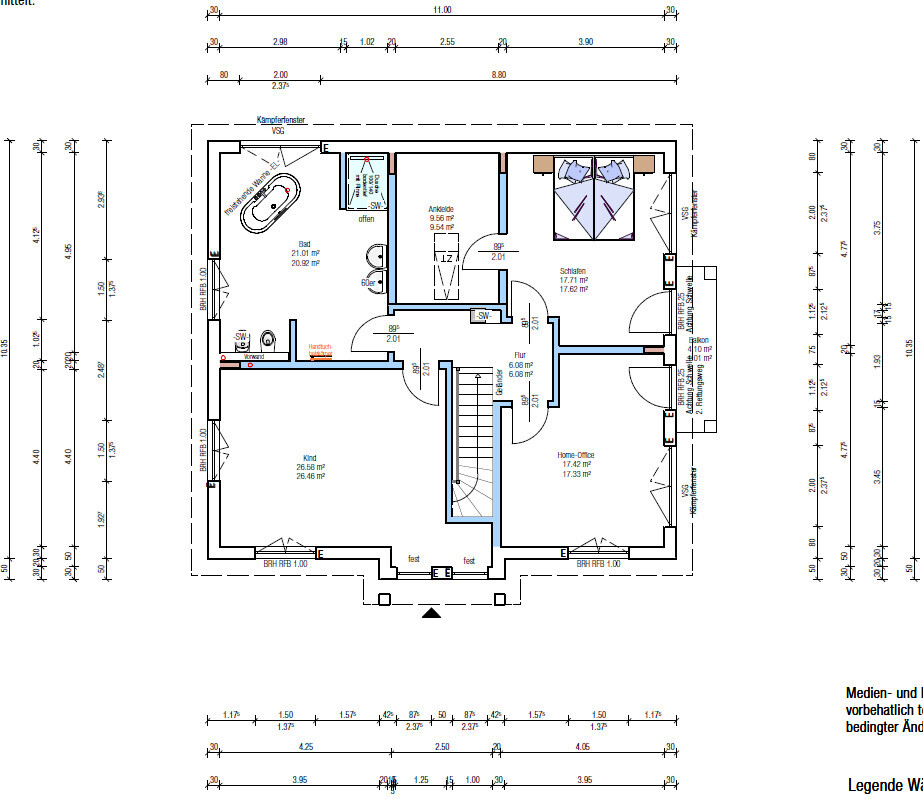
The main issue is probably how to integrate a straight staircase from the ground floor to the upper floor, and how we would have to modify or extend the hallway to fit such a staircase without "breaking up" the other rooms.
Development plan / Restrictions
Plot size: 1005 m² (0.25 acres)
Slope: no
Site coverage ratio: according to neighboring developments
Floor area ratio: according to neighboring developments
Building envelope, building line, and boundary: according to neighboring developments
Edge development: no
Number of parking spaces: double / large garage planned
Number of stories: 2
Roof type: hipped roof
Style: urban villa
Orientation: street facing northeast, plot extends sideways toward west-northwest, garden planned all around southwest / west-northwest
Client requirements
Style, roof type, building type: urban villa with hipped roof
Basement, floors: basement + ground floor + upper floor
Number of occupants, ages: 2 adults + young child (3)
Office: home office?
Closed architecture
Closed kitchen, kitchen island
Fireplace
Balcony
Garage
House design
Who designed the plan:
- Option 1: planner from a construction company (not yet an architect)
- Option 2: do-it-yourself
What do you particularly like? Why?
Overall, the floor plan is good and was implemented largely according to our ideas.
What do you dislike? Why?
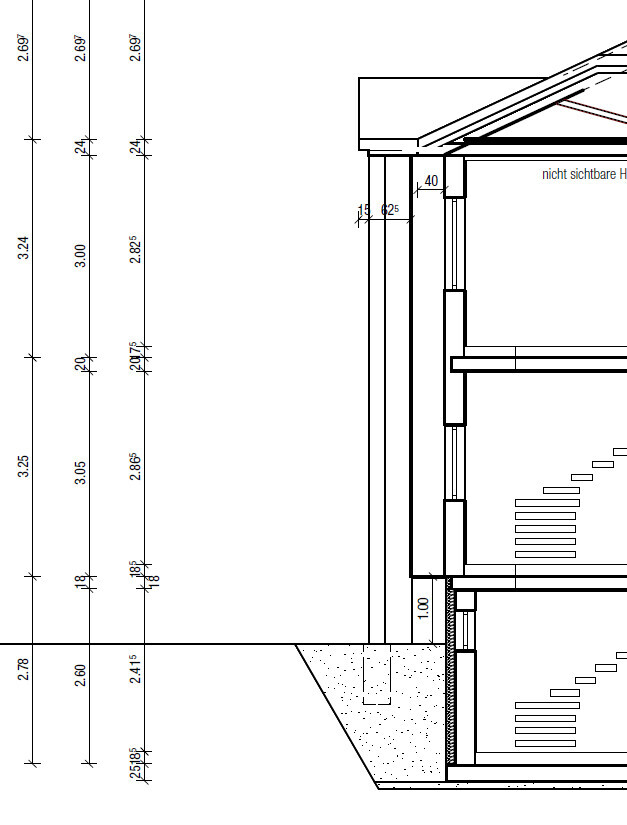
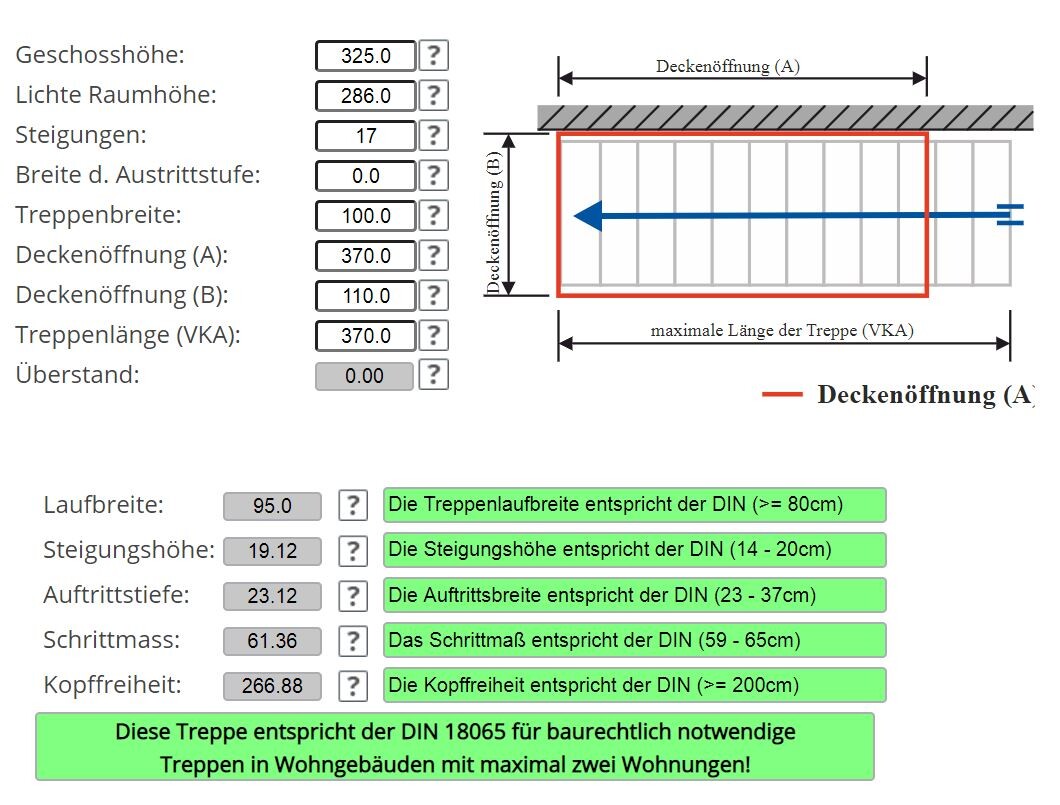
We would prefer a straight staircase. According to a staircase calculator tool, it would require a length of 3.70 m (12 ft).
From research, this might be rather uncomfortable and therefore unrealistic.
We would be willing to extend the hallway for the straight staircase if necessary.
Symmetry, especially in the front view of the house, is very important to us, so we want to keep the type of front door as is.
The awkward corner in the upper hallway is not very appealing (bedroom / office).
Furthermore, the hallway window was initially placed in the child’s bedroom, but that will be changed so there is natural light in the upper floor hallway.
I’m also wondering if the chimney flue on the upper floor can still be routed freely, possibly offset within the ceiling/floor. Or does it have to go straight up from the ground floor fireplace? Because then it would end up right in the middle of the upper floor hallway.
If you have to give up something, which details or fittings could you do without?
- Could you compromise on: I’m open to suggestions for now
- Cannot compromise on: ideally the straight staircase
What do you think makes it particularly good or bad?
See differences between our design and the construction company’s plan
- straight staircase instead of quarter-turn
- kitchen recessed
- window in the hallway instead of in the child’s room
- ideally no hallway obstruction on the upper floor
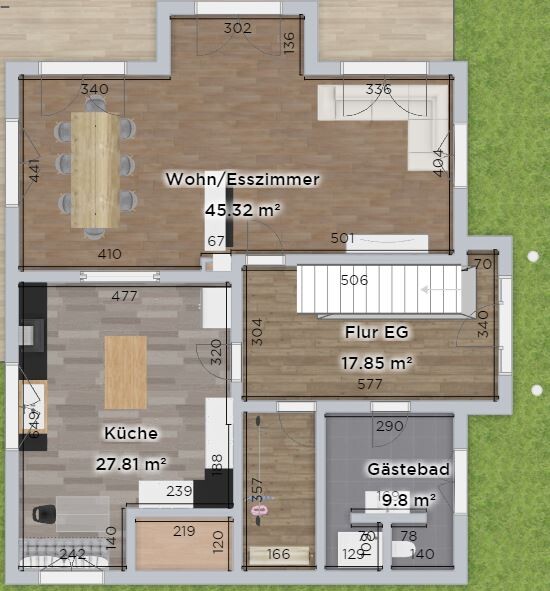
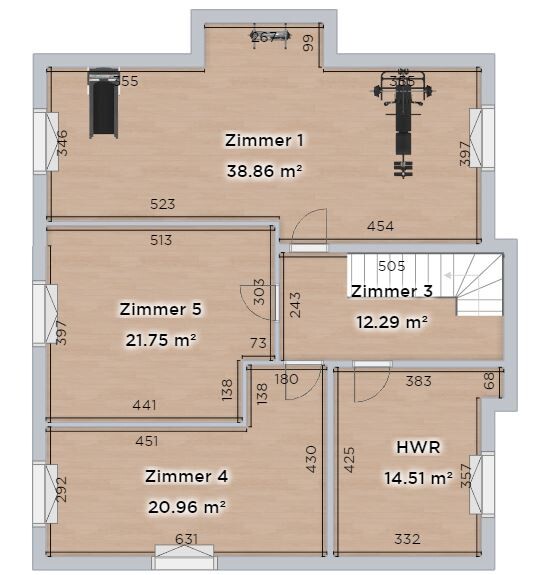
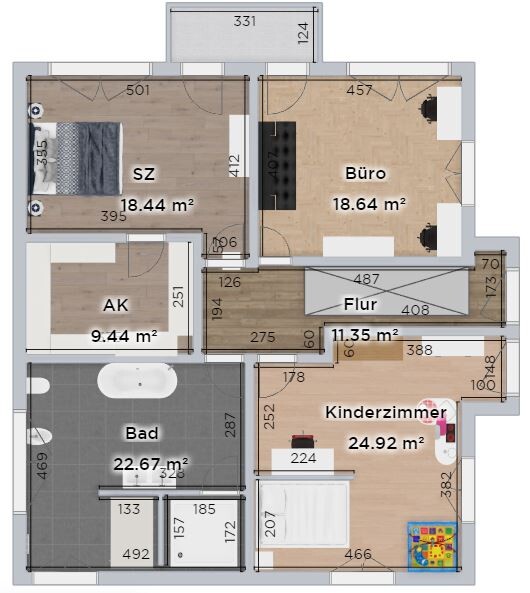
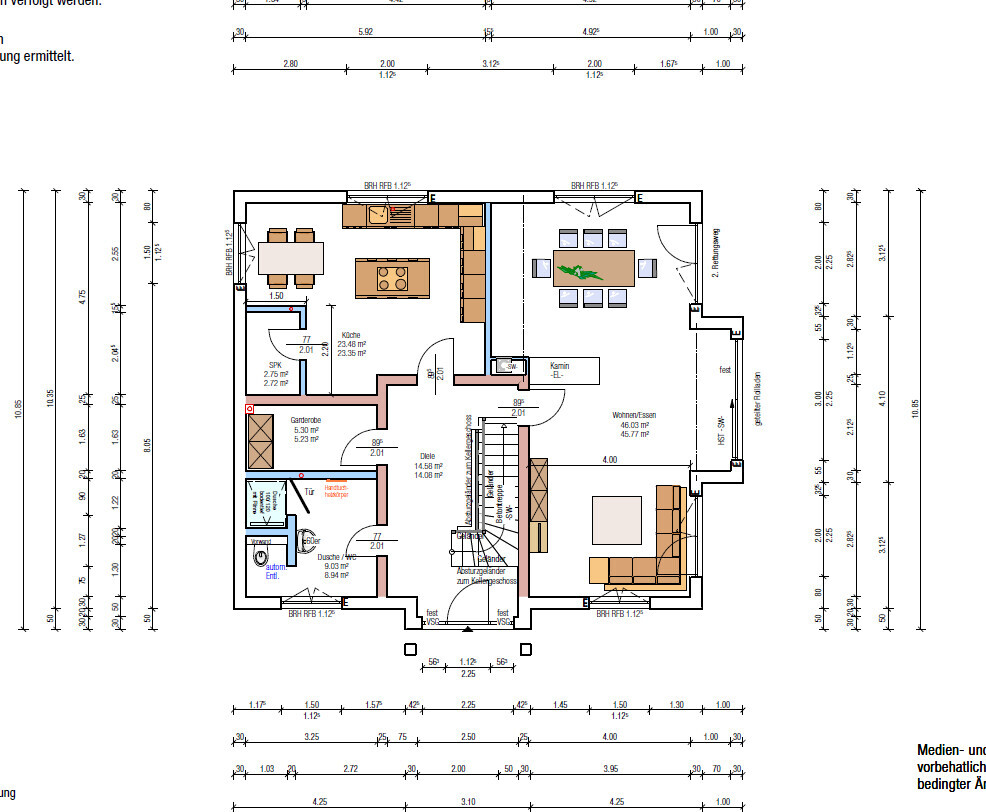
I’m a bit overwhelmed with our floor plan and keep running into the same problems...
The main issue is probably how to integrate a straight staircase from the ground floor to the upper floor, and how we would have to modify or extend the hallway to fit such a staircase without "breaking up" the other rooms.
Development plan / Restrictions
Plot size: 1005 m² (0.25 acres)
Slope: no
Site coverage ratio: according to neighboring developments
Floor area ratio: according to neighboring developments
Building envelope, building line, and boundary: according to neighboring developments
Edge development: no
Number of parking spaces: double / large garage planned
Number of stories: 2
Roof type: hipped roof
Style: urban villa
Orientation: street facing northeast, plot extends sideways toward west-northwest, garden planned all around southwest / west-northwest
Client requirements
Style, roof type, building type: urban villa with hipped roof
Basement, floors: basement + ground floor + upper floor
Number of occupants, ages: 2 adults + young child (3)
Office: home office?
Closed architecture
Closed kitchen, kitchen island
Fireplace
Balcony
Garage
House design
Who designed the plan:
- Option 1: planner from a construction company (not yet an architect)
- Option 2: do-it-yourself
What do you particularly like? Why?
Overall, the floor plan is good and was implemented largely according to our ideas.
What do you dislike? Why?
We would prefer a straight staircase. According to a staircase calculator tool, it would require a length of 3.70 m (12 ft).
From research, this might be rather uncomfortable and therefore unrealistic.
We would be willing to extend the hallway for the straight staircase if necessary.
Symmetry, especially in the front view of the house, is very important to us, so we want to keep the type of front door as is.
The awkward corner in the upper hallway is not very appealing (bedroom / office).
Furthermore, the hallway window was initially placed in the child’s bedroom, but that will be changed so there is natural light in the upper floor hallway.
I’m also wondering if the chimney flue on the upper floor can still be routed freely, possibly offset within the ceiling/floor. Or does it have to go straight up from the ground floor fireplace? Because then it would end up right in the middle of the upper floor hallway.
If you have to give up something, which details or fittings could you do without?
- Could you compromise on: I’m open to suggestions for now
- Cannot compromise on: ideally the straight staircase
What do you think makes it particularly good or bad?
See differences between our design and the construction company’s plan
- straight staircase instead of quarter-turn
- kitchen recessed
- window in the hallway instead of in the child’s room
- ideally no hallway obstruction on the upper floor
Tolentino schrieb:
... buy a small bungalow on the Baltic Sea (then near Berlin).Oh yes, who doesn't know the Baltic Sea near Berlin – absolutely fantastic. But maybe you really have to accept that something like this isn't for "forever"...
Even though, of course, it would be nice...
P
pagoni202014 Jul 2020 09:37ECE-2021 schrieb:
The advantage of a closed kitchen, as I see it, is that you can simply close it when cooking dishes with strong odors. And you don’t “dirty up” the living/dining area as much.To me, that sounds a bit old-fashioned, especially since for my first house, I was convinced by the older generation’s argument to have a closed kitchen with two sliding doors... unfortunately. Of course, the doors were always open anyway. Later in life, that was the first thing I corrected: removed the door and partition wall, added a nice counter opening to the dining room and the adjacent patio door... wow, what a feeling of freedom. That argument might make sense if you were running a canteen or didn’t have a proper extractor hood, and it may be true that sometimes you notice the smell in the house after cooking. But you should let go of the nightmare vision of constant cooking odors from oily foods and fried oil throughout the house and instead appreciate the other advantages of an open layout, because it won’t be like that anyway.Have you ever considered an outdoor sauna? It costs a fraction, and there are no problems with ventilation or humidity.
Otherwise, I agree with the general view of @Tolentino; looking back, that’s how it feels to me. Maybe just keep a few options open with lightweight construction for easy modifications, prepare some extra connections for water/electricity where needed, and if you never end up needing them, that’s fine too. Some of the concerns I’ve read sound more like excessive worry, and be sure, the opposite will usually happen.

ECE-2021 schrieb:
Oh yes, who wouldn’t know the Baltic Sea near Berlin—amazing In over 30 years...
ECE-2021 schrieb:
Even though it would of course be nice... I would like that, then I wouldn’t have to travel so far. Seriously: I believe that changes, including those I cannot (or can only partially) influence, enrich life. Without them, life would quickly become boring.
There are many types of range hoods. We have a Berbel downdraft extractor. It uses a charcoal filter and doesn’t have a grease filter. The exhaust vent is located between the stove and the oven.
How do sand dunes sound through the living room? That happens even with young ladies.
Try to clear your mind and start completely from scratch. Don’t focus on square meter measurements. What matters is the content and design, not the size. Also, take a look at urban villas with two or three children’s bedrooms. For example, these rooms can be connected with a door. Sleeping and playing areas can be separated, and later sleeping and living/study spaces can be separated as well.
How do sand dunes sound through the living room? That happens even with young ladies.
Try to clear your mind and start completely from scratch. Don’t focus on square meter measurements. What matters is the content and design, not the size. Also, take a look at urban villas with two or three children’s bedrooms. For example, these rooms can be connected with a door. Sleeping and playing areas can be separated, and later sleeping and living/study spaces can be separated as well.
P
pagoni202014 Jul 2020 09:43ECE-2021 schrieb:
But maybe you really have to accept that some things aren’t meant to last “forever”...
Even though, of course, it would be nice...Here, too, you might want to loosen up on strict planning and try to see it this way: It wouldn’t be a “negative acceptance” of something terrible, but rather fortunately a chance to reshape your life and adapt to the changed situation and desires. Your way of looking at it would have always made me more afraid—that I wouldn’t be able or allowed to change when my life changes. And THAT definitely changes... which is usually the beautiful and exciting part of life.
haydee schrieb:
We have a Berbel downdraft extractor.Of course, that also requires a significant investment. Some people buy their entire kitchen with that money. But I agree, even recirculating hoods (including more affordable ones) have become quite effective nowadays.Similar topics