
Hello dear forum,
Our ideas are slowly becoming more concrete, and we have found a floor plan that we quite like and that fits our requirements. We would love to hear your opinions and suggestions for improvement.
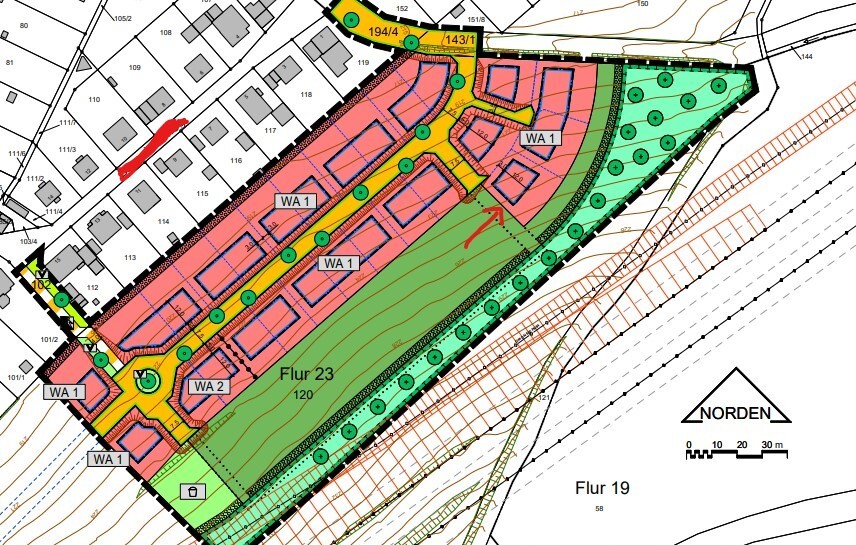
Development Plan/Restrictions
Plot size 518 sqm (5574 sq ft)
Slope Yes, about 2 m (6.5 ft) within the building zone, total about 3.5 m (11.5 ft), rising from the street
Floor area ratio 0.3
Plot ratio 0.6
Building zone, building line, and boundary approximately 13.5 x 12 m (44 x 39 ft)
Edge development As a new development area, everyone has the same specifications
Number of parking spaces 2
Number of floors 1.5 plus a basement, which is allowed and intended to be a full floor
Roof type gable roof, shed roof
Style open construction method
Orientation north-south
Maximum heights/limits 11 m (36 ft) ridge height
Homeowners’ Requirements
Style, roof type, building type single-family house with basement and gable roof
Basement, floors basement for living space plus 1.5 floors
Number of people, age currently a couple in their mid-30s plus a one-year-old child, more children planned
Space requirements
Ground floor: open plan living area, pantry/storage room, guest WC, 1 children’s room
Upper floor: 2 children’s rooms, family bathroom with bathtub, master bedroom with walk-in closet and shower bath
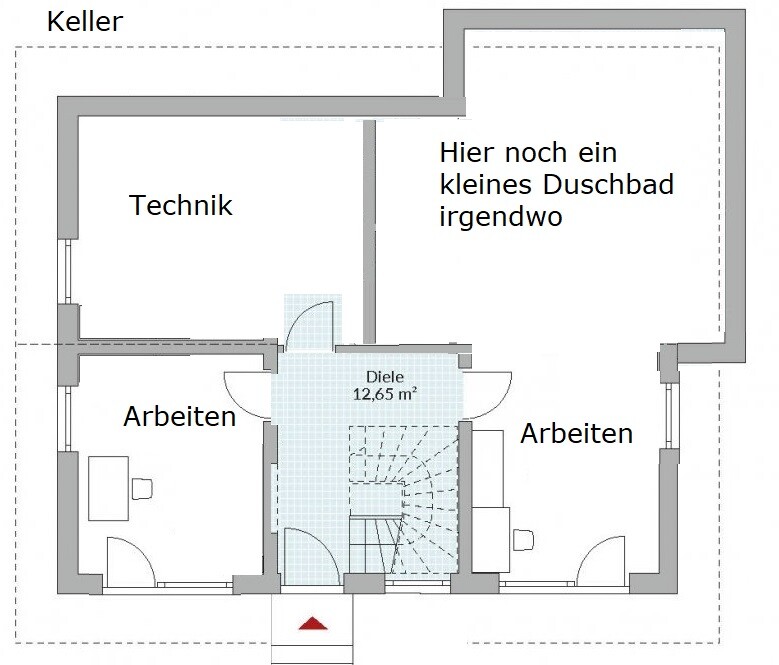
Basement: 2 offices, small shower bath, technical room/storage
Office: home office
Guest sleeping per year: rarely, so the office might occasionally be used as guest room
Open or closed architecture: open architecture
Open kitchen, kitchen island: open kitchen with island
Number of dining seats: at least 6
Fireplace: yes
Music/stereo wall: no
Balcony, roof terrace: standard terrace
Garage, carport: garage, but planned for later; possibly a carport
Utility garden, greenhouse: utility and play garden
Additional wishes/particulars: the main entrance will be moved to the basement, where the two offices are also planned. We want a high knee wall, which is why we plan a bay window to better utilize the 75% rule.
We are also still considering whether to place the main entrance on the left side of the house to make better use of space in the basement.
Furthermore, if possible, the terrace should be located above the garage on the right side of the house, as this side receives the most sun.
House Design
Who designed it: planner from a construction company plus do-it-yourself
What do you particularly like? the open and bright staircase, the living and dining area because everything is very bright
What do you dislike? Why? the solution with the parents’ area on the upper floor — hard to imagine and possibly too small
Price estimate according to architect/planner: 375,000
Personal price limit for the house, including equipment: 400,000
Preferred heating technology: air-to-water heat pump
If you have to give up something, which details/ extensions
-can you do without: fireplace
-can you not give up: parents’ area with walk-in and bathroom
Why did the design turn out as it is now? For example:
Standard design by the planner?
Which wishes were implemented by the architect? the plan is mainly the result of the spatial concept
What do you think makes it particularly good or bad? good question, it’s nothing exceptional, rather practical
What is the most important/fundamental question about the floor plan summarized in 130 characters?
What advantages or disadvantages do you see in the floor plan and design, especially regarding our large spatial concept?
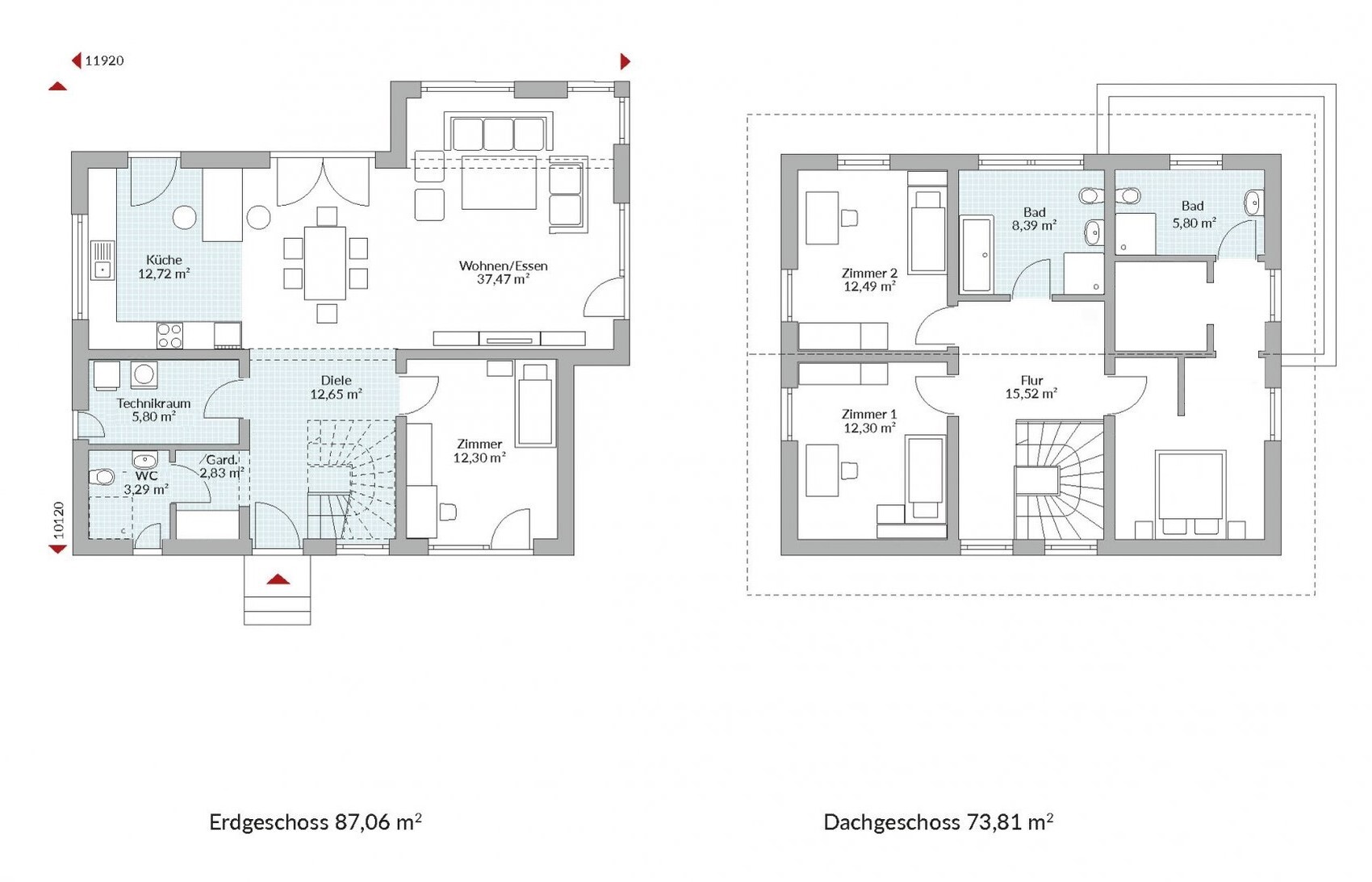

Our ideas are slowly becoming more concrete, and we have found a floor plan that we quite like and that fits our requirements. We would love to hear your opinions and suggestions for improvement.
Development Plan/Restrictions
Plot size 518 sqm (5574 sq ft)
Slope Yes, about 2 m (6.5 ft) within the building zone, total about 3.5 m (11.5 ft), rising from the street
Floor area ratio 0.3
Plot ratio 0.6
Building zone, building line, and boundary approximately 13.5 x 12 m (44 x 39 ft)
Edge development As a new development area, everyone has the same specifications
Number of parking spaces 2
Number of floors 1.5 plus a basement, which is allowed and intended to be a full floor
Roof type gable roof, shed roof
Style open construction method
Orientation north-south
Maximum heights/limits 11 m (36 ft) ridge height
Homeowners’ Requirements
Style, roof type, building type single-family house with basement and gable roof
Basement, floors basement for living space plus 1.5 floors
Number of people, age currently a couple in their mid-30s plus a one-year-old child, more children planned
Space requirements
Ground floor: open plan living area, pantry/storage room, guest WC, 1 children’s room
Upper floor: 2 children’s rooms, family bathroom with bathtub, master bedroom with walk-in closet and shower bath
Basement: 2 offices, small shower bath, technical room/storage
Office: home office
Guest sleeping per year: rarely, so the office might occasionally be used as guest room
Open or closed architecture: open architecture
Open kitchen, kitchen island: open kitchen with island
Number of dining seats: at least 6
Fireplace: yes
Music/stereo wall: no
Balcony, roof terrace: standard terrace
Garage, carport: garage, but planned for later; possibly a carport
Utility garden, greenhouse: utility and play garden
Additional wishes/particulars: the main entrance will be moved to the basement, where the two offices are also planned. We want a high knee wall, which is why we plan a bay window to better utilize the 75% rule.
We are also still considering whether to place the main entrance on the left side of the house to make better use of space in the basement.
Furthermore, if possible, the terrace should be located above the garage on the right side of the house, as this side receives the most sun.
House Design
Who designed it: planner from a construction company plus do-it-yourself
What do you particularly like? the open and bright staircase, the living and dining area because everything is very bright
What do you dislike? Why? the solution with the parents’ area on the upper floor — hard to imagine and possibly too small
Price estimate according to architect/planner: 375,000
Personal price limit for the house, including equipment: 400,000
Preferred heating technology: air-to-water heat pump
If you have to give up something, which details/ extensions
-can you do without: fireplace
-can you not give up: parents’ area with walk-in and bathroom
Why did the design turn out as it is now? For example:
Standard design by the planner?
Which wishes were implemented by the architect? the plan is mainly the result of the spatial concept
What do you think makes it particularly good or bad? good question, it’s nothing exceptional, rather practical
What is the most important/fundamental question about the floor plan summarized in 130 characters?
What advantages or disadvantages do you see in the floor plan and design, especially regarding our large spatial concept?
P
pagoni20209 Jul 2020 19:18Thirteen schrieb:
Since here it is always referred to as planner and not architect, someone unfamiliar might assume these are two different types of professionals. That’s why I’m asking this way. Sorry, I might have put it too simply. It could be a freelance architect, interior architect, or someone working for a general contractor or construction company – basically anyone who has been trained specifically for this role. They do this every day, so your wishes won’t be unfamiliar to them, and they will have solutions.
The draftsman mentioned by @11ant usually doesn’t have the same qualifications, so you should approach them with clearer instructions to avoid ending up with poor results. They often use software and let the program do most of the thinking. The software usually doesn’t provide detailed solutions, even if those would be possible.
Maybe look for an architect near you with good references and just have a conversation.
We also have two full stories on a slope.
The basement level includes an entrance, a large cloakroom, three children’s bedrooms, the technical room, and the utility room.
The upper floor has the kitchen, living and dining area, a small storage room, a guest toilet, an office, and the master suite with a dressing room, master bedroom, and master bathroom.
From the upper floor, you have direct access to the garden.
You definitely need to reduce the size. For 400k, you can get a maximum of 200 m² (2,150 sq ft) and likely not an extra basement.
The basement level includes an entrance, a large cloakroom, three children’s bedrooms, the technical room, and the utility room.
The upper floor has the kitchen, living and dining area, a small storage room, a guest toilet, an office, and the master suite with a dressing room, master bedroom, and master bathroom.
From the upper floor, you have direct access to the garden.
You definitely need to reduce the size. For 400k, you can get a maximum of 200 m² (2,150 sq ft) and likely not an extra basement.

P
pagoni20209 Jul 2020 19:34Mellina schrieb:
@Mellina That already looks really good. Would love to see more of it. Ok, here’s another view from the other side, with preparations for the kitchen on the wall.
The floor... so stylish!
That’s the liquid cork, right?

haydee schrieb:
In our case, even rooms with full standing height were built under the attic. The knee wall area is then used as storage space.I see storage space as sufficiently manageable in the basement part of the lower ground floor, and a knee wall area wouldn't necessarily have to be created just to avoid a full upper floor without an extension on the ground floor. Not even with a two-thirds attic, and here we are talking about a three-quarters attic.https://www.instagram.com/11antgmxde/
https://www.linkedin.com/company/bauen-jetzt/
Similar topics