
ᐅ Floor Plan Optimization | Semi-Detached House on a Slope with 192 m² of Living Space
Created on: 7 Jun 2020 21:28
E
erazorlll
Dear Forum,
In recent weeks, I shared my experiences searching for and selecting a construction company. Thanks again for all your help and discussions!
As promised, I am posting our current plans here and would appreciate your comments and suggestions. Some minor details are not ideal but likely cannot be changed – I have explained these below.
Development Plan / Restrictions
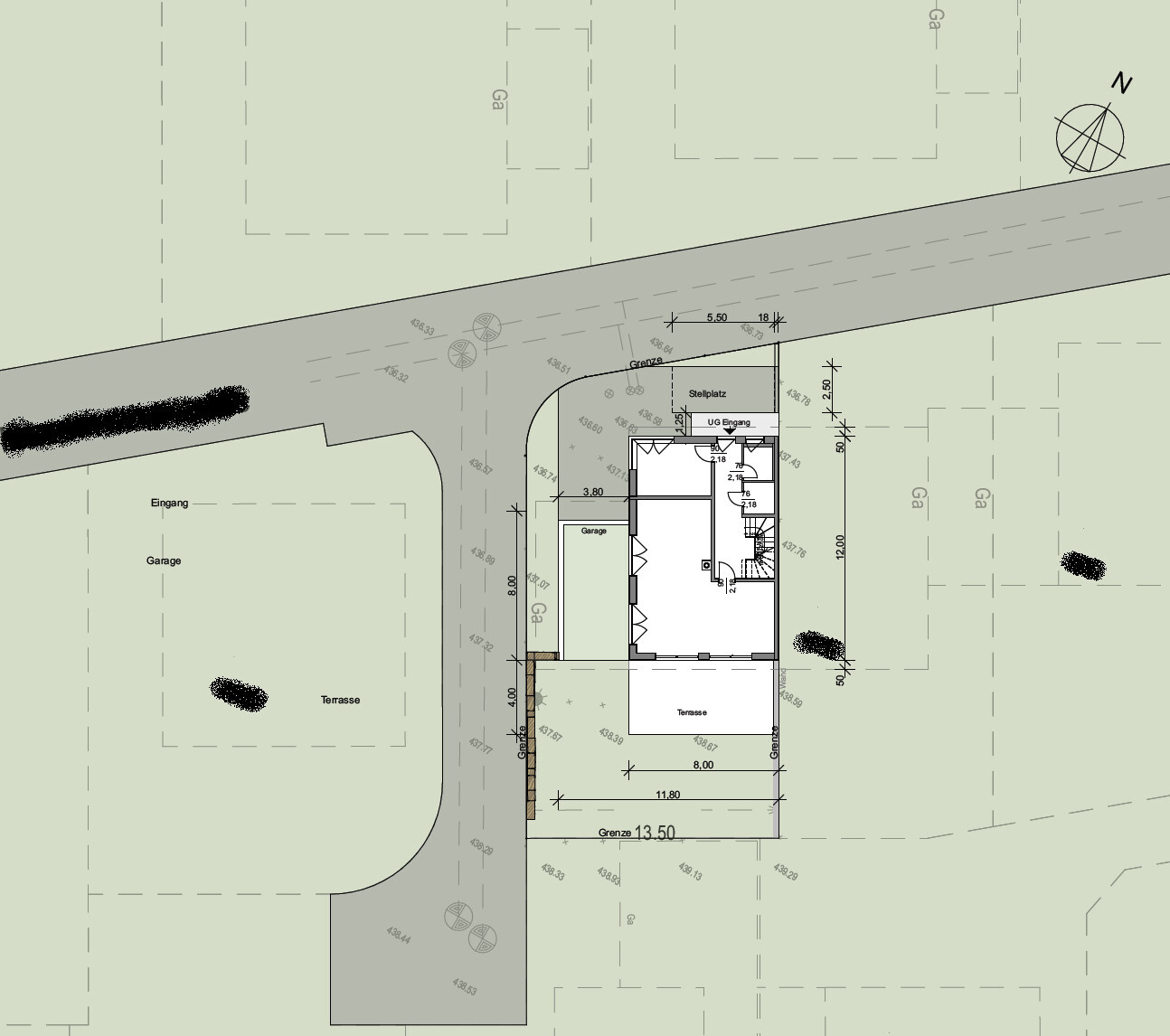
Plot size: 340m² (3,659 sq ft)
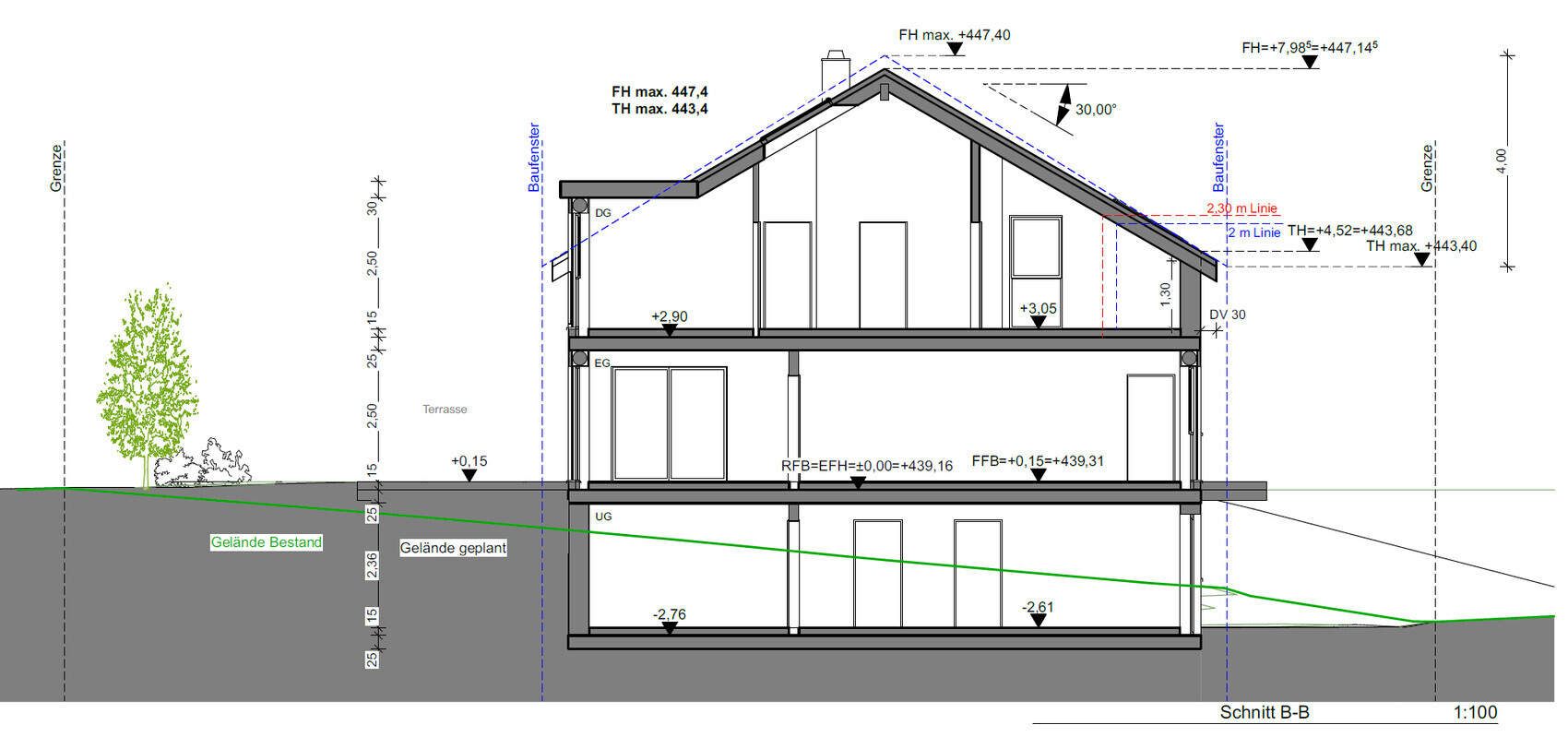
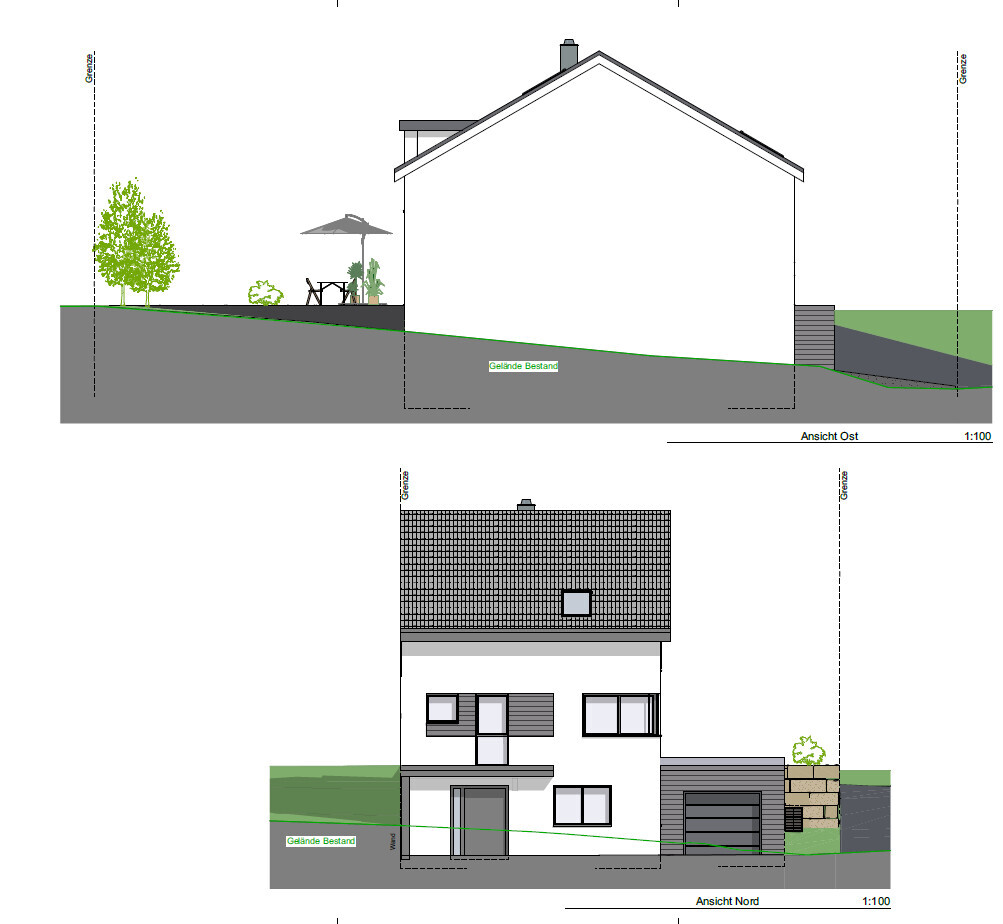
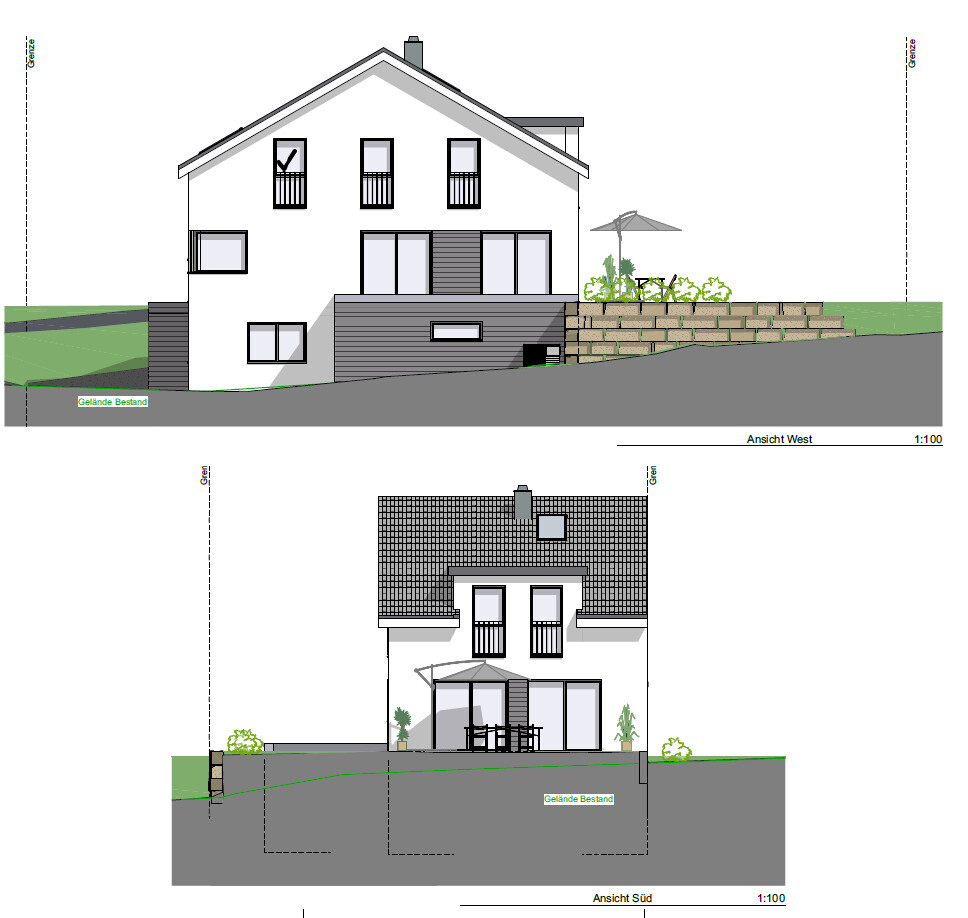
Slope: Yes, approximately 2m (6.5 ft) difference over 17m (56 ft) length
Site coverage ratio: 0.4
Floor area ratio: none
Building envelope, building line and boundary:
Maximum building envelope for semi-detached house: 8x13m (26x43 ft)
Maximum garage building envelope: 5x9m (16x30 ft)
Building boundaries may be exceeded by a maximum of 5m (16 ft) in width and 1.5m (5 ft) in depth per building side, as well as by minor structural elements
Number of parking spaces: 2 cars and 2 bicycles
Storeys: No direct specification, but height limits above sea level apply
Roof type: Gable roof, 30-40° pitch
Architectural style: -
Orientation: Southeast
Maximum heights/limits:
Maximum eaves and ridge heights are given as heights above sea level.
No roof structures are permitted on the north side.
Additional requirements:
A cistern is mandatory. The maximum height of the garage within its designated envelope is specified.
Client Requirements
Style, roof type, building type: Modern, gable roof, semi-detached house
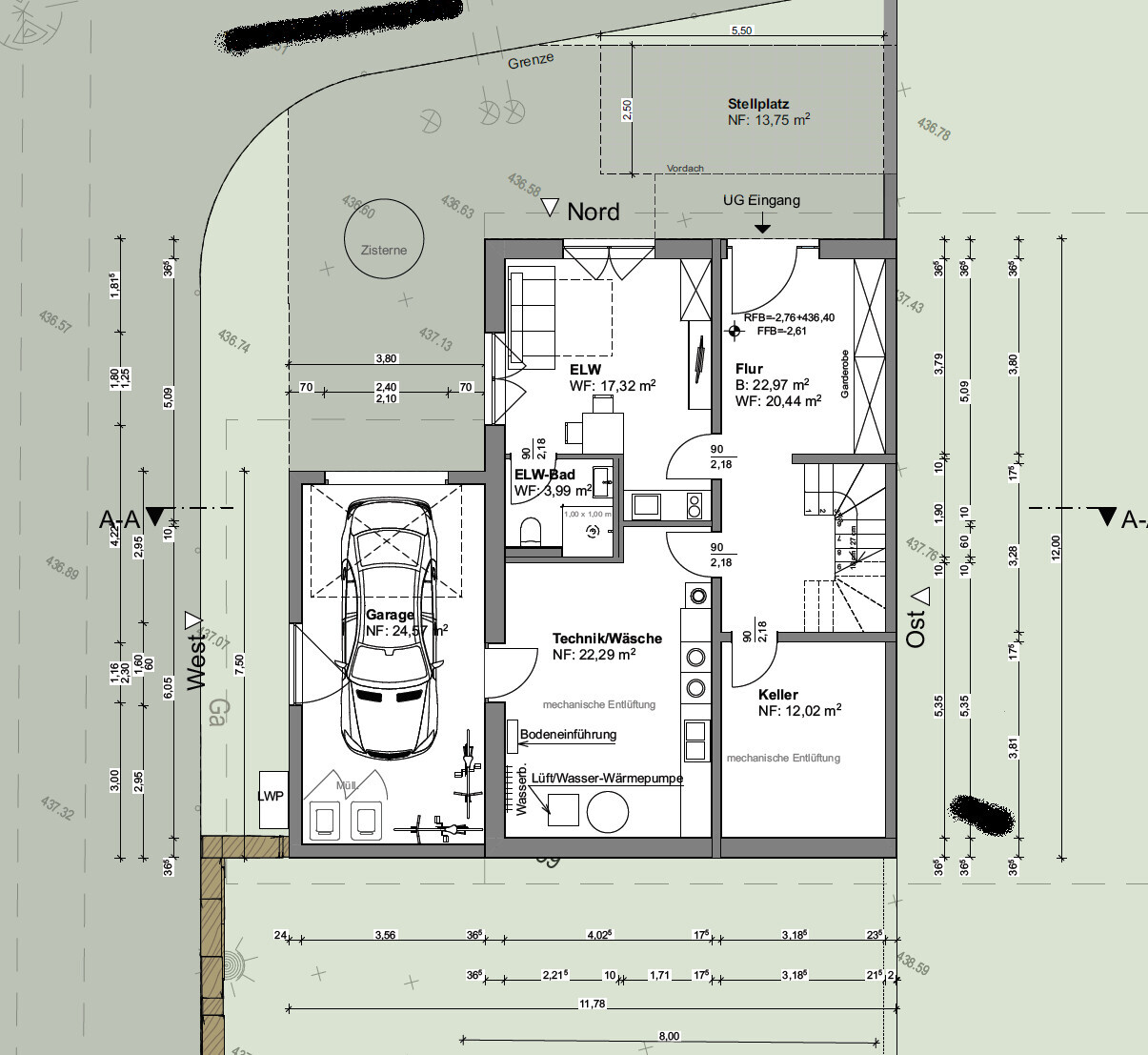
Basement, floors: At least two floors required; the open basement results from the slope
Number of occupants, age: 2 adults in their early/mid-30s, planning for 1-2 children
Space requirements on ground and upper floors:
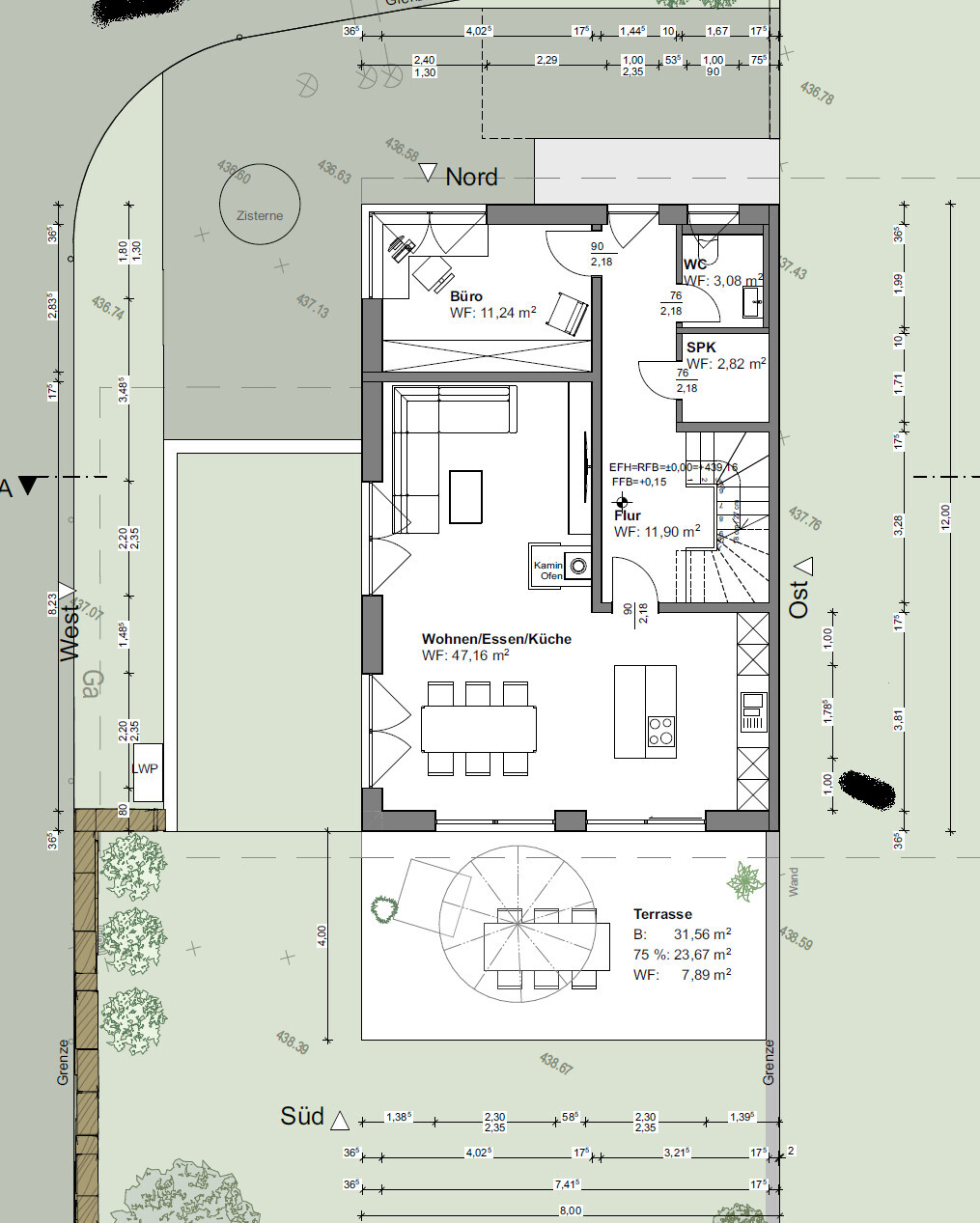
Ground floor: office, living room, dining room, kitchen, pantry, and shower/WC
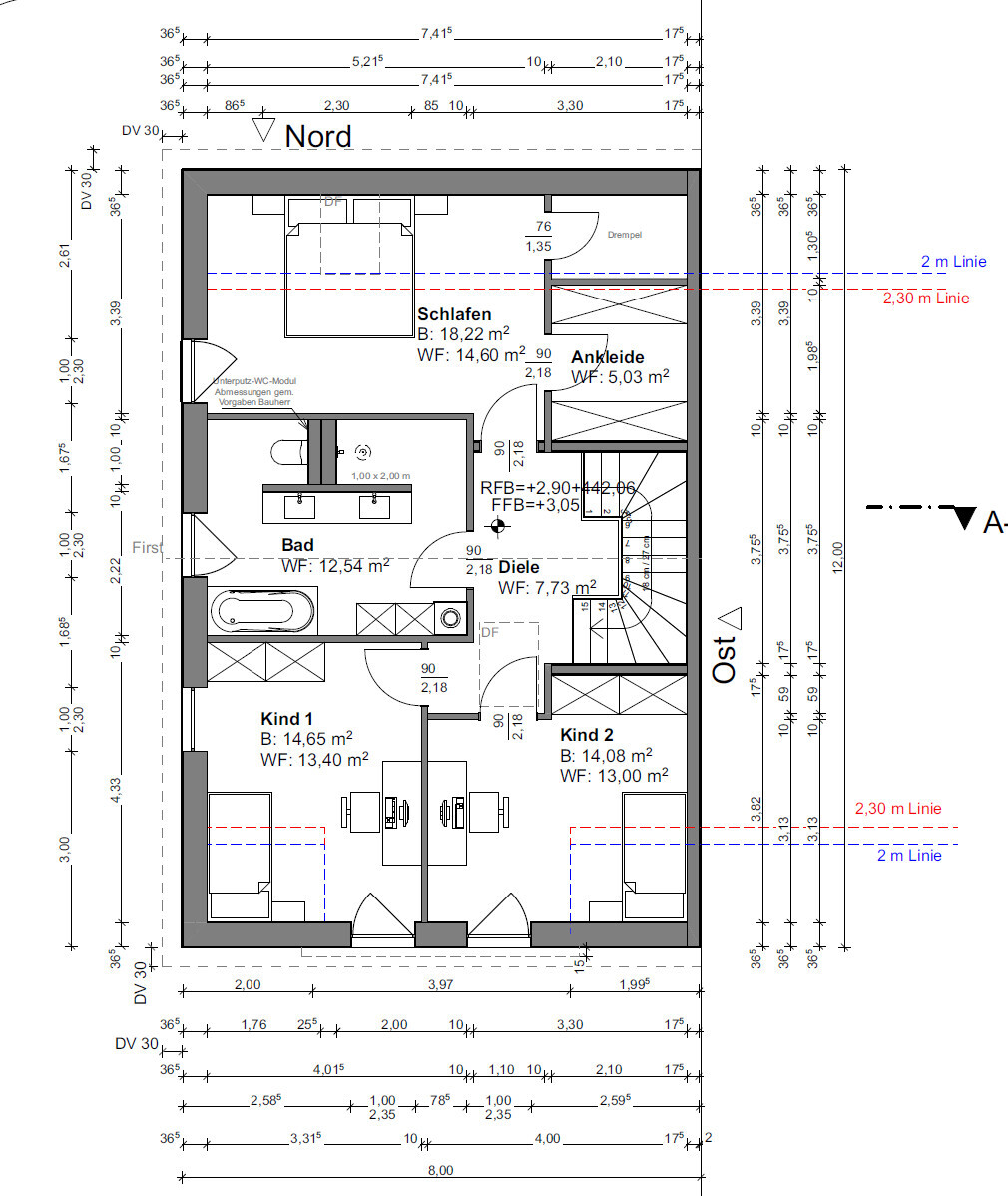
Upper floor: bedroom, dressing room, bathroom, and two children’s bedrooms
Office: family use or home office? An office is essential
Overnight guests per year: 2-3 times
Open or closed architecture: Good mix. Kitchen, dining, and living areas are mostly open; the rest are mostly closed
Conservative or modern construction: Modern construction preferred
Open kitchen, island: Open kitchen with island
Number of dining seats: 4-6
Fireplace: Yes, if feasible
Music/sound wall: ?
Balcony, roof terrace: No, not needed
Garage, carport: Double garage is not possible due to development plan restrictions. Therefore, a slightly wider single garage with space for trash bins and bicycles.
Utility garden, greenhouse: No
Additional wishes/special features/daily routine, reasons for preferences:
The master bedroom can be smaller since it is only for sleeping; the space should benefit other rooms.
A large bathroom with a spacious, airy feel.
See also text below.
House Design
Planning source: Discussions with the general contractor and implementation by architects
What do you especially like? Why?
Bathroom – relatively large, wide double vanity, WC somewhat hidden, and walk-in shower without enclosure
Staircase – not too tightly curved for a semi-detached house
Children’s rooms – equally sized but not mirrored exactly, slightly different layouts
What do you not like? Why?
Pantry – unfortunately not directly behind the kitchen, with stairs in between
Ground floor WC – initially planned as a shower toilet but moved to basement due to space constraints
Estimated cost according to architect/planner: approx. 2,400 euros per m² (approx. $220 per sq ft)
Personal price limit for house including fittings:
Preferred heating system: Air-to-water heat pump as a split unit – suggested model was "Weishaupt Air/Water Heat Pump Biblock (WWP LB)"
If you had to give up, which details or expansions would you skip
-Could you skip: Fireplace, granny flat, size of basement hallway, knee wall in master bedroom
-Cannot skip: Large bathroom, pantry and ground floor WC, office
Why was the design created this way?
We discussed our wishes for each floor with the general contractor, who then worked with the architect to create a design.
We reviewed and adjusted the design several times to meet our needs.
The suggestion to place the kitchen directly by the terrace and the living room more inward came from the general contractor.
Additional remarks:
We acquired a plot for a semi-detached house and after long research chose a solid construction provider.
Besides standard rooms, we require two children’s rooms and a home office. Due to the slope, a three-story building with an open basement at the front evolved. An open kitchen-dining-living area with a possible small division to the living room via a fireplace is important to us.
The general contractor proposed placing the kitchen on the garden side for easy access between garden and kitchen/refrigerator, especially in summer. The living area was placed more inward for more privacy. Initially, this seemed unusual since most floor plans are the other way around. Now we find it quite interesting.
After the first draft, two problems arose: the kitchen was too narrow for our ideas. We wanted an open kitchen with a large central island. The dressing room upstairs was hard to use due to layout and a 2m (6.5 ft) boundary line. We reworked the plan extensively and had to move the staircase, which affected the layout on all floors. The dressing room has become acceptable and usable. Unfortunately, these changes meant that the pantry was no longer behind the kitchen and the ground floor WC lost its shower. We see no option to change this without causing other issues.
We do not actually need a granny flat. However, due to the open basement design, an extra room emerged. Initially planned as a hobby room, it became a granny flat because the ground floor shower had to be removed and we wanted a second shower for safety. This is not bad for several reasons: 1) if we are older, we would have everything needed downstairs and on the ground floor; 2) if a child wants to move in, they have a WC and shower; 3) there would be a second shower in the house (in case there are three women living here).
And if you wonder why the house is so large with 192m² (2,067 sq ft) of living space:
We never planned for so much space; it developed naturally. We do not want to change the width of 8m (26 ft), as it would become too narrow. The length of 12m (39 ft) could theoretically be reduced, but currently, only the basement area seems oversized. On the ground floor, space is tight for pantry and shower, and upstairs for dressing room layout.
That’s the overview of our ideas and plans. I look forward to your comments and questions.
What is the most important/basic question about the floor plan in 130 characters?
We would appreciate general opinions on the floor plan.
Have we overlooked anything that only becomes apparent in daily life?
Are there smarter ideas for alternative layouts?
What do you think about the kitchen’s layout and size?
What about the garage size? I’m unsure whether width or length is more important.
What do you think about the door orientations? Some open inward, some outward due to space. Is this inconvenient or acceptable?
If anything is missing, please let me know.
PS: The exterior design of the house and garage (color, wood between windows, etc.) and the type of doors in the dining room (sliding/door/fixed) are not finalized and just roughly sketched. Please disregard.
Thank you!
//Edit: If anyone wonders why the maximum roof height in the plan differs slightly from the building roof height: this was a later change to the development plan and is correct.
In recent weeks, I shared my experiences searching for and selecting a construction company. Thanks again for all your help and discussions!
As promised, I am posting our current plans here and would appreciate your comments and suggestions. Some minor details are not ideal but likely cannot be changed – I have explained these below.
Development Plan / Restrictions
Plot size: 340m² (3,659 sq ft)
Slope: Yes, approximately 2m (6.5 ft) difference over 17m (56 ft) length
Site coverage ratio: 0.4
Floor area ratio: none
Building envelope, building line and boundary:
Maximum building envelope for semi-detached house: 8x13m (26x43 ft)
Maximum garage building envelope: 5x9m (16x30 ft)
Building boundaries may be exceeded by a maximum of 5m (16 ft) in width and 1.5m (5 ft) in depth per building side, as well as by minor structural elements
Number of parking spaces: 2 cars and 2 bicycles
Storeys: No direct specification, but height limits above sea level apply
Roof type: Gable roof, 30-40° pitch
Architectural style: -
Orientation: Southeast
Maximum heights/limits:
Maximum eaves and ridge heights are given as heights above sea level.
No roof structures are permitted on the north side.
Additional requirements:
A cistern is mandatory. The maximum height of the garage within its designated envelope is specified.
Client Requirements
Style, roof type, building type: Modern, gable roof, semi-detached house
Basement, floors: At least two floors required; the open basement results from the slope
Number of occupants, age: 2 adults in their early/mid-30s, planning for 1-2 children
Space requirements on ground and upper floors:
Ground floor: office, living room, dining room, kitchen, pantry, and shower/WC
Upper floor: bedroom, dressing room, bathroom, and two children’s bedrooms
Office: family use or home office? An office is essential
Overnight guests per year: 2-3 times
Open or closed architecture: Good mix. Kitchen, dining, and living areas are mostly open; the rest are mostly closed
Conservative or modern construction: Modern construction preferred
Open kitchen, island: Open kitchen with island
Number of dining seats: 4-6
Fireplace: Yes, if feasible
Music/sound wall: ?
Balcony, roof terrace: No, not needed
Garage, carport: Double garage is not possible due to development plan restrictions. Therefore, a slightly wider single garage with space for trash bins and bicycles.
Utility garden, greenhouse: No
Additional wishes/special features/daily routine, reasons for preferences:
The master bedroom can be smaller since it is only for sleeping; the space should benefit other rooms.
A large bathroom with a spacious, airy feel.
See also text below.
House Design
Planning source: Discussions with the general contractor and implementation by architects
What do you especially like? Why?
Bathroom – relatively large, wide double vanity, WC somewhat hidden, and walk-in shower without enclosure
Staircase – not too tightly curved for a semi-detached house
Children’s rooms – equally sized but not mirrored exactly, slightly different layouts
What do you not like? Why?
Pantry – unfortunately not directly behind the kitchen, with stairs in between
Ground floor WC – initially planned as a shower toilet but moved to basement due to space constraints
Estimated cost according to architect/planner: approx. 2,400 euros per m² (approx. $220 per sq ft)
Personal price limit for house including fittings:
Preferred heating system: Air-to-water heat pump as a split unit – suggested model was "Weishaupt Air/Water Heat Pump Biblock (WWP LB)"
If you had to give up, which details or expansions would you skip
-Could you skip: Fireplace, granny flat, size of basement hallway, knee wall in master bedroom
-Cannot skip: Large bathroom, pantry and ground floor WC, office
Why was the design created this way?
We discussed our wishes for each floor with the general contractor, who then worked with the architect to create a design.
We reviewed and adjusted the design several times to meet our needs.
The suggestion to place the kitchen directly by the terrace and the living room more inward came from the general contractor.
Additional remarks:
We acquired a plot for a semi-detached house and after long research chose a solid construction provider.
Besides standard rooms, we require two children’s rooms and a home office. Due to the slope, a three-story building with an open basement at the front evolved. An open kitchen-dining-living area with a possible small division to the living room via a fireplace is important to us.
The general contractor proposed placing the kitchen on the garden side for easy access between garden and kitchen/refrigerator, especially in summer. The living area was placed more inward for more privacy. Initially, this seemed unusual since most floor plans are the other way around. Now we find it quite interesting.
After the first draft, two problems arose: the kitchen was too narrow for our ideas. We wanted an open kitchen with a large central island. The dressing room upstairs was hard to use due to layout and a 2m (6.5 ft) boundary line. We reworked the plan extensively and had to move the staircase, which affected the layout on all floors. The dressing room has become acceptable and usable. Unfortunately, these changes meant that the pantry was no longer behind the kitchen and the ground floor WC lost its shower. We see no option to change this without causing other issues.
We do not actually need a granny flat. However, due to the open basement design, an extra room emerged. Initially planned as a hobby room, it became a granny flat because the ground floor shower had to be removed and we wanted a second shower for safety. This is not bad for several reasons: 1) if we are older, we would have everything needed downstairs and on the ground floor; 2) if a child wants to move in, they have a WC and shower; 3) there would be a second shower in the house (in case there are three women living here).
And if you wonder why the house is so large with 192m² (2,067 sq ft) of living space:
We never planned for so much space; it developed naturally. We do not want to change the width of 8m (26 ft), as it would become too narrow. The length of 12m (39 ft) could theoretically be reduced, but currently, only the basement area seems oversized. On the ground floor, space is tight for pantry and shower, and upstairs for dressing room layout.
That’s the overview of our ideas and plans. I look forward to your comments and questions.
What is the most important/basic question about the floor plan in 130 characters?
We would appreciate general opinions on the floor plan.
Have we overlooked anything that only becomes apparent in daily life?
Are there smarter ideas for alternative layouts?
What do you think about the kitchen’s layout and size?
What about the garage size? I’m unsure whether width or length is more important.
What do you think about the door orientations? Some open inward, some outward due to space. Is this inconvenient or acceptable?
If anything is missing, please let me know.
PS: The exterior design of the house and garage (color, wood between windows, etc.) and the type of doors in the dining room (sliding/door/fixed) are not finalized and just roughly sketched. Please disregard.
Thank you!
//Edit: If anyone wonders why the maximum roof height in the plan differs slightly from the building roof height: this was a later change to the development plan and is correct.
E
erazorlll22 Jun 2020 11:19saralina87 schrieb:
What’s wrong with your hardwood floor in the kitchen?The issue was that it’s too high-maintenance. If something falls on it, you immediately get scratches and dents – vinyl would be more durable in this case.
Liquids – if you don’t notice and wipe them up right away, the floor swells and can discolor. Especially with acidic juices or dark stains, it’s quite challenging. Vinyl wouldn’t have this problem.
Grease – it’s hard to remove without damaging the surface.
In our current apartment, we have strip parquet (or whatever it’s called) in the living room, and I have to say, you really need to be careful. If something drips and you don’t clean it up soon, it soaks into the joints between the strips and causes dark lines (“gaps”) there.
I don’t mind normal wear and tear over time – that’s natural and wood floors have character. But I wonder if it’s practical. When cooking and washing dishes, things do splash. Or when cutting tomatoes, some juice might end up on the floor. I don’t want to have to panic and clean up immediately every single time or the parquet could get damaged. The kitchen is also where things are more likely to get broken or dropped while loading and unloading.
E
erazorlll22 Jun 2020 11:20Climbee schrieb:
Vinyl is simply a plastic product. I find the feel more pleasant than traditional laminate, but I personally wouldn’t want a “plastic floor” in my own home. I’d rather have tiles. What flooring did you choose for the rest of the house? Specifically the children's rooms and the master bedroom?

What are your plans for the area around the stove, assuming it is still going to be used? I could imagine extending a tile from there in a nice curve leading to the kitchen, and then equipping the dining and living rooms with parquet flooring. This can be done with good design, including a smooth transition without the often unattractive metal strips between parquet and tile.
S
saralina8722 Jun 2020 11:28erazorlll schrieb:
The maintenance was too demanding.
If something drops onto the floor, you immediately get scratches and dents – vinyl would be more durable in this regard.
Liquids – if you don’t notice and wipe them up right away, the floor swells and discolors. This is especially tricky with acidic juices or dark stains – vinyl wouldn’t have this issue.
Grease – would be hard to remove without damaging the surface.
In our current apartment, we have strip parquet (or whatever it’s called) in the living room, and I have to say you really have to be careful. If something drips and you don’t clean it up soon, it soaks between the planks and causes dark lines (the “joints”) between them.
I’m okay with some wear and tear over time, that’s normal and wood is a living material. But I wonder how practical it is. When cooking and washing dishes, spills happen. Or when cutting tomatoes, juice might get on the floor. I don’t want to have to immediately wipe it up every time to avoid damaging the parquet. The kitchen is also where you’re more likely to accidentally drop or knock things over. We have oiled country-style floorboards in both our current and future kitchens – no problems at all.
With lacquered parquet, the risk is clearly higher, but I think the rest of the concerns are exaggerated.

We have tiles in the entrance area and bathrooms, and parquet flooring everywhere else. Like Saralilna's oiled country-style oak planks. We also use the kitchen a lot.
Our parquet was installed as natural and treated with a very good oil finish. We have absolutely no problems with the parquet in the kitchen, not even in front of the stove. Even grease stains disappear when I clean with the Bissell.
If I spill something, I wipe it up right away. I did the same when I had a kitchen with tiles. I always wonder who expects spills in the kitchen to be left without cleaning?
As I said: make sure to use a good oil finish (which is really not cheap, but worth every cent), and there’s no reason not to have a wooden floor in the kitchen. The only exception is if you have an old-fashioned wood-burning stove in the kitchen – then parquet flooring can be tricky. But other than that? I can’t think of any reason against it. Especially in today’s typical open-plan living/dining/kitchen areas, I find a unified floor much more attractive and it allows much more freedom in kitchen design.
Lacquered parquet is a different matter. I wouldn’t want it, because every scratch becomes annoying.
Our parquet was installed as natural and treated with a very good oil finish. We have absolutely no problems with the parquet in the kitchen, not even in front of the stove. Even grease stains disappear when I clean with the Bissell.
If I spill something, I wipe it up right away. I did the same when I had a kitchen with tiles. I always wonder who expects spills in the kitchen to be left without cleaning?
As I said: make sure to use a good oil finish (which is really not cheap, but worth every cent), and there’s no reason not to have a wooden floor in the kitchen. The only exception is if you have an old-fashioned wood-burning stove in the kitchen – then parquet flooring can be tricky. But other than that? I can’t think of any reason against it. Especially in today’s typical open-plan living/dining/kitchen areas, I find a unified floor much more attractive and it allows much more freedom in kitchen design.
Lacquered parquet is a different matter. I wouldn’t want it, because every scratch becomes annoying.
Similar topics