
ᐅ Floor Plan Optimization | Semi-Detached House on a Slope with 192 m² of Living Space
Created on: 7 Jun 2020 21:28
E
erazorlll
Dear Forum,
In recent weeks, I shared my experiences searching for and selecting a construction company. Thanks again for all your help and discussions!
As promised, I am posting our current plans here and would appreciate your comments and suggestions. Some minor details are not ideal but likely cannot be changed – I have explained these below.
Development Plan / Restrictions
Plot size: 340m² (3,659 sq ft)
Slope: Yes, approximately 2m (6.5 ft) difference over 17m (56 ft) length
Site coverage ratio: 0.4
Floor area ratio: none
Building envelope, building line and boundary:
Maximum building envelope for semi-detached house: 8x13m (26x43 ft)
Maximum garage building envelope: 5x9m (16x30 ft)
Building boundaries may be exceeded by a maximum of 5m (16 ft) in width and 1.5m (5 ft) in depth per building side, as well as by minor structural elements
Number of parking spaces: 2 cars and 2 bicycles
Storeys: No direct specification, but height limits above sea level apply
Roof type: Gable roof, 30-40° pitch
Architectural style: -
Orientation: Southeast
Maximum heights/limits:
Maximum eaves and ridge heights are given as heights above sea level.
No roof structures are permitted on the north side.
Additional requirements:
A cistern is mandatory. The maximum height of the garage within its designated envelope is specified.
Client Requirements
Style, roof type, building type: Modern, gable roof, semi-detached house
Basement, floors: At least two floors required; the open basement results from the slope
Number of occupants, age: 2 adults in their early/mid-30s, planning for 1-2 children
Space requirements on ground and upper floors:
Ground floor: office, living room, dining room, kitchen, pantry, and shower/WC
Upper floor: bedroom, dressing room, bathroom, and two children’s bedrooms
Office: family use or home office? An office is essential
Overnight guests per year: 2-3 times
Open or closed architecture: Good mix. Kitchen, dining, and living areas are mostly open; the rest are mostly closed
Conservative or modern construction: Modern construction preferred
Open kitchen, island: Open kitchen with island
Number of dining seats: 4-6
Fireplace: Yes, if feasible
Music/sound wall: ?
Balcony, roof terrace: No, not needed
Garage, carport: Double garage is not possible due to development plan restrictions. Therefore, a slightly wider single garage with space for trash bins and bicycles.
Utility garden, greenhouse: No
Additional wishes/special features/daily routine, reasons for preferences:
The master bedroom can be smaller since it is only for sleeping; the space should benefit other rooms.
A large bathroom with a spacious, airy feel.
See also text below.
House Design
Planning source: Discussions with the general contractor and implementation by architects
What do you especially like? Why?
Bathroom – relatively large, wide double vanity, WC somewhat hidden, and walk-in shower without enclosure
Staircase – not too tightly curved for a semi-detached house
Children’s rooms – equally sized but not mirrored exactly, slightly different layouts
What do you not like? Why?
Pantry – unfortunately not directly behind the kitchen, with stairs in between
Ground floor WC – initially planned as a shower toilet but moved to basement due to space constraints
Estimated cost according to architect/planner: approx. 2,400 euros per m² (approx. $220 per sq ft)
Personal price limit for house including fittings:
Preferred heating system: Air-to-water heat pump as a split unit – suggested model was "Weishaupt Air/Water Heat Pump Biblock (WWP LB)"
If you had to give up, which details or expansions would you skip
-Could you skip: Fireplace, granny flat, size of basement hallway, knee wall in master bedroom
-Cannot skip: Large bathroom, pantry and ground floor WC, office
Why was the design created this way?
We discussed our wishes for each floor with the general contractor, who then worked with the architect to create a design.
We reviewed and adjusted the design several times to meet our needs.
The suggestion to place the kitchen directly by the terrace and the living room more inward came from the general contractor.
Additional remarks:
We acquired a plot for a semi-detached house and after long research chose a solid construction provider.
Besides standard rooms, we require two children’s rooms and a home office. Due to the slope, a three-story building with an open basement at the front evolved. An open kitchen-dining-living area with a possible small division to the living room via a fireplace is important to us.
The general contractor proposed placing the kitchen on the garden side for easy access between garden and kitchen/refrigerator, especially in summer. The living area was placed more inward for more privacy. Initially, this seemed unusual since most floor plans are the other way around. Now we find it quite interesting.
After the first draft, two problems arose: the kitchen was too narrow for our ideas. We wanted an open kitchen with a large central island. The dressing room upstairs was hard to use due to layout and a 2m (6.5 ft) boundary line. We reworked the plan extensively and had to move the staircase, which affected the layout on all floors. The dressing room has become acceptable and usable. Unfortunately, these changes meant that the pantry was no longer behind the kitchen and the ground floor WC lost its shower. We see no option to change this without causing other issues.
We do not actually need a granny flat. However, due to the open basement design, an extra room emerged. Initially planned as a hobby room, it became a granny flat because the ground floor shower had to be removed and we wanted a second shower for safety. This is not bad for several reasons: 1) if we are older, we would have everything needed downstairs and on the ground floor; 2) if a child wants to move in, they have a WC and shower; 3) there would be a second shower in the house (in case there are three women living here).
And if you wonder why the house is so large with 192m² (2,067 sq ft) of living space:
We never planned for so much space; it developed naturally. We do not want to change the width of 8m (26 ft), as it would become too narrow. The length of 12m (39 ft) could theoretically be reduced, but currently, only the basement area seems oversized. On the ground floor, space is tight for pantry and shower, and upstairs for dressing room layout.
That’s the overview of our ideas and plans. I look forward to your comments and questions.
What is the most important/basic question about the floor plan in 130 characters?
We would appreciate general opinions on the floor plan.
Have we overlooked anything that only becomes apparent in daily life?
Are there smarter ideas for alternative layouts?
What do you think about the kitchen’s layout and size?
What about the garage size? I’m unsure whether width or length is more important.
What do you think about the door orientations? Some open inward, some outward due to space. Is this inconvenient or acceptable?
If anything is missing, please let me know.
PS: The exterior design of the house and garage (color, wood between windows, etc.) and the type of doors in the dining room (sliding/door/fixed) are not finalized and just roughly sketched. Please disregard.
Thank you!
//Edit: If anyone wonders why the maximum roof height in the plan differs slightly from the building roof height: this was a later change to the development plan and is correct.
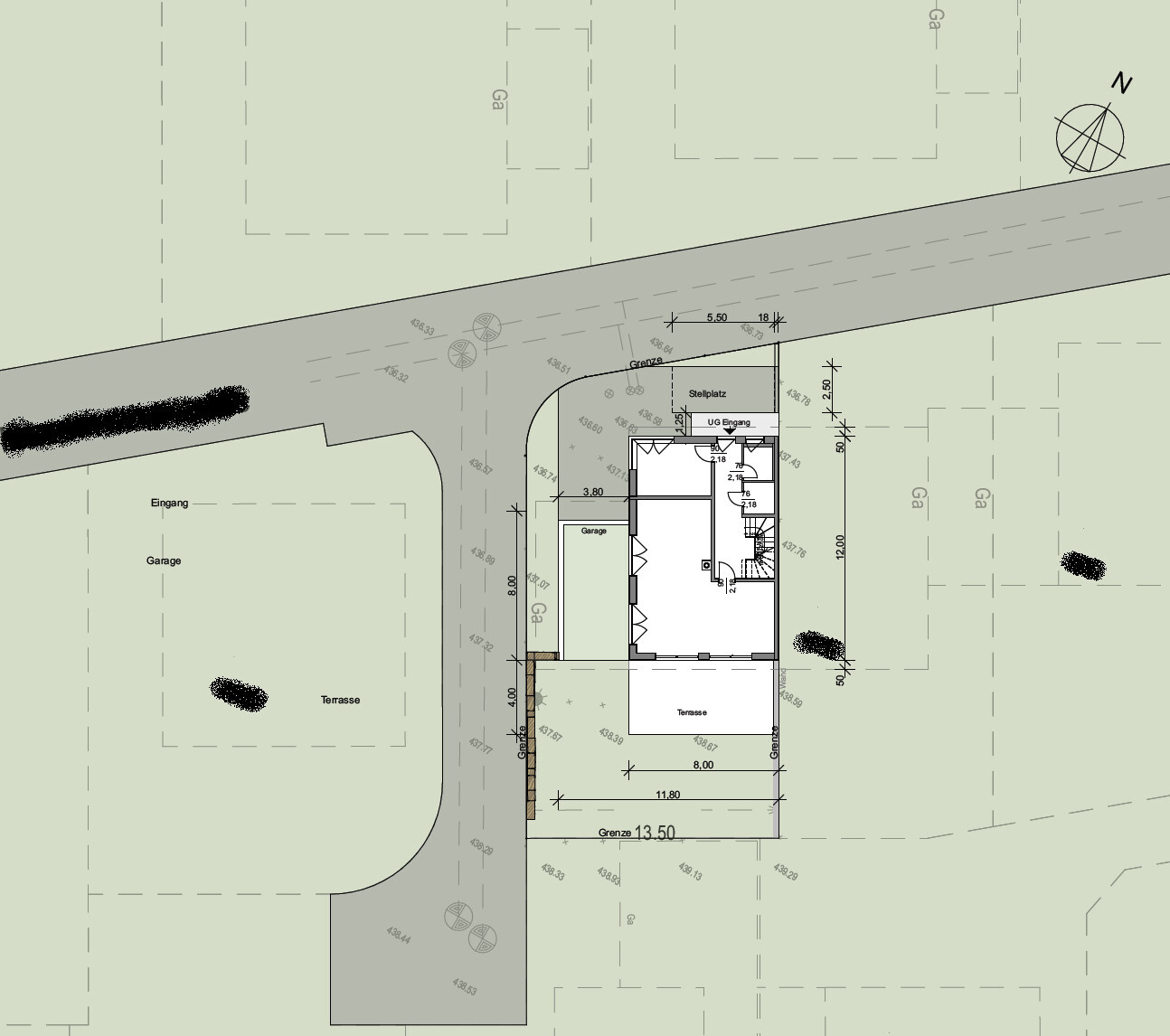
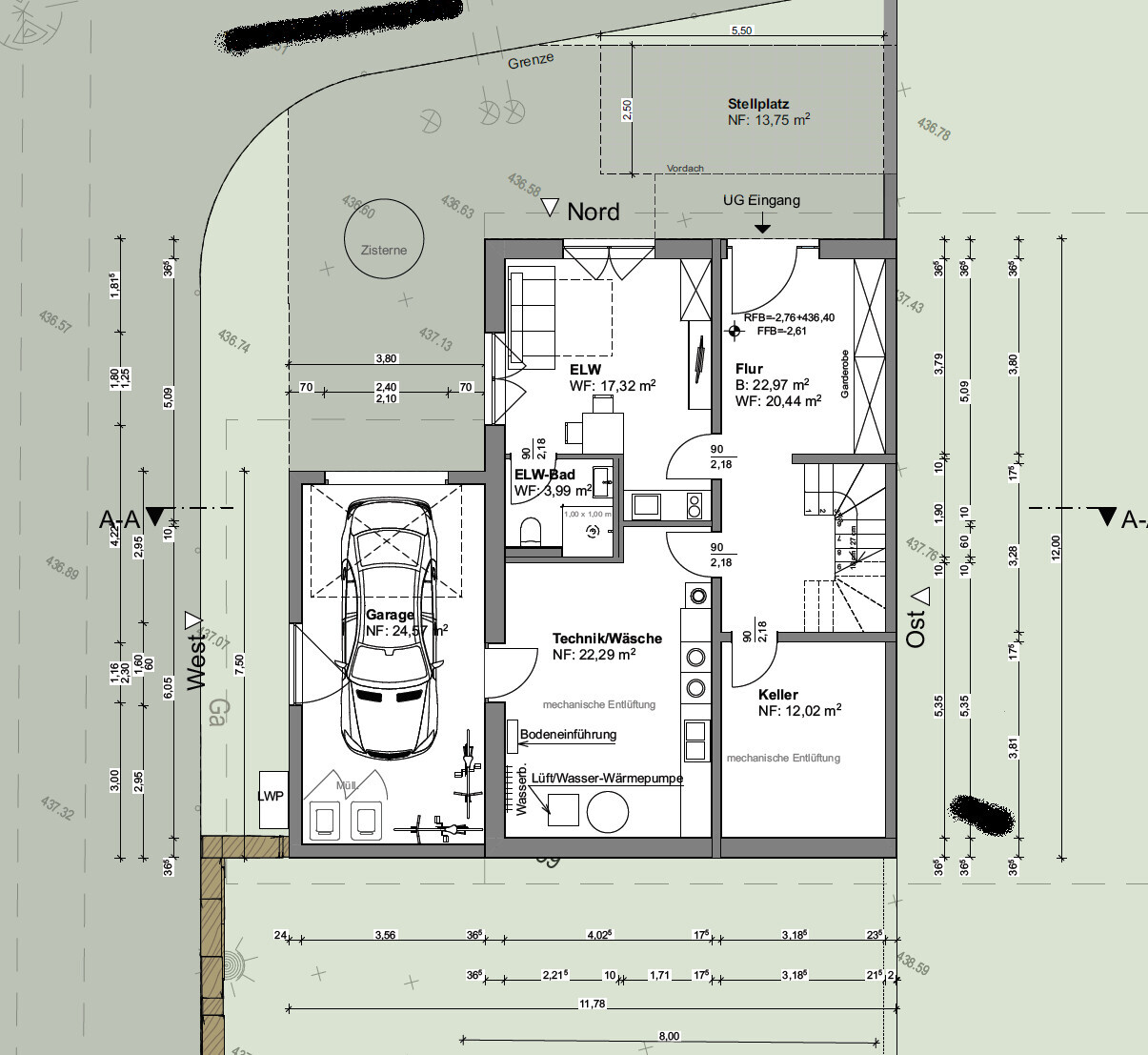
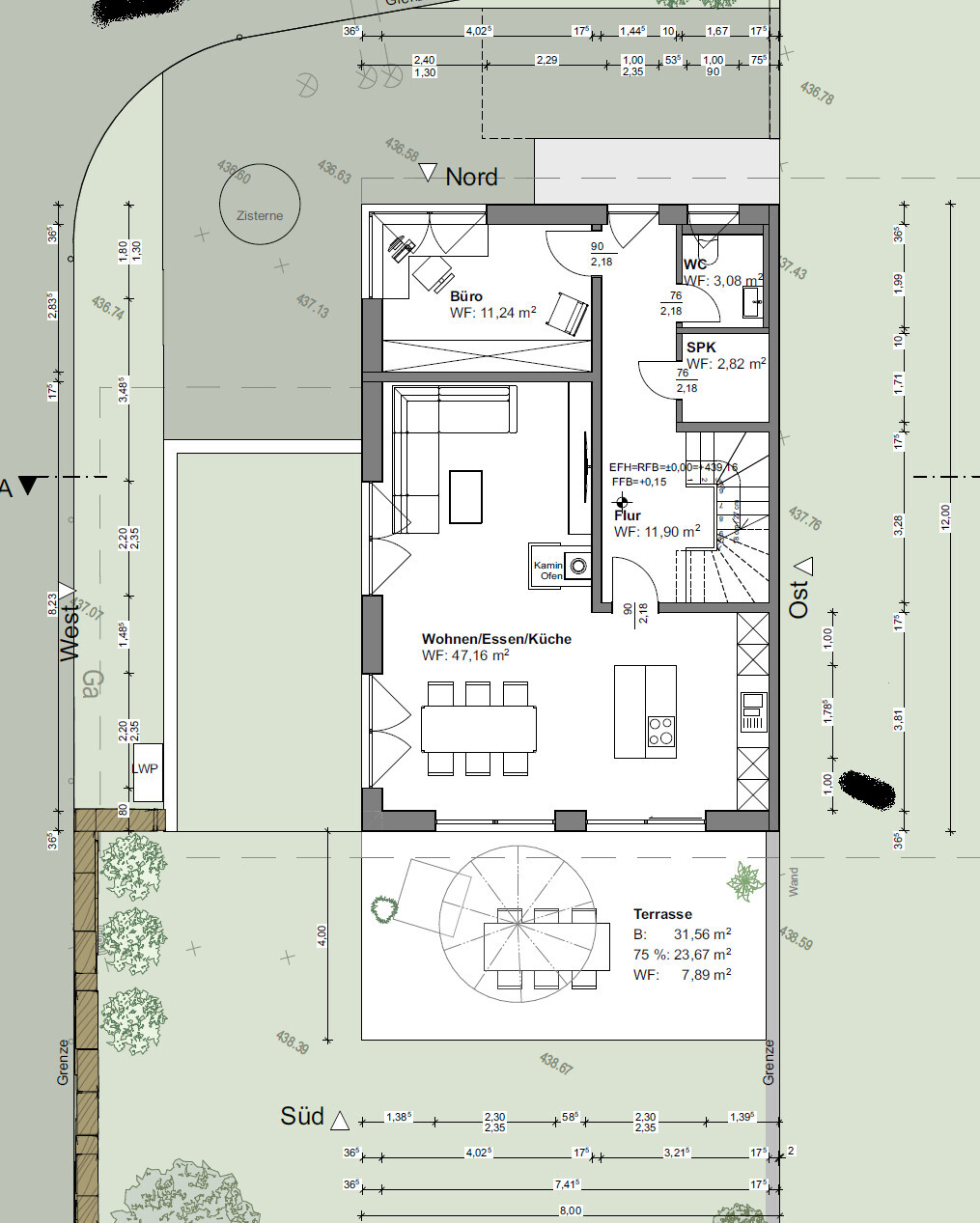
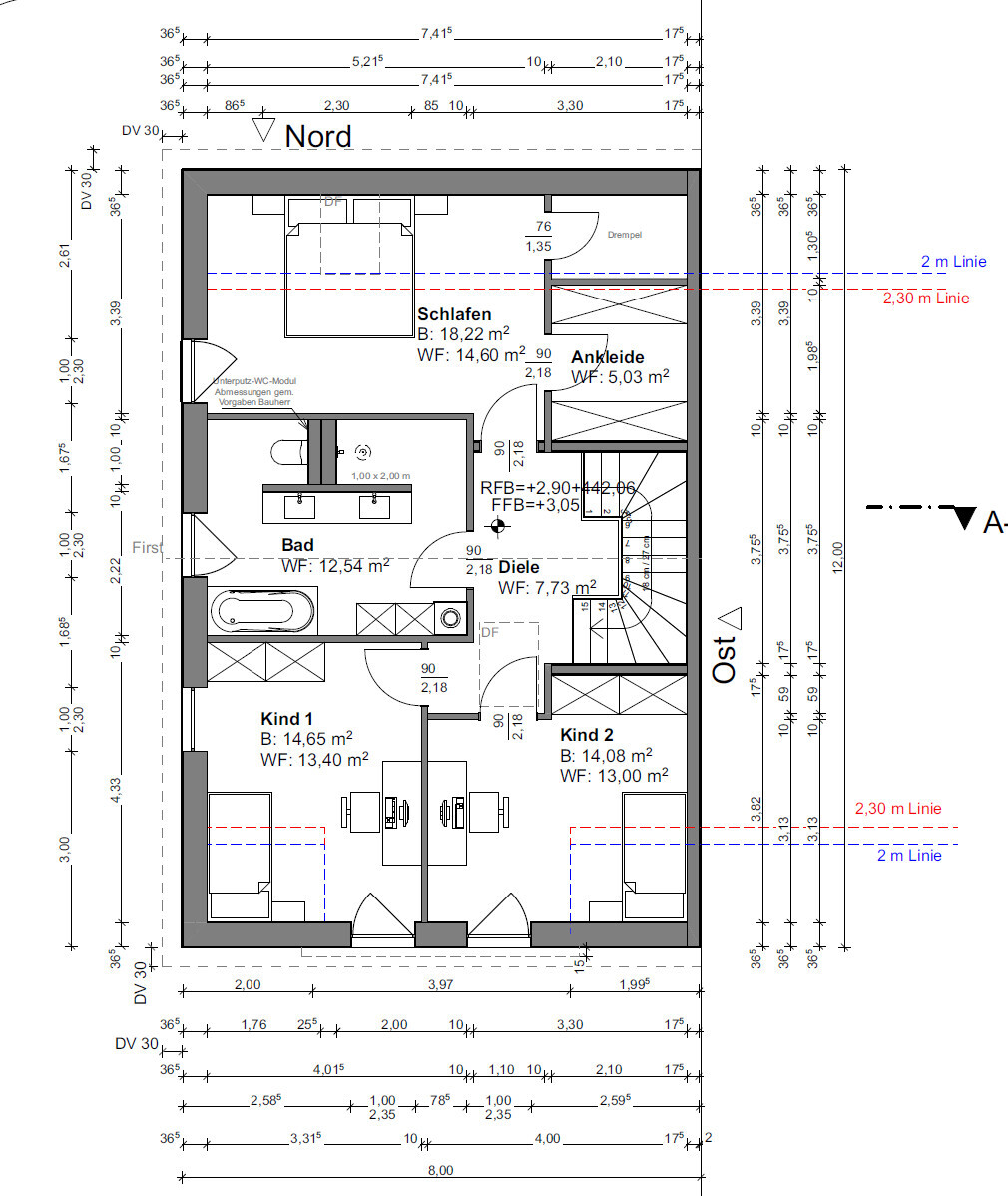
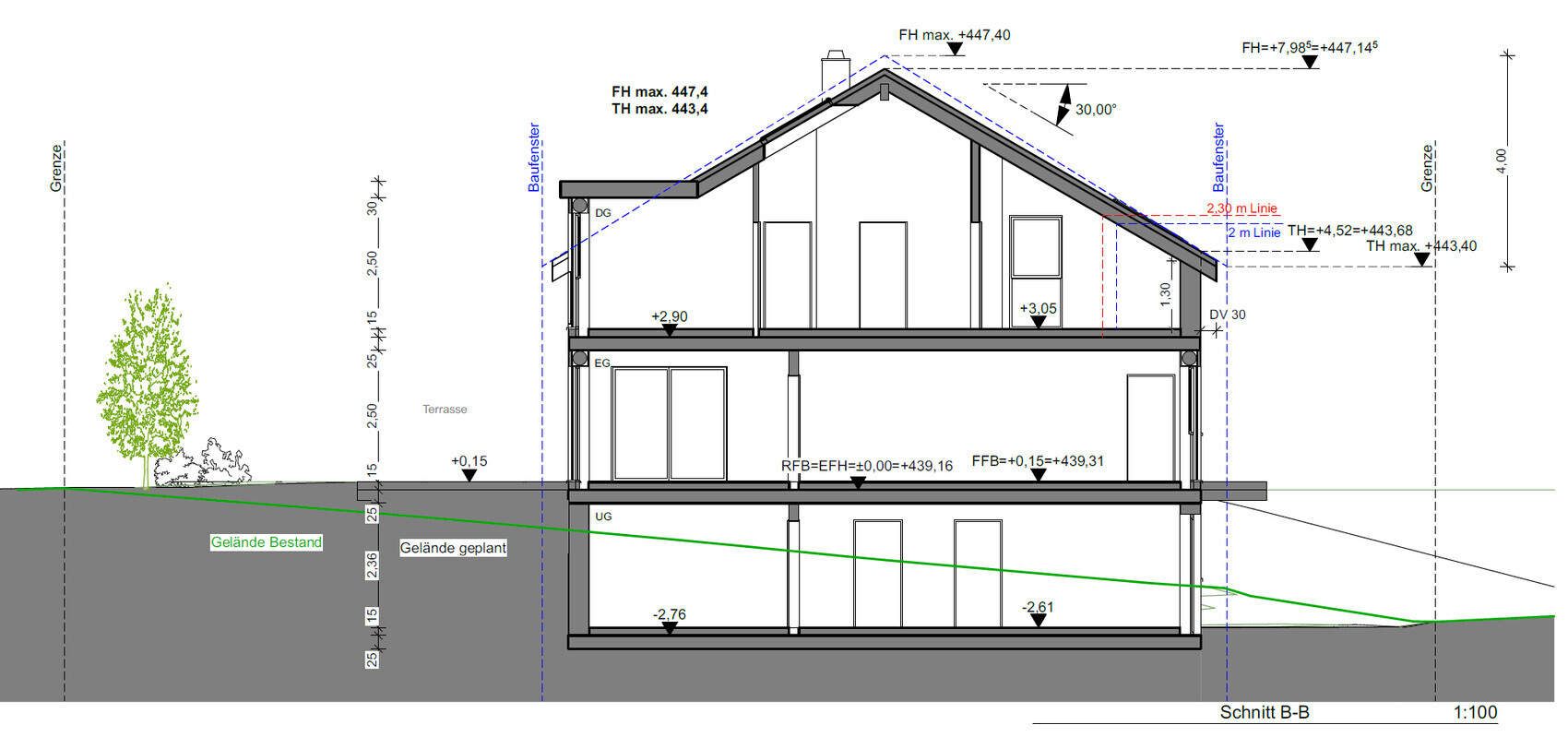
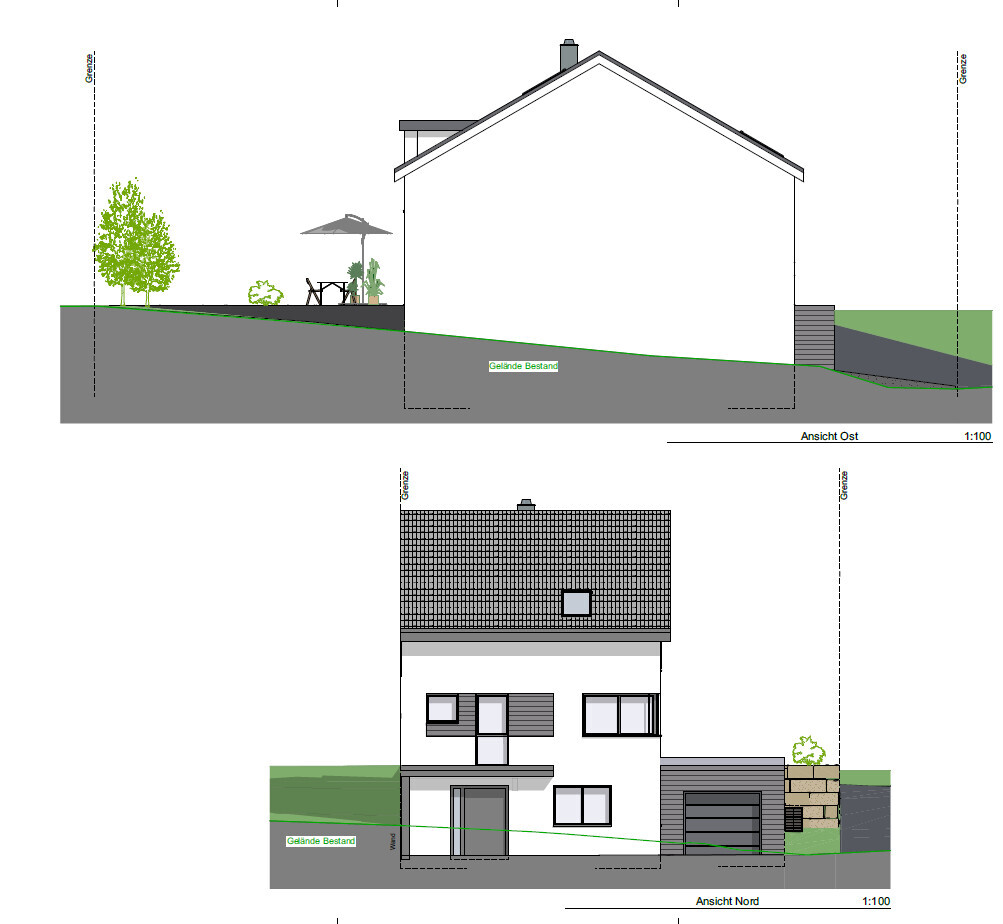
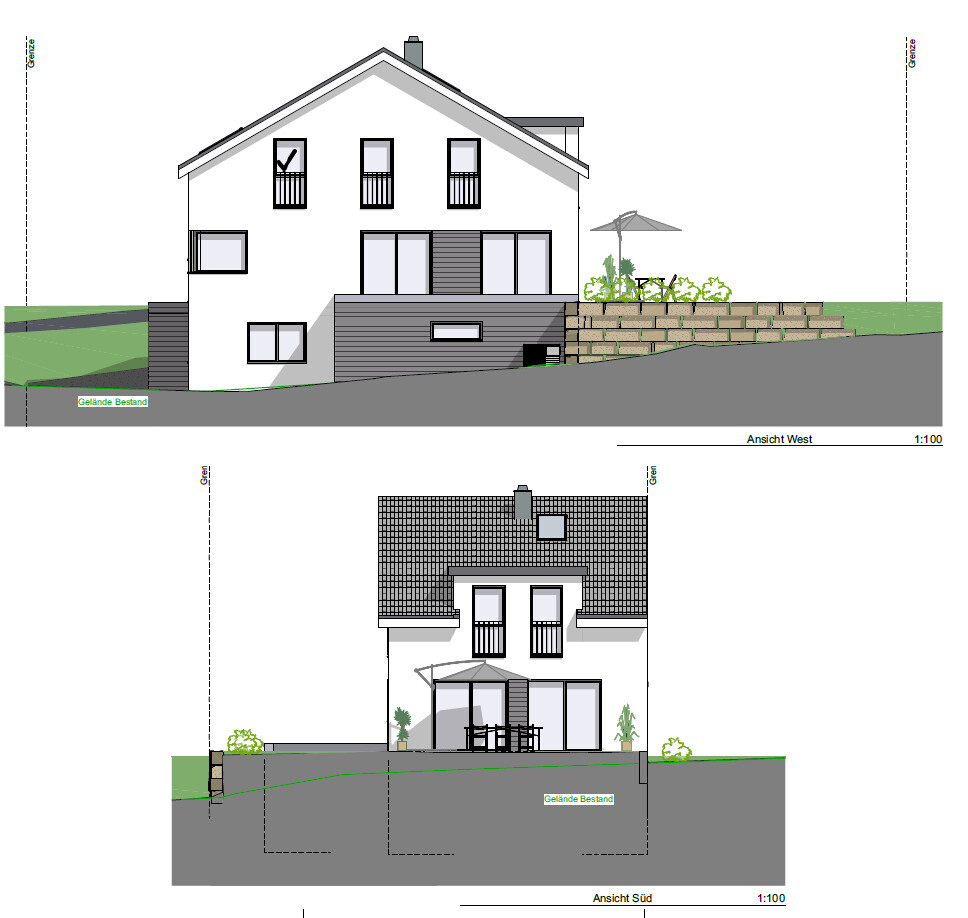
In recent weeks, I shared my experiences searching for and selecting a construction company. Thanks again for all your help and discussions!
As promised, I am posting our current plans here and would appreciate your comments and suggestions. Some minor details are not ideal but likely cannot be changed – I have explained these below.
Development Plan / Restrictions
Plot size: 340m² (3,659 sq ft)
Slope: Yes, approximately 2m (6.5 ft) difference over 17m (56 ft) length
Site coverage ratio: 0.4
Floor area ratio: none
Building envelope, building line and boundary:
Maximum building envelope for semi-detached house: 8x13m (26x43 ft)
Maximum garage building envelope: 5x9m (16x30 ft)
Building boundaries may be exceeded by a maximum of 5m (16 ft) in width and 1.5m (5 ft) in depth per building side, as well as by minor structural elements
Number of parking spaces: 2 cars and 2 bicycles
Storeys: No direct specification, but height limits above sea level apply
Roof type: Gable roof, 30-40° pitch
Architectural style: -
Orientation: Southeast
Maximum heights/limits:
Maximum eaves and ridge heights are given as heights above sea level.
No roof structures are permitted on the north side.
Additional requirements:
A cistern is mandatory. The maximum height of the garage within its designated envelope is specified.
Client Requirements
Style, roof type, building type: Modern, gable roof, semi-detached house
Basement, floors: At least two floors required; the open basement results from the slope
Number of occupants, age: 2 adults in their early/mid-30s, planning for 1-2 children
Space requirements on ground and upper floors:
Ground floor: office, living room, dining room, kitchen, pantry, and shower/WC
Upper floor: bedroom, dressing room, bathroom, and two children’s bedrooms
Office: family use or home office? An office is essential
Overnight guests per year: 2-3 times
Open or closed architecture: Good mix. Kitchen, dining, and living areas are mostly open; the rest are mostly closed
Conservative or modern construction: Modern construction preferred
Open kitchen, island: Open kitchen with island
Number of dining seats: 4-6
Fireplace: Yes, if feasible
Music/sound wall: ?
Balcony, roof terrace: No, not needed
Garage, carport: Double garage is not possible due to development plan restrictions. Therefore, a slightly wider single garage with space for trash bins and bicycles.
Utility garden, greenhouse: No
Additional wishes/special features/daily routine, reasons for preferences:
The master bedroom can be smaller since it is only for sleeping; the space should benefit other rooms.
A large bathroom with a spacious, airy feel.
See also text below.
House Design
Planning source: Discussions with the general contractor and implementation by architects
What do you especially like? Why?
Bathroom – relatively large, wide double vanity, WC somewhat hidden, and walk-in shower without enclosure
Staircase – not too tightly curved for a semi-detached house
Children’s rooms – equally sized but not mirrored exactly, slightly different layouts
What do you not like? Why?
Pantry – unfortunately not directly behind the kitchen, with stairs in between
Ground floor WC – initially planned as a shower toilet but moved to basement due to space constraints
Estimated cost according to architect/planner: approx. 2,400 euros per m² (approx. $220 per sq ft)
Personal price limit for house including fittings:
Preferred heating system: Air-to-water heat pump as a split unit – suggested model was "Weishaupt Air/Water Heat Pump Biblock (WWP LB)"
If you had to give up, which details or expansions would you skip
-Could you skip: Fireplace, granny flat, size of basement hallway, knee wall in master bedroom
-Cannot skip: Large bathroom, pantry and ground floor WC, office
Why was the design created this way?
We discussed our wishes for each floor with the general contractor, who then worked with the architect to create a design.
We reviewed and adjusted the design several times to meet our needs.
The suggestion to place the kitchen directly by the terrace and the living room more inward came from the general contractor.
Additional remarks:
We acquired a plot for a semi-detached house and after long research chose a solid construction provider.
Besides standard rooms, we require two children’s rooms and a home office. Due to the slope, a three-story building with an open basement at the front evolved. An open kitchen-dining-living area with a possible small division to the living room via a fireplace is important to us.
The general contractor proposed placing the kitchen on the garden side for easy access between garden and kitchen/refrigerator, especially in summer. The living area was placed more inward for more privacy. Initially, this seemed unusual since most floor plans are the other way around. Now we find it quite interesting.
After the first draft, two problems arose: the kitchen was too narrow for our ideas. We wanted an open kitchen with a large central island. The dressing room upstairs was hard to use due to layout and a 2m (6.5 ft) boundary line. We reworked the plan extensively and had to move the staircase, which affected the layout on all floors. The dressing room has become acceptable and usable. Unfortunately, these changes meant that the pantry was no longer behind the kitchen and the ground floor WC lost its shower. We see no option to change this without causing other issues.
We do not actually need a granny flat. However, due to the open basement design, an extra room emerged. Initially planned as a hobby room, it became a granny flat because the ground floor shower had to be removed and we wanted a second shower for safety. This is not bad for several reasons: 1) if we are older, we would have everything needed downstairs and on the ground floor; 2) if a child wants to move in, they have a WC and shower; 3) there would be a second shower in the house (in case there are three women living here).
And if you wonder why the house is so large with 192m² (2,067 sq ft) of living space:
We never planned for so much space; it developed naturally. We do not want to change the width of 8m (26 ft), as it would become too narrow. The length of 12m (39 ft) could theoretically be reduced, but currently, only the basement area seems oversized. On the ground floor, space is tight for pantry and shower, and upstairs for dressing room layout.
That’s the overview of our ideas and plans. I look forward to your comments and questions.
What is the most important/basic question about the floor plan in 130 characters?
We would appreciate general opinions on the floor plan.
Have we overlooked anything that only becomes apparent in daily life?
Are there smarter ideas for alternative layouts?
What do you think about the kitchen’s layout and size?
What about the garage size? I’m unsure whether width or length is more important.
What do you think about the door orientations? Some open inward, some outward due to space. Is this inconvenient or acceptable?
If anything is missing, please let me know.
PS: The exterior design of the house and garage (color, wood between windows, etc.) and the type of doors in the dining room (sliding/door/fixed) are not finalized and just roughly sketched. Please disregard.
Thank you!
//Edit: If anyone wonders why the maximum roof height in the plan differs slightly from the building roof height: this was a later change to the development plan and is correct.

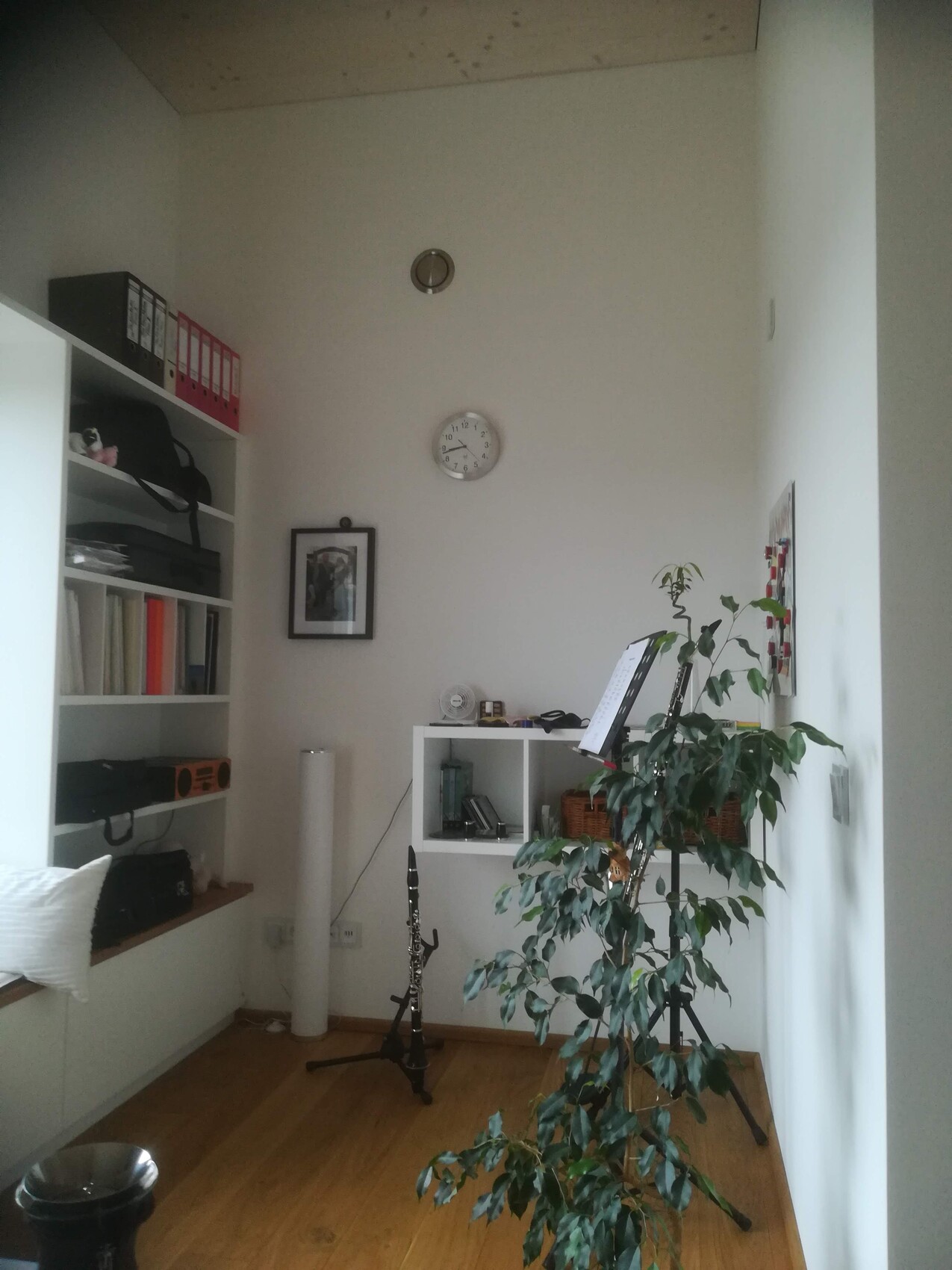
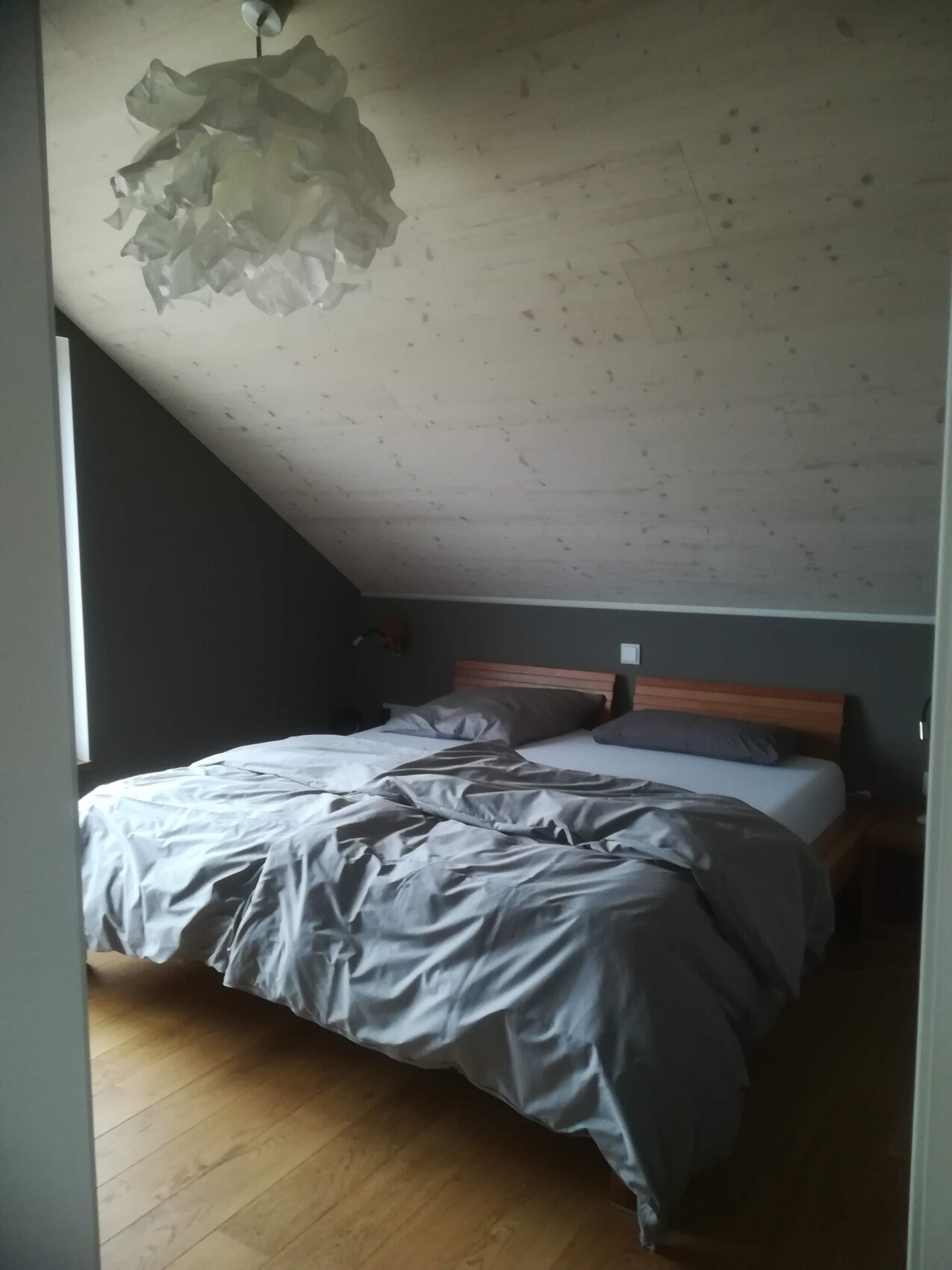
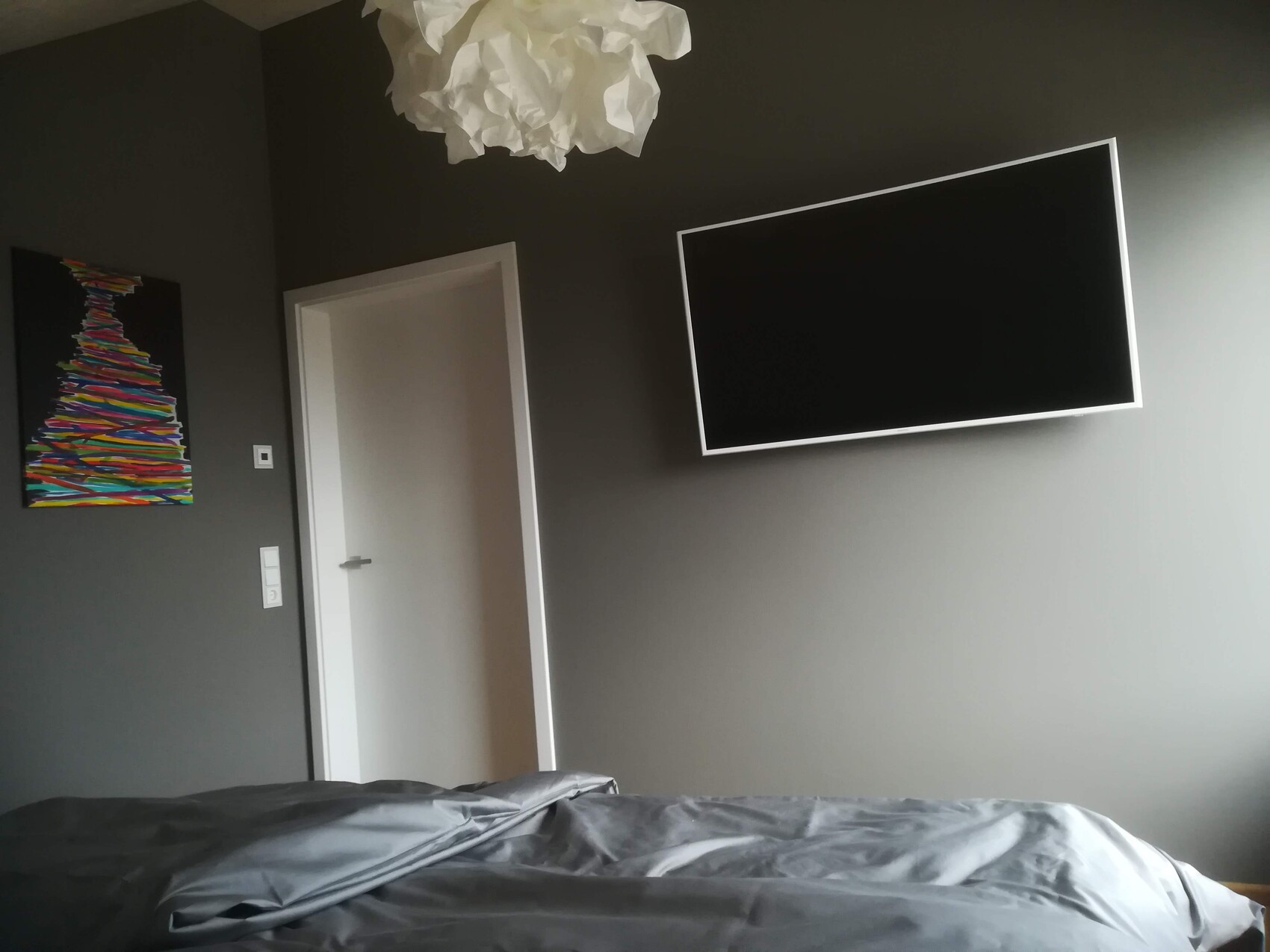
We have it too, even in the smaller rooms. We like it. However, we don’t have an exposed roof structure but a wooden ceiling, and the room is not fully open up to the ridge beam. Still, the high ceilings work well. Especially in the gallery, but also in the relatively small rooms like my office and our bedroom, it fits nicely.
Unfortunately, it’s not as visible in the photos of the smaller rooms – I would have needed a wide-angle lens, but my phone doesn’t have one:
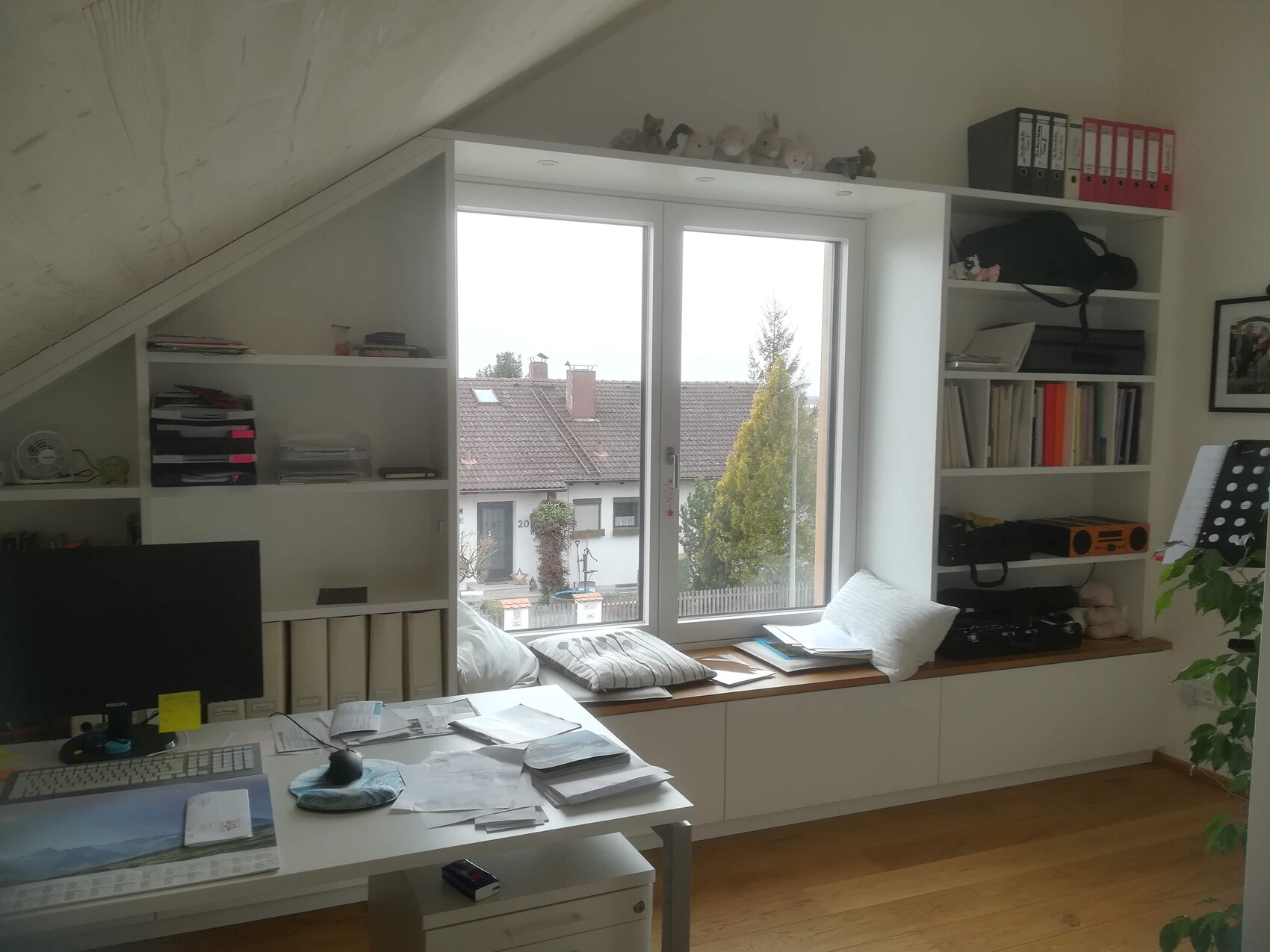
The gallery:
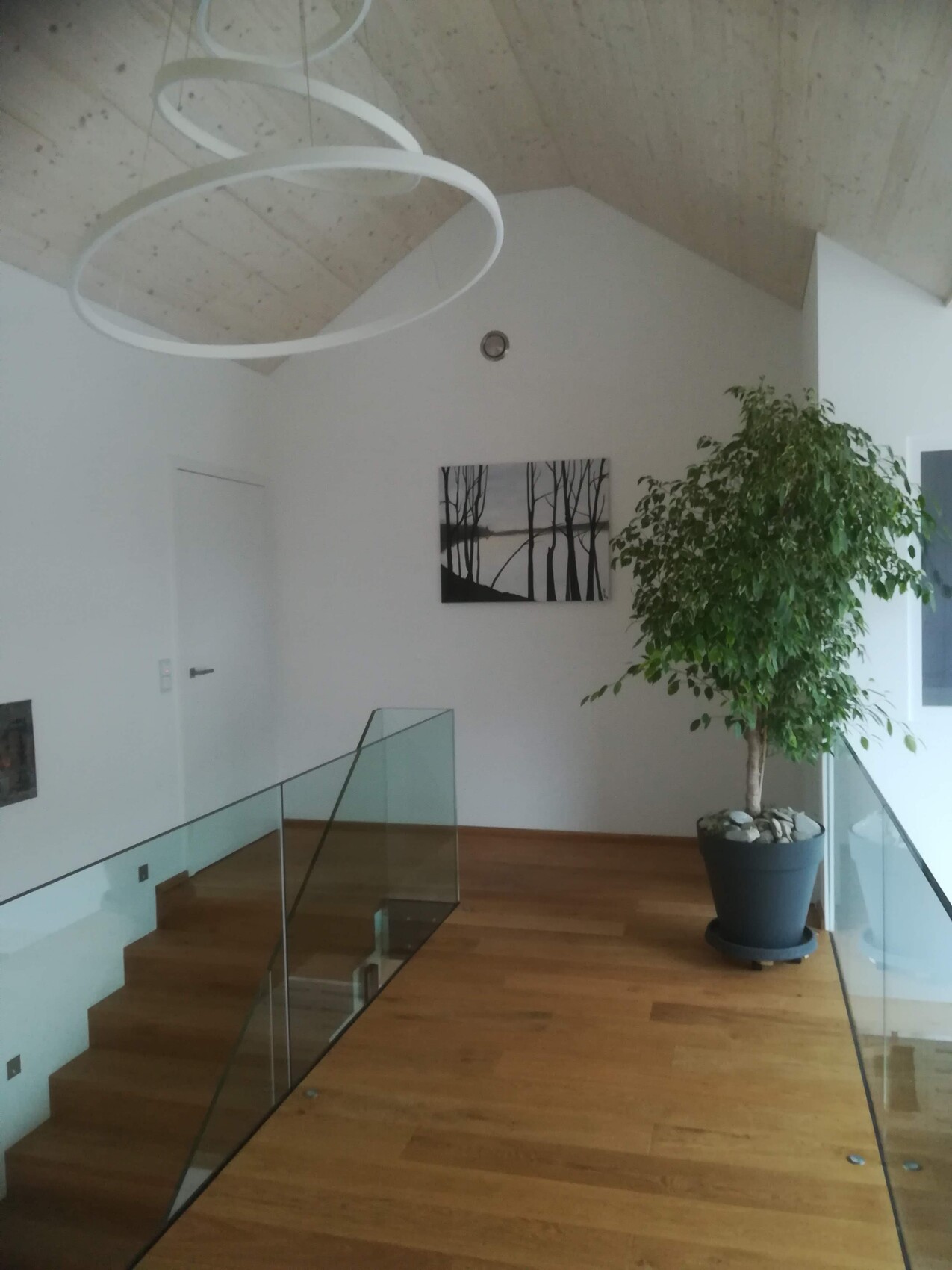
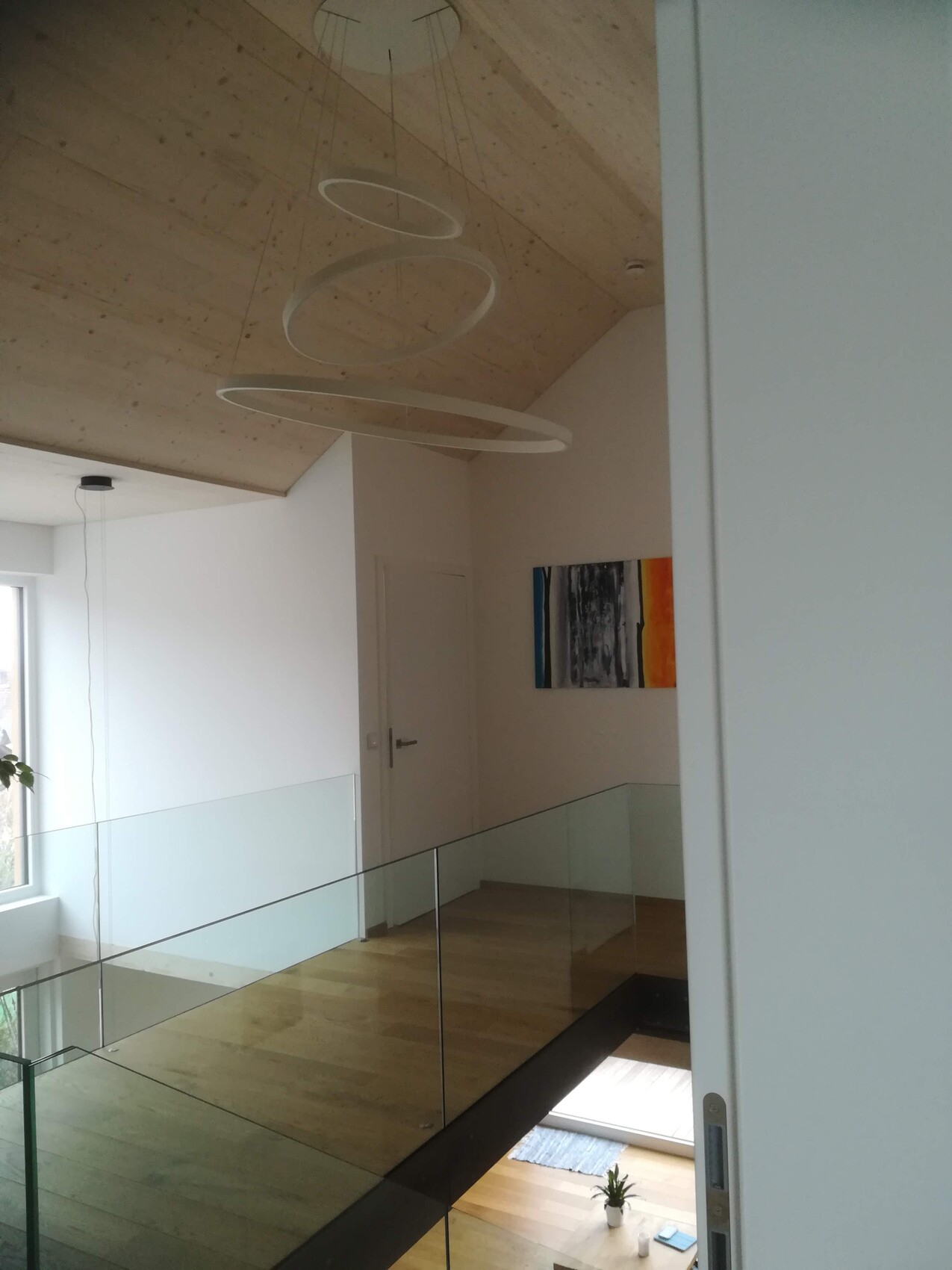
As you can see: the ridge beam is covered in our case. An exposed roof structure was too rustic for us, but it can definitely look good!
For our walk-in closet, we chose a shed dormer because we had the same issue with the sloping roof and cabinet height.
Of course, it depends on the roof pitch – ours is 34° – with a very steep roof I would probably prefer an attic, and if I otherwise had no storage space, that would of course also be an option to create some.
Unfortunately, it’s not as visible in the photos of the smaller rooms – I would have needed a wide-angle lens, but my phone doesn’t have one:
The gallery:
As you can see: the ridge beam is covered in our case. An exposed roof structure was too rustic for us, but it can definitely look good!
For our walk-in closet, we chose a shed dormer because we had the same issue with the sloping roof and cabinet height.
Of course, it depends on the roof pitch – ours is 34° – with a very steep roof I would probably prefer an attic, and if I otherwise had no storage space, that would of course also be an option to create some.
We have a similar setup in the upper floor hallway: also covered without exposed beams. (Offset shed roof with a window in the third gable)
In the bathroom and bedroom, it is fully enclosed.
I experienced it in our old terraced house: a combination of 2 meters (6 ft 7 in) knee wall height and a 22-degree roof pitch. This resulted in rooms with a central height of 3.40 meters (11 ft 2 in).
Because the rooms were narrower than they were tall, I found the space felt oppressive.
The rooms seemed even smaller.
Open doesn’t always mean open: the feeling with a climber roof, for example, is very different than with a high knee wall.
Therefore, it’s important to draw it out and calculate how tall the room will actually be.
In the bathroom and bedroom, it is fully enclosed.
I experienced it in our old terraced house: a combination of 2 meters (6 ft 7 in) knee wall height and a 22-degree roof pitch. This resulted in rooms with a central height of 3.40 meters (11 ft 2 in).
Because the rooms were narrower than they were tall, I found the space felt oppressive.
The rooms seemed even smaller.
Open doesn’t always mean open: the feeling with a climber roof, for example, is very different than with a high knee wall.
Therefore, it’s important to draw it out and calculate how tall the room will actually be.
E
erazorlll15 Jun 2020 12:29@Climbee and @ypg, thank you very much for your answers and especially the pictures.
So, I think an open ridge beam is already off the table. We generally prefer a more modern style, and I’m not sure if that would look too rustic.
Regarding the ceiling height, I’m still undecided. I think in the children’s room it can work well if you can use the extra height. In the bathroom, it is more of a disadvantage. In small rooms, there is a risk it might feel cramped. Maybe a compromise, setting the ceiling relatively high (2.80m or even 3.00m (9 ft 2 in or 9 ft 10 in))?
Then there is the hallway. Because of the semi-detached (duplex) construction, we don’t have natural light here and have therefore planned a skylight. If I close off the ceiling in the hallway, that would obviously be lost. So I would either have to leave the hallway as the only open room (directly under the ridge) or work with a light shaft.
@ypg: do you also have a picture of your hallway on the upper floor? And preferably of the other rooms as well. I briefly checked your blog but didn’t find anything right away.
Regarding your question about room height:
Knee wall is 1.30m (4 ft 3 in) everywhere.
Roof pitch 30°
Ceiling height children’s room: 3.10m (10 ft 2 in)
Ceiling height bedroom: 3.45m (11 ft 4 in)
Ceiling height bathroom and hallway (ridge): 4.30m (14 ft 1 in)
Each measurement is the highest point where the wall meets the ceiling in a cross-section of the room.
So, I think an open ridge beam is already off the table. We generally prefer a more modern style, and I’m not sure if that would look too rustic.
Regarding the ceiling height, I’m still undecided. I think in the children’s room it can work well if you can use the extra height. In the bathroom, it is more of a disadvantage. In small rooms, there is a risk it might feel cramped. Maybe a compromise, setting the ceiling relatively high (2.80m or even 3.00m (9 ft 2 in or 9 ft 10 in))?
Then there is the hallway. Because of the semi-detached (duplex) construction, we don’t have natural light here and have therefore planned a skylight. If I close off the ceiling in the hallway, that would obviously be lost. So I would either have to leave the hallway as the only open room (directly under the ridge) or work with a light shaft.
@ypg: do you also have a picture of your hallway on the upper floor? And preferably of the other rooms as well. I briefly checked your blog but didn’t find anything right away.
Regarding your question about room height:
Knee wall is 1.30m (4 ft 3 in) everywhere.
Roof pitch 30°
Ceiling height children’s room: 3.10m (10 ft 2 in)
Ceiling height bedroom: 3.45m (11 ft 4 in)
Ceiling height bathroom and hallway (ridge): 4.30m (14 ft 1 in)
Each measurement is the highest point where the wall meets the ceiling in a cross-section of the room.
erazorlll schrieb:
We generally prefer a modern style, and I’m not sure if this looks too rustic.It looks modern!erazorlll schrieb:
If I close off the ceiling in the hallway, of course that option is eliminated. So I would have to either leave the hallway as the only open room (directly under the ridge) or work with a light shaft.That’s no problem if you design the hallway differently. You can also add a skylight above the bathroom door to get nice natural light in the hallway.erazorlll schrieb:
Do you also have a picture of your upstairs hallway? And the other rooms as well. I briefly looked at your blog but didn’t find anything right away.The hallway won’t help much because our roof pitch is oriented differently. Attached is the bedroom with a 135cm (53 inch) knee wall and a roof pitch of 26 or 28 degrees. The clear ceiling height here is only 235cm (7 ft 9 in).
ypg schrieb:
A hallway won’t help you further because the roof pitch is reversed.Is that maintenance hatch for the boiler room at the apex?https://www.instagram.com/11antgmxde/
https://www.linkedin.com/company/bauen-jetzt/
11ant schrieb:
Is that the maintenance hatch for the heating room at the peak?These will be my parents’ future accommodations :P
No, these are so-called attic hatches, which make the space above the suspended ceiling in the bathroom and bedroom accessible by crawling.
Similar topics