
ᐅ Installation of an Air-to-Water Heat Pump – Is This Setup Correct?
Created on: 6 Jun 2020 13:58
M
Mertha257
Hello dear forum members,
We have been considering the installation location for our planned air-to-water heat pump for several days now. It is intended to be placed on the east side of the house, specifically in the gap between the bay window wall and the back wall of the garage (see image).
The discharge direction would be toward the east, away from the house, but after about 3 meters (10 feet) there is the neighbor’s garage/garden shed.
After researching various manufacturers, the heat pump fits in this space, as the minimum clearances from walls at the back and sides range between 15–40 cm (6–16 inches), which we can achieve.
However, I have two concerns:
1.) Possible thermal short-circuit: Given the enclosure by the bay window, our own garage rear wall, and the neighboring building, will the air-to-water heat pump be able to discharge the used, cooler air effectively enough and far enough so that sufficient fresh, warm air can flow to the intake? I do not want to compromise the efficiency of the heat pump due to the installation location. Unfortunately, there is no other feasible place to install it...
2.) Noise impact: It is often advised that air-to-water heat pumps should not be placed in wall niches or corners to avoid sound amplification/reflection. Although I plan to decouple the heat pump as much as possible and build a proper foundation, our bedroom is located on the first floor directly above this spot.
What are your thoughts on these two points? Do you have any experience regarding this? Point #1 is especially important to me, as I have found some good approaches to avoid or reduce noise.
Thank you very much for your advice!
Have a great weekend everyone!
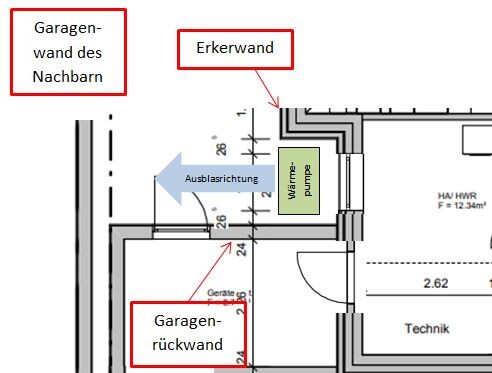
We have been considering the installation location for our planned air-to-water heat pump for several days now. It is intended to be placed on the east side of the house, specifically in the gap between the bay window wall and the back wall of the garage (see image).
The discharge direction would be toward the east, away from the house, but after about 3 meters (10 feet) there is the neighbor’s garage/garden shed.
After researching various manufacturers, the heat pump fits in this space, as the minimum clearances from walls at the back and sides range between 15–40 cm (6–16 inches), which we can achieve.
However, I have two concerns:
1.) Possible thermal short-circuit: Given the enclosure by the bay window, our own garage rear wall, and the neighboring building, will the air-to-water heat pump be able to discharge the used, cooler air effectively enough and far enough so that sufficient fresh, warm air can flow to the intake? I do not want to compromise the efficiency of the heat pump due to the installation location. Unfortunately, there is no other feasible place to install it...
2.) Noise impact: It is often advised that air-to-water heat pumps should not be placed in wall niches or corners to avoid sound amplification/reflection. Although I plan to decouple the heat pump as much as possible and build a proper foundation, our bedroom is located on the first floor directly above this spot.
What are your thoughts on these two points? Do you have any experience regarding this? Point #1 is especially important to me, as I have found some good approaches to avoid or reduce noise.
Thank you very much for your advice!
Have a great weekend everyone!
M
Mertha2579 Jun 2020 13:46Snowy36 schrieb:
Yes, we will actually position it so that it blows onto our property, but it is located less than 3 meters (10 feet) from the property line, which is why we have written consent. Otherwise, the neighbor is very understanding...However, after reading hausnrplus25’s post, I wonder if this is sensible or necessary, considering that only the noise emission is legally regulated or should be. I need to do some more research regarding Schleswig-Holstein.
 hausnrplus259 Jun 2020 20:35
But even with the neighbor's consent, it still needs to be officially approved first, right? Please feel free to provide an update.
We have also found varying information. However, we have noted that at a distance of 3 m (10 feet), only 35 dB is allowed.
We have also found varying information. However, we have noted that at a distance of 3 m (10 feet), only 35 dB is allowed.
T
T_im_Norden9 Jun 2020 20:42Limit values according to TA-Luft must be complied with.
Which rooms are located on your neighbor's side?
Which rooms are located on your neighbor's side?
M
Mertha2579 Jun 2020 21:58T_im_Norden schrieb:
Limit values according to TA-Luft must be complied with.
Which rooms does the neighbor have on your side? At the property boundary, the neighbor doesn’t have any living spaces, only their garage and a shed or garden house.
Does that mean I am responsible for both
1. obtaining written permission to place something less than 3 m (10 feet) from the property boundary, and
2. ensuring that 35 dB is not exceeded?
Thank you!
35dB is specified by the TA-Lärm guideline only for nighttime, only in purely residential areas, and only for "protected rooms." Specifically: the heat pump must not generate more than 35dB of noise in front of your neighbor’s bedroom window at night. The garage is not considered a protected room according to TA-Lärm. However, it is still advisable to coordinate with your neighbor if you are blowing cold air onto their property from a distance of 1m (3 feet).
Regards, Karl
Regards, Karl
Regarding building setback requirements, 3 meters (10 feet) are only necessary if, in a dispute, a court classifies your heat pump as a "building structure." There have already been rulings referencing the noise emissions of the heat pump. The reasoning is that the heat pump causes disturbances to the neighbor similar to those that could be caused by a building structure.
Regards, Karl H.
Regards, Karl H.
Similar topics