
Hello everyone,
we are currently planning our single-family house in Würzburg, and the building permit / planning permission application has been in process for about three weeks. Hopefully, we can start construction in October 2020:
- Plot size: 774 m² (8329 ft²), of which approximately 500 m² (5382 ft²) is buildable, due to about 27% sloping terrain facing south and the plot being somewhat irregular with a path on it.
- Solid construction house, 2 floors, footprint 11 x 15 m (36 x 49 ft). The basement is about two-thirds underground because of the slope.
- Roof pitch 23-30°, gable roof. Roof orientation southwest (or northeast, depending on perspective), so I calculate the southwest roof area as 6.24 m x 15 m = about 93.6 m² (assuming the 30° pitch).
- Household of 5 (2 adults, one ten-year-old child, and 2 babies), living area 214 m² (2303 ft²).
- Planned photovoltaic system with full coverage, air-to-water heat pump, underfloor heating, and central ventilation system with heat recovery. A ground source heat pump with trench collector is unfortunately not possible, as rock is expected everywhere at about 1-1.20 m (3-4 ft) depth.
Two days ago, I had a very interesting meeting with my architect and a solar technician on site.
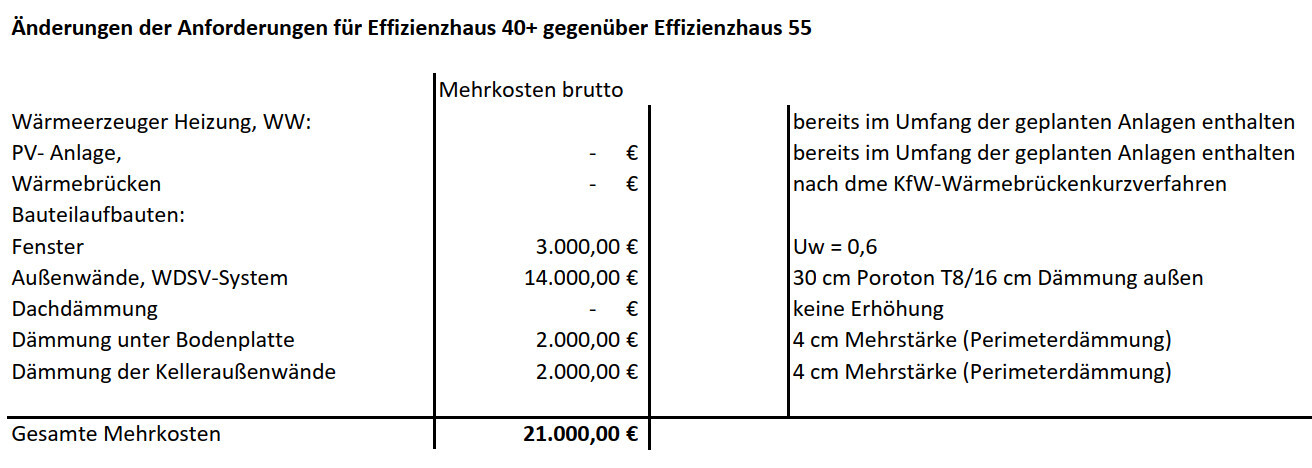
My architect calculated the additional costs for KfW 40 instead of KfW 55. For about €21,000, we can achieve KfW 40, which is less than he initially expected (he had estimated €50,000 and was originally reluctant to perform this calculation; I pushed for it). He has since changed his opinion and now recommends it. The solar technician said during the discussion that for our 5-person family and an estimated annual electricity consumption of 10 kilowatt (his estimate), a battery storage system would probably make sense anyway (as a layperson, I had previously thought a battery storage system would not be worthwhile). Since we already meet all requirements for 40+ except for the battery storage, reaching KfW 40+ would be possible directly.
This brings me to the following considerations:
Pros of 40+:
- €12,000 repayment bonus from the government in addition
- Lower heating costs, higher resale value
- Higher energy self-sufficiency through the battery storage
Cons of 40+:
- 30 cm (12 inches) thick (and somewhat harder) brick wall with external thermal insulation instead of the previously planned 40.5 cm (16 inches) thick (softer) brick wall with internal insulation
- €21,000 additional costs
- About €5,000 extra costs for the battery storage
But what do you think? 55 or 40+?
For completeness, here is the architect’s calculation:
we are currently planning our single-family house in Würzburg, and the building permit / planning permission application has been in process for about three weeks. Hopefully, we can start construction in October 2020:
- Plot size: 774 m² (8329 ft²), of which approximately 500 m² (5382 ft²) is buildable, due to about 27% sloping terrain facing south and the plot being somewhat irregular with a path on it.
- Solid construction house, 2 floors, footprint 11 x 15 m (36 x 49 ft). The basement is about two-thirds underground because of the slope.
- Roof pitch 23-30°, gable roof. Roof orientation southwest (or northeast, depending on perspective), so I calculate the southwest roof area as 6.24 m x 15 m = about 93.6 m² (assuming the 30° pitch).
- Household of 5 (2 adults, one ten-year-old child, and 2 babies), living area 214 m² (2303 ft²).
- Planned photovoltaic system with full coverage, air-to-water heat pump, underfloor heating, and central ventilation system with heat recovery. A ground source heat pump with trench collector is unfortunately not possible, as rock is expected everywhere at about 1-1.20 m (3-4 ft) depth.
Two days ago, I had a very interesting meeting with my architect and a solar technician on site.
My architect calculated the additional costs for KfW 40 instead of KfW 55. For about €21,000, we can achieve KfW 40, which is less than he initially expected (he had estimated €50,000 and was originally reluctant to perform this calculation; I pushed for it). He has since changed his opinion and now recommends it. The solar technician said during the discussion that for our 5-person family and an estimated annual electricity consumption of 10 kilowatt (his estimate), a battery storage system would probably make sense anyway (as a layperson, I had previously thought a battery storage system would not be worthwhile). Since we already meet all requirements for 40+ except for the battery storage, reaching KfW 40+ would be possible directly.
This brings me to the following considerations:
Pros of 40+:
- €12,000 repayment bonus from the government in addition
- Lower heating costs, higher resale value
- Higher energy self-sufficiency through the battery storage
Cons of 40+:
- 30 cm (12 inches) thick (and somewhat harder) brick wall with external thermal insulation instead of the previously planned 40.5 cm (16 inches) thick (softer) brick wall with internal insulation
- €21,000 additional costs
- About €5,000 extra costs for the battery storage
But what do you think? 55 or 40+?
For completeness, here is the architect’s calculation:
N
nordbayer17 May 2020 10:16For KfW 55, you will need an energy consultant anyway. You pay them specifically to answer these kinds of questions. Otherwise, you can create a large Excel sheet and try to estimate it yourself, but without knowledge of thermal bridge details, it is quite inaccurate.
In principle, it might just be possible, but with solid construction, KfW 40 is often not really cost-effective.
By the way, you should install ventilation regardless. If it’s missing, you will regret it...
In principle, it might just be possible, but with solid construction, KfW 40 is often not really cost-effective.
By the way, you should install ventilation regardless. If it’s missing, you will regret it...
T
TraumvHaus17 May 2020 10:21Currently, we do not have an energy consultant, so we have a question.
We were thinking about going for the 40 plus standard since photovoltaic panels and battery storage are already planned, and the higher subsidies are quite attractive.
As mentioned, it is important to us that no additional insulation or insulated bricks, etc., are required – otherwise, that would be an immediate deal-breaker.
Regarding the ventilation system, there are probably 10,000 different opinions. If we go for KfW 40 plus, we understand that one must be installed.
We were thinking about going for the 40 plus standard since photovoltaic panels and battery storage are already planned, and the higher subsidies are quite attractive.
As mentioned, it is important to us that no additional insulation or insulated bricks, etc., are required – otherwise, that would be an immediate deal-breaker.
Regarding the ventilation system, there are probably 10,000 different opinions. If we go for KfW 40 plus, we understand that one must be installed.
R
RotorMotor17 May 2020 10:28Energy storage systems do not make sense without subsidies.
Central controlled residential ventilation not only reduces humidity and saves energy but also increases comfort.
Whether additional insulation is needed must be calculated (or have it calculated).
Central controlled residential ventilation not only reduces humidity and saves energy but also increases comfort.
Whether additional insulation is needed must be calculated (or have it calculated).
N
nordbayer17 May 2020 10:28There are also 49cm (19 inches) bricks available, which will definitely work. Or insulated bricks with a lambda value of 0.07. With 42cm (16.5 inches), it might work if the rest of the building is insulated accordingly more intensively.
Yes, the thermal storage tank is the largest unnecessary cost factor for systems over 40, so financially it could add up. And with 40, you might also be able to use a smaller heating system that is slightly cheaper. However, achieving the BAFA subsidy with 40 will be more difficult...
Yes, the thermal storage tank is the largest unnecessary cost factor for systems over 40, so financially it could add up. And with 40, you might also be able to use a smaller heating system that is slightly cheaper. However, achieving the BAFA subsidy with 40 will be more difficult...
T
TraumvHaus17 May 2020 10:41We did not want to use the 49cm (19 inches) bricks because we would lose a significant amount of living space. We also do not want the insulated bricks. It either works with the 42.5cm (17 inches) bricks or it doesn’t.
Thanks for the tip about the BAFA subsidy – we definitely planned for that. I will need to check with our plumber again.
Thanks for the tip about the BAFA subsidy – we definitely planned for that. I will need to check with our plumber again.
N
nordbayer17 May 2020 10:59The issue with BAFA regarding air-to-water heat pumps and kfw40 standards is the lower heating limit temperature used in the annual performance factor calculation, which typically causes the annual performance factor to drop below 4.5. I have no idea how exactly BAFA will verify the calculations.
At this point, a reminder that, with some clever approach, the entire cost of the mechanical ventilation with heat recovery can also be subsidized at 35%.
At this point, a reminder that, with some clever approach, the entire cost of the mechanical ventilation with heat recovery can also be subsidized at 35%.