
ᐅ The wall has uneven discoloration. What can be done? New construction.
Created on: 11 May 2020 20:58
T
Tx-25
Hello, what can we do about the appearance shown in the picture? We applied a thick base coat of gypsum plaster with Pufas Grundierweis GP5. The finishing coat with Herbol RF was also applied thickly. The picture even shows a double finishing coat. Application was done with a roller. Does it need to be applied differently?
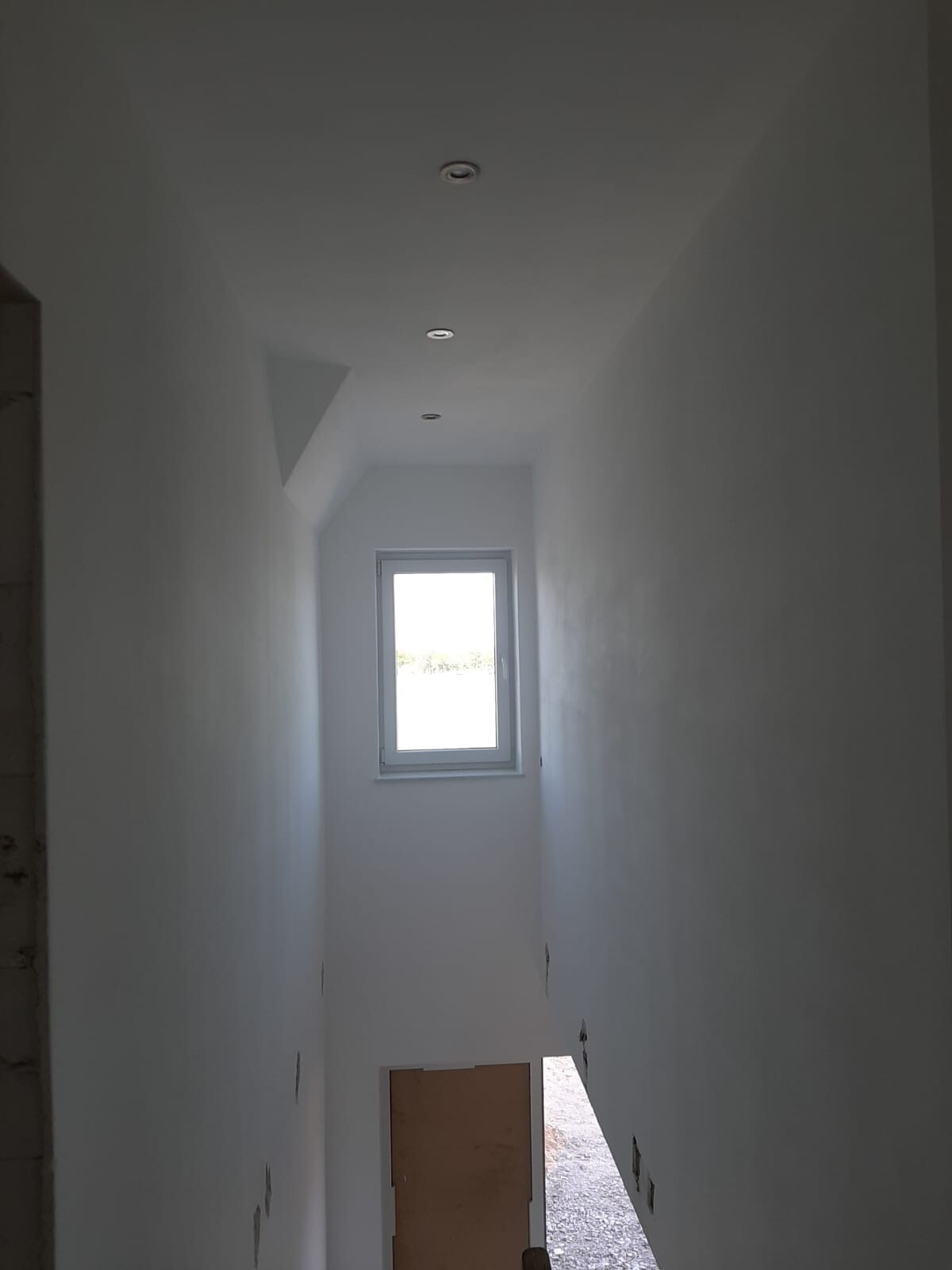
It is hard to see in the picture, but it is clearly visible in person.
It is hard to see in the picture, but it is clearly visible in person.

Oh, come on...
Painting is a pain.
Everyone assumes I just paint the wall white.
Raking light is very unforgiving. Here are some other possible issues:
- Paint applied too thickly, resulting in uneven coverage
- The roller wasn’t "loaded" often enough, so the end of the roller stroke was too dry, leading to uneven coverage (see first point)
- Unevenly sanded surface—you even mentioned the wall reacted differently to sanding (clearly not the fault of the person who sanded)
- The surface itself isn’t completely flat, causing shadows
What could have been done? Hire a professional, but even then, some might have had a similar result. If you want a perfectly smooth surface, use painter’s fleece, but that requires an absolutely flawless substrate.
What now? See the reply from @Zaba12
Edit: I don’t really understand the hype around perfectly smooth walls. It doesn’t have to be a coarse plaster finish, but I personally prefer a slight residual texture with about 1mm (0.04 inches) grain.
Painting is a pain.
Everyone assumes I just paint the wall white.
Raking light is very unforgiving. Here are some other possible issues:
- Paint applied too thickly, resulting in uneven coverage
- The roller wasn’t "loaded" often enough, so the end of the roller stroke was too dry, leading to uneven coverage (see first point)
- Unevenly sanded surface—you even mentioned the wall reacted differently to sanding (clearly not the fault of the person who sanded)
- The surface itself isn’t completely flat, causing shadows
What could have been done? Hire a professional, but even then, some might have had a similar result. If you want a perfectly smooth surface, use painter’s fleece, but that requires an absolutely flawless substrate.
What now? See the reply from @Zaba12
Edit: I don’t really understand the hype around perfectly smooth walls. It doesn’t have to be a coarse plaster finish, but I personally prefer a slight residual texture with about 1mm (0.04 inches) grain.
Zaba12 schrieb:
I can’t help myself, sorry!
I would be more concerned about cleaning the windows and changing the light bulbs. I’ll only worry about the light bulbs in 10 years, maybe if an LED fails.
We really wanted the window because we want to maximize natural light, and the window is also crucial for the exterior appearance (two windows side by side at the top of the gable).
The window will be cleaned once a year when we put up the Christmas decorations. The stair landing plus a ladder should make that easy.
face26 schrieb:
- Unevenly sanded surface, you yourself said the wall reacted differently to sanding (obviously it wasn’t the fault of the person who did the sanding) I did the sanding. So the wall must be to blame.
When I saw the sanding marks, I asked a painter who said it was quite normal. Honestly, I had never seen such pronounced marks on interior walls before. He just said the paint would cover it again. But that is only true to some extent.
face26 schrieb:
Edit: I don’t really get the hype about super smooth walls. It doesn’t have to be perfect plaster, but I prefer a slight texture with a grain of about 1mm. A 1mm grain is fine. But this kind of appearance caused by grazing light is really unpleasant. The photos don’t even fully capture it.
Is there a special type of paint that handles grazing light better?
Our paint is white with a matte eggshell finish. Could that be the reason?
…well, let’s say this… if you sand and paint as well as you take photos…
I’m not an expert either, I’ve just seen this many times during our previous renovations and at friends’ houses.
The only results I’ve seen so far without any “patchiness” were always walls and ceilings done by professionals and always with painter’s fleece. Mostly drywall (plasterboard) walls. Those are already flat by themselves. If you have a brick wall and then the plasterer applies the interior plaster over it, no matter how good they are, they won’t get it perfectly smooth without any unevenness like a drywall wall. And with the latter, every small filler patch is visible if it’s not done perfectly clean.
Under raking light, you hardly have a chance. But hardly anyone gets upset about that.
Of course, it might look much worse in reality and it just can’t be seen in photos.
I’m not an expert either, I’ve just seen this many times during our previous renovations and at friends’ houses.
The only results I’ve seen so far without any “patchiness” were always walls and ceilings done by professionals and always with painter’s fleece. Mostly drywall (plasterboard) walls. Those are already flat by themselves. If you have a brick wall and then the plasterer applies the interior plaster over it, no matter how good they are, they won’t get it perfectly smooth without any unevenness like a drywall wall. And with the latter, every small filler patch is visible if it’s not done perfectly clean.
Under raking light, you hardly have a chance. But hardly anyone gets upset about that.
Of course, it might look much worse in reality and it just can’t be seen in photos.
F
fach1werk14 May 2020 07:48It would have been better if you had applied some filler over the unevenly sanded areas. Those spots are always noticeable. It’s also preferable to apply several thin layers rather than one thick one. Thickness is not a sign of quality here. The fillers help smooth out imperfections when you go over them, but why would the material fill in one spot and not another? With paint containing fillers, you can lightly sand off small imperfections. But I don’t think it’s that bad. Even though I can paint well, for example, I’ve produced terrible walls at too high room temperatures, where the paint seemed to bake onto the surface. Everyone makes mistakes.
Best regards
Gabriele
Best regards
Gabriele
Similar topics