
Hello everyone,
we are currently planning our single-family house in Würzburg, and the building permit / planning permission application has been in process for about three weeks. Hopefully, we can start construction in October 2020:
- Plot size: 774 m² (8329 ft²), of which approximately 500 m² (5382 ft²) is buildable, due to about 27% sloping terrain facing south and the plot being somewhat irregular with a path on it.
- Solid construction house, 2 floors, footprint 11 x 15 m (36 x 49 ft). The basement is about two-thirds underground because of the slope.
- Roof pitch 23-30°, gable roof. Roof orientation southwest (or northeast, depending on perspective), so I calculate the southwest roof area as 6.24 m x 15 m = about 93.6 m² (assuming the 30° pitch).
- Household of 5 (2 adults, one ten-year-old child, and 2 babies), living area 214 m² (2303 ft²).
- Planned photovoltaic system with full coverage, air-to-water heat pump, underfloor heating, and central ventilation system with heat recovery. A ground source heat pump with trench collector is unfortunately not possible, as rock is expected everywhere at about 1-1.20 m (3-4 ft) depth.
Two days ago, I had a very interesting meeting with my architect and a solar technician on site.
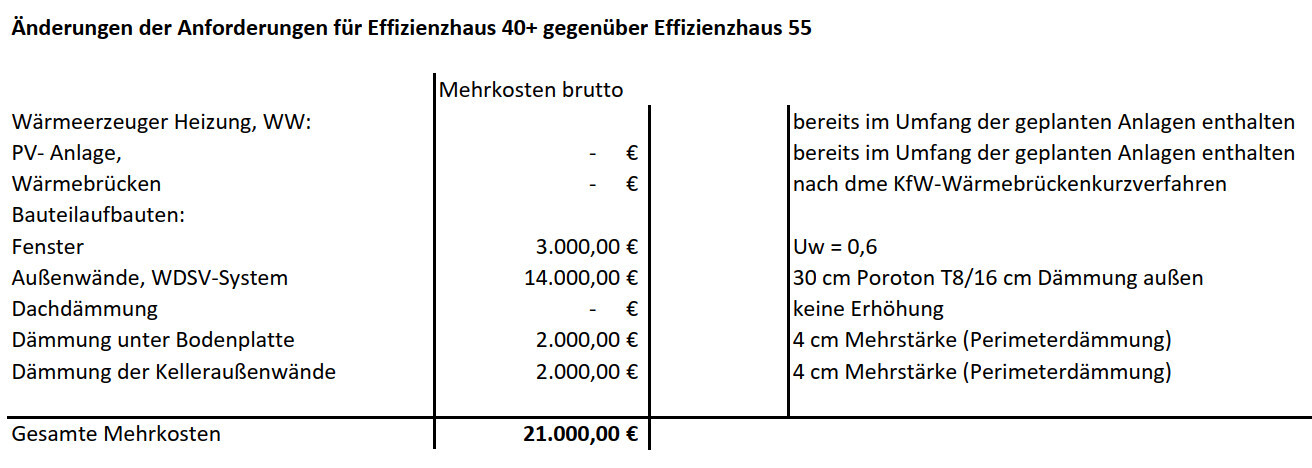
My architect calculated the additional costs for KfW 40 instead of KfW 55. For about €21,000, we can achieve KfW 40, which is less than he initially expected (he had estimated €50,000 and was originally reluctant to perform this calculation; I pushed for it). He has since changed his opinion and now recommends it. The solar technician said during the discussion that for our 5-person family and an estimated annual electricity consumption of 10 kilowatt (his estimate), a battery storage system would probably make sense anyway (as a layperson, I had previously thought a battery storage system would not be worthwhile). Since we already meet all requirements for 40+ except for the battery storage, reaching KfW 40+ would be possible directly.
This brings me to the following considerations:
Pros of 40+:
- €12,000 repayment bonus from the government in addition
- Lower heating costs, higher resale value
- Higher energy self-sufficiency through the battery storage
Cons of 40+:
- 30 cm (12 inches) thick (and somewhat harder) brick wall with external thermal insulation instead of the previously planned 40.5 cm (16 inches) thick (softer) brick wall with internal insulation
- €21,000 additional costs
- About €5,000 extra costs for the battery storage
But what do you think? 55 or 40+?
For completeness, here is the architect’s calculation:
we are currently planning our single-family house in Würzburg, and the building permit / planning permission application has been in process for about three weeks. Hopefully, we can start construction in October 2020:
- Plot size: 774 m² (8329 ft²), of which approximately 500 m² (5382 ft²) is buildable, due to about 27% sloping terrain facing south and the plot being somewhat irregular with a path on it.
- Solid construction house, 2 floors, footprint 11 x 15 m (36 x 49 ft). The basement is about two-thirds underground because of the slope.
- Roof pitch 23-30°, gable roof. Roof orientation southwest (or northeast, depending on perspective), so I calculate the southwest roof area as 6.24 m x 15 m = about 93.6 m² (assuming the 30° pitch).
- Household of 5 (2 adults, one ten-year-old child, and 2 babies), living area 214 m² (2303 ft²).
- Planned photovoltaic system with full coverage, air-to-water heat pump, underfloor heating, and central ventilation system with heat recovery. A ground source heat pump with trench collector is unfortunately not possible, as rock is expected everywhere at about 1-1.20 m (3-4 ft) depth.
Two days ago, I had a very interesting meeting with my architect and a solar technician on site.
My architect calculated the additional costs for KfW 40 instead of KfW 55. For about €21,000, we can achieve KfW 40, which is less than he initially expected (he had estimated €50,000 and was originally reluctant to perform this calculation; I pushed for it). He has since changed his opinion and now recommends it. The solar technician said during the discussion that for our 5-person family and an estimated annual electricity consumption of 10 kilowatt (his estimate), a battery storage system would probably make sense anyway (as a layperson, I had previously thought a battery storage system would not be worthwhile). Since we already meet all requirements for 40+ except for the battery storage, reaching KfW 40+ would be possible directly.
This brings me to the following considerations:
Pros of 40+:
- €12,000 repayment bonus from the government in addition
- Lower heating costs, higher resale value
- Higher energy self-sufficiency through the battery storage
Cons of 40+:
- 30 cm (12 inches) thick (and somewhat harder) brick wall with external thermal insulation instead of the previously planned 40.5 cm (16 inches) thick (softer) brick wall with internal insulation
- €21,000 additional costs
- About €5,000 extra costs for the battery storage
But what do you think? 55 or 40+?
For completeness, here is the architect’s calculation:
 bauenmk20209 May 2020 15:03
You have a large house. The additional costs are mainly material costs, of course. Since you probably don’t need to worry too much about small expenses – why not?
I would personally prefer a brick wall with external insulation rather than internal insulation. However, 30cm (12 inches) Poroton? Wouldn't 36.5cm (14.4 inches) be more common? A 4cm (1.6 inches) thinner wall also means more interior space.
I would personally prefer a brick wall with external insulation rather than internal insulation. However, 30cm (12 inches) Poroton? Wouldn't 36.5cm (14.4 inches) be more common? A 4cm (1.6 inches) thinner wall also means more interior space.
N
nordbayer9 May 2020 18:55Connecting the Poroton T8 with external insulation is somewhat stubborn. Usually, the various disadvantages of this expensive "crumbly cookie" brick are accepted in monolithic construction to avoid the drawbacks of external thermal insulation composite systems (ETICS).
Therefore, my suggestion: Have the Poroton calculated at 49cm (19 inches) thickness, without ETICS. As an option, also filled as T7. And if necessary, for KfW 40 standards, improve the insulation slightly on the roof or under the slab. Alternatively, use a standard solid 24cm (9.5 inches) brick plus appropriately thick ETICS.
How is the roof insulation currently planned? A list of all U-values would be helpful.
Therefore, my suggestion: Have the Poroton calculated at 49cm (19 inches) thickness, without ETICS. As an option, also filled as T7. And if necessary, for KfW 40 standards, improve the insulation slightly on the roof or under the slab. Alternatively, use a standard solid 24cm (9.5 inches) brick plus appropriately thick ETICS.
How is the roof insulation currently planned? A list of all U-values would be helpful.
N
nordbayer10 May 2020 08:54And if the budget allows, plan the roof with wood fiber boards as exterior roof insulation, combined with insulation between the rafters. Expensive, but the highest quality.
Or do you have a cold attic with insulation on the top floor ceiling?
Or do you have a cold attic with insulation on the top floor ceiling?
nordbayer schrieb:
Therefore, my suggestion: Have the Poroton brick calculated at 49cm (19 inches) thickness, without external thermal insulation composite system (ETICS). As a variant, also insulated as T7. And if necessary for kfw40 standard, improve the insulation of the roof or under the slab a bit. Alternatively, use the standard stable 24cm (9.5 inches) brick with appropriately thick ETICS.
How is the roof insulation currently planned? A list of all U-values would be helpful.Thank you very much for the suggestion. Attached is an excerpt from the preliminary report on insulation values; I hope you can make sense of it, because as a layperson, I don’t really understand it well.
I will forward these suggestions to my architect.

Buffer tanks for heating systems and also for photovoltaic setups should be omitted. They only lead to additional costs that never pay off. Unless you install a photovoltaic storage system purely for personal preference.
Instead, use the money saved for greater investment in insulation and other measures.
Instead, use the money saved for greater investment in insulation and other measures.
Similar topics