
ᐅ How to Integrate a Utility Room in the Basement Effectively Within the Thermal Envelope?
Created on: 2 May 2020 13:59
V
voicepointV
voicepoint2 May 2020 13:59Hello everyone,
We are currently in the planning phase.
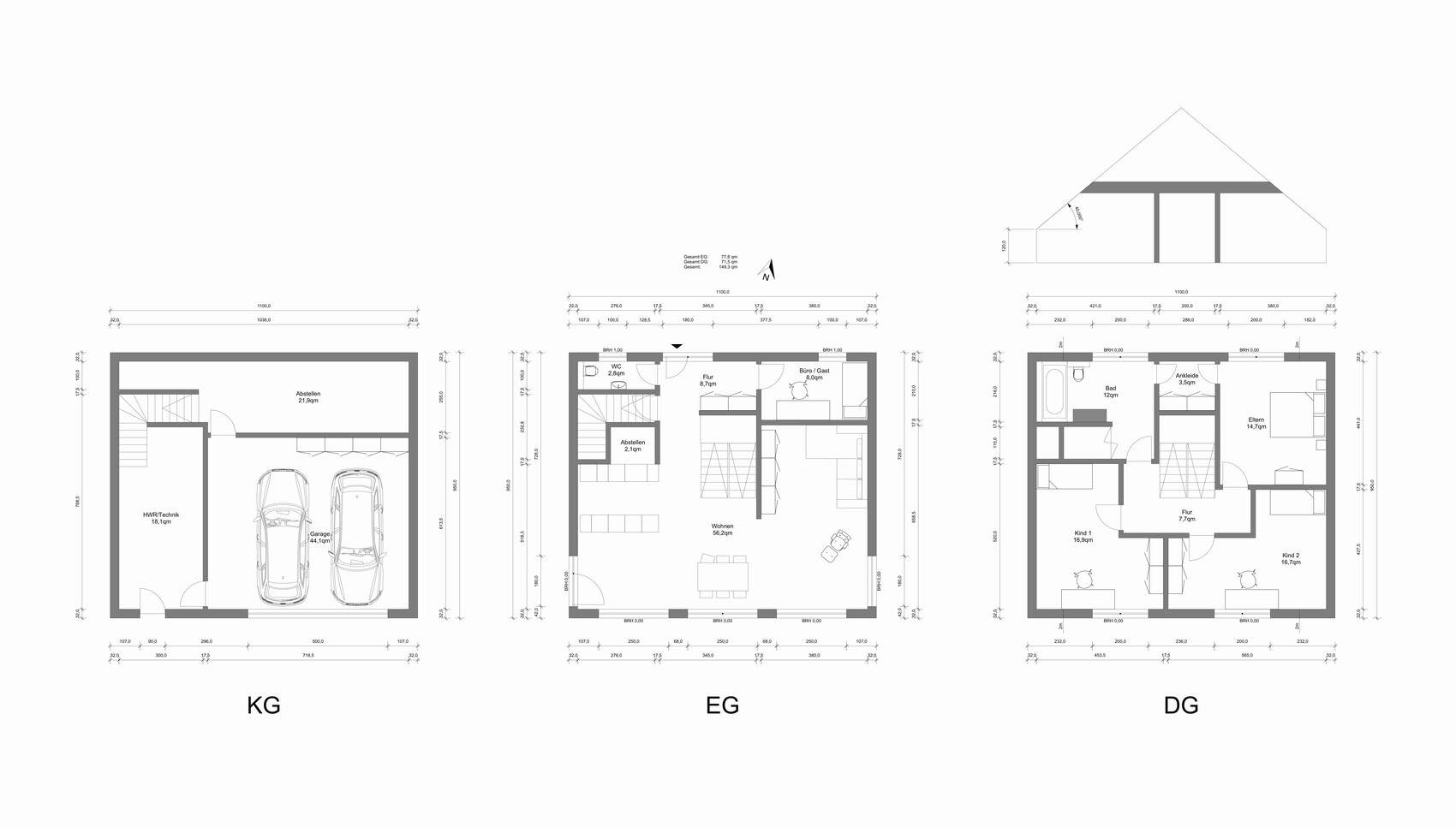
We are planning to build a single-family house with a basement. The ground floor (GF) and upper floor (UF) will be constructed using wood frame construction, while the basement will be either masonry or precast concrete (partially underground due to the sloped site).
The GF and UF will meet the KFW 40 standard as built. Accordingly, a (partial) inclusion of the basement in the thermal envelope would probably make sense. Depending on the decision regarding the 52 GW ceiling, it might also become a 40+ house (a ventilation system will be installed in any case).
The basement is planned to have a utility/technical room, and the rest of the basement will be used as a garage. The heating system will be installed in the utility room, so this room must be included in the building’s thermal envelope.
Currently, I see five possible options to implement this (options 1-3 could be simplified to meet KFW 55):
1) Include only the utility room in the thermal envelope
2) Include the entire basement in the thermal envelope (garage door?!)
3) Create a small, separate room in the basement for the heating system, leaving the rest outside the thermal envelope
4) Skip all measures and not use the KFW loans and funding
5) Extend the ground floor with a technical room exclusively for the heating system (electricity, ventilation, etc. would remain in the basement)
All options obviously differ in costs but also allow for higher levels of funding.
So far, we have been offered a 20cm (8 inch) thick slab in C20/25 concrete, masonry or concrete for the basement floor, external basement wall insulation of 120mm (5 inches), and a screed with 50mm (2 inches) insulation in the utility room. It was noted that additional insulation might be necessary (perimeter insulation).
Which approach would you choose, or what would you consider most sensible? Is there a better solution we might have overlooked?
Thank you very much and best regards,
Noel
We are currently in the planning phase.
We are planning to build a single-family house with a basement. The ground floor (GF) and upper floor (UF) will be constructed using wood frame construction, while the basement will be either masonry or precast concrete (partially underground due to the sloped site).
The GF and UF will meet the KFW 40 standard as built. Accordingly, a (partial) inclusion of the basement in the thermal envelope would probably make sense. Depending on the decision regarding the 52 GW ceiling, it might also become a 40+ house (a ventilation system will be installed in any case).
The basement is planned to have a utility/technical room, and the rest of the basement will be used as a garage. The heating system will be installed in the utility room, so this room must be included in the building’s thermal envelope.
Currently, I see five possible options to implement this (options 1-3 could be simplified to meet KFW 55):
1) Include only the utility room in the thermal envelope
2) Include the entire basement in the thermal envelope (garage door?!)
3) Create a small, separate room in the basement for the heating system, leaving the rest outside the thermal envelope
4) Skip all measures and not use the KFW loans and funding
5) Extend the ground floor with a technical room exclusively for the heating system (electricity, ventilation, etc. would remain in the basement)
All options obviously differ in costs but also allow for higher levels of funding.
So far, we have been offered a 20cm (8 inch) thick slab in C20/25 concrete, masonry or concrete for the basement floor, external basement wall insulation of 120mm (5 inches), and a screed with 50mm (2 inches) insulation in the utility room. It was noted that additional insulation might be necessary (perimeter insulation).
Which approach would you choose, or what would you consider most sensible? Is there a better solution we might have overlooked?
Thank you very much and best regards,
Noel

voicepoint schrieb:
According to the current plan, the heating system will be located in the utility room, so theAre you sure? In our case, the heating is installed in the unheated basement, which is outside the thermal envelope.V
voicepoint2 May 2020 15:56One of the six following system concepts must be implemented for the building services. The installation location of the heat generator or the heat transfer station must be inside the building’s thermal envelope, and a centralized domestic hot water system must be provided. A domestic hot water circulation system is allowed.
Or have I misunderstood something here?
Or have I misunderstood something here?
V
voicepoint2 May 2020 16:30I am also not 100% sure about this, as we have not yet consulted an energy advisor.
I only understood it this way from the linked document.
Can someone here confirm or refute this?
I only understood it this way from the linked document.
Can someone here confirm or refute this?
V
voicepoint2 May 2020 17:21I did some more research. Apparently, a "heat generator within a thermal envelope" is only required if you want to meet KFW55 based on reference values (i.e., without exact calculations).
So I’m expanding my question:
Is it possible to achieve KFW40 without an adequately insulated basement where the heat generator is located? Or can the required limits be met with such a concept? Has anyone possibly implemented this themselves?
So I’m expanding my question:
Is it possible to achieve KFW40 without an adequately insulated basement where the heat generator is located? Or can the required limits be met with such a concept? Has anyone possibly implemented this themselves?
Similar topics