
Hello dear forum,
We have been thinking for weeks about which areas in the bathroom should be tiled but can’t find a solution. That’s why we are hoping for your help.
We want to tile as little as possible, but we have the problem that there is a window on the wall opposite the shower, and we don’t know how to tile around it without it looking awkward. Also, we are unsure how to tile around the bathtub. And for the wall under the large window in general, should we plaster it, tile halfway up, or something else? We just aren’t creative enough here.
At the washbasin, we would like to tile only halfway up, and behind the toilet, we want to tile just the wall behind it, also halfway up.
We would really appreciate any tips.
Best regards,
Ivonne
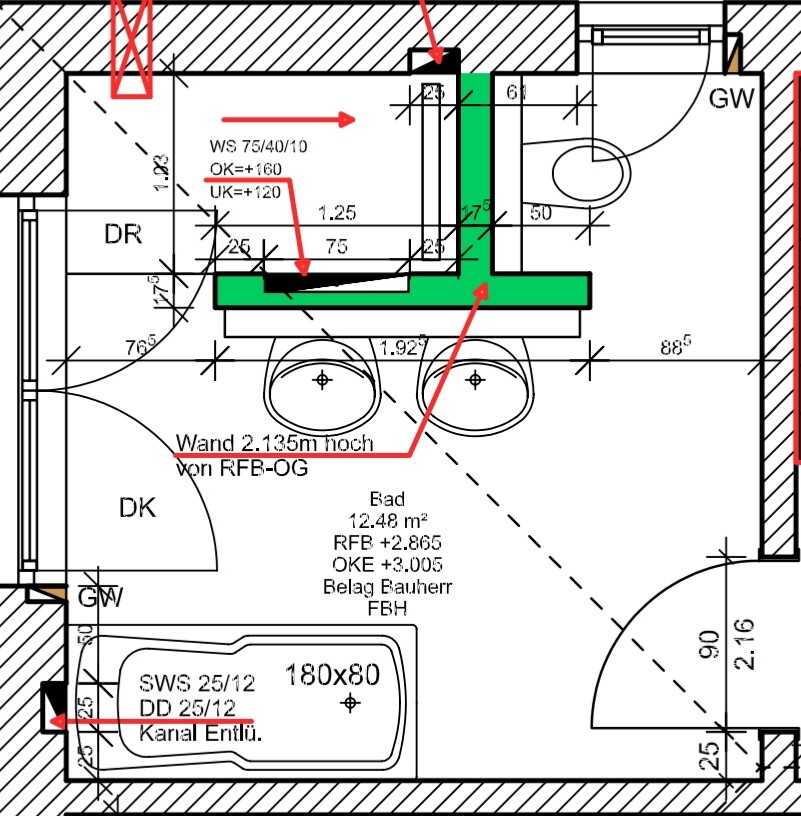
We have been thinking for weeks about which areas in the bathroom should be tiled but can’t find a solution. That’s why we are hoping for your help.
We want to tile as little as possible, but we have the problem that there is a window on the wall opposite the shower, and we don’t know how to tile around it without it looking awkward. Also, we are unsure how to tile around the bathtub. And for the wall under the large window in general, should we plaster it, tile halfway up, or something else? We just aren’t creative enough here.
At the washbasin, we would like to tile only halfway up, and behind the toilet, we want to tile just the wall behind it, also halfway up.
We would really appreciate any tips.
Best regards,
Ivonne
A
Alessandro29 Apr 2020 11:26I assume you haven’t planned a door for the shower, right?
I would definitely tile the wall behind the washbasin all the way up as a feature.
As long as you’re careful while bathing, you don’t necessarily need tiles on that wall. If it gets wet occasionally, it will dry again, and generally, people bathe less often than they shower.
In the shower, I would tile the wall at the top of the plan up to the height of the T-piece. Also, I would install a towel rail/radiator on the small wall next to the window at the top of the plan.
I would definitely tile the wall behind the washbasin all the way up as a feature.
As long as you’re careful while bathing, you don’t necessarily need tiles on that wall. If it gets wet occasionally, it will dry again, and generally, people bathe less often than they shower.
In the shower, I would tile the wall at the top of the plan up to the height of the T-piece. Also, I would install a towel rail/radiator on the small wall next to the window at the top of the plan.
A
Alessandro29 Apr 2020 11:30Edit: I would connect the bathtub to the T-joint and place the washbasin opposite, against the wall. This way, you have a bathtub open on three sides, with a decorative tile feature behind it all the way up. With some cool lighting added, the dream bathroom is complete.

Do you have an open roof structure?
Then in the shower, tile only as high as the partition wall (for us about 220cm (87 inches)), the toilet and washbasin only as high as the installation base, and the bathtub tiled. Behind the bathtub, the tile height should either align with the bathtub tiles (so they don’t have to be cut) or be set in some relation to the window.
We have white wall tiles and dark floor tiles, and we tiled the bathtub area with the floor tiles. Since our bathroom is very bright, this works well; without our large double casement window, it might have felt a bit too dark.
What I want to say is: you don’t need to have the same tile height and type throughout the entire bathroom. This can be a good way to create distinct zones.
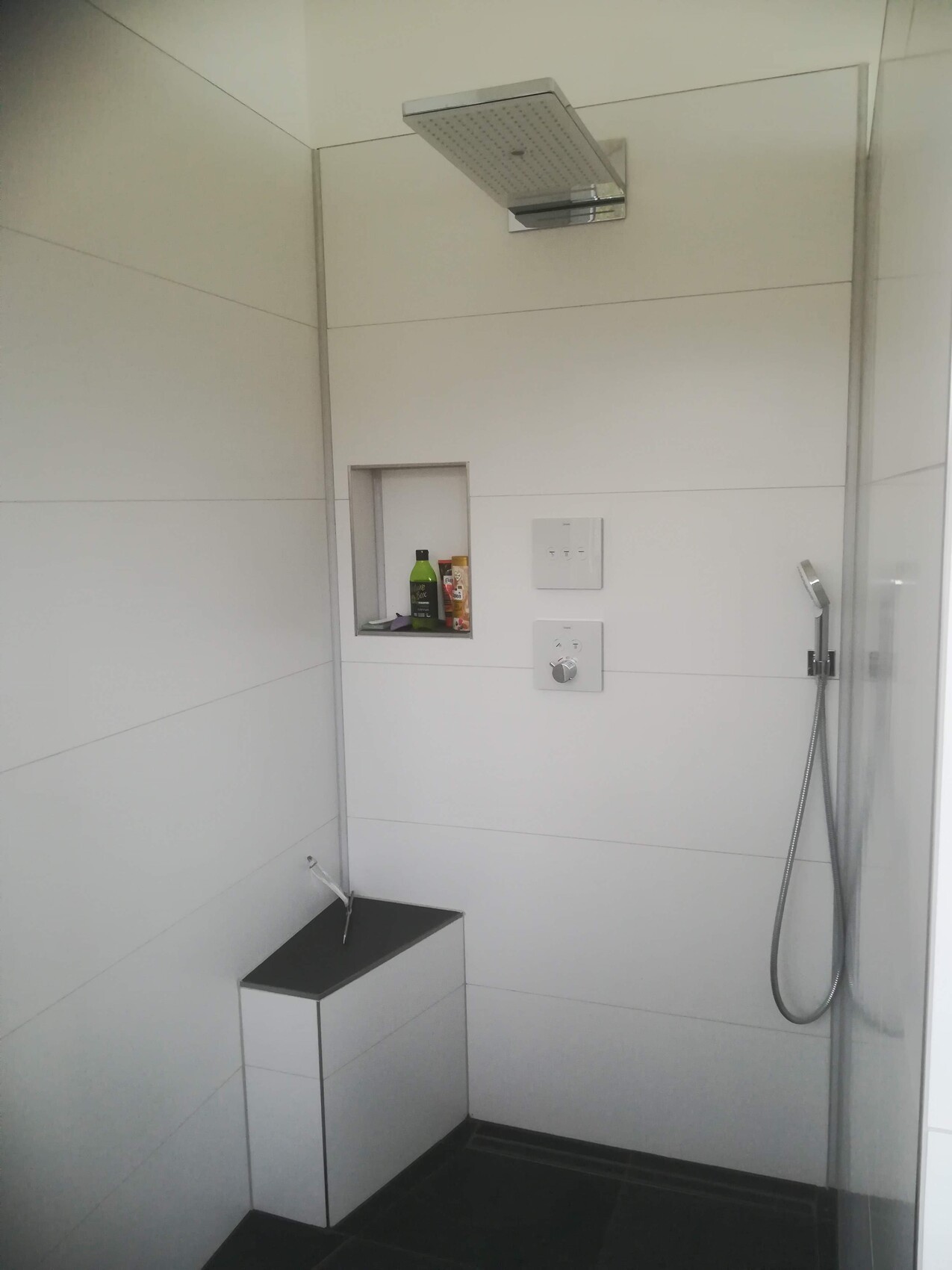
Here is the shower, tiled about 220cm (87 inches) high (as high as the shower partition wall). Above that, it’s open to the roof structure, so full-height tiling never made sense.
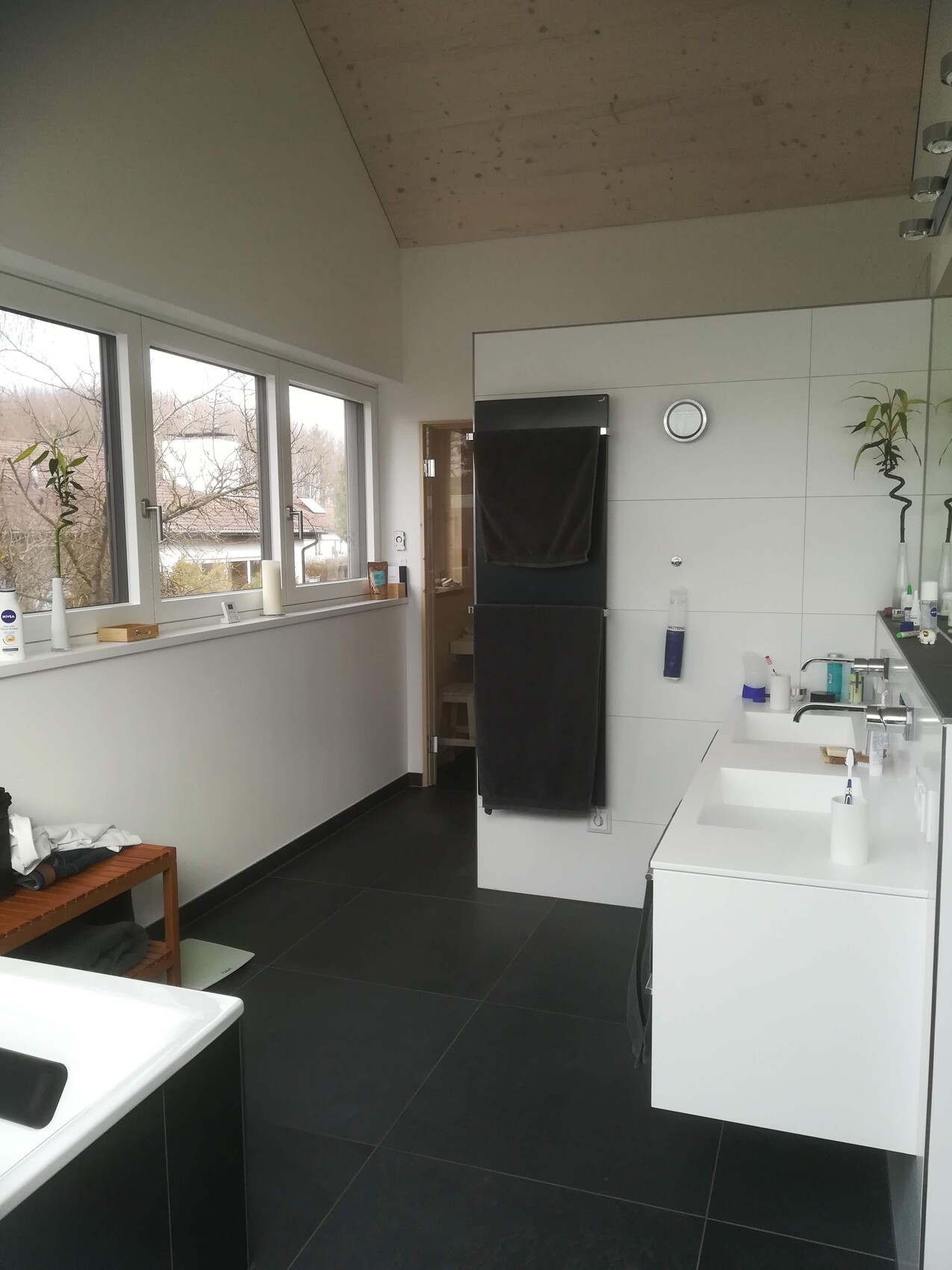
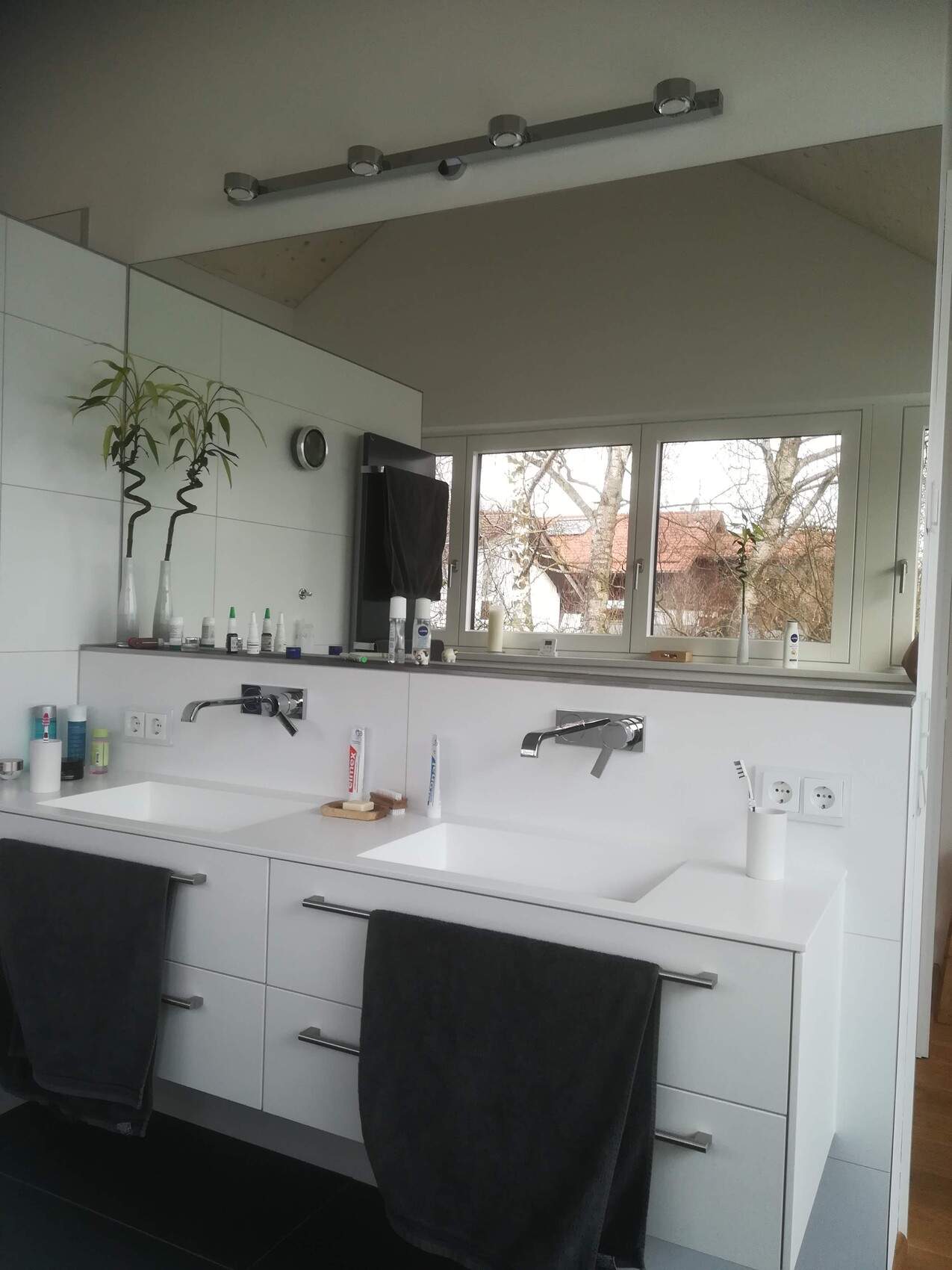
The shower from the other side, including the washbasin—here the installation base was also tiled (with the horizontal surfaces in the floor tile):
Around the bathtub, we used the tile size as a guide: specifically, one tile above the bathtub edge.
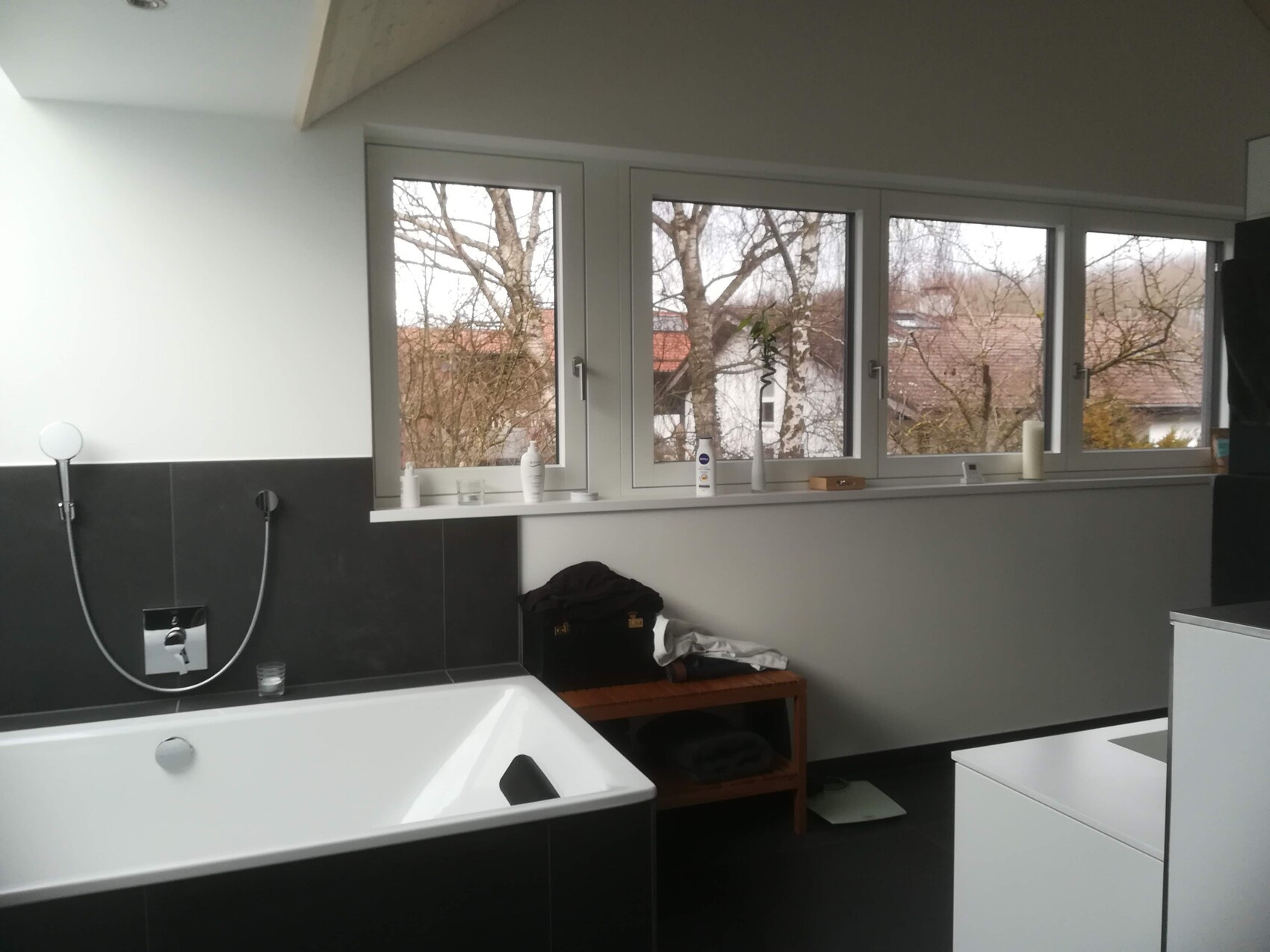
And then this was continued all around, but limited by the double casement window.

As mentioned, the bathtub area is enclosed with the floor tiles, and we also used those tiles on the wall in that corner. This works very well because a lot of light comes from above through the double casement window. Otherwise, it would have been too dark for me. But using only light tiles there would likely have been glaringly bright.
Overall, we have three different tile heights, and I don’t think it looks inconsistent. The areas are clearly separated, so it fits well. Of course, it always depends on the bathroom.
Then in the shower, tile only as high as the partition wall (for us about 220cm (87 inches)), the toilet and washbasin only as high as the installation base, and the bathtub tiled. Behind the bathtub, the tile height should either align with the bathtub tiles (so they don’t have to be cut) or be set in some relation to the window.
We have white wall tiles and dark floor tiles, and we tiled the bathtub area with the floor tiles. Since our bathroom is very bright, this works well; without our large double casement window, it might have felt a bit too dark.
What I want to say is: you don’t need to have the same tile height and type throughout the entire bathroom. This can be a good way to create distinct zones.
Here is the shower, tiled about 220cm (87 inches) high (as high as the shower partition wall). Above that, it’s open to the roof structure, so full-height tiling never made sense.
The shower from the other side, including the washbasin—here the installation base was also tiled (with the horizontal surfaces in the floor tile):
Around the bathtub, we used the tile size as a guide: specifically, one tile above the bathtub edge.
And then this was continued all around, but limited by the double casement window.
As mentioned, the bathtub area is enclosed with the floor tiles, and we also used those tiles on the wall in that corner. This works very well because a lot of light comes from above through the double casement window. Otherwise, it would have been too dark for me. But using only light tiles there would likely have been glaringly bright.
Overall, we have three different tile heights, and I don’t think it looks inconsistent. The areas are clearly separated, so it fits well. Of course, it always depends on the bathroom.
Your shower back wall is about 2 meters (6.5 feet) away from the opposite wall – in our case (measured straight), it’s about 2.4 meters (7.9 feet), and our wall is painted with latex paint, so it can handle some water splashes without getting soaked through.
So far, even during long showers, water has never splashed all the way to the wall; only the floor gets wet up to about 2.2 meters (7.2 feet). This would mean that in your case, the lower part of the wall could get some moisture. Therefore, maybe tile the wall up to the height of the windowsill?
By the way, I think Alessandro’s suggestion about swapping the positions of the washbasin and bathtub is worth considering.
So far, even during long showers, water has never splashed all the way to the wall; only the floor gets wet up to about 2.2 meters (7.2 feet). This would mean that in your case, the lower part of the wall could get some moisture. Therefore, maybe tile the wall up to the height of the windowsill?
By the way, I think Alessandro’s suggestion about swapping the positions of the washbasin and bathtub is worth considering.
neutri80 schrieb:
Thank you for your quick reply.
Yes, the shower is actually the biggest challenge. Do you think it would look strange if we only tile up to the T wall? But having the entire wall half-height doesn’t seem quite right either, right?
And for the bathtub, would you only tile the walls up to the edge of the tub?
For the tiles, we were thinking of 60x60cm (24x24 inches) concrete-look tiles on the floor and possibly on the walls too, in a subtle gray or beige tone. In the shower and behind the toilet, maybe a nice decorative tile. We would also like something different by the bathtub, but we’re not sure if that would look too heavy. Our vanity will look like the one in the attached picture, although we are flexible with the color. We also have concrete-look tiles on the floor and a white-beige color on the walls. I can take a photo in the evening. We only tiled around the bathtub area. The shower should definitely be tiled up to the ceiling. I think tiling a bit under the window is fine. Tiling up to the bathtub isn’t really my preference; then you might as well tile the whole room, except tiling half-height in the shower.
Climbee schrieb:
Do you have an open roof structure?
Then tile the shower only up to the height of the partition wall (about 220cm (87 inches) in our case), the toilet and washbasin up to the height of the installation base, and the bathtub fully tiled. Behind the bathtub, align the tile height either with the existing tiles (so they don’t need cutting) or in some relation to the window height.
We have white wall tiles and dark floor tiles, and the bathtub is tiled with the floor tiles. Since our bathroom is very bright, this works well. Without our large double casement window, it might feel a bit dark.
My point is: you don’t have to have the same tile height and type throughout the entire bathroom. This can be a good way to clearly define different areas.
Here is the shower, tiled up to about 220cm (87 inches)—the same height as the shower partition wall. Above that, it’s open to the roof structure, so full-height tiling didn’t make sense.
[ATTACH alt="IMG_20200306_165958.jpg"]46147[/ATTACH]
This is the shower viewed from the other side, with the washbasin. The installation base was tiled here as well, using floor tiles on the horizontal surfaces:
[ATTACH alt="IMG_20200306_165925.jpg"]46145[/ATTACH][ATTACH alt="IMG_20200306_165941.jpg"]46146[/ATTACH]
Around the bathtub, we used the tile size as a measure: so specifically, one tile above the bathtub edge:
[ATTACH alt="IMG_20200306_165913.jpg"]46144[/ATTACH]
And then tiled all around, but limited by the double casement window:
[ATTACH alt="IMG_20200306_165849.jpg"]46143[/ATTACH]
As I said, the bathtub is framed with the floor tiles, which we also used on the wall in that corner. This fits well because a lot of light comes in from above through the double casement window. Otherwise, it would have felt too dark. Using only light tiles there would probably have made it glaringly bright.
Overall, we have three different tile heights, and I don’t think it looks inconsistent. The areas are clearly separated, so it works. Of course, it always depends on the bathroom. OMG, this is not just a bathroom but a wellness retreat! Very beautiful.
Similar topics