
ᐅ Irrigation – Detailed Planning and Fundamental Considerations
Created on: 23 Apr 2020 17:14
O
opalau
After completing the house construction, moving in, and with summer approaching, we are increasingly focusing on the garden. Since we currently have a barren plot, I will plan the irrigation system as soon as possible to start by digging the trenches.
A few months ago, I thought I was clever by having a well drilled. Unfortunately, I failed to research further and was only pleased with the low price of the driven well. Now I am beginning to suspect that this might not have been such a smart decision.
Once these basic questions are clarified, I would like to focus on detailed planning. I have already attached a first version. Our plot is relatively narrow and long—about 15 by 75 meters (50 by 246 feet)—but so far it does not seem to pose a major problem.
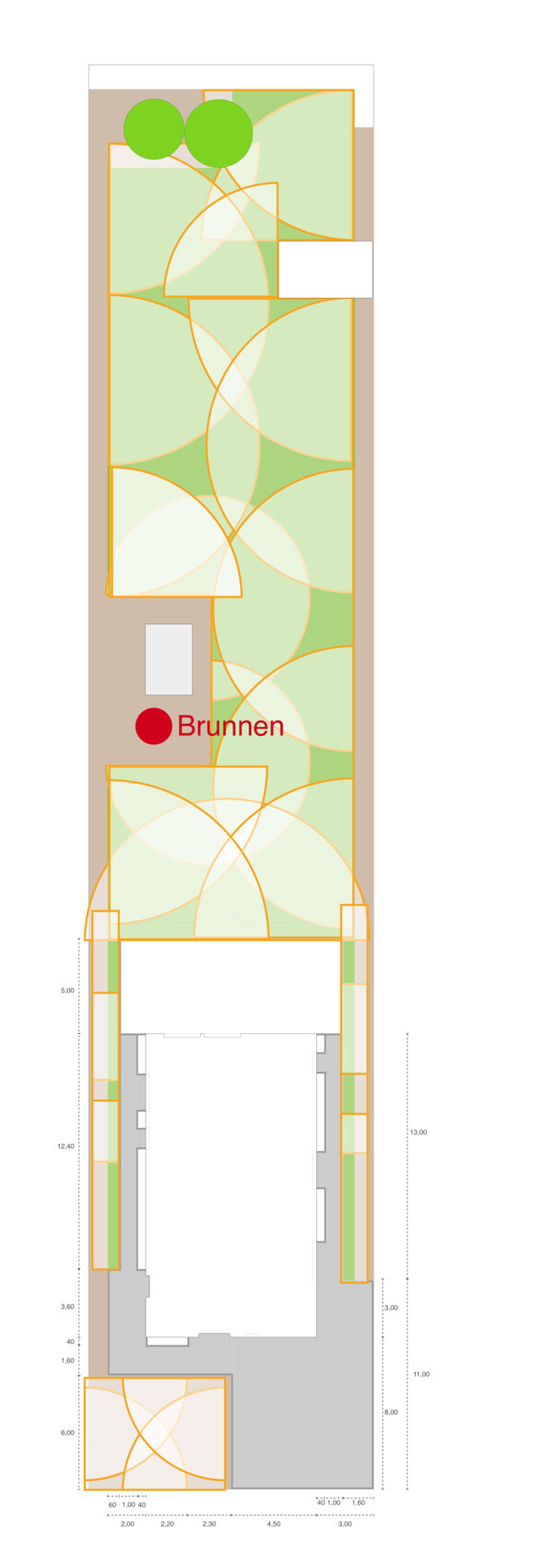
A few months ago, I thought I was clever by having a well drilled. Unfortunately, I failed to research further and was only pleased with the low price of the driven well. Now I am beginning to suspect that this might not have been such a smart decision.
- Apparently, you should not extract more than about 900 liters per hour (~240 gallons per hour) from a driven well to minimize the risk of incrustation. This is bad news for the number of sprinkler heads. I should have done better research beforehand…
- Yesterday, I made a first attempt by connecting the suction pump (Grundfos JP5), which the well driller "included." Using the “bucket method” and a pressure gauge set to 3.5 bar (2.8 bar for Hunter rotators plus 0.7 bar system loss), only a trickle comes out. (Without back pressure, my pump provides about 1800 liters per hour (~475 gallons per hour), with the valve closed about 3.9 bar is registered.) When I mentioned this to the well driller, he did not understand the problem and said that with 1800 liters per hour I could flood my property within a few hours. Am I misunderstanding the method?
- Assuming the situation is as poor as feared, what could be a possible solution? Getting a buffer tank (1000–2000 liters [260–530 gallons]), letting the suction pump keep it full, and then using a submersible pump in the tank to supply the irrigation system? Any other ideas?
Once these basic questions are clarified, I would like to focus on detailed planning. I have already attached a first version. Our plot is relatively narrow and long—about 15 by 75 meters (50 by 246 feet)—but so far it does not seem to pose a major problem.

opalau schrieb:
In the worst case, the planting will only become fully established in all areas after several years. At least plant the trees now. Otherwise, you’ll be old before they turn green.

kaho674 schrieb:
At least plant the trees. Otherwise, you’ll be old before they turn green. It’s sweet how you’re concerned. Don’t worry, they will be planted soon!
@Tego12
Our irrigation system is going to be a bit larger.
It is fed from a 76m³ (2,680 ft³) cistern which is filled via the roofs, terraces, and a well.
In other words, there is a pump in the well and a large pump (>30m³/h (13,200 gallons per hour)) in the cistern with appropriate monitoring and control.
The main distribution pipe is DN63 (63mm diameter), the valve boxes are connected with DN40 (40mm diameter), and the irrigation zones themselves are DN32 (32mm diameter).
Due to the high pressure and large pipe diameters, we can theoretically pump about 7m³/h (3,080 gallons per hour) through each zone.
Since the pump delivers significantly more and the distribution pipes are even larger, multiple zones can run simultaneously.
This is not possible with standard irrigation controllers.
The whole system runs on KNX. A Gira Facility Server is used as the logic server.
The weather station provides current data, and the weather forecast gives a multi-day outlook.
Irrigation is disabled during strong wind, rain, rain expected within x hours/days, low temperatures, etc.
If temperatures are particularly high, irrigation time is extended...
We have decided not to use soil moisture sensors. We would need so many to get a meaningful moisture profile.
You can easily tell by looking at the lawn if the irrigation amount is correct and then adjust accordingly.
If you actually irrigate with 15 liters per square meter (0.61 inches per square yard) three times a week, that’s too much. How long does each zone run? Are the sprinklers arranged in a triangle or square pattern?
During heat periods, lawns typically need about 20-25 liters per square meter (0.81-1.02 inches per square yard) per week. You are applying 45 liters per square meter (1.83 inches per square yard). There is significant potential to save water here!
Where do you source the water from?
Our irrigation system is going to be a bit larger.
It is fed from a 76m³ (2,680 ft³) cistern which is filled via the roofs, terraces, and a well.
In other words, there is a pump in the well and a large pump (>30m³/h (13,200 gallons per hour)) in the cistern with appropriate monitoring and control.
The main distribution pipe is DN63 (63mm diameter), the valve boxes are connected with DN40 (40mm diameter), and the irrigation zones themselves are DN32 (32mm diameter).
Due to the high pressure and large pipe diameters, we can theoretically pump about 7m³/h (3,080 gallons per hour) through each zone.
Since the pump delivers significantly more and the distribution pipes are even larger, multiple zones can run simultaneously.
This is not possible with standard irrigation controllers.
The whole system runs on KNX. A Gira Facility Server is used as the logic server.
The weather station provides current data, and the weather forecast gives a multi-day outlook.
Irrigation is disabled during strong wind, rain, rain expected within x hours/days, low temperatures, etc.
If temperatures are particularly high, irrigation time is extended...
We have decided not to use soil moisture sensors. We would need so many to get a meaningful moisture profile.
You can easily tell by looking at the lawn if the irrigation amount is correct and then adjust accordingly.
If you actually irrigate with 15 liters per square meter (0.61 inches per square yard) three times a week, that’s too much. How long does each zone run? Are the sprinklers arranged in a triangle or square pattern?
During heat periods, lawns typically need about 20-25 liters per square meter (0.81-1.02 inches per square yard) per week. You are applying 45 liters per square meter (1.83 inches per square yard). There is significant potential to save water here!
Where do you source the water from?
rick2018 schrieb:
It is supplied by a 76m3 (2,683 ft3) cistern that is filled via the roofs, terraces, and a well. What type of construction does this huge cistern have? What material is it made of? And where is it installed?
Similar topics