
ᐅ Irrigation – Detailed Planning and Fundamental Considerations
Created on: 23 Apr 2020 17:14
O
opalau
After completing the house construction, moving in, and with summer approaching, we are increasingly focusing on the garden. Since we currently have a barren plot, I will plan the irrigation system as soon as possible to start by digging the trenches.
A few months ago, I thought I was clever by having a well drilled. Unfortunately, I failed to research further and was only pleased with the low price of the driven well. Now I am beginning to suspect that this might not have been such a smart decision.
Once these basic questions are clarified, I would like to focus on detailed planning. I have already attached a first version. Our plot is relatively narrow and long—about 15 by 75 meters (50 by 246 feet)—but so far it does not seem to pose a major problem.
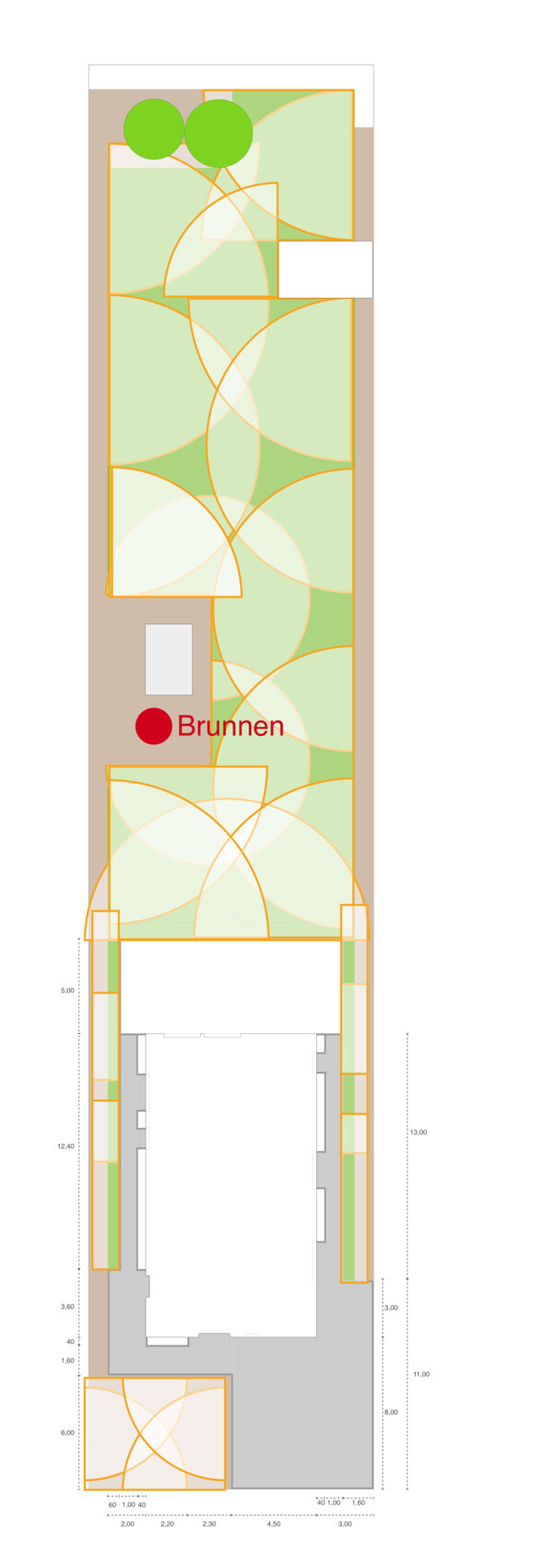
A few months ago, I thought I was clever by having a well drilled. Unfortunately, I failed to research further and was only pleased with the low price of the driven well. Now I am beginning to suspect that this might not have been such a smart decision.
- Apparently, you should not extract more than about 900 liters per hour (~240 gallons per hour) from a driven well to minimize the risk of incrustation. This is bad news for the number of sprinkler heads. I should have done better research beforehand…
- Yesterday, I made a first attempt by connecting the suction pump (Grundfos JP5), which the well driller "included." Using the “bucket method” and a pressure gauge set to 3.5 bar (2.8 bar for Hunter rotators plus 0.7 bar system loss), only a trickle comes out. (Without back pressure, my pump provides about 1800 liters per hour (~475 gallons per hour), with the valve closed about 3.9 bar is registered.) When I mentioned this to the well driller, he did not understand the problem and said that with 1800 liters per hour I could flood my property within a few hours. Am I misunderstanding the method?
- Assuming the situation is as poor as feared, what could be a possible solution? Getting a buffer tank (1000–2000 liters [260–530 gallons]), letting the suction pump keep it full, and then using a submersible pump in the tank to supply the irrigation system? Any other ideas?
Once these basic questions are clarified, I would like to focus on detailed planning. I have already attached a first version. Our plot is relatively narrow and long—about 15 by 75 meters (50 by 246 feet)—but so far it does not seem to pose a major problem.

@Tarnari you’re welcome to go ahead. However, plumbing rough-in and finishing work is already too late.
Will you have a cistern? A well? Or will you need to use the water supply line?
If the latter, you should have a 25mm (1 inch) water meter installed right away.
You will also need a conduit for the control cables going into the house.
Sorry @opalau for briefly hijacking your thread.
Will you have a cistern? A well? Or will you need to use the water supply line?
If the latter, you should have a 25mm (1 inch) water meter installed right away.
You will also need a conduit for the control cables going into the house.
Sorry @opalau for briefly hijacking your thread.

@rick2018 No problem
So, as mentioned, a 32mm (1 1/4 inch) PE-HD pipe is already ready. That might be a bit overkill, but the 25mm (1 inch) pipes weren’t much cheaper anyway (100m for €70 vs. €100).
I already understood the thing with the T.I.P. pump correctly. I also think I’ll use the existing setup for now. Tomorrow, I need to find out why the check valve isn’t working and the water column keeps dropping…
Now, a few detailed questions about the planning.
We can’t manage 8 p.m. either. But around 9 p.m. is doable. The wasteland is great for wearing the kids out. And on the (unfenced) neighboring lots, sprinklers, rabbits, chickens, etc. are quite enticing.
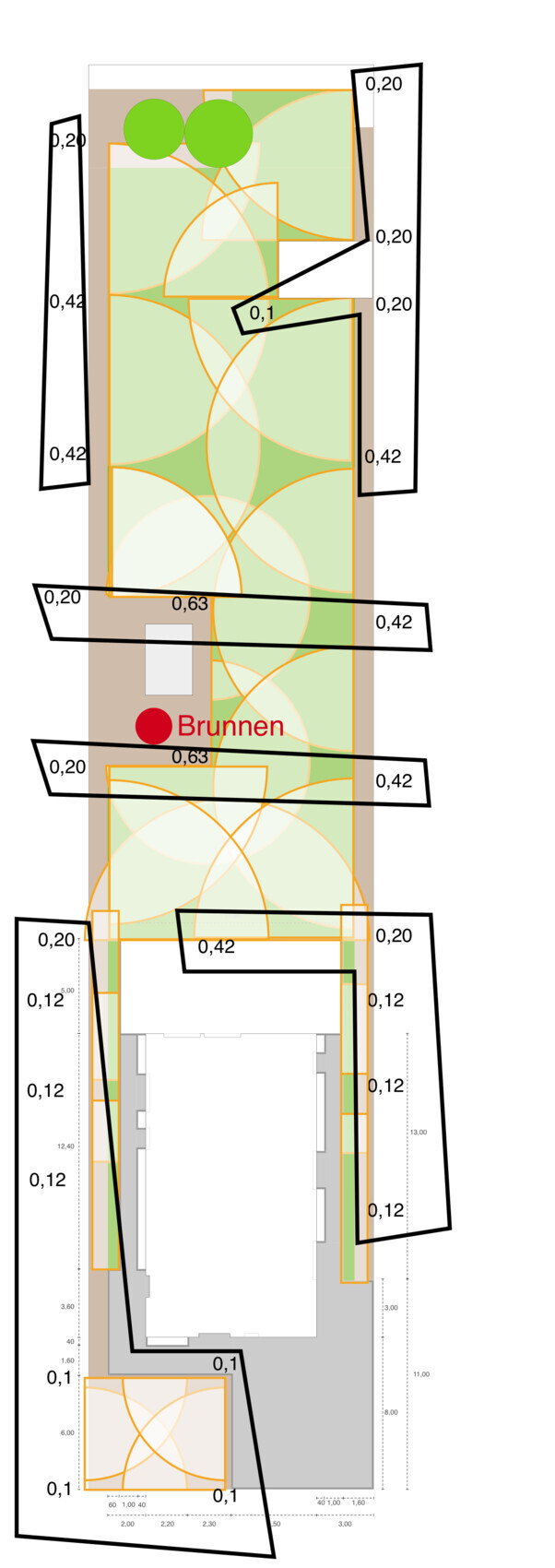
So, as mentioned, a 32mm (1 1/4 inch) PE-HD pipe is already ready. That might be a bit overkill, but the 25mm (1 inch) pipes weren’t much cheaper anyway (100m for €70 vs. €100).
I already understood the thing with the T.I.P. pump correctly. I also think I’ll use the existing setup for now. Tomorrow, I need to find out why the check valve isn’t working and the water column keeps dropping…
Now, a few detailed questions about the planning.
- Attached are the planned zones. Most of the sprinklers are lined up in series, also due to the shape of the lot. How problematic is this? Usually, it’s recommended to branch the zone instead.
- How do you handle unplanned areas? The rectangle at the top edge of the lot is a garden shed that’s only tentatively planned so far. Should we roughly fix its size and position and plan the sprinklers accordingly around it?
- I want to distribute about 3 Gardena-style water outlets around the property. I’ll branch off their common main line (3/4") before the valve box with a T-joint and keep them constantly pressurized. Does that make sense?
- For the area around the well (greenhouse) and also along the property edges (hedges), I want to at least prepare piping now, so I can install drip irrigation later if needed. For now, these lines will be capped. (The plan is for an 8-zone valve box and a 12mm (1/2 inch) Hydrawise controller.)
- Are there significant differences in the fittings? There’s about a threefold price difference. Is a Unidelta T-joint 32 x 32 x 32 really worth €8.10 when you can get the same from HTC for €2.45?
Tarnari schrieb:
8 p.m.? Your kids are asleep?
Our four-year-old is still awake during corona times. What are we doing wrong?
Joking aside, very interesting topic. I’ll follow it closely.
We can’t manage 8 p.m. either. But around 9 p.m. is doable. The wasteland is great for wearing the kids out. And on the (unfenced) neighboring lots, sprinklers, rabbits, chickens, etc. are quite enticing.
1. Pressure-regulating housings mean there is no problem if the sprinklers are installed in series, as long as at least 2.8 bar (40.6 psi) reaches the last one.
2. Yes, plan the "outer loop" from the start. If it will only be installed in a few years, use normal irrigation for now and relocate the sprinklers during construction.
3. Branch the water outlets before the valve box. There are few cases where a valve is necessary or useful. As long as the pump is powered, the outlets can be used.
4. Place the reserve lines for, for example, drip irrigation at the intended spots right away. Leave them sticking out of the ground a bit and cap them with an end plug.
5. I have had several cheap fittings break (some already during tightening) or later leak. Most connections hold without problems. I now only use Unidelta fittings, which I have yet to experience any failures with. Of course, the additional cost adds up significantly, but I don’t have to dig up the garden again. It’s a risk assessment. If you document the location of your pipes and connections well, you can also use the cheaper fittings.
2. Yes, plan the "outer loop" from the start. If it will only be installed in a few years, use normal irrigation for now and relocate the sprinklers during construction.
3. Branch the water outlets before the valve box. There are few cases where a valve is necessary or useful. As long as the pump is powered, the outlets can be used.
4. Place the reserve lines for, for example, drip irrigation at the intended spots right away. Leave them sticking out of the ground a bit and cap them with an end plug.
5. I have had several cheap fittings break (some already during tightening) or later leak. Most connections hold without problems. I now only use Unidelta fittings, which I have yet to experience any failures with. Of course, the additional cost adds up significantly, but I don’t have to dig up the garden again. It’s a risk assessment. If you document the location of your pipes and connections well, you can also use the cheaper fittings.

rick2018 schrieb:
@kaho674 Gardena is less durable, more susceptible to wind, does not provide uniform irrigation, etc.I’m afraid we’re not that demanding. In my opinion, the advantage of Gardena is that it’s simply the brand you can find everywhere. If you need any additional part, you just go and get it. With alternatives, you often have to do online research first. rick2018 schrieb:
At the beginning and end of the coverage area, the precipitation is lower. Therefore, the sprinklers should always overlap.That’s strange, I can’t confirm that here. It’s actually the opposite for us. Are you sure? rick2018 schrieb:
The irrigation (drip, root zone, area watering...) must be adapted to the respective plants.Yes, that’s why I would first plan the planting before planning the irrigation. rick2018 schrieb:
After two weeks of drought even a natural meadow doesn’t look good.It can handle that as long as it’s not mowed. But without any water at all, eventually it becomes desert – of course. The thing is, climate change is hitting us so hard that eventually you can hardly keep up watering. A cistern won’t get you very far. It simply runs dry too quickly.
kaho674 schrieb:
Yes, that’s why I would suggest the original poster plan the planting first before designing the irrigation system. Basically, we’re doing the same. There are several areas where “planting” is only planned for now, so I’m installing a conduit there and can add irrigation later. The landscaper is coming in two weeks; the garden will be tilled and then seeded. Until then, I want to close up the trenches for the pipes. The planting will, in the worst case, only develop in all areas over the course of several years.
@rick2018
1. You mean the PRS40, right? Now I understand their advantage. I had only planned with pressure-regulating valves inside the valve box and thought that would allow me to skip using them in the sprinklers. Do I understand correctly that with the PRS40, I prevent a sprinkler at the beginning of the line from using too much water or causing a drop in pressure? Do I even need the pressure-regulating valves then?
Thanks for all the feedback. It’s really helpful to read that I wasn’t completely on the wrong track.
1. You mean the PRS40, right? Now I understand their advantage. I had only planned with pressure-regulating valves inside the valve box and thought that would allow me to skip using them in the sprinklers. Do I understand correctly that with the PRS40, I prevent a sprinkler at the beginning of the line from using too much water or causing a drop in pressure? Do I even need the pressure-regulating valves then?
Thanks for all the feedback. It’s really helpful to read that I wasn’t completely on the wrong track.
Similar topics