
ᐅ Irrigation – Detailed Planning and Fundamental Considerations
Created on: 23 Apr 2020 17:14
O
opalau
After completing the house construction, moving in, and with summer approaching, we are increasingly focusing on the garden. Since we currently have a barren plot, I will plan the irrigation system as soon as possible to start by digging the trenches.
A few months ago, I thought I was clever by having a well drilled. Unfortunately, I failed to research further and was only pleased with the low price of the driven well. Now I am beginning to suspect that this might not have been such a smart decision.
Once these basic questions are clarified, I would like to focus on detailed planning. I have already attached a first version. Our plot is relatively narrow and long—about 15 by 75 meters (50 by 246 feet)—but so far it does not seem to pose a major problem.
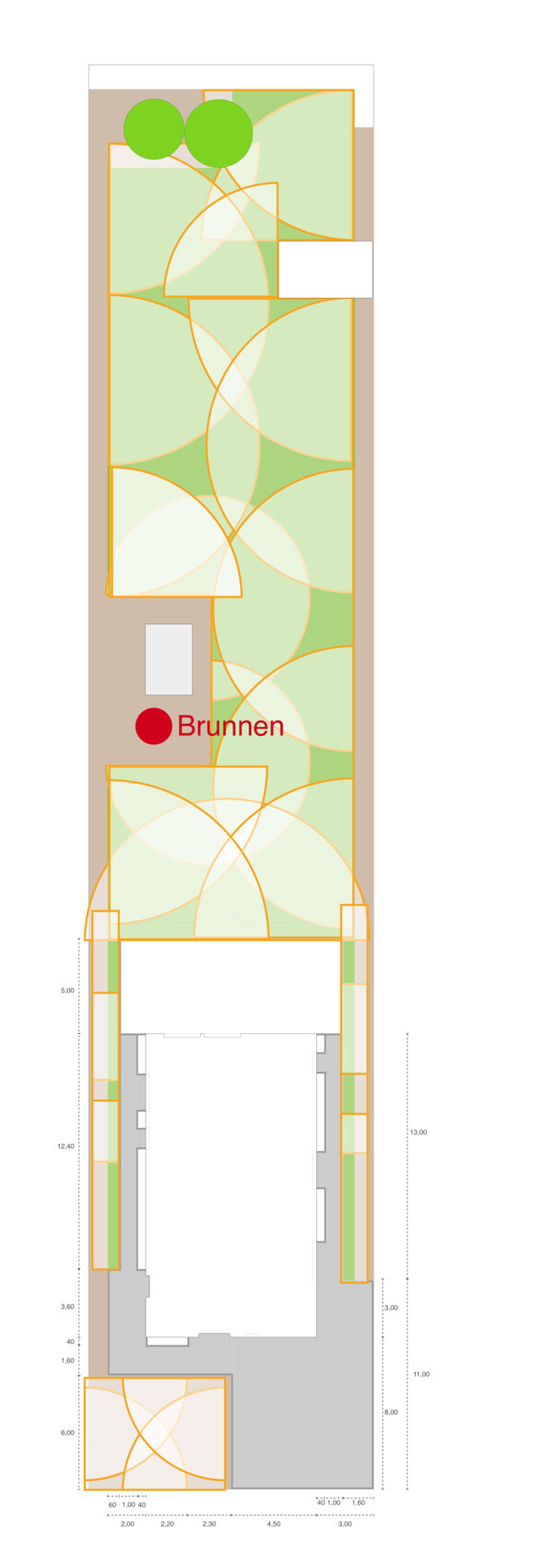
A few months ago, I thought I was clever by having a well drilled. Unfortunately, I failed to research further and was only pleased with the low price of the driven well. Now I am beginning to suspect that this might not have been such a smart decision.
- Apparently, you should not extract more than about 900 liters per hour (~240 gallons per hour) from a driven well to minimize the risk of incrustation. This is bad news for the number of sprinkler heads. I should have done better research beforehand…
- Yesterday, I made a first attempt by connecting the suction pump (Grundfos JP5), which the well driller "included." Using the “bucket method” and a pressure gauge set to 3.5 bar (2.8 bar for Hunter rotators plus 0.7 bar system loss), only a trickle comes out. (Without back pressure, my pump provides about 1800 liters per hour (~475 gallons per hour), with the valve closed about 3.9 bar is registered.) When I mentioned this to the well driller, he did not understand the problem and said that with 1800 liters per hour I could flood my property within a few hours. Am I misunderstanding the method?
- Assuming the situation is as poor as feared, what could be a possible solution? Getting a buffer tank (1000–2000 liters [260–530 gallons]), letting the suction pump keep it full, and then using a submersible pump in the tank to supply the irrigation system? Any other ideas?
Once these basic questions are clarified, I would like to focus on detailed planning. I have already attached a first version. Our plot is relatively narrow and long—about 15 by 75 meters (50 by 246 feet)—but so far it does not seem to pose a major problem.


opalau schrieb:
That’s not really what “basic principles” was meant to imply either. Okay, then I probably misunderstood the intention of the thread.
@kaho674 Gardena is less durable, more susceptible to wind, and doesn’t provide uniform irrigation, etc.
At the beginning and end of the coverage area, the precipitation rate is lower. Therefore, sprinklers should always overlap.
You can be satisfied with Gardena (at least temporarily), but there is a reason why professional equipment exists for this purpose. Compared to Gardena sprinklers, professional gear isn’t really more expensive. You need the piping anyway. It’s better to use higher quality and more affordable potable water piping instead of the soft, overpriced Gardena hoses.
Professional manufacturers offer sprinklers with a range of 30 meters (98 feet) or more. However, that doesn’t help if you want precise control (not to mention that these require very different flow rates).
The rotors that @opalau is using are very water-efficient. They have a low precipitation rate and therefore wet the soil more slowly. This means less water is needed.
Different radii and ranges can also be combined without changing the precipitation rate per square meter. The pressure-regulating housings are a real advantage. This allows the piping to be installed without concerning yourself with pressure distribution or the number of outlets.
Irrigation should be controlled according to temperature, wind, sunlight, soil moisture, and rainfall probability.
It shouldn’t just run rigidly every three days.
Irrigation (drip, root, or surface) needs to be adapted to the type of plants involved.
Therefore, it makes sense to plan the irrigation system carefully and properly during new installations. That way, you’ll have peace of mind for years or even decades.
Whether you like or plan lawns, natural meadows, hedges, flower beds, or trees doesn’t necessarily indicate whether irrigation is useful.
Especially in new installations, the water demand is higher early on. You invest a lot of money and don’t want it to dry out. Manually providing enough water is no longer feasible.
An irrigation system is also very convenient.
After two weeks of drought, even a natural meadow doesn’t look good anymore.
We will create different zones in the garden, not just lawn. Here, the mix makes the difference.
At the beginning and end of the coverage area, the precipitation rate is lower. Therefore, sprinklers should always overlap.
You can be satisfied with Gardena (at least temporarily), but there is a reason why professional equipment exists for this purpose. Compared to Gardena sprinklers, professional gear isn’t really more expensive. You need the piping anyway. It’s better to use higher quality and more affordable potable water piping instead of the soft, overpriced Gardena hoses.
Professional manufacturers offer sprinklers with a range of 30 meters (98 feet) or more. However, that doesn’t help if you want precise control (not to mention that these require very different flow rates).
The rotors that @opalau is using are very water-efficient. They have a low precipitation rate and therefore wet the soil more slowly. This means less water is needed.
Different radii and ranges can also be combined without changing the precipitation rate per square meter. The pressure-regulating housings are a real advantage. This allows the piping to be installed without concerning yourself with pressure distribution or the number of outlets.
Irrigation should be controlled according to temperature, wind, sunlight, soil moisture, and rainfall probability.
It shouldn’t just run rigidly every three days.
Irrigation (drip, root, or surface) needs to be adapted to the type of plants involved.
Therefore, it makes sense to plan the irrigation system carefully and properly during new installations. That way, you’ll have peace of mind for years or even decades.
Whether you like or plan lawns, natural meadows, hedges, flower beds, or trees doesn’t necessarily indicate whether irrigation is useful.
Especially in new installations, the water demand is higher early on. You invest a lot of money and don’t want it to dry out. Manually providing enough water is no longer feasible.
An irrigation system is also very convenient.
After two weeks of drought, even a natural meadow doesn’t look good anymore.
We will create different zones in the garden, not just lawn. Here, the mix makes the difference.

opalau schrieb:
That’s not what I meant by “fundamental questions.” 8 PM? Are your children already asleep?
Our four-year-old is still awake during the pandemic. What are we doing wrong?
Jokes aside, a very interesting topic. I will follow it closely.
@Tarnari There are already several irrigation threads, and some planning was done through private messages. Early planning regarding the water source and control lines is especially important.
@opalau has followed almost all the basic principles.
The points are basically always the same.
@opalau has followed almost all the basic principles.
The points are basically always the same.
rick2018 schrieb:
@Tarnari There are already several irrigation threads, and some planning has also been done via private messages. Early planning regarding the water source and control lines is especially important.
@opalau has followed almost all the key principles. The points are basically always the same. I will definitely get back to you once approved. This topic is pressing for me since the plumber and landscaper have not started yet, or even begun preparations.
Similar topics