
ᐅ Natural-style garden with hedge instead of fence (boundary hedge instead of fence)
Created on: 14 Apr 2019 17:52
M
Müllerin
I still owe you some garden photos...
As I’ve mentioned a few times before, we’re getting an “eco garden.”
After the excavation spoil from both halves of the house, which was just lying around here, was finally removed in September, nothing happened for a while.
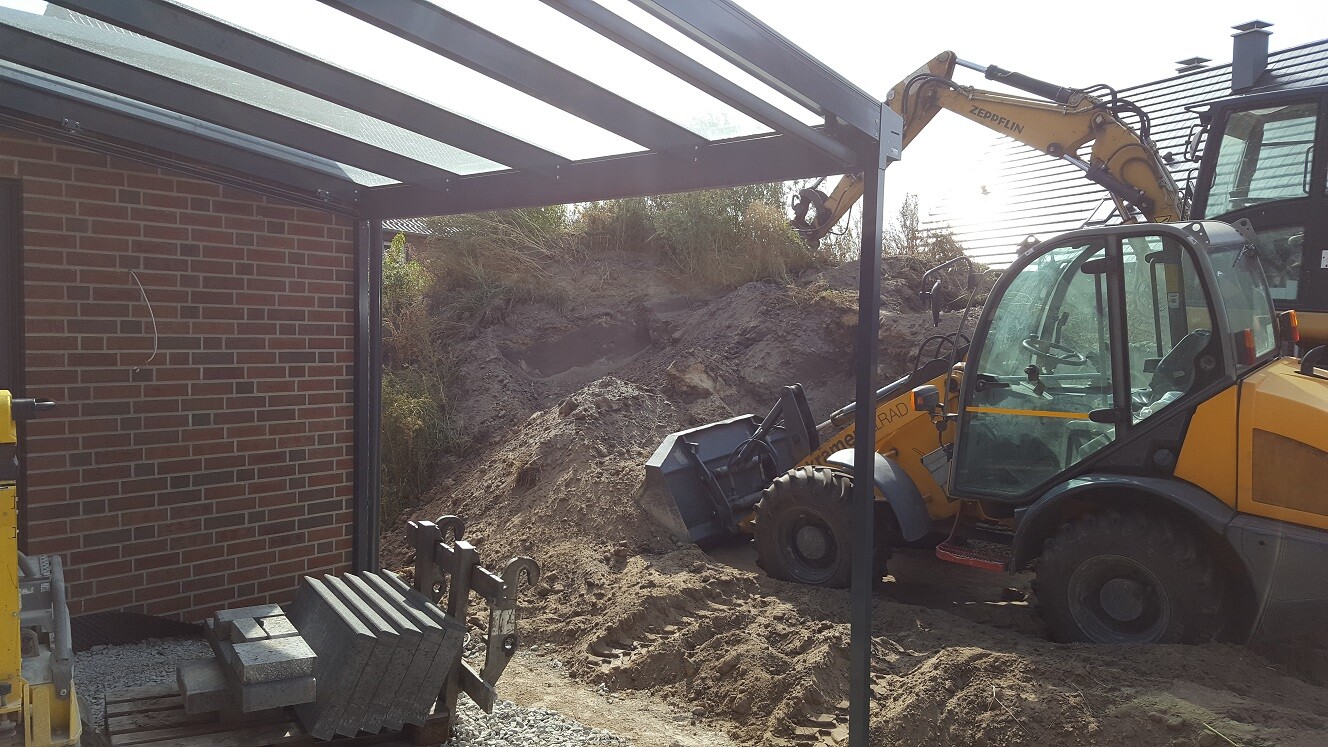
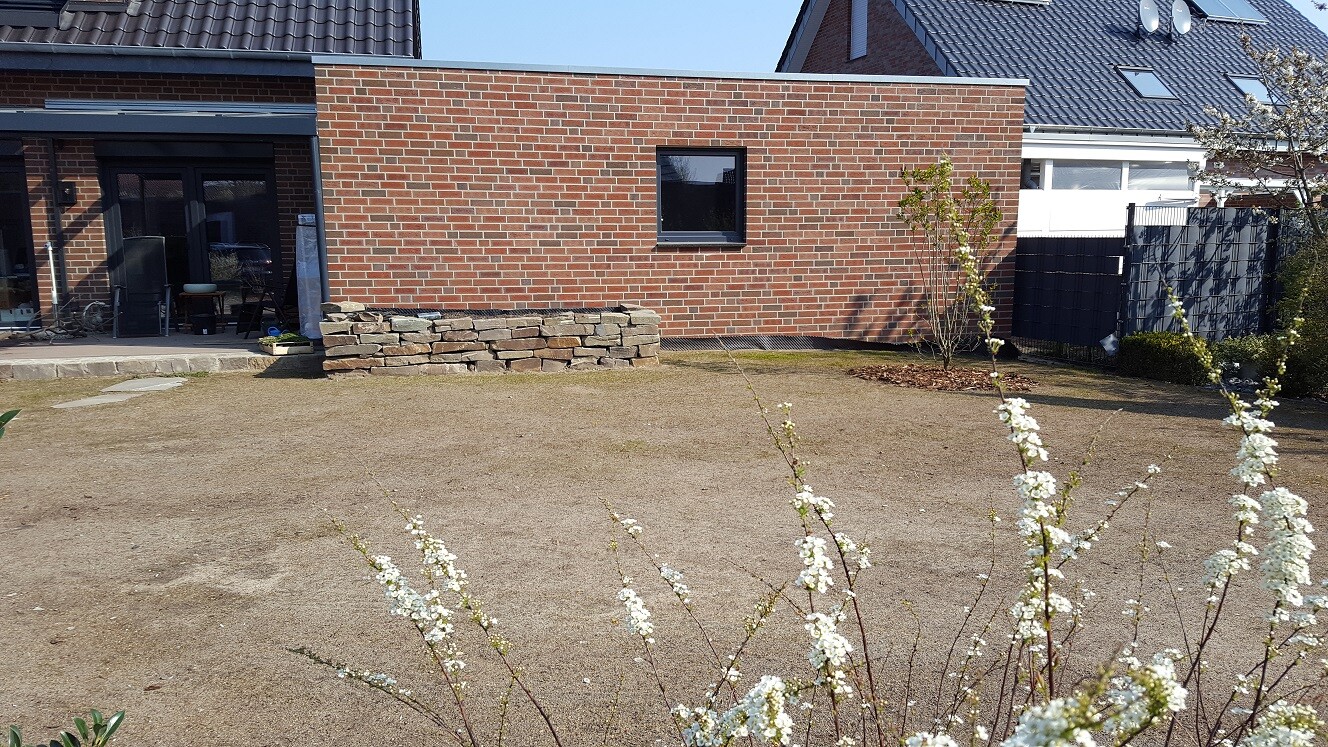
At the end of March, it looked like this
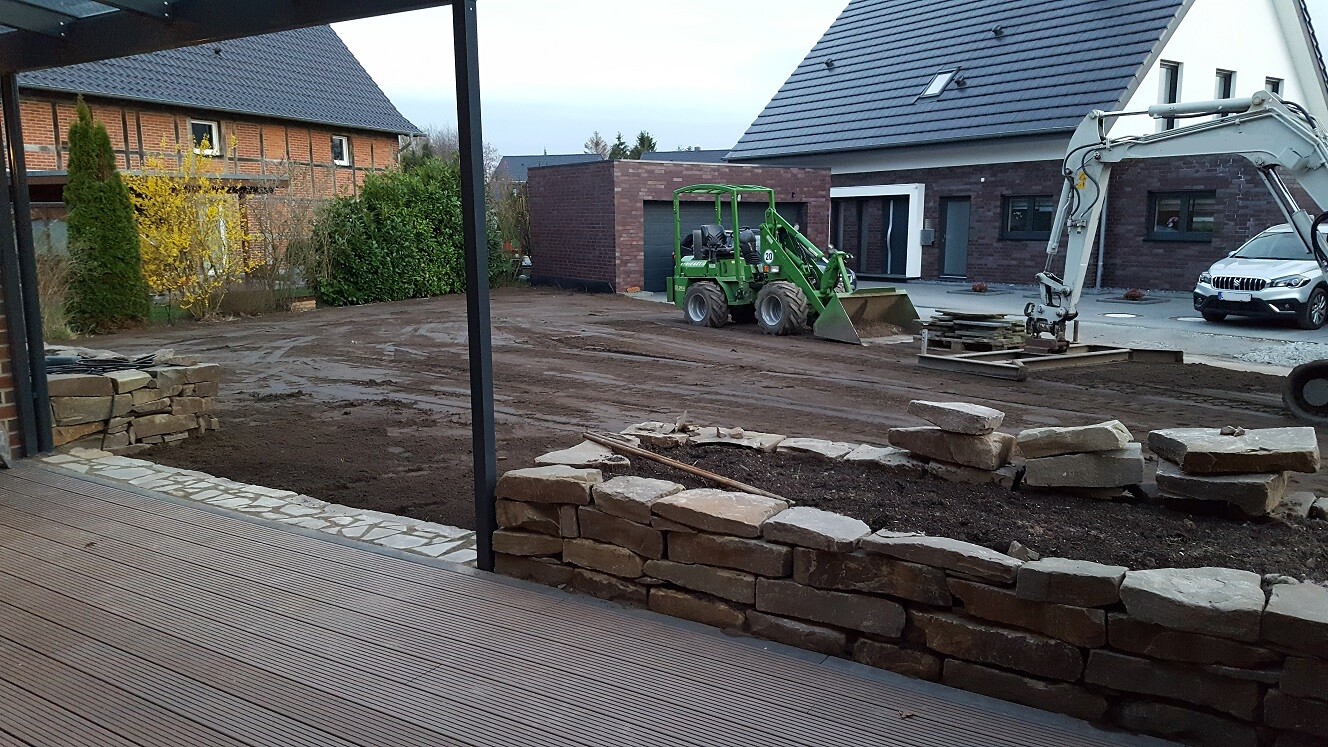
Then I planted the hedge (with the gardeners).
On the outside there is a lot of hawthorn, then 2 holly bushes (we’ll see if they don’t dry out too much in summer), 2 firethorns, a witch hazel, a butterfly bush, 2 copper mountain ashes, spireas, a viburnum, and a mock orange. Up front, separately, a maple.
Eventually, there will be a rose arch with a gate at the end of the path.
The lawn is growing rather slowly; it’s just too cold right now.
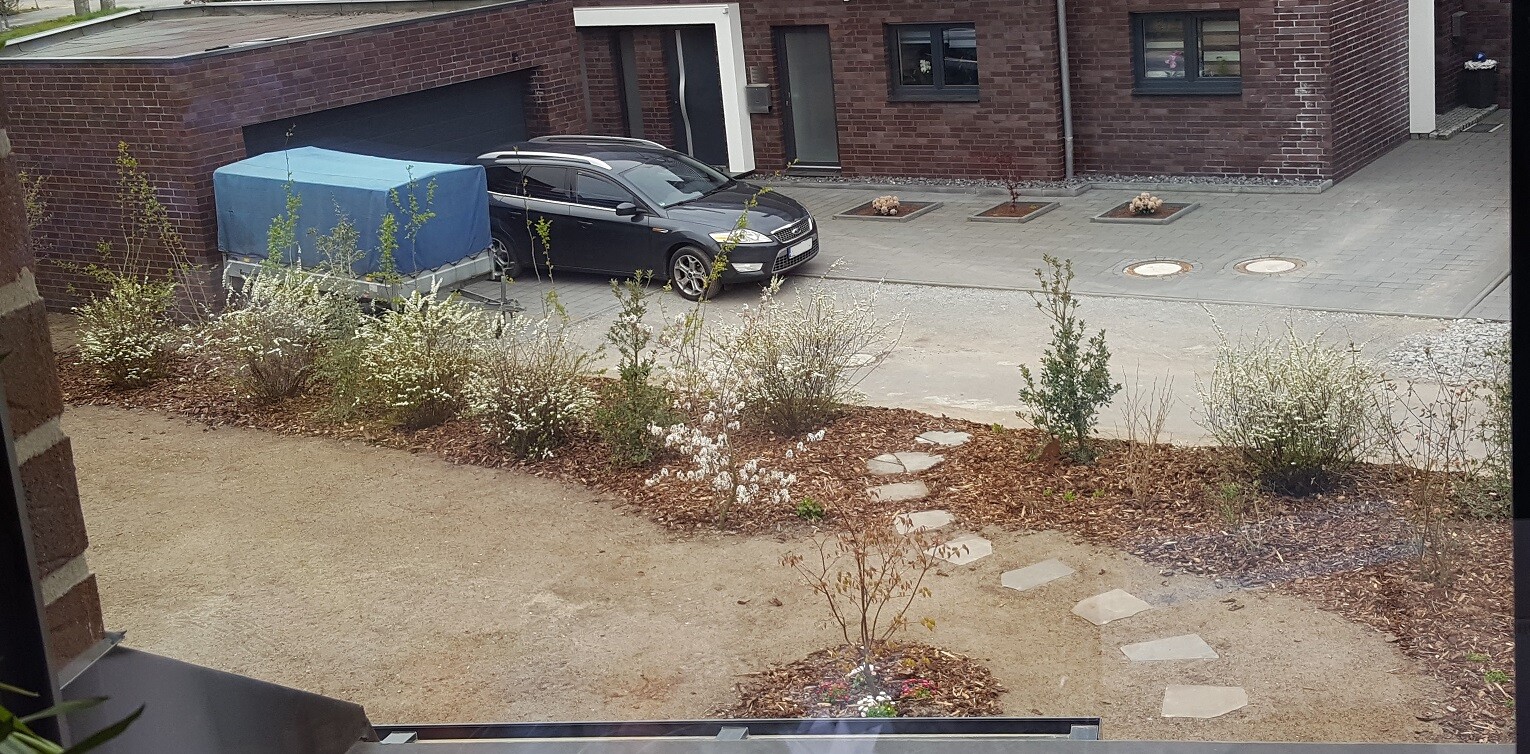
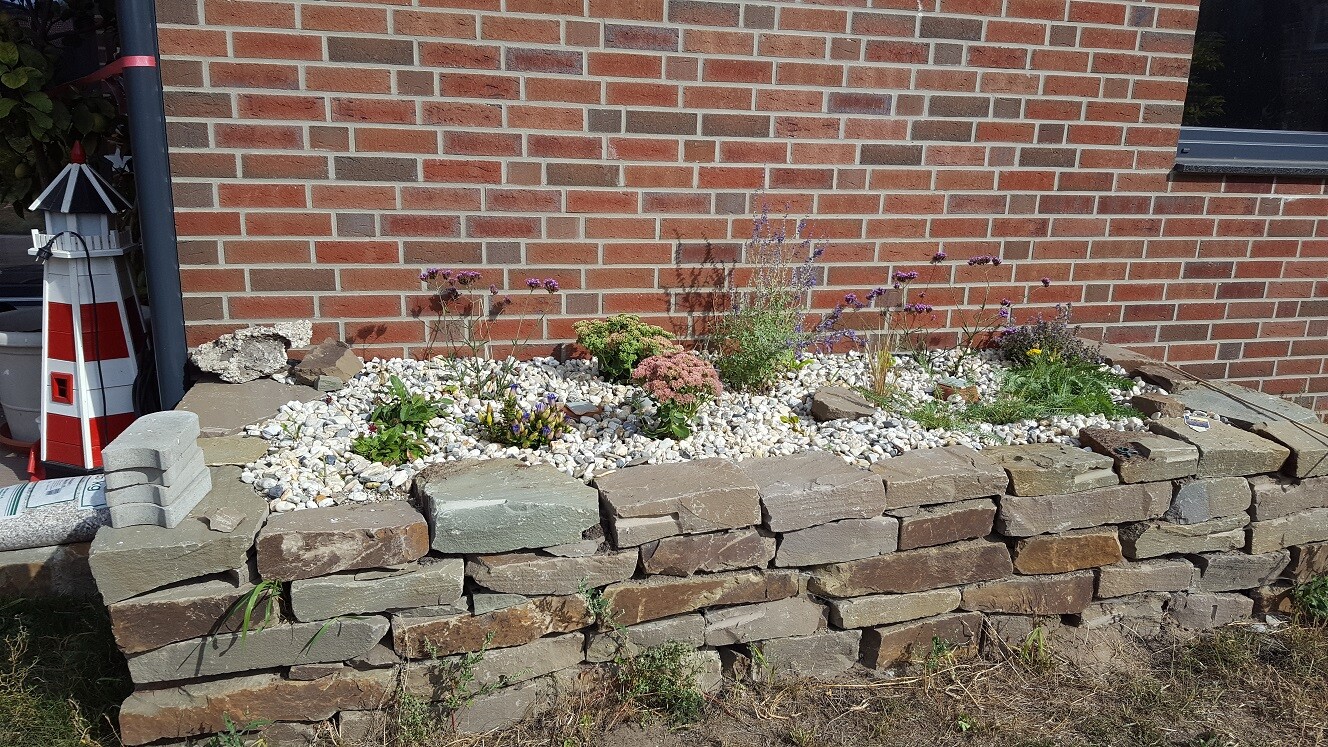
In the raised bed there are herbs and a few flowers, and in the mulched bed only blue/white/pink flowers will bloom. A privet hedge will be planted along the border this week. Luckily, I was able to convince our neighbors not to go for anything like thuja or cherry laurel or anything similarly horrible. (Actually, it was pretty simple: I would have refused to plant that stuff in our garden. That would have meant installing a fence, and they would have had to pay for the hedge themselves.)
If you don’t prune privet to a blocky shape, it flowers beautifully.
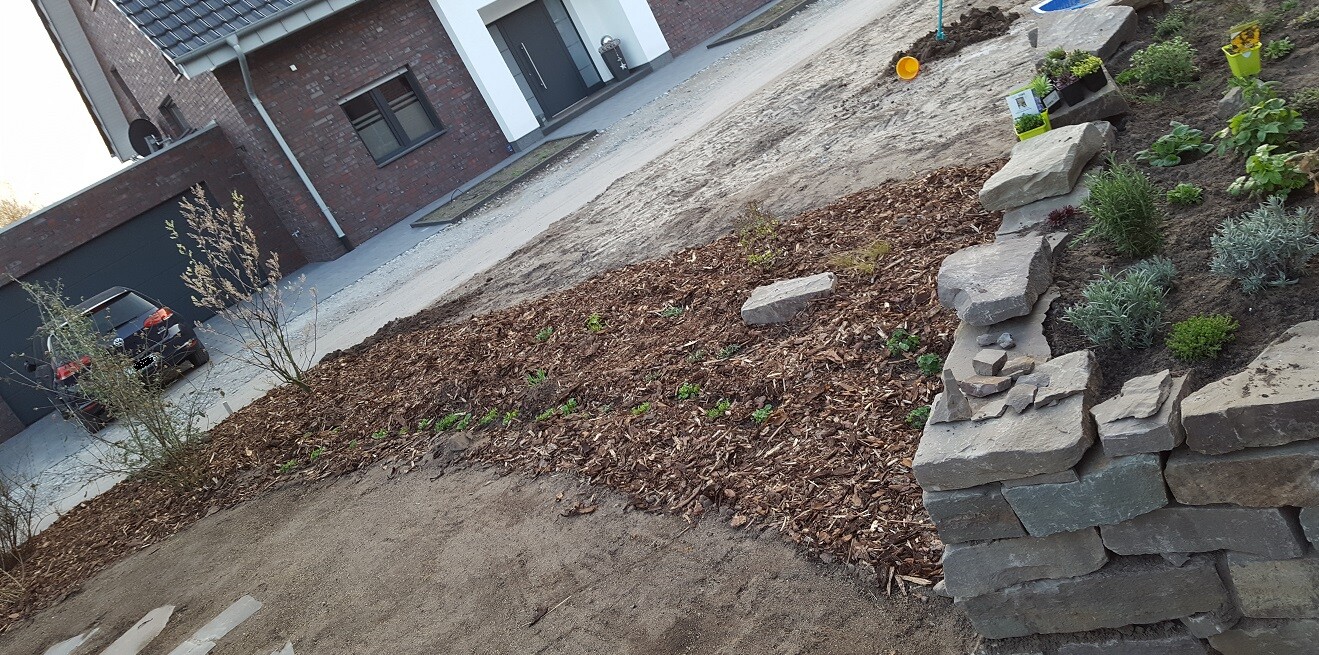
Here’s a lilac; over Easter, vegetables will go into the raised bed, and on the right side towards the neighbors there will be a large bed in orange/yellow/red.
Yes.
Eventually, there will be an apple tree, once we find a tasty variety that the child isn’t allergic to.
I’d also like to add some kind of water feature, but we’ll see how that works without a fence with so many children around. Probably not at all.
We’ll see how it all turns out, but a gardener needs patience.
And here we’ll have the only nature-friendly garden; all around us there are golf-course lawns, gabions, dull uniform beech hedges, and hardly any flower beds.
As I’ve mentioned a few times before, we’re getting an “eco garden.”
After the excavation spoil from both halves of the house, which was just lying around here, was finally removed in September, nothing happened for a while.
At the end of March, it looked like this
Then I planted the hedge (with the gardeners).
On the outside there is a lot of hawthorn, then 2 holly bushes (we’ll see if they don’t dry out too much in summer), 2 firethorns, a witch hazel, a butterfly bush, 2 copper mountain ashes, spireas, a viburnum, and a mock orange. Up front, separately, a maple.
Eventually, there will be a rose arch with a gate at the end of the path.
The lawn is growing rather slowly; it’s just too cold right now.
In the raised bed there are herbs and a few flowers, and in the mulched bed only blue/white/pink flowers will bloom. A privet hedge will be planted along the border this week. Luckily, I was able to convince our neighbors not to go for anything like thuja or cherry laurel or anything similarly horrible. (Actually, it was pretty simple: I would have refused to plant that stuff in our garden. That would have meant installing a fence, and they would have had to pay for the hedge themselves.)
If you don’t prune privet to a blocky shape, it flowers beautifully.
Here’s a lilac; over Easter, vegetables will go into the raised bed, and on the right side towards the neighbors there will be a large bed in orange/yellow/red.
Yes.
Eventually, there will be an apple tree, once we find a tasty variety that the child isn’t allergic to.
I’d also like to add some kind of water feature, but we’ll see how that works without a fence with so many children around. Probably not at all.
We’ll see how it all turns out, but a gardener needs patience.
And here we’ll have the only nature-friendly garden; all around us there are golf-course lawns, gabions, dull uniform beech hedges, and hardly any flower beds.
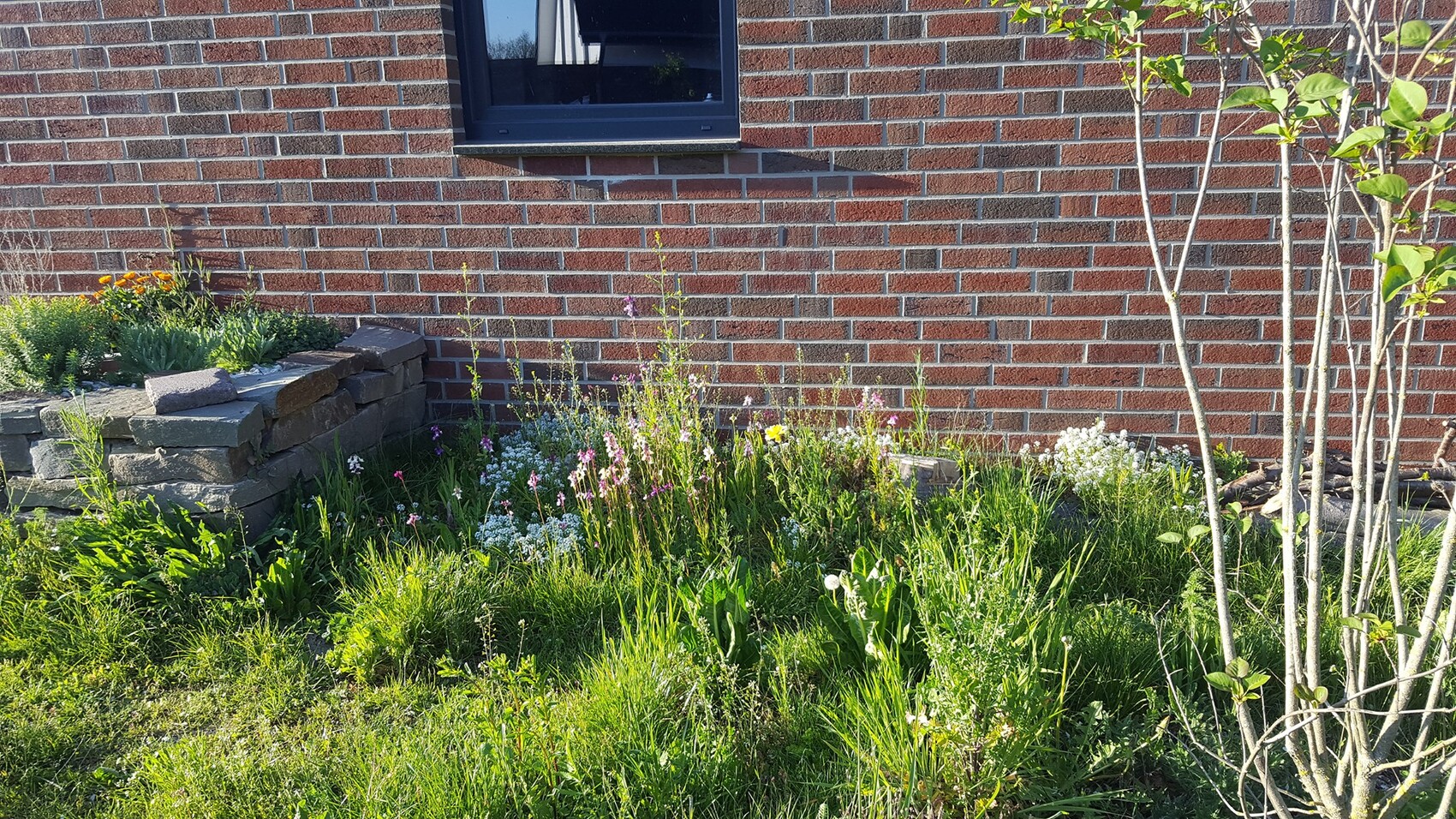
A small snapshot of how the meadow is currently blooming:
Yesterday, I was watering the hedge near the neighbor—the visitor was there. The visitor looked through the bushes toward us and asked, “Is that supposed to be a garden over there?”
I almost burst out laughing and kindly replied, “Yes, it’s a garden, we like it this way...”
The window cleaner who was here last week said while cleaning the glass roof, “The garden is still being worked on, right?”
When I asked him in confusion what exactly still needed to be done... he didn’t say anything more. I then explained to him (he couldn’t just leave) why the garden looks exactly the way it does. But he didn’t really understand, because at the end of the cleaning, he asked (at least he asked instead of just doing it) if he could pour the rinse water onto the meadow.
When I asked if he would do that at his own home, he said “yes.” Um, I then suggested he put the water in the drain at the front... seriously.
These two examples just show me that the concept of “meadow instead of lawn” is still slowly spreading and that it is still seen as untidy chaos.
Which is a pity—it only has advantages:
- nature benefits more from meadow
- significantly less maintenance effort, only cut or scythe twice a year
- you automatically get beautiful flowers
- children stay busy watching small creatures
- no need to water in summer, as the meadow stays green and adapts in its composition so that only plants that need little water are present
Yesterday, I was watering the hedge near the neighbor—the visitor was there. The visitor looked through the bushes toward us and asked, “Is that supposed to be a garden over there?”
I almost burst out laughing and kindly replied, “Yes, it’s a garden, we like it this way...”
The window cleaner who was here last week said while cleaning the glass roof, “The garden is still being worked on, right?”
When I asked him in confusion what exactly still needed to be done... he didn’t say anything more. I then explained to him (he couldn’t just leave) why the garden looks exactly the way it does. But he didn’t really understand, because at the end of the cleaning, he asked (at least he asked instead of just doing it) if he could pour the rinse water onto the meadow.
When I asked if he would do that at his own home, he said “yes.” Um, I then suggested he put the water in the drain at the front... seriously.
These two examples just show me that the concept of “meadow instead of lawn” is still slowly spreading and that it is still seen as untidy chaos.
Which is a pity—it only has advantages:
- nature benefits more from meadow
- significantly less maintenance effort, only cut or scythe twice a year
- you automatically get beautiful flowers
- children stay busy watching small creatures
- no need to water in summer, as the meadow stays green and adapts in its composition so that only plants that need little water are present
Müllerin schrieb:
These two examples show me that the concept of a "meadow instead of lawn" is unfortunately still spreading slowly, and it is often seen as unkempt chaos.
Which is a shame – it has only advantages:
- Nature benefits more from meadows
- Much less maintenance, as it only needs to be mowed or scythed twice a year
- You automatically get beautiful flowers
- Children are occupied watching small animals
- No need to irrigate in summer, since meadows stay green and adapt their plant composition to include only drought-tolerant species Is it really like that? I’m also very nature-oriented, but I have some different thoughts:
- It looks untidy to let everything grow freely (although I don’t like overly manicured lawns or rock gardens either)
- Weeds can spread and take over the property
- Children can play better on a lawn and see where they are stepping
- Irrigation uses water from the cistern, and if the lawn does turn brown, it usually recovers
I find structured gardens much nicer, with some areas left "wild," but definitely not the entire garden.
 Tina mit K22 Apr 2020 13:53
For the remaining earthworks on our site, we are also letting nature take its course to see what will grow. There isn’t much soil left visible, and this is an example of what has started to grow here:
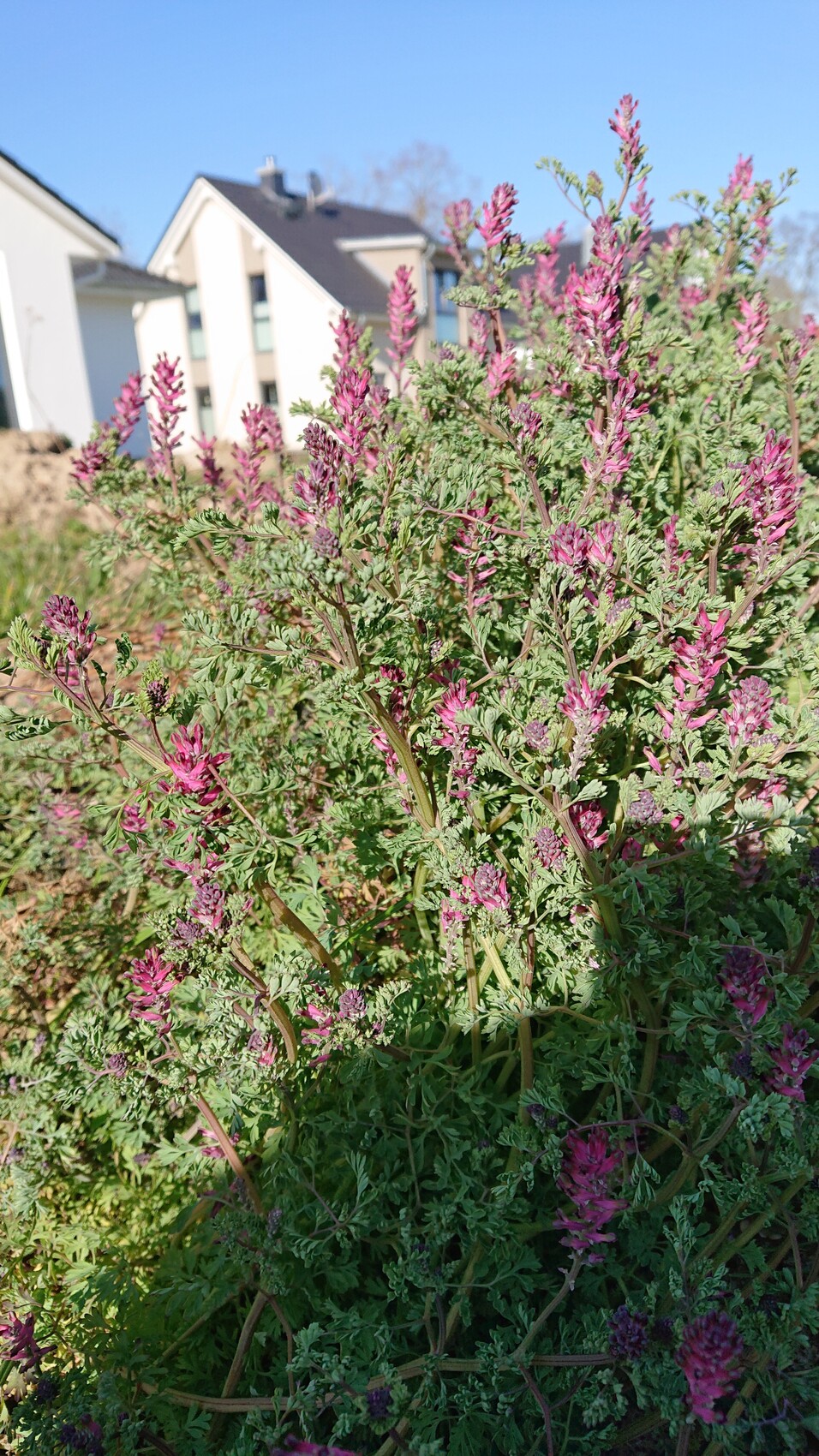
Does anyone know what this is? It grows more like a ground cover and reaches about elbow height.
We are also planning to leave an area as a meadow, which will create quite a strong contrast to the neighbor, who is apparently trying to maintain a lawn resembling an English garden.
Does anyone know what this is? It grows more like a ground cover and reaches about elbow height.
We are also planning to leave an area as a meadow, which will create quite a strong contrast to the neighbor, who is apparently trying to maintain a lawn resembling an English garden.
@Mojos sure – right in the first post when it was still fresh.
And since I only have limited space, I give priority to what I find most beautiful and important. And that is meadow. There is far too little of it, which is why I have it. Last year the orb-weaver spiders and many other insects showed me that this is exactly right...
This is not to criticize – I can tell the difference between someone who simply has lawn space for children, dogs, or regular barbecues, with many beds and bushes around it; someone who really LOVES GARDENING and enjoys taking care of it;
or someone who has gabions and/or laurel cherry hedges around a putting green lawn, and maybe a gifted flower in a pot that soon withers. With such people, my understanding ends.
Bookstar schrieb:
- it looks unkempt to just let everything grow (though I don’t like boring lawns or rock gardens either)
not at all, there are great flowers. Flowers are not unkempt.
- all the weeds can spread and take over the property
what weeds? In a natural garden there are no weeds. If my entire lawn is full of dandelions, it just shows what the soil supports. If I want fewer dandelions, I have to change the soil. Add more sand, make it leaner...
- children can play better on the lawn and see where they step
I do mow paths through the meadow, because I need access to the hedge for watering and I also mow the strip along the neighbor’s fence so it doesn’t get overgrown beneath it. So actually, no soccer is played here – but that’s not important anyway.
- sprinklers use water from the cistern and if the lawn turns brown, it recovers too
Collecting rainwater is fine – what I don’t like is when everyone taps into groundwater to fill a paddling pool. Then my hedge (and also the monoculture beech and laurel hedge) gets no water and I have to water even more.
I find structured gardens much nicer, ones that have areas which are “wild,” but please not the whole garden.
I also like structured gardens, with lovely perennial beds, hedges, trees, etc. There can certainly be lawn between them. I also have a bed with roses (we'll see if they survive or if I don’t care for them enough :-P) and a perennial bed. Almost all plants there are native species and some that tolerate drought.
And since I only have limited space, I give priority to what I find most beautiful and important. And that is meadow. There is far too little of it, which is why I have it. Last year the orb-weaver spiders and many other insects showed me that this is exactly right...
This is not to criticize – I can tell the difference between someone who simply has lawn space for children, dogs, or regular barbecues, with many beds and bushes around it; someone who really LOVES GARDENING and enjoys taking care of it;
or someone who has gabions and/or laurel cherry hedges around a putting green lawn, and maybe a gifted flower in a pot that soon withers. With such people, my understanding ends.
Similar topics