
ᐅ Solid construction or timber / Borehole or trench collector
Created on: 14 Apr 2020 11:35
M
maleba89
Hello to all building experts, and thanks in advance for your support. I hope I’m posting in the right subforum with my questions.
We are currently planning our single-family home and would appreciate some assistance. We already own a plot of land, and I have a few questions about it. I’ve attached some pictures of the property and our plans. The marked stream runs underground in a pipe about 25-30cm (10-12 inches) deep. However, the land slopes down from the street about 90cm (35 inches) toward the middle and will be leveled at street level with fill.
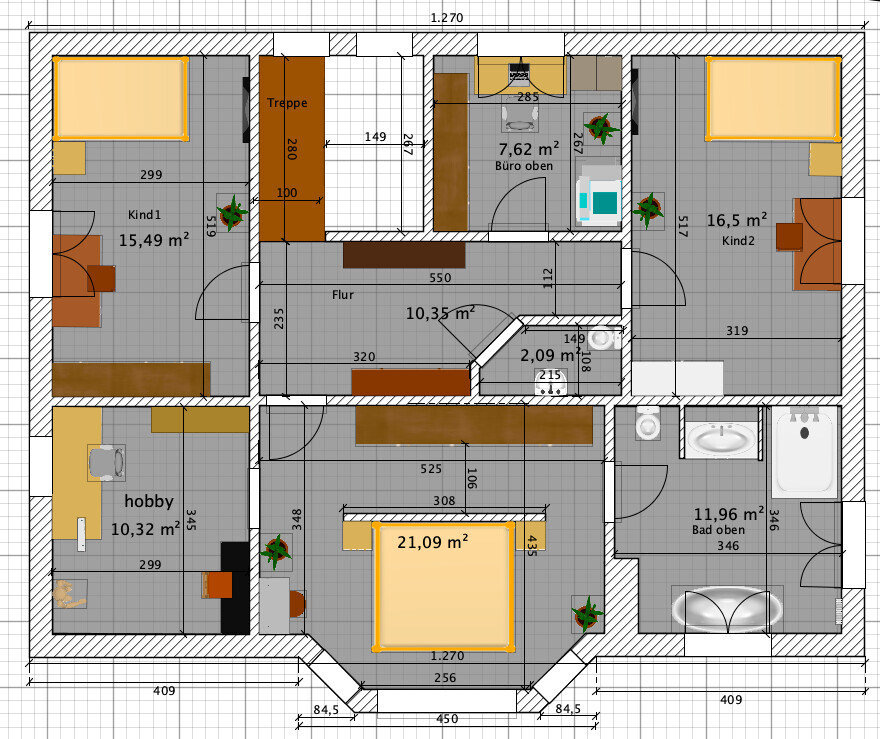
We intend to build a single-family house with two floors, no basement, a knee wall height of 1.60m (5.25 feet), and a roof pitch of 38°. The residential area is very quiet and not on a main road. The site elevation is 540m (1772 feet).
We don’t plan to apply for KfW funding, but we do want to achieve at least the KfW 55 standard regarding energy efficiency.
We will only have the shell construction done professionally: foundation slab and roof. The rest we will do ourselves, as my father owns a carpentry/joinery business specializing in windows, and we also have a plastering company in the family. So we will handle floors, windows, doors, stairs, installation layers, roof insulation, non-load-bearing interior walls, interior plaster, and possibly exterior plaster ourselves.
I will take care of the electrical work; I’m a certified master electrician and work professionally in this field.
Currently, we are still undecided between timber frame construction and solid masonry.
For timber frame construction, I have concerns about sound insulation inside the house (children’s rooms above the living room with home theater). Is good sound insulation between floors achievable in this system?
With timber frame construction, we can do much ourselves since only the stud frame with plaster carrier board (or wood fiber board with an air gap and wood facade) would be installed by the builder. We would take care of wall insulation and cladding ourselves. We already built my uncle’s house ourselves this way about 10 years ago. What bothers me there is that when the children play upstairs, the noise is clearly audible in the living room below. However, his house has an open beam ceiling with ventilation ducts running above the visible boards.
1. Are there any experiences with other floor constructions here in the forum? We don’t need an exposed beam ceiling and have also considered a cross-laminated timber (CLT) ceiling.
2. As an alternative, solid construction is also an option—only the outer walls and load-bearing walls. However, I would prefer to avoid external thermal insulation composite systems (ETICS / external wall insulation) and build monolithically if possible. Or do you think there are better alternatives currently?
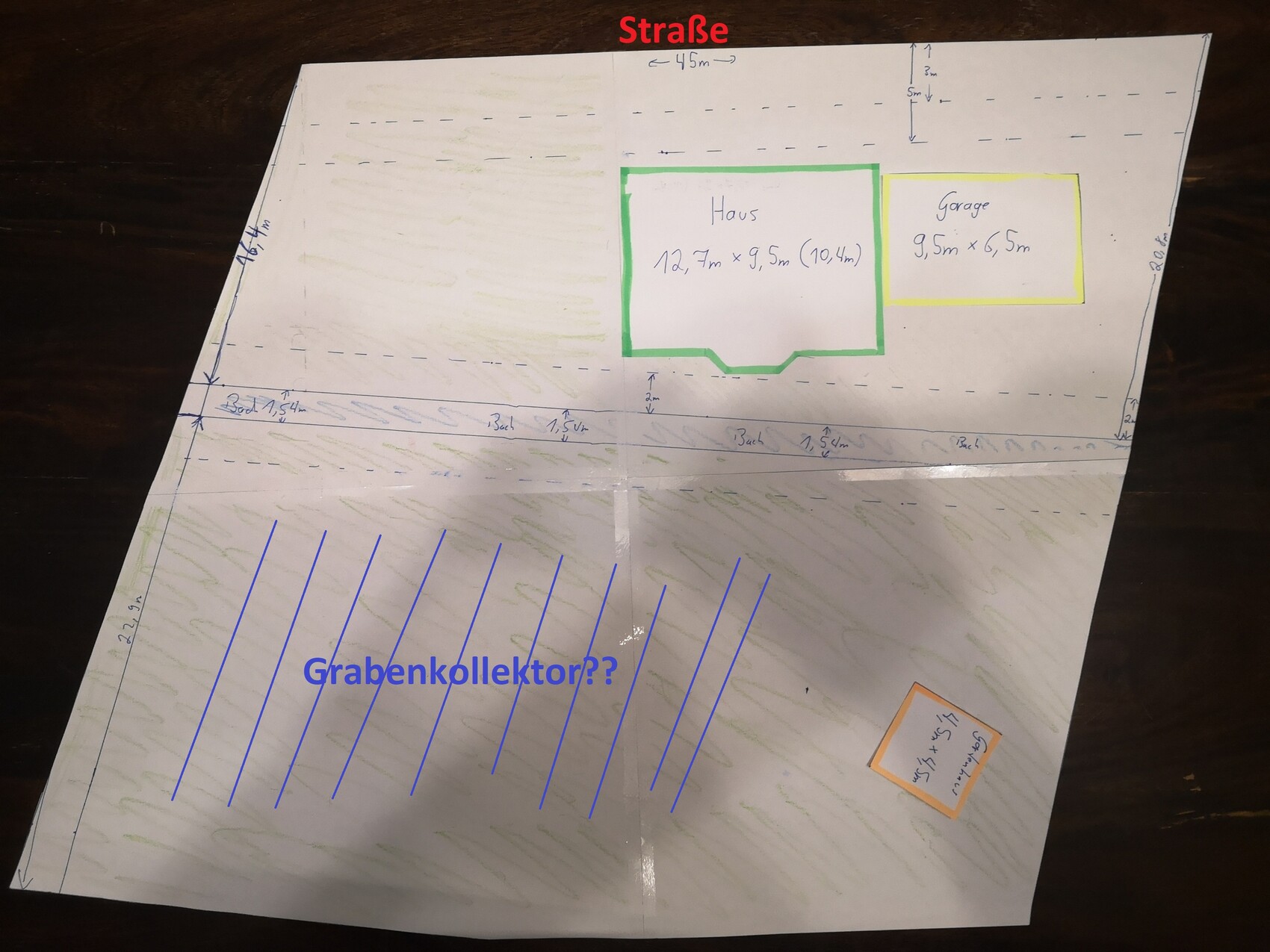
3. We plan to use a heat pump with geothermal energy. Given the lot size, I considered trench collectors, but I wonder whether they have to be placed directly next to the house or, as in the drawing, can be a bit away from the building? The piping would then connect in the garage approximately.
4. Heat distribution is planned via underfloor heating throughout the rooms, and a stove with a water jacket in the living room is intended to support heating. I thought the heat from the stove would be fed through a mixing valve to both the underfloor heating circuit and the hot water circuit.
5. A central ventilation system is not planned; instead, decentralized ventilation will be used in the living area, kitchen, bathroom, and possibly bedrooms.
Maybe you have some additional ideas?
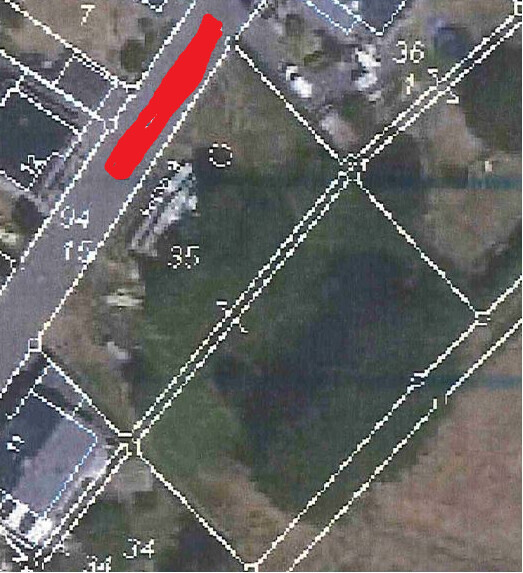
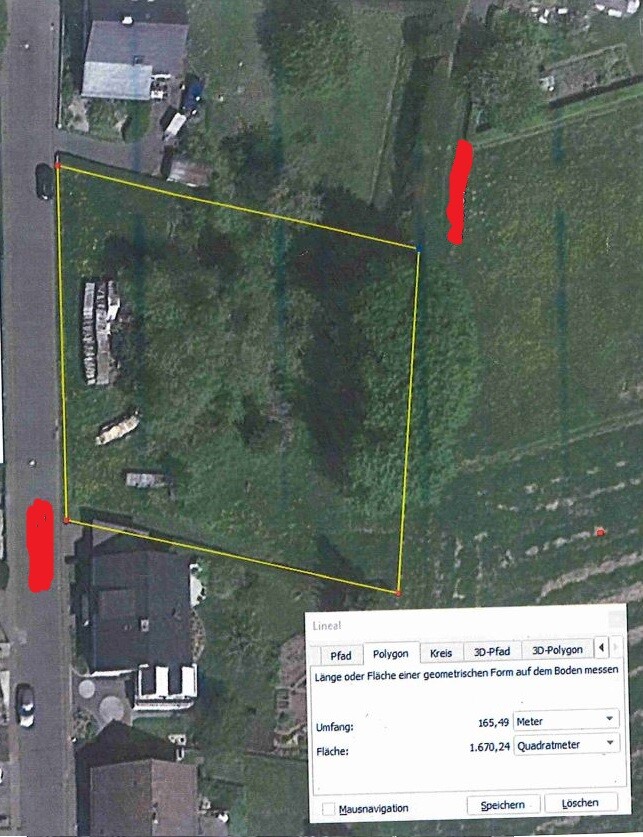

We are currently planning our single-family home and would appreciate some assistance. We already own a plot of land, and I have a few questions about it. I’ve attached some pictures of the property and our plans. The marked stream runs underground in a pipe about 25-30cm (10-12 inches) deep. However, the land slopes down from the street about 90cm (35 inches) toward the middle and will be leveled at street level with fill.
We intend to build a single-family house with two floors, no basement, a knee wall height of 1.60m (5.25 feet), and a roof pitch of 38°. The residential area is very quiet and not on a main road. The site elevation is 540m (1772 feet).
We don’t plan to apply for KfW funding, but we do want to achieve at least the KfW 55 standard regarding energy efficiency.
We will only have the shell construction done professionally: foundation slab and roof. The rest we will do ourselves, as my father owns a carpentry/joinery business specializing in windows, and we also have a plastering company in the family. So we will handle floors, windows, doors, stairs, installation layers, roof insulation, non-load-bearing interior walls, interior plaster, and possibly exterior plaster ourselves.
I will take care of the electrical work; I’m a certified master electrician and work professionally in this field.
Currently, we are still undecided between timber frame construction and solid masonry.
For timber frame construction, I have concerns about sound insulation inside the house (children’s rooms above the living room with home theater). Is good sound insulation between floors achievable in this system?
With timber frame construction, we can do much ourselves since only the stud frame with plaster carrier board (or wood fiber board with an air gap and wood facade) would be installed by the builder. We would take care of wall insulation and cladding ourselves. We already built my uncle’s house ourselves this way about 10 years ago. What bothers me there is that when the children play upstairs, the noise is clearly audible in the living room below. However, his house has an open beam ceiling with ventilation ducts running above the visible boards.
1. Are there any experiences with other floor constructions here in the forum? We don’t need an exposed beam ceiling and have also considered a cross-laminated timber (CLT) ceiling.
2. As an alternative, solid construction is also an option—only the outer walls and load-bearing walls. However, I would prefer to avoid external thermal insulation composite systems (ETICS / external wall insulation) and build monolithically if possible. Or do you think there are better alternatives currently?
3. We plan to use a heat pump with geothermal energy. Given the lot size, I considered trench collectors, but I wonder whether they have to be placed directly next to the house or, as in the drawing, can be a bit away from the building? The piping would then connect in the garage approximately.
4. Heat distribution is planned via underfloor heating throughout the rooms, and a stove with a water jacket in the living room is intended to support heating. I thought the heat from the stove would be fed through a mixing valve to both the underfloor heating circuit and the hot water circuit.
5. A central ventilation system is not planned; instead, decentralized ventilation will be used in the living area, kitchen, bathroom, and possibly bedrooms.
Maybe you have some additional ideas?
Steven schrieb:
Hello maleba89
The collector is initially cheaper than drilling. However, the drilling pays off quickly.
Calculate this: How warm is it at 1 meter (3 feet) depth during frost? You have to keep in mind that you are continuously extracting heat from the ground. After a short period, the compressor has to run non-stop because no more heat is coming through. Most likely, the electric heating element will keep turning on frequently.
Cooling in summer? You can forget about that quickly. In that case, leaving the refrigerator door open is more effective.
Now about drilling: Even if there are weeks of minus 20°C (minus 4°F), the temperature at depth remains constant. You simply cannot extract so much heat that nothing is left. It is always cool in summer. At my place, it is always around 15°C (59°F) at 75 meters (246 feet).
You save several thousand euros upfront, but those costs are quickly eaten up by higher electricity consumption (compressor, electric heating element).
Steven Are you familiar with the heat pump energy consumption database (if not, just search and compare)? It is probably the most objective source you can get for comparisons. There are practically no efficiency differences between drilling and horizontal collector loops.
You never need an electric heating element (and by that I really mean never), not even during extended frost periods (of course, proper system sizing like with drilling is essential). The collector is fully recharged by spring and ready at 100% for the next cold season.
Tego12 schrieb:
You know the heat pump consumption database Hello Tego12
I relied on an expert. He was neutral and had no shares in any company.
Also, logic tells me that boreholes are more efficient than surface collectors.
Steven
Steven schrieb:
Hello Tego12,
I relied on an expert. He was neutral and had no shares in any company.
The logic also tells me that boreholes are more effective than surface collectors.
StevenEven modern air-to-water heat pumps operate almost without an electric heating element. So why would a brine-to-water heat pump, whose medium is "naturally" much warmer than the outside air in the case of a trench collector, need a heating element? The consumption database supports this, as the coefficients of performance (COP) between boreholes and trench collectors do not really differ.
It is true that boreholes have a theoretical efficiency advantage in winter due to the generally higher brine temperatures, but near-surface collectors are more efficient for domestic hot water heating in summer... in practice, there is practically no difference.
Even for cooling: you don’t want to use passive cooling with 14°C (57°F) supply temperature in underfloor heating because your feet will get cold (and it is simply not feasible due to the dew point in summer—otherwise, water would condense on the floor).
A constant 18–19°C (64–66°F), possibly for 12–24 hours per day, steadily drawing energy from the building’s thermal mass to prevent it from warming up (concrete, screed, etc.) and thus keeping the house cool.
D
Denk_Mal1916 Apr 2020 09:47If the space on the property is limited, it is possible to choose a trench collector to increase the efficiency of the ground source heat exchanger. This involves using a narrow trench, 60 cm (24 inches) wide, with a borehole depth of 4.5 meters (15 feet). One advantage is higher average annual fluid temperatures and lower land use because the fluid loops are positioned vertically in the trench. An installation depth of 1.50 meters (5 feet) below ground level is acceptable. Shrubs and shallow-rooted plants can still be planted above.
Similar topics