
Hello everyone,
We are currently planning our outdoor area and would like to build a pool ourselves. The pool will be constructed from 17.5 cm (7 inch) concrete formwork blocks and will be fully embedded in the ground on two sides, while about two-thirds of it will extend above ground on the other two sides.
We have put together a cost estimate and are now looking to cut expenses where possible.
One major cost item is the concrete slab. Originally, a concrete truck with a pump was budgeted, but this is one of the largest expenses in the plan, so we would like to pour the slab ourselves.
We definitely have the necessary skills and sufficient physical strength.
The pool will measure 7 x 4 meters (23 x 13 feet), and with a 20 cm (8 inch) thick slab, about 5.6 cubic meters (about 7.3 cubic yards) of concrete will need to be poured.
That is quite a lot of concrete to mix and work by hand with a concrete mixer.
Therefore, our question is whether the slab can be poured in sections.
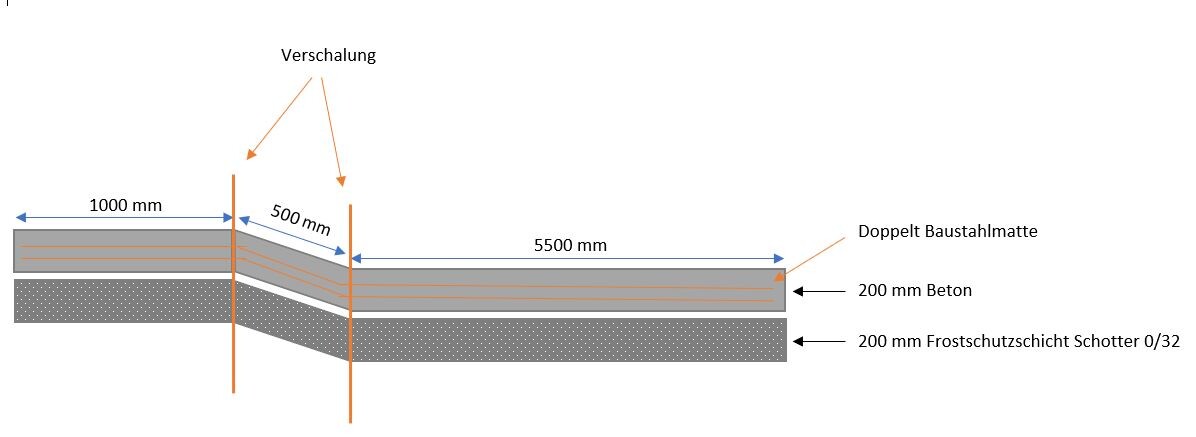
The setup would be 20 mm (0.8 inch) gravel, then a mesh of double-layer steel reinforcement mats. The pool will have two levels connected by a slope.
As shown in the attached sketch, can the slab be divided into these three sections and poured separately, or would that be ineffective and not durable in the long term?
The connecting reinforcement would be in place for the individual sections.
I’m looking forward to your knowledge and feedback.
Thank you very much.
We are currently planning our outdoor area and would like to build a pool ourselves. The pool will be constructed from 17.5 cm (7 inch) concrete formwork blocks and will be fully embedded in the ground on two sides, while about two-thirds of it will extend above ground on the other two sides.
We have put together a cost estimate and are now looking to cut expenses where possible.
One major cost item is the concrete slab. Originally, a concrete truck with a pump was budgeted, but this is one of the largest expenses in the plan, so we would like to pour the slab ourselves.
We definitely have the necessary skills and sufficient physical strength.
The pool will measure 7 x 4 meters (23 x 13 feet), and with a 20 cm (8 inch) thick slab, about 5.6 cubic meters (about 7.3 cubic yards) of concrete will need to be poured.
That is quite a lot of concrete to mix and work by hand with a concrete mixer.
Therefore, our question is whether the slab can be poured in sections.
The setup would be 20 mm (0.8 inch) gravel, then a mesh of double-layer steel reinforcement mats. The pool will have two levels connected by a slope.
As shown in the attached sketch, can the slab be divided into these three sections and poured separately, or would that be ineffective and not durable in the long term?
The connecting reinforcement would be in place for the individual sections.
I’m looking forward to your knowledge and feedback.
Thank you very much.

Foundations can be built in sections if done properly.
But honestly: if your budget is so tight that you have to cut costs on the concrete mixer and pump, you shouldn’t be thinking about a pool and its operation.
Will it be a lined pool? A counter-current system? What kind of pumps and filtration plus dosing, covers, heating...?
Even if you have the manpower and skills, sometimes it still makes sense to do it right. You also have to arrange delivery for the raw materials. If you get them yourself, you’ll probably have to make several trips and also factor in the wear and tear on your vehicle, etc.
You also need to provide food for the crew. Currently only one person not living in the household...
With a vehicle and pump, the job is done in a maximum of an hour.
But honestly: if your budget is so tight that you have to cut costs on the concrete mixer and pump, you shouldn’t be thinking about a pool and its operation.
Will it be a lined pool? A counter-current system? What kind of pumps and filtration plus dosing, covers, heating...?
Even if you have the manpower and skills, sometimes it still makes sense to do it right. You also have to arrange delivery for the raw materials. If you get them yourself, you’ll probably have to make several trips and also factor in the wear and tear on your vehicle, etc.
You also need to provide food for the crew. Currently only one person not living in the household...
With a vehicle and pump, the job is done in a maximum of an hour.
Thanks for the advice.
Everything is fully planned and budgeted at 15,000 euros. It’s still unclear whether we will go for a liner pool or tiled finish, but we already have quotes from a professional for installing the liner. A counter-current system is unnecessary—it’s only meant for cooling. All the technical aspects have already been planned.
The materials will, of course, be delivered by the building materials supplier. The excavator is ready to start digging the hole.
My main question now concerns the foundation slab.
When you say it can be done in sections if done properly, it makes me wonder what “done properly” actually looks like.
Could you share some details on this, or are there any websites where I can see examples? I haven’t found anything so far.
If I do it myself and save a four-figure amount, then the refreshments for the crew will be factored in as well.
That would leave a bit more budget for planning the remaining landscaping.
Everything is fully planned and budgeted at 15,000 euros. It’s still unclear whether we will go for a liner pool or tiled finish, but we already have quotes from a professional for installing the liner. A counter-current system is unnecessary—it’s only meant for cooling. All the technical aspects have already been planned.
The materials will, of course, be delivered by the building materials supplier. The excavator is ready to start digging the hole.
My main question now concerns the foundation slab.
When you say it can be done in sections if done properly, it makes me wonder what “done properly” actually looks like.
Could you share some details on this, or are there any websites where I can see examples? I haven’t found anything so far.
If I do it myself and save a four-figure amount, then the refreshments for the crew will be factored in as well.
That would leave a bit more budget for planning the remaining landscaping.
At 7 meters (23 feet), a counter-current system makes sense. Of course, not if it’s just for paddling.
It’s better to use a liner. In our latitudes, outdoor tiles are not ideal. What are the opportunity costs if you do it yourself? Plus helpers?
But let’s not be too nitpicky.
You should be able to handle 5.6 m³ (200 cubic feet) by hand in one day with help.
Just strip the formwork and install the reinforcement connections.
You didn’t cover many details about the pool itself, which is a pity. There are also forums dedicated solely to pools and their construction.
Please plan carefully. $15,000 is not very much for a pool of this size.
Please keep sharing updates about the project.
It’s better to use a liner. In our latitudes, outdoor tiles are not ideal. What are the opportunity costs if you do it yourself? Plus helpers?
But let’s not be too nitpicky.
You should be able to handle 5.6 m³ (200 cubic feet) by hand in one day with help.
Just strip the formwork and install the reinforcement connections.
You didn’t cover many details about the pool itself, which is a pity. There are also forums dedicated solely to pools and their construction.
Please plan carefully. $15,000 is not very much for a pool of this size.
Please keep sharing updates about the project.

rick2018 schrieb:
But honestly: if your budget is so tight that you’re cutting costs on the concrete mixer and pump, you shouldn’t be thinking about a pool and its operating expenses. I agree with that. Seven meters (23 feet) in length without a counter-current system but with two depths (swimming / non-swimming?) and a sloped stepped transition – that sounds to me overall like "I don’t believe that, Tim."
https://www.instagram.com/11antgmxde/
https://www.linkedin.com/company/bauen-jetzt/
Since this thread is about the topic of the foundation slab, I didn’t assume you would be interested in the background story, so I didn’t go into detail. That’s also why I didn’t place it in the garden section, as it is primarily about the foundation slab. However, an admin is welcome to move the topic if it would fit better elsewhere.
But here are some details. It is not a chemical pool but a natural pool, divided into a usage/swimming zone and a regeneration zone. The equipment will be installed by Glenk Pond Construction, which means deep suction, skimmer, curve filter basket, and a pump for the regeneration zone, where the water is finally cleaned by plants. Everything is already fully planned.
The two levels of the pool are due to the built-in masonry stairs leading into it. The “shallow area” will be 1.5 meters deep (5 feet) and then slope down to 2.0 meters (6.5 feet). This has nothing to do with swimmer or non-swimmer zones. Since, as mentioned, it will mostly be used for cooling down, a counter-current system is not an option. The pool will not be heated directly. Heating will take place in spring and autumn via a self-built system made of PE pipe, a temperature controller, and a pump. The PE pipe will be laid in a snake-like pattern on a fully south-facing 25 m² (270 ft²) garage roof.
However, I need to revise my calculation... I just looked at my “old” calculation. Adding the stone thickness and an additional 5 cm (2 inches) edging all around plus the technical shaft, we would need 7.4 m³ (260 ft³) of concrete to be processed.
But here are some details. It is not a chemical pool but a natural pool, divided into a usage/swimming zone and a regeneration zone. The equipment will be installed by Glenk Pond Construction, which means deep suction, skimmer, curve filter basket, and a pump for the regeneration zone, where the water is finally cleaned by plants. Everything is already fully planned.
The two levels of the pool are due to the built-in masonry stairs leading into it. The “shallow area” will be 1.5 meters deep (5 feet) and then slope down to 2.0 meters (6.5 feet). This has nothing to do with swimmer or non-swimmer zones. Since, as mentioned, it will mostly be used for cooling down, a counter-current system is not an option. The pool will not be heated directly. Heating will take place in spring and autumn via a self-built system made of PE pipe, a temperature controller, and a pump. The PE pipe will be laid in a snake-like pattern on a fully south-facing 25 m² (270 ft²) garage roof.
However, I need to revise my calculation... I just looked at my “old” calculation. Adding the stone thickness and an additional 5 cm (2 inches) edging all around plus the technical shaft, we would need 7.4 m³ (260 ft³) of concrete to be processed.
Similar topics