
ᐅ How should these points be interpreted in the zoning plan (building plan)?
Created on: 8 Apr 2020 13:55
K
Katdreas
Hello,
maybe you can help me again this time. I have already spoken to the building authority, but the caseworker seemed to have a bad day and wasn’t very willing to explain things clearly—or maybe I’m just having trouble understanding...
We want to start planning our outdoor areas. We border three neighbors and a sidewalk.
Neighbor 1 is somewhat lower (40cm (16 inches)), neighbor 2 is a bit higher (70-80cm (27-31 inches)), neighbor 3 is significantly higher (120cm (47 inches) and more), and the sidewalk is lower (60cm (24 inches)).
Basically, anyone who excavates or fills in must stabilize the ground, right? But I guess that can be agreed on between the parties...
What I’m more concerned about now is what is actually allowed according to the development plan / building permit regulations.
As I understood the caseworker, you can do whatever you want within your own property, but then I don’t understand the rules about “raised terraces and steep slopes.” When exactly is a terrace considered raised, and when is a slope considered steep?
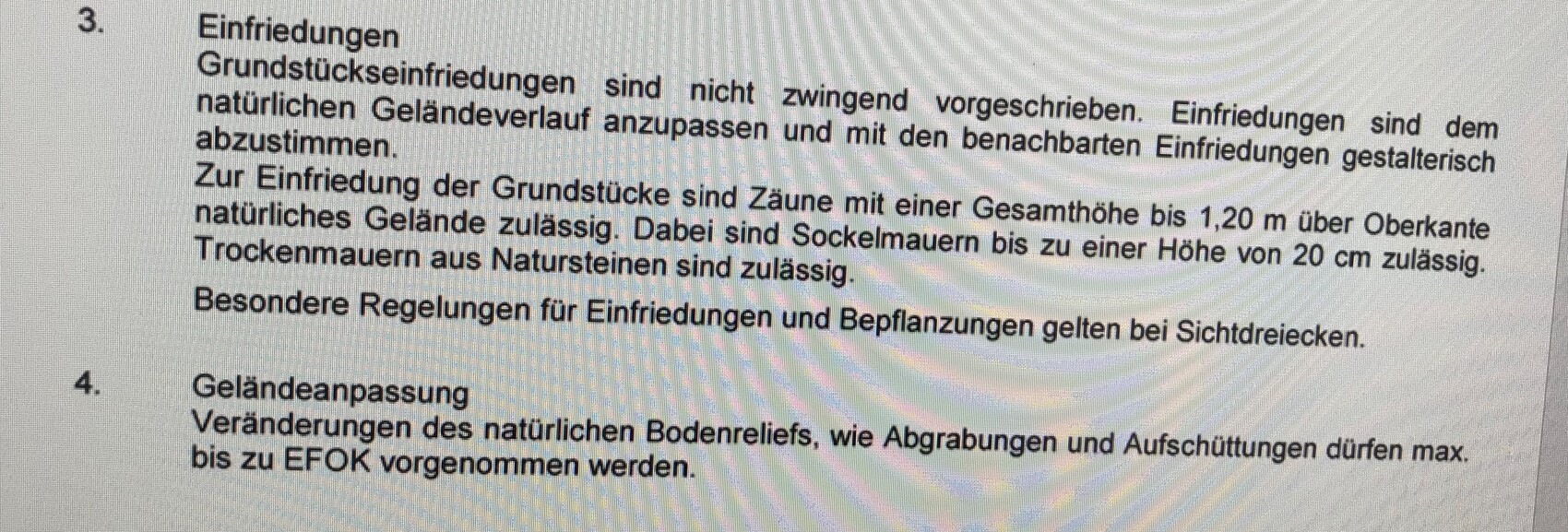
I was told that walls can only be 20cm (8 inches) high, and can be made of natural stone (but again, only 20cm high). When I read the relevant section in the development plan, I understand it as saying that base walls for fences can only be 20cm high, but natural stone walls are allowed??? How are you supposed to compensate for height differences then?
Fences can be a maximum of 120cm (47 inches) high from the top edge of the natural ground, right? Then neighbor 3 wouldn’t even be allowed to build a fence because the fill already exceeds 120cm.
By the way, the maximum finished ground floor level (finished floor level) was specified.
Thank you very much and Happy Easter!

maybe you can help me again this time. I have already spoken to the building authority, but the caseworker seemed to have a bad day and wasn’t very willing to explain things clearly—or maybe I’m just having trouble understanding...
We want to start planning our outdoor areas. We border three neighbors and a sidewalk.
Neighbor 1 is somewhat lower (40cm (16 inches)), neighbor 2 is a bit higher (70-80cm (27-31 inches)), neighbor 3 is significantly higher (120cm (47 inches) and more), and the sidewalk is lower (60cm (24 inches)).
Basically, anyone who excavates or fills in must stabilize the ground, right? But I guess that can be agreed on between the parties...
What I’m more concerned about now is what is actually allowed according to the development plan / building permit regulations.
As I understood the caseworker, you can do whatever you want within your own property, but then I don’t understand the rules about “raised terraces and steep slopes.” When exactly is a terrace considered raised, and when is a slope considered steep?
I was told that walls can only be 20cm (8 inches) high, and can be made of natural stone (but again, only 20cm high). When I read the relevant section in the development plan, I understand it as saying that base walls for fences can only be 20cm high, but natural stone walls are allowed??? How are you supposed to compensate for height differences then?
Fences can be a maximum of 120cm (47 inches) high from the top edge of the natural ground, right? Then neighbor 3 wouldn’t even be allowed to build a fence because the fill already exceeds 120cm.
By the way, the maximum finished ground floor level (finished floor level) was specified.
Thank you very much and Happy Easter!
Good grief, what have the city planners come up with this time? This could be the final exam in an advanced German language course: Interpret the text and explain the author’s intentions.
Yes.
No. "The natural terrain must be largely preserved."
Nobody knows. You might say that anything higher than the surrounding area is elevated, and anything steeper than the natural slope ratio of 1:1.5 is considered steep. Maybe the justification for the zoning plan provides some insight. The regulation itself is vague unless something from unpublished clauses helps clarify.
Was that really stated? It’s not clear from the regulation.
I agree with that too.
This only concerns boundary walls or fences, which usually run along property lines where height differences have to be managed by slopes.
No fill is permitted directly on the boundary; otherwise, the zoning plan has been violated. If there is an exemption, it likely applies to the fence as well. Or those approving it are just as careless as those who made the plans.
Correct.
20cm base walls are allowed, but not for retaining purposes.
No.
Yes, walls are allowed as enclosures but not as retaining walls.
For what purpose?
Yes, unless it impairs the character of the townscape or landscape. Which brings us back to the language exam again.
<Nitpicking>That would be 30%. At 30°, the height difference would be 0.58m (58cm).</Nitpicking>
<More nitpicking>Based on the natural slope ratio, it would be 90cm (35 inches) horizontally to accommodate a 60cm (24 inches) height difference.</More nitpicking>
Katdreas schrieb:
Basically, if someone excavates or adds fill, they have to stabilize it, right?
Yes.
Katdreas schrieb:
You can do whatever you want within your own property, right?
No. "The natural terrain must be largely preserved."
Katdreas schrieb:
When is a terrace considered elevated and when is a slope considered steep?
Nobody knows. You might say that anything higher than the surrounding area is elevated, and anything steeper than the natural slope ratio of 1:1.5 is considered steep. Maybe the justification for the zoning plan provides some insight. The regulation itself is vague unless something from unpublished clauses helps clarify.
Katdreas schrieb:
(but only 20cm high)
Was that really stated? It’s not clear from the regulation.
Katdreas schrieb:
That base walls of fences are only allowed up to 20cm high, but natural stone walls are permitted.
I agree with that too.
Katdreas schrieb:
How are you supposed to handle differences in height then?
This only concerns boundary walls or fences, which usually run along property lines where height differences have to be managed by slopes.
Katdreas schrieb:
Then Neighbor 3 shouldn’t be allowed to build a fence at all, since the fill already exceeds 120cm.
No fill is permitted directly on the boundary; otherwise, the zoning plan has been violated. If there is an exemption, it likely applies to the fence as well. Or those approving it are just as careless as those who made the plans.
Katdreas schrieb:
No retaining walls allowed? At least along the boundaries?
Correct.
Katdreas schrieb:
Not even 20cm?
20cm base walls are allowed, but not for retaining purposes.
Katdreas schrieb:
Are planting rings considered a slope?
No.
Katdreas schrieb:
No walls of any kind?
Yes, walls are allowed as enclosures but not as retaining walls.
Katdreas schrieb:
To have a level area in front of the entrance?
For what purpose?
Katdreas schrieb:
Am I allowed to build a wall with some distance from the sidewalk (maximum, easing factor) and have a surface between the wall and sidewalk at sidewalk level?
Yes, unless it impairs the character of the townscape or landscape. Which brings us back to the language exam again.
ypg schrieb:
So 30cm rise over one meter?
<Nitpicking>That would be 30%. At 30°, the height difference would be 0.58m (58cm).</Nitpicking>
ypg schrieb:
That means you have to “sacrifice” 2 meters of your land along the boundary if you want to adjust 60cm.
<More nitpicking>Based on the natural slope ratio, it would be 90cm (35 inches) horizontally to accommodate a 60cm (24 inches) height difference.</More nitpicking>
Escroda schrieb:
<smartass> That would be 30%. At 30°, the height difference is 0.58 m (1.9 ft). </smartass>Escroda schrieb:
<arduinosmartass> Based on the natural slope ratio, it would be 90 cm (35 inches) for a height difference of 60 cm (24 inches). </arduinosmartass>sorry, I can’t figure out how to quote properly. but Escroda’s post is slowly starting to clear things up for meDry stone walls are allowed as fencing up to a height of 120cm (47 inches), plinth walls for fences up to 20cm (8 inches), no walls are permitted for support purposes; instead, embankments must be created.
Within the property, walls (probably only dry stone walls) are allowed as long as the natural terrain is largely preserved.
If this were a German exam, I would have failed.

Katdreas schrieb:
Dry stone walls can be up to 120cm (47 inches) high as fencing, [...]
if this were a German language test, I would have received a fail At least this paragraph would be heavily marked in red.
Only fences (or nothing) are allowed as boundary enclosures; the bases of the fences may only be 20cm (8 inches) high, regardless of whether they are concreted, wet-built, or dry-stacked. Only fences may have a total height of 120cm (47 inches); inside the property, EFOK is the rule. Within the property, you can create grass or natural stone embankments; the use of planting rings does not appear to be excluded. The terrain should remain as close to the original as possible, meaning it can be shaped but not radically altered.
https://www.instagram.com/11antgmxde/
https://www.linkedin.com/company/bauen-jetzt/
When in doubt, stack the natural stone only up to the base height, without using it as the foundation of a fence (?) – what does @Escroda say: is the certainty neglected here?
https://www.instagram.com/11antgmxde/
https://www.linkedin.com/company/bauen-jetzt/
https://www.instagram.com/11antgmxde/
https://www.linkedin.com/company/bauen-jetzt/
Similar topics