
ᐅ Modernist Concrete Villa with Cavity Wall Insulation – Experiences
Created on: 11 Sep 2018 07:32
R
rick2018
Hello everyone,
I just wanted to briefly introduce myself and say thank you.
For about a year and a half, I have been a silent reader here to gather inspiration and especially to gain more knowledge about construction technology.
Now a bit about me:
After more than a year of searching for a plot of land, I was able to purchase one from a developer who couldn’t move forward quickly with his plans.
So we found our dream plot (good location, 2500 m² (0.62 acres), slight slope, underground private spring that we have to preserve and are allowed to use).
There was an old house on the property, which we have since demolished.
There is no zoning plan, so §34 applies. During an initial informal inquiry at the building authority, almost everything we planned was rejected.
So we submitted an official preliminary building inquiry, involved the right people, and had lengthy discussions. In the end, we received a positive decision.
Therefore, there is nothing standing in the way of the building permit. The building permit should be granted within the next few weeks as there are no changes from the preliminary inquiry.
My wife (37) and I (36) want to build a Bauhaus-style villa in southern Baden-Württemberg.
It will be constructed from concrete (with core insulation) or in combination with insulated precast elements.
A lot of glass (full-glass system), textile shading, KNX, fast network both wired and wireless, strong mechanical ventilation with additional cooling coils, stainless steel pool, large cistern, and more.
The electrical planning must be 100% spot on since it’s almost impossible to make changes afterward.
Since I am friends with an architect from a larger firm, it was clear which route we would take. Such a house can basically only be realized with an architect.
I also personally know the electrician and KNX system integrator, as well as the owners and work approach of the heating, plumbing, and ventilation companies involved.
Some trades have already been contracted, and part of the equipment has already been ordered.
I’m really looking forward to getting started and to the final result. The goal is to move in by the end of 2019.
Once again, many thanks for the information I have received from you so far.
If you have any questions, just let me know.
Attached is the design, though not the final version. There have been a few minor changes.
Greetings from Swabia
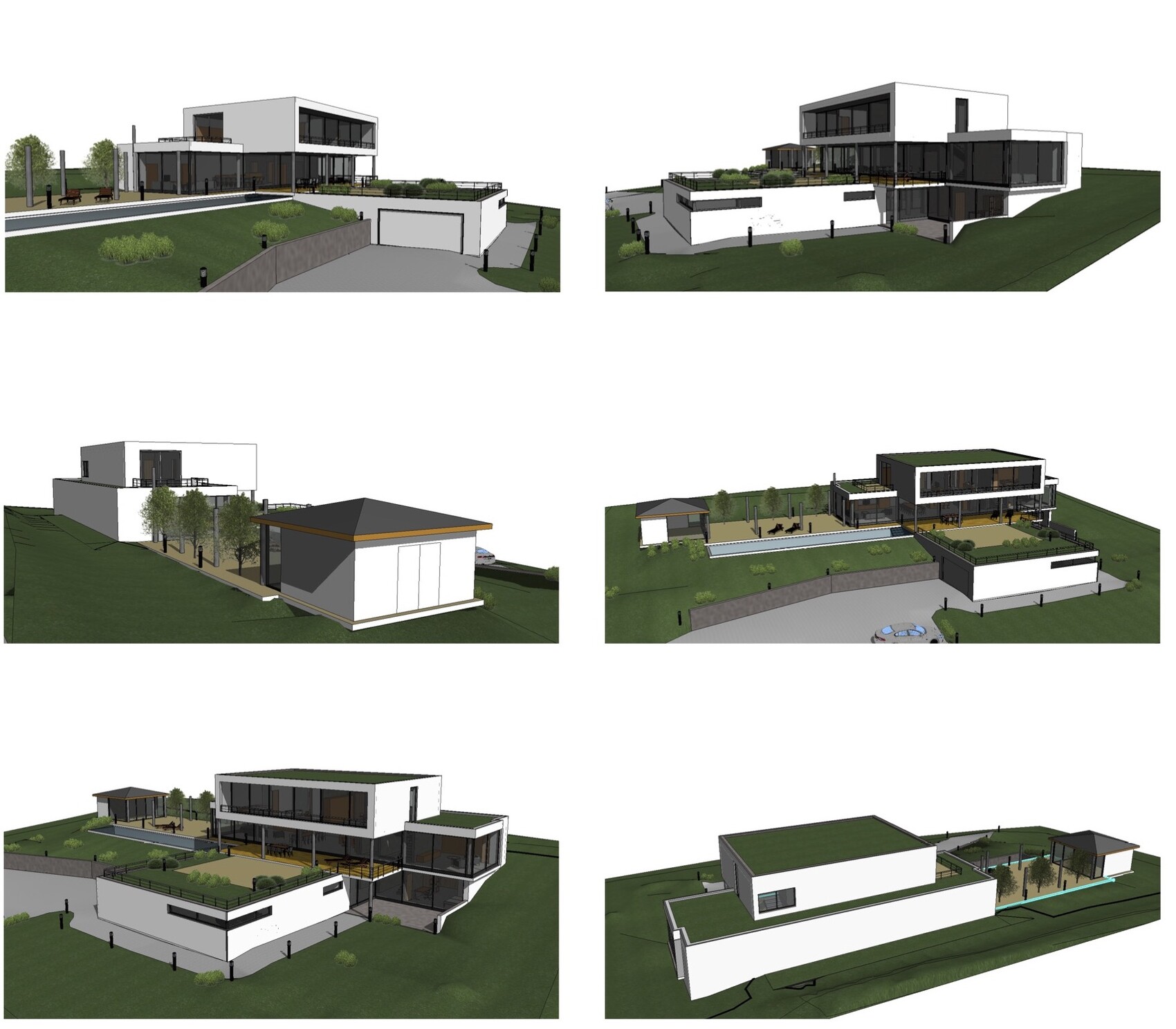
I just wanted to briefly introduce myself and say thank you.
For about a year and a half, I have been a silent reader here to gather inspiration and especially to gain more knowledge about construction technology.
Now a bit about me:
After more than a year of searching for a plot of land, I was able to purchase one from a developer who couldn’t move forward quickly with his plans.
So we found our dream plot (good location, 2500 m² (0.62 acres), slight slope, underground private spring that we have to preserve and are allowed to use).
There was an old house on the property, which we have since demolished.
There is no zoning plan, so §34 applies. During an initial informal inquiry at the building authority, almost everything we planned was rejected.
So we submitted an official preliminary building inquiry, involved the right people, and had lengthy discussions. In the end, we received a positive decision.
Therefore, there is nothing standing in the way of the building permit. The building permit should be granted within the next few weeks as there are no changes from the preliminary inquiry.
My wife (37) and I (36) want to build a Bauhaus-style villa in southern Baden-Württemberg.
It will be constructed from concrete (with core insulation) or in combination with insulated precast elements.
A lot of glass (full-glass system), textile shading, KNX, fast network both wired and wireless, strong mechanical ventilation with additional cooling coils, stainless steel pool, large cistern, and more.
The electrical planning must be 100% spot on since it’s almost impossible to make changes afterward.
Since I am friends with an architect from a larger firm, it was clear which route we would take. Such a house can basically only be realized with an architect.
I also personally know the electrician and KNX system integrator, as well as the owners and work approach of the heating, plumbing, and ventilation companies involved.
Some trades have already been contracted, and part of the equipment has already been ordered.
I’m really looking forward to getting started and to the final result. The goal is to move in by the end of 2019.
Once again, many thanks for the information I have received from you so far.
If you have any questions, just let me know.
Attached is the design, though not the final version. There have been a few minor changes.
Greetings from Swabia
H
hampshire8 Apr 2020 16:00Do we need another photovoltaic thread?
11ant schrieb:
That makes more sense to me. It’s unclear why grids would handle the "roast goose peak" phenomenon worse on the feed-in side than on the demand side. After all, solar irradiation doesn’t increase suddenly, and temperatures rise in a predictable way with several hours of lead time. Moreover, this whole approach would only make sense if there were, for example, annual limits on capacity additions.
Year 1: 100 GWp of installed capacity, of which 70 GWp can feed in
Year 2: an additional 100 GWp added, again with 70 GWp feed-in capacity.
That means the grid would already have to handle peaks of 140 GWp in Year 2, while in the previous year it only had to cope with 70 GWp.
Why not just plan for 100 GWp right from Year 1 and 200 GWp in Year 2?
Again here: flatten the curve. Probably investment protection for grid operators, so they don’t experience the expansion of renewables driven by strong Renewable Energy Act subsidies all at once but only with a delay. Economically, perhaps still reasonable (no idea, we may never know), but from the operator’s business perspective inconvenient, and environmentally absolutely nonsensical.

guckuck2 schrieb:
ecologically absolutely foolishNevertheless, the official reason for the subsidy is the climate.https://www.instagram.com/11antgmxde/
https://www.linkedin.com/company/bauen-jetzt/

I also find it ridiculous. And also that I have to pay taxes on the electricity I generate with my own system (financed with money that has already been taxed multiple times) and consume myself... If that weren’t the case, we would definitely have found a way to install 30 kWp or more to become more self-sufficient.
rick2018 schrieb:
And also that I have to pay taxes on the electricity I produce with my own system (financed with money taxed multiple times) and consume myself...You only have to if you choose to.
You can install the photovoltaic system without feeding surplus electricity into the grid, which means you are not considered self-employed. This way, income tax on your self-consumption is avoided, but you won’t receive any revenue from selling electricity. You can also opt for the small business regulation, which exempts you from VAT on self-consumption, but in that case, you won’t be able to reclaim input tax on the system’s purchase.
However, this is usually not worthwhile. That’s why 99% of people treat it as a self-employed activity to benefit from all the associated tax advantages (!)
H
hampshire8 Apr 2020 17:08It is an emotional topic. Paying the renewable energy surcharge on self-consumed electricity from your rooftop feels like paying sales tax on a home-cooked meal. It just takes the fun out of it for me. I would rather build another system over 0.1 MWp for full feed-in or agricultural use as an eco-financial investment – but not on my property at the house, rather on a farm or alongside a highway / railway line.
Similar topics