
ᐅ How should these points be interpreted in the zoning plan (building plan)?
Created on: 8 Apr 2020 13:55
K
KatdreasHello,
maybe you can help me again this time. I have already spoken to the building authority, but the caseworker seemed to have a bad day and wasn’t very willing to explain things clearly—or maybe I’m just having trouble understanding...
We want to start planning our outdoor areas. We border three neighbors and a sidewalk.
Neighbor 1 is somewhat lower (40cm (16 inches)), neighbor 2 is a bit higher (70-80cm (27-31 inches)), neighbor 3 is significantly higher (120cm (47 inches) and more), and the sidewalk is lower (60cm (24 inches)).
Basically, anyone who excavates or fills in must stabilize the ground, right? But I guess that can be agreed on between the parties...
What I’m more concerned about now is what is actually allowed according to the development plan / building permit regulations.
As I understood the caseworker, you can do whatever you want within your own property, but then I don’t understand the rules about “raised terraces and steep slopes.” When exactly is a terrace considered raised, and when is a slope considered steep?
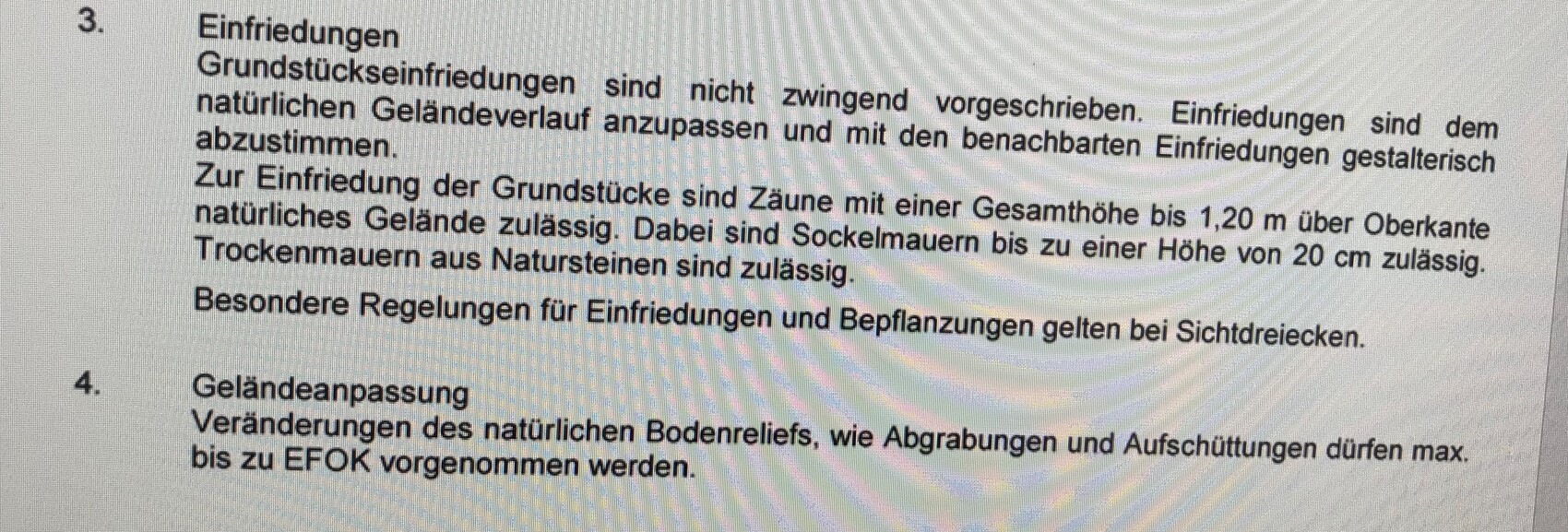
I was told that walls can only be 20cm (8 inches) high, and can be made of natural stone (but again, only 20cm high). When I read the relevant section in the development plan, I understand it as saying that base walls for fences can only be 20cm high, but natural stone walls are allowed??? How are you supposed to compensate for height differences then?
Fences can be a maximum of 120cm (47 inches) high from the top edge of the natural ground, right? Then neighbor 3 wouldn’t even be allowed to build a fence because the fill already exceeds 120cm.
By the way, the maximum finished ground floor level (finished floor level) was specified.
Thank you very much and Happy Easter!

maybe you can help me again this time. I have already spoken to the building authority, but the caseworker seemed to have a bad day and wasn’t very willing to explain things clearly—or maybe I’m just having trouble understanding...
We want to start planning our outdoor areas. We border three neighbors and a sidewalk.
Neighbor 1 is somewhat lower (40cm (16 inches)), neighbor 2 is a bit higher (70-80cm (27-31 inches)), neighbor 3 is significantly higher (120cm (47 inches) and more), and the sidewalk is lower (60cm (24 inches)).
Basically, anyone who excavates or fills in must stabilize the ground, right? But I guess that can be agreed on between the parties...
What I’m more concerned about now is what is actually allowed according to the development plan / building permit regulations.
As I understood the caseworker, you can do whatever you want within your own property, but then I don’t understand the rules about “raised terraces and steep slopes.” When exactly is a terrace considered raised, and when is a slope considered steep?
I was told that walls can only be 20cm (8 inches) high, and can be made of natural stone (but again, only 20cm high). When I read the relevant section in the development plan, I understand it as saying that base walls for fences can only be 20cm high, but natural stone walls are allowed??? How are you supposed to compensate for height differences then?
Fences can be a maximum of 120cm (47 inches) high from the top edge of the natural ground, right? Then neighbor 3 wouldn’t even be allowed to build a fence because the fill already exceeds 120cm.
By the way, the maximum finished ground floor level (finished floor level) was specified.
Thank you very much and Happy Easter!
In the second image, I believe an important part is cut off. At section 1.9.1 it says at the end:
the height differences to the edge of the roadway or the neighboring properties must be overcome by a slope on your own property.
Doesn't that mean that no retaining walls are allowed? At least not on the boundaries? Not even the 20cm (8 inches) ones???
Are planters considered a slope?
the height differences to the edge of the roadway or the neighboring properties must be overcome by a slope on your own property.
Doesn't that mean that no retaining walls are allowed? At least not on the boundaries? Not even the 20cm (8 inches) ones???
Are planters considered a slope?

For fencing, you are only allowed to use fences; however, these fences do not need to extend all the way to the ground and may be combined with walls up to the lowest 20 cm (8 inches). Dry stone walls may fully enclose a terrain modification, but this is limited to the property-specific EFOK. At the boundary line, you must return to the original ground level with a sloped embankment—not a steep drop. Slopes should have a "roof pitch" style ground gradient. Using planting rings in this context is not excluded. You should not use wire mesh fences if the neighbor uses a picket fence, or vice versa.
https://www.instagram.com/11antgmxde/
https://www.linkedin.com/company/bauen-jetzt/
https://www.instagram.com/11antgmxde/
https://www.linkedin.com/company/bauen-jetzt/
Katdreas schrieb:
In section 1.9.1 it says at the end:
height differences to the roadway edge or neighboring properties must be leveled by a slope on the owner’s own property.This was also stated in our development plan: retaining walls, whether for elevation or lowering, are prohibited. If there is a height difference, the higher property owner must create a slope with a maximum angle of 30 degrees, which means a rise of 30cm (12 inches) over one meter (3.3 feet). Therefore, to adjust a 60cm (24 inches) difference, about 2 meters (6.6 feet) of the property’s boundary area must be used for the slope. Most people in this section then planted hedges. There was no subsequent re-measurement.
Katdreas schrieb:
Doesn’t that mean that no retaining walls are allowed? At least not at the borders? Not even 20cm (8 inches)? Are planting rings considered a slope?Since the 30cm (12 inches) refers to our area, I would say you can of course create a slope using planting rings, just staggered stepwise. This applies to property boundaries.
Terraces with steep slopes would count as walls for me, as well as anything built steeper than 45 degrees.
All without guarantee.
Thank you very much to start with. However, I still haven’t quite figured it out.
Regarding the neighboring properties, you have to build a slope, possibly with planting rings, but no kind of wall is allowed.
If I now build a wall in the front yard to create a level area in front of the entrance, am I allowed to build a wall with some distance from the sidewalk (Max, EFOK) and have an area between the wall and the sidewalk at the same level as the sidewalk?
Regarding the neighboring properties, you have to build a slope, possibly with planting rings, but no kind of wall is allowed.
If I now build a wall in the front yard to create a level area in front of the entrance, am I allowed to build a wall with some distance from the sidewalk (Max, EFOK) and have an area between the wall and the sidewalk at the same level as the sidewalk?
Katdreas schrieb:
If I build a wall in the front yard to create a level area in front of the entrance, am I allowed to build a wall set back a bit from the sidewalk (Max, EFOK) and have a surface between the wall and the sidewalk at sidewalk height?From my point of view, yes. However, every straight section on the path between the EFOK level and the boundary (which is also on the street side) increases the effort required to smoothly transition the further course. Height difference, slope steepness, and plateau section form a tricky combination.https://www.instagram.com/11antgmxde/
https://www.linkedin.com/company/bauen-jetzt/
Similar topics