
ᐅ Lighting Design for Recessed Ceiling Spots on Ground and Upper Floors
Created on: 24 Mar 2020 12:27
M
mambo1988
Hello everyone,
We are currently facing a challenging situation as we need to roughly position the recessed lights for our future house.
Attached are 4 images where we have tried to place the lights as accurately as possible, once with furniture layout and once with measurements.
We would appreciate some feedback so we can finalize this topic.
Rooms with recessed lights are:
Ground floor:
- Living room: These lights are mainly for illumination when cleaning. For dining, there is a regular ceiling light and some corner lights for ambiance. Possibly dimmable for events.
- Kitchen: These are intended to illuminate the work surfaces. The range hood above the kitchen island will have a light as well. On the side wall, there are tall cabinets with refrigerator, oven, etc. Possibly dimmable for events.
- Hallway: These lights are solely for illuminating the hallway. We want to manage without any additional light sources here.
Upper floor:
- Staircase: For basic lighting of the stairs, with a motion sensor. Possibly dimmable at night.
- Hallway: These lights are solely for illuminating the hallway. We want to manage without any additional light sources here.
- Bathroom: These lights provide full lighting of the bathroom. Possibly dimmable for a relaxing bath.
We look forward to your suggestions and advice.
Thank you very much!
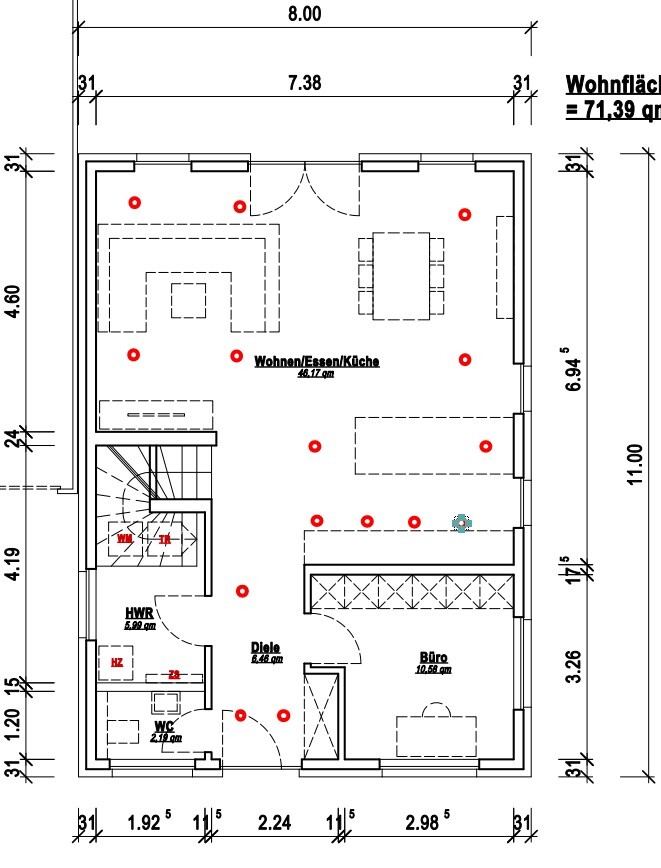
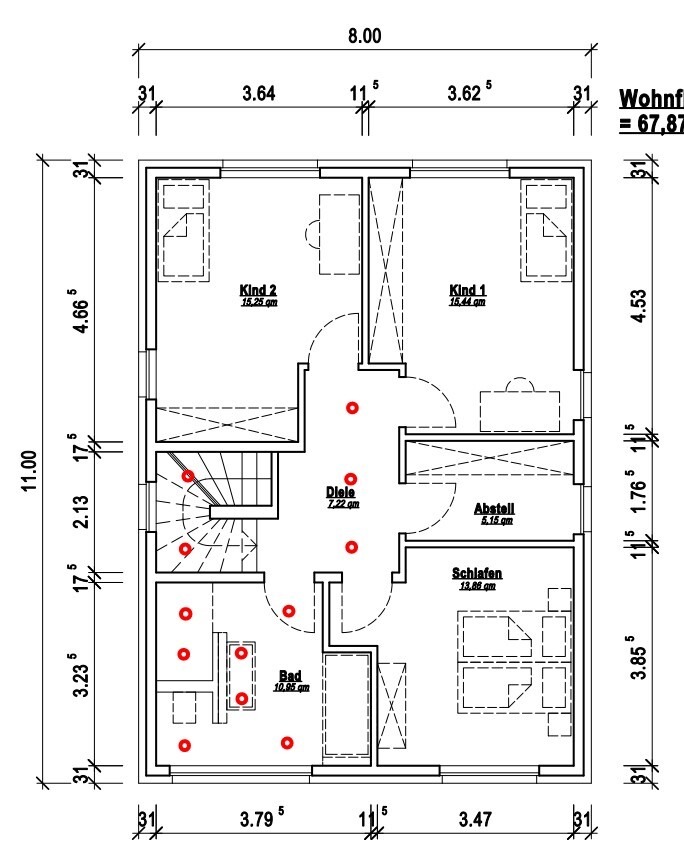
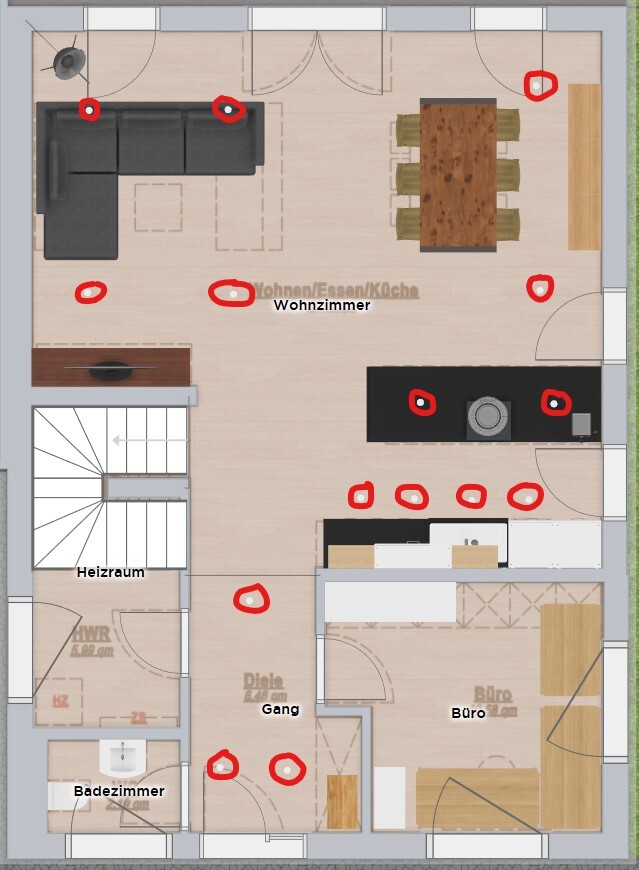

We are currently facing a challenging situation as we need to roughly position the recessed lights for our future house.
Attached are 4 images where we have tried to place the lights as accurately as possible, once with furniture layout and once with measurements.
We would appreciate some feedback so we can finalize this topic.
Rooms with recessed lights are:
Ground floor:
- Living room: These lights are mainly for illumination when cleaning. For dining, there is a regular ceiling light and some corner lights for ambiance. Possibly dimmable for events.
- Kitchen: These are intended to illuminate the work surfaces. The range hood above the kitchen island will have a light as well. On the side wall, there are tall cabinets with refrigerator, oven, etc. Possibly dimmable for events.
- Hallway: These lights are solely for illuminating the hallway. We want to manage without any additional light sources here.
Upper floor:
- Staircase: For basic lighting of the stairs, with a motion sensor. Possibly dimmable at night.
- Hallway: These lights are solely for illuminating the hallway. We want to manage without any additional light sources here.
- Bathroom: These lights provide full lighting of the bathroom. Possibly dimmable for a relaxing bath.
We look forward to your suggestions and advice.
Thank you very much!
M
mambo19886 Apr 2020 18:06Hello everyone,
We’ve made some progress on the ground floor. Thanks again for all the feedback!
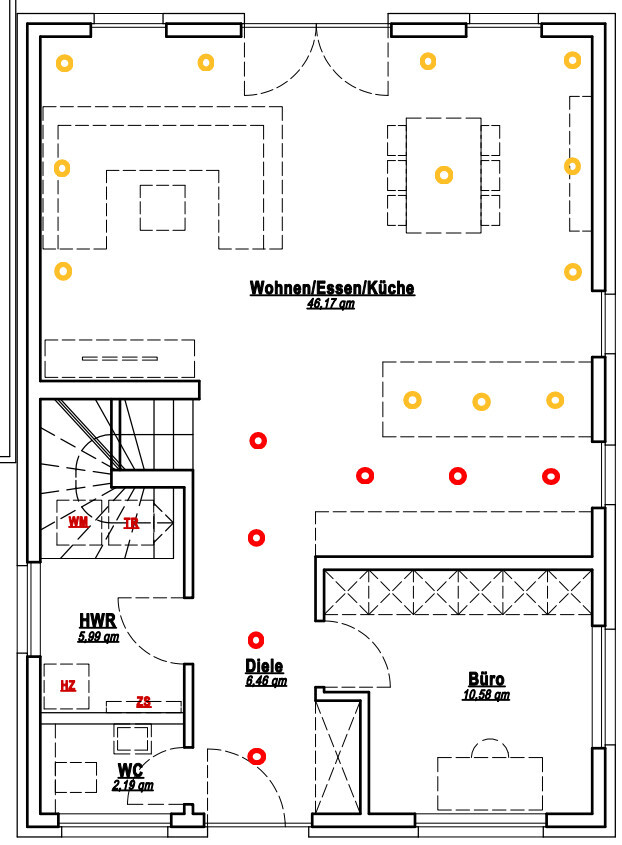
We decided against some of the recessed spots and now plan to use standard ceiling outlets in the living room instead. Small lamps will be angled to illuminate the walls, and they should be able to be dimmed down very low if needed.
What do you think about this idea?
For the kitchen island, we will have a downdraft extractor and three pendant lights. Under the wall-mounted cabinets, there will be additional LED lighting.
Above the dining table, there will be one or more pendant lamps as well.
We still need to choose the exact bulbs and fixtures. We’re waiting until the stores reopen to do that.
What do you think? Any more comments?
Orange = ceiling outlets; Red = recessed spots
Planned 6 circuits
Thank you!
We’ve made some progress on the ground floor. Thanks again for all the feedback!
We decided against some of the recessed spots and now plan to use standard ceiling outlets in the living room instead. Small lamps will be angled to illuminate the walls, and they should be able to be dimmed down very low if needed.
What do you think about this idea?
For the kitchen island, we will have a downdraft extractor and three pendant lights. Under the wall-mounted cabinets, there will be additional LED lighting.
Above the dining table, there will be one or more pendant lamps as well.
We still need to choose the exact bulbs and fixtures. We’re waiting until the stores reopen to do that.
What do you think? Any more comments?
Orange = ceiling outlets; Red = recessed spots
Planned 6 circuits
Thank you!
H
hampshire7 Apr 2020 06:59Personal experience: Ansorg spotlights, commonly used in retail construction, provide excellent light quality and maximum flexibility in configuring brightness, color temperature, and beam angle. The installation dimensions are quite specific and must be considered during planning. Expect a delivery time of around 10 weeks and prices in the upper mid-range, though not luxury level. I was very pleasantly surprised by the Luxvenum lights, which offer great light quality at a good price, although they are not cheap. Unfortunately, the equipment the electrician brought us is quite poor quality, with PWM dimming that causes flickering and an annoying power-on delay. Either the electrician manages to fix this, or I will replace all nine spotlights in the children’s apartments with Luxvenum units myself.
A
Alessandro7 Apr 2020 12:47Do you want to control the hallway spotlights with motion sensors or conventionally with a switch?


Climbee schrieb:
I would skip spots 3 and 4 in the hallway and instead opt for nice staircase lighting (illuminated handrail, recessed wall lights following the stair path, or illuminated stair treads, etc.)If you use standard spots with a beam angle of 36-40°, then only 2 spots are not enough for the hallway area, even if they are spaced out. From the front door to the living room wall, it’s about 5.5m (18 feet). Assume that there will definitely be switches for both the hallway and the living room.@mambo1988
Personally, I also find the living room lacks basic ambient lighting.
This is roughly how it would look.
I simulated your plan.
There are only 2 lights in the dining area.
Ceiling height – 2.7 m (9 ft).
The lux values were measured at a height of 80 cm (31.5 inches).
All lamps are switched on.
That’s why I said that the living room area lacks general lighting.
If the walls are not white but rather dark, even less light will be reflected off the walls.
- Ceiling lights in the living and dining rooms directed towards the wall. 500 lm and 50° beam angle.
- 2 dining table lights at a distance of 65 cm (26 inches) from the table. Each light provides 190 lm and about 120° beam angle.
Surface of the dining table = approximately 250 lux.
- 3 lights above the worktop with 1.2 m (4 ft) distance above the work surface. Each light roughly 450 lm and 33° beam angle.
- Hallway and kitchen spotlights. Each spot about 500 lm and 40° beam angle.
Certain illuminance levels measured in lux are recommended.
You can roughly follow those.
Much more important is having the right light in the right place.
There are many possibilities: different beam angles, light colors, luminous intensity as Hampshire already mentioned. Direct light, indirect light, direct/indirect combinations.
Directional light for decoration. Diffuse general lighting, and so on.
That is why it makes sense to divide lighting into several groups.
Creating optimal lighting is unfortunately not so simple.
I hope, however, that you now have an idea of how it could look.
I am currently working on learning Dialux and using it to simulate my electrical planning.
For everyone planning their lighting, Dialux is the right software.
Of course, you need time and motivation for it.
Best regards,
AMNE3IA
I simulated your plan.
There are only 2 lights in the dining area.
Ceiling height – 2.7 m (9 ft).
The lux values were measured at a height of 80 cm (31.5 inches).
All lamps are switched on.
That’s why I said that the living room area lacks general lighting.
If the walls are not white but rather dark, even less light will be reflected off the walls.
- Ceiling lights in the living and dining rooms directed towards the wall. 500 lm and 50° beam angle.
- 2 dining table lights at a distance of 65 cm (26 inches) from the table. Each light provides 190 lm and about 120° beam angle.
Surface of the dining table = approximately 250 lux.
- 3 lights above the worktop with 1.2 m (4 ft) distance above the work surface. Each light roughly 450 lm and 33° beam angle.
- Hallway and kitchen spotlights. Each spot about 500 lm and 40° beam angle.
Certain illuminance levels measured in lux are recommended.
You can roughly follow those.
Much more important is having the right light in the right place.
There are many possibilities: different beam angles, light colors, luminous intensity as Hampshire already mentioned. Direct light, indirect light, direct/indirect combinations.
Directional light for decoration. Diffuse general lighting, and so on.
That is why it makes sense to divide lighting into several groups.
Creating optimal lighting is unfortunately not so simple.
I hope, however, that you now have an idea of how it could look.
I am currently working on learning Dialux and using it to simulate my electrical planning.
For everyone planning their lighting, Dialux is the right software.
Of course, you need time and motivation for it.
Best regards,
AMNE3IA
Similar topics