
ᐅ Building Without a Ventilation System Using Porous Clay Blocks?
Created on: 17 Oct 2012 20:26
F
Fabian S.
Hello everyone,
my wife and I are planning to build a house next year. We are considering using a hollow clay block filled with perlite without any additional insulation (such as expanded polystyrene or similar). How thick should the block be at a minimum to achieve a good insulation value (KfW 40)? What would the wall structure look like?
Is it possible to omit a ventilation system when using this type of block?
Please share any experiences from those who have built with hollow blocks filled with perlite.
Best regards, Fabian
my wife and I are planning to build a house next year. We are considering using a hollow clay block filled with perlite without any additional insulation (such as expanded polystyrene or similar). How thick should the block be at a minimum to achieve a good insulation value (KfW 40)? What would the wall structure look like?
Is it possible to omit a ventilation system when using this type of block?
Please share any experiences from those who have built with hollow blocks filled with perlite.
Best regards, Fabian
This is just my personal opinion and shouldn’t be given too much weight; it’s all secondary.
I wonder why something like this is marketed as innovative?
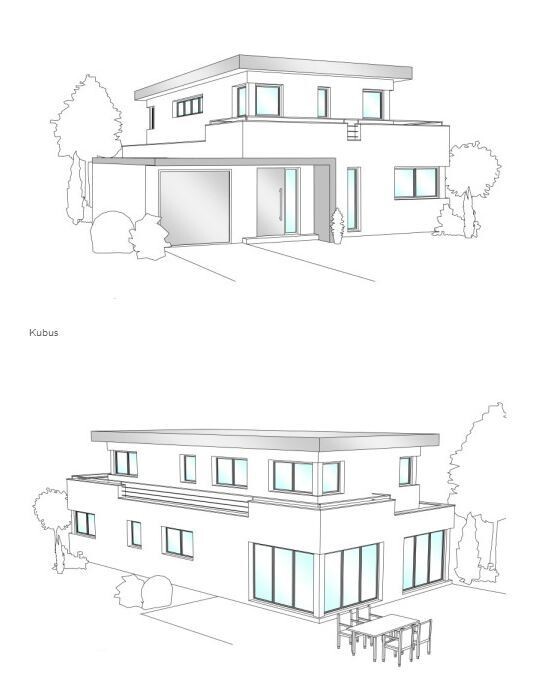
The problem with a homeowner who has been persuaded to build or accept these flat roofs is that water always collects in some gutter or recess. Why build something like this? Any traditional master builder would just shake their head – today, architectural designs receive awards that would have been called barns or farm sheds in the past.
Or why nail vertical fence slats onto the exterior wall of a house when the impregnation clearly deteriorates after 6 years? Why invest more than 150,000 euros in complex heating systems, including ventilation systems, etc., that become completely obsolete after 30 years? And so on.
The old master builders were not foolish, and most of their houses still stand strong today. In my view, many so-called innovations are actually steps backward, not progress.
Off-topic: what purpose does a ventilation system serve in brick construction? According to my argument = unnecessary.
Any arguments in favor?
I wonder why something like this is marketed as innovative?
The problem with a homeowner who has been persuaded to build or accept these flat roofs is that water always collects in some gutter or recess. Why build something like this? Any traditional master builder would just shake their head – today, architectural designs receive awards that would have been called barns or farm sheds in the past.
Or why nail vertical fence slats onto the exterior wall of a house when the impregnation clearly deteriorates after 6 years? Why invest more than 150,000 euros in complex heating systems, including ventilation systems, etc., that become completely obsolete after 30 years? And so on.
The old master builders were not foolish, and most of their houses still stand strong today. In my view, many so-called innovations are actually steps backward, not progress.
Off-topic: what purpose does a ventilation system serve in brick construction? According to my argument = unnecessary.
Any arguments in favor?
This is about ventilation systems + 36 cm (14 inch) hollow bricks, right?That was the topic before you started this little chat group ^^
because bricks compensate heat outside the house and do not absorb it, unlike prefab houses with ultra insulation.Please explain more... how exactly do bricks compensate heat? Are you sure bricks don’t absorb heat?
Is insulation bad for protection against summer heat?
The same applies in winter: if you consistently reduce indoor humidity through vapor barriers and not ventilating.Excuse me? ^^
Then you have two options to choose from:
aa) humidify the air with a machine (technology becomes waste after 20–25 years; money down the drain)
bb) or you occasionally open the windows?
cc) or you buy a humidifier for 200 euros net + a few bottles of distilled water for a few cents?What happens to my indoor humidity if I open the windows and let in cold winter air? Does it then increase? Yes?
And humidifiers instead of ventilation in well-insulated new buildings? Because you supposedly have too little humidity there?
Do you think the purpose of a ventilation system is to humidify indoor air?
Core problem in Germany: building is too expensive. So I gave it some thought.Could you maybe also share your thoughts on the pension system? And the euro? Would surely be interesting weekend reading.
Conclusion: one can only hope nobody follows your advice here...
I am also no fan of polystyrene insulation, but what you are saying here is partly dangerous nonsense because you obviously have no understanding of the subject... your experiences from your 1978 house cannot be applied to a modern new build!
With a ventilation system and a well-insulated house, comfort also plays a role... you don’t have to sneak to the bathroom freezing in winter or shiver in the morning lighting the wood stove... and by the time the rooms warm up after 30 minutes, I’m already slowly leaving the house...
Why do you always spend the winter in Thailand anyway? Is it perhaps uncomfortable in your cold, drafty building? ^^
OT: Why have a ventilation system in brick construction?In a new, almost airtight house, moisture is constantly generated... when showering, cooking, from plants, the occupants, the building materials, etc...
Humidity levels keep rising...
You need to know that warm air can hold more moisture than cold air... when this warm air comes into contact with colder building parts and cools down, moisture can condense. That’s why windows, for example, fog up on the inside because they are often the coldest surfaces in an old house...
If this happens inside or on a wall, it creates a perfect breeding ground for mold...
The problem is therefore not too low humidity, but too high! That's why you have to ventilate briefly but thoroughly (shock ventilation), so that cold, dry air from outside enters the house and humidity decreases...
Since you cannot or do not want to ventilate this way too often or for long periods, it makes sense to use a ventilation system to remove this moist air and bring in fresh air...
In your old building, you have the problem that you are practically ventilating all the time (because it is not airtight), resulting in very dry indoor air... your beloved wood stove also contributes to that... that’s why you then need the humidifier...
B
Bauexperte26 Oct 2012 12:23Hello,
Here is a commentary on the flat roof directive for interested building novices:
"Since October 2008, the new flat roof directive has been officially implemented and
has undergone many significant changes compared to the old version from September 2003,
for example regarding its scope, rules for waterproofing, materials, etc.
It has aligned its essential rules with DIN 18531 for unoccupied
roofs.
The so-called basic rules, which serve as the foundation for the entire
roofing trade regulations and therefore for all planning and
execution principles defined by the relevant standards, have remained unchanged.
This includes, for example, all definitions such as waterproofing, joints and edges,
roof pitch, installed components, substructure, etc. The modal auxiliary verbs and
their meanings, which repeatedly appear throughout the technical rules, are also
covered in the basic rules.
The technical rules, which have been revised in the new flat roof directive,
contain procedures for planning and execution that have proven to be theoretically correct and practically feasible in their respective
specialized areas.
If we start with the scope of the technical rule, we find that it expands beyond its
usual jurisdiction for unoccupied areas to include occupied spaces, with the note that the technical rule is also responsible for
waterproofing against non-pressurized water. However, with the condition that
DIN 18195 must also be observed here, as expressed under section 3 Rules for waterproofing
of occupied roofs and areas.."
"Douglas fir (Pseudotsuga menziesii) can undoubtedly be described as by far the most important
naturalized wood species in Germany and Central Europe. A closely related species
of Douglas fir from the genus Pseudotsuga also existed here until the ice ages.
The Douglas fir survived the ice age because of the north-south orientation
of the large mountain ranges in North America.
Due to its good technological and mechanical properties and high natural
durability on the one hand, as well as its decorative, larch-like appearance on the other,
Douglas fir can fulfill both structural and decorative functions.
Douglas fir is suitable for exterior use with additional protection by a suitable coating,
providing a long service life due to its good natural durability. However, Douglas fir is not very
durable in contact with soil or under prolonged high moisture conditions, so pressure impregnation is
required."
Best regards
kamnik schrieb:If you present your personal opinion as a topic for discussion, you shouldn’t try to pass it off as a fact. What you are sharing here is at best ill-considered—and therefore potentially dangerous nonsense for inexperienced building novices.
this is just my personal opinion and should not be overestimated; it’s all secondary.
kamnik schrieb:This is a design tailored to a specific living situation; you copied the views from the entrance page of my website in the single-family house section. These views are an example of a cube-style building.
? I wonder why something like this is sold as innovative?
kamnik schrieb:Many of your so-called "old" master builders have actually created this dangerous nonsense. Incidentally, just like their “estimates” of a single-family house heating energy demand. I know quite a few of them and have “owed” them a lot of additional and unnecessary work. Currently, one of your old “masters” has again arbitrarily decided to install a heating unit with a 3 kW higher capacity—better safe than sorry. Apart from being completely unnecessary—the heating load calculation confirms the specified heating unit—this would have cost my client about EUR 5,000–6,000 more. That says a lot about these “old masters.”
The problem with a builder who has allowed themselves to be convinced to build these flat roofs. Water always stands in some kind of depression. Why build something like this? Any old master builder would just shake their head—nowadays architects receive awards for designs that would once have been called barns or haylofts.
Here is a commentary on the flat roof directive for interested building novices:
"Since October 2008, the new flat roof directive has been officially implemented and
has undergone many significant changes compared to the old version from September 2003,
for example regarding its scope, rules for waterproofing, materials, etc.
It has aligned its essential rules with DIN 18531 for unoccupied
roofs.
The so-called basic rules, which serve as the foundation for the entire
roofing trade regulations and therefore for all planning and
execution principles defined by the relevant standards, have remained unchanged.
This includes, for example, all definitions such as waterproofing, joints and edges,
roof pitch, installed components, substructure, etc. The modal auxiliary verbs and
their meanings, which repeatedly appear throughout the technical rules, are also
covered in the basic rules.
The technical rules, which have been revised in the new flat roof directive,
contain procedures for planning and execution that have proven to be theoretically correct and practically feasible in their respective
specialized areas.
If we start with the scope of the technical rule, we find that it expands beyond its
usual jurisdiction for unoccupied areas to include occupied spaces, with the note that the technical rule is also responsible for
waterproofing against non-pressurized water. However, with the condition that
DIN 18195 must also be observed here, as expressed under section 3 Rules for waterproofing
of occupied roofs and areas.."
kamnik schrieb:If the respective builder uses "Douglas fir" instead of spruce and properly maintains the façade, this statement doesn’t apply. But—in your case again—Douglas fir is naturally more expensive.
Or why would anyone nail vertical fence slats to a house wall when the impregnation demonstrably deteriorates after 6 years?
"Douglas fir (Pseudotsuga menziesii) can undoubtedly be described as by far the most important
naturalized wood species in Germany and Central Europe. A closely related species
of Douglas fir from the genus Pseudotsuga also existed here until the ice ages.
The Douglas fir survived the ice age because of the north-south orientation
of the large mountain ranges in North America.
Due to its good technological and mechanical properties and high natural
durability on the one hand, as well as its decorative, larch-like appearance on the other,
Douglas fir can fulfill both structural and decorative functions.
Douglas fir is suitable for exterior use with additional protection by a suitable coating,
providing a long service life due to its good natural durability. However, Douglas fir is not very
durable in contact with soil or under prolonged high moisture conditions, so pressure impregnation is
required."
kamnik schrieb:There is a petition committee—even in Brussels. You should raise your questions there!
Why invest more than 150,000 euros in complex heating systems, including ventilation systems, etc., that are completely obsolete after 30 years? And so on and so forth.
kamnik schrieb:Not all, that’s true—but I still prefer the very old church or cathedral builders over the “old masters or master builders” you generally praise.
The old master builders were no fools, and most houses still withstand the test of time. Many innovations, in my view, are more of a step backward than progress.
Best regards
Hello Fabian,
I’ll put the popcorn aside and skip the entertaining but somewhat misleading discussion from kamnik. I’m not an expert, but I’m starting a house construction project next year with a general contractor and have asked myself similar questions.
A small tip: Besides hollow clay bricks filled with perlite, the same manufacturers (Schlagmann, Wienerberger & Co., brand name Poroton) also offer filled bricks with mineral wool, which have a U-value of 0.08 and are significantly more affordable.
With today’s standard wall thickness of 36.5 cm (14.4 inches) and a U-value of 0.07 or 0.08, you will probably just barely manage or not achieve it at all. They will likely recommend at least a wall thickness of 42.5 or 49 cm (16.7 or 19.3 inches). For bricks, the material cost is almost proportional to the wall thickness, so expect several thousand dollars extra. Additionally, the planner will have to enlarge the foundation slab and the roof (roof frame, roof tiles, etc.) accordingly while maintaining the same living area, and this will usually be charged based on the increased external dimensions. A thicker wall (36.5 vs. 49 cm) for a 10 x 10 meter (33 x 33 feet) house results in an increase of the foundation slab by 5 square meters (54 square feet). Consider that the cost for these 5 square meters is roughly equivalent to 5 square meters of additional living space per floor, so 10 square meters (108 square feet) in total. How much do an extra 10 square meters cost with your house planner/general contractor?
My concern: KFW 40 is a huge financial challenge for a traditional brick-built house. The subsidy you receive from the KfW bank for the KFW 40 standard will never offset your additional investment, even when factoring in energy savings and future energy price increases. So why aim for KFW 40?
With the KFW 153 program, you can get up to 50,000 euros (or the equivalent) in low-interest loans with a secondary lien, giving you more buffer in your equity. But anything beyond the KFW 70 standard hardly improves your financial situation.
Yes. Every newly built house must meet legal requirements and be airtight (blower-door test). This means you will likely ventilate much more through windows than in your current home. No one can forbid that.
I’ll put the popcorn aside and skip the entertaining but somewhat misleading discussion from kamnik. I’m not an expert, but I’m starting a house construction project next year with a general contractor and have asked myself similar questions.
Fabian S. schrieb:
(...) We are planning to build with hollow clay bricks filled with perlite, without additional insulation (Styrofoam or similar).
A small tip: Besides hollow clay bricks filled with perlite, the same manufacturers (Schlagmann, Wienerberger & Co., brand name Poroton) also offer filled bricks with mineral wool, which have a U-value of 0.08 and are significantly more affordable.
How thick should the brick be at least to achieve a good value (KFW 40) for insulation?
With today’s standard wall thickness of 36.5 cm (14.4 inches) and a U-value of 0.07 or 0.08, you will probably just barely manage or not achieve it at all. They will likely recommend at least a wall thickness of 42.5 or 49 cm (16.7 or 19.3 inches). For bricks, the material cost is almost proportional to the wall thickness, so expect several thousand dollars extra. Additionally, the planner will have to enlarge the foundation slab and the roof (roof frame, roof tiles, etc.) accordingly while maintaining the same living area, and this will usually be charged based on the increased external dimensions. A thicker wall (36.5 vs. 49 cm) for a 10 x 10 meter (33 x 33 feet) house results in an increase of the foundation slab by 5 square meters (54 square feet). Consider that the cost for these 5 square meters is roughly equivalent to 5 square meters of additional living space per floor, so 10 square meters (108 square feet) in total. How much do an extra 10 square meters cost with your house planner/general contractor?
My concern: KFW 40 is a huge financial challenge for a traditional brick-built house. The subsidy you receive from the KfW bank for the KFW 40 standard will never offset your additional investment, even when factoring in energy savings and future energy price increases. So why aim for KFW 40?
With the KFW 153 program, you can get up to 50,000 euros (or the equivalent) in low-interest loans with a secondary lien, giving you more buffer in your equity. But anything beyond the KFW 70 standard hardly improves your financial situation.
Is it possible to omit the ventilation system with this brick?
Yes. Every newly built house must meet legal requirements and be airtight (blower-door test). This means you will likely ventilate much more through windows than in your current home. No one can forbid that.
K
karliseppel27 Oct 2012 13:55o.s. schrieb:
And it is rare to find such a consistent positive opinion among homeowners who now never want to be without a ventilation system again. Do I need to say more? Fully agree
Shism schrieb:
Please tell me more... exactly how does the brick compensate for heat? Are you sure that bricks don’t absorb heat?
Is insulation bad for protecting against summer heat? Stand inside a prefabricated house and then inside a brick house during a 40°C (104°F) summer day.
In the prefabricated house, heat builds up and must be removed using an expensive air conditioning system.
In the brick house, this problem doesn’t even arise because the brick provides sufficient cooling. An air conditioner is therefore not necessary. For just a few weeks of summer, it’s overkill (investment vs. cost/benefit comparison).
That’s why I would never build a prefabricated or even a low-energy house in southern Europe; why install an expensive air conditioner that:
a) breaks down after 20 years,
b) constantly needs maintenance (filters),
c) consumes electricity.
It’s all marketing.
In Sweden, the situation is different. There, I would opt for a prefabricated house because it’s cold to very cold, especially in winter. Summer temperatures rarely go above 20°C (68°F). Air conditioning isn’t worth it there—nor even a prefabricated house—because you can get 140 m2 (1,500 sq ft) houses for around 30,000 euros.
Shism schrieb:
What happens to indoor humidity when I open the windows and let cold winter air in? Does it go up? Yes?
And humidifiers instead of ventilation systems in well-insulated new builds? Because there isn’t enough humidity?
Do you think ventilation systems are supposed to humidify indoor air? That’s a popular misconception. People open windows in winter because their throat feels scratchy and they assume oxygen levels must be low.
That’s exactly where the problem lies.
The real reason is that heating dries out the indoor air, causing throat irritation and discomfort, which leads to opening the windows.
Using small humidifiers helps maintain sufficient humidity indoors so you don’t have to constantly open windows—because often the oxygen level is adequate.
Of course, this depends on the heating method. If a combustion stove (like a Chief/Bullerjan) consumes oxygen volume, you need to supply fresh air; this can be managed with a small control system, a fresh air duct plus a fan, without opening windows.
Over-insulating tends to cause mold in corners, like an 80s-era roller shutter window unit that has leaks in the frame. However, this is negligible when you compare the costs of air conditioning, maintenance, and energy consumption to the increased fuel consumption caused by less insulation.
For example, one tonne of extra hardwood briquettes per year over a 20-year air conditioner lifespan is still cheaper.
You can easily calculate that. This is a suggestion some builders use to convince clients: invest now, and you’ll save later.
But when you compare investment to savings, you quickly realize you’ve wasted a lot of money. And here’s the problem: after 20–25 years, the entire system is obsolete and you start all over again.
That’s why winemakers in the Trieste area are returning to clay pots. Why? It’s already been explained!
Shism schrieb:
Could you maybe share your thoughts on the pension system? And on the euro? That would certainly be interesting weekend reading. Sure. Invest your money in gold, diamonds, and commodity stocks—diversify everything.
I wouldn’t even take out life insurance. Keep money in banks short-term.
Put another part in Swiss banks; rent safe deposit boxes; avoid investments so tax authorities can’t track capital gains. No gains, no taxes.
Germany will become uninteresting anyway. Markets are shifting. You won’t be able to rely on the state pension in 30 to 40 years (projection). Sure, there will always be a basic pension, but probably just three digits for everyone.
Anyone who thinks differently should keep investing, consuming, spending on overpriced houses? We’re not living under Stalinism.
Shism schrieb:
Conclusion: one can only hope nobody follows your advice here… Well, my mentor once taught me basic economics.
It’s no longer taught in schools and that’s the start of arrogance and decadence.
If you act normal today, you’re seen as boring. If you recklessly throw money away, you’re “the king.” (See the banking crisis.)
Shism schrieb:
I’m also not a fan of styrofoam insulation... but some of what you’re saying is dangerous nonsense because you clearly don’t understand the subject... your experiences with your 1978 house can’t be transferred to a modern new build!
With a ventilation system and good insulation, comfort also plays an important role... you don’t have to creep to the bathroom shivering in winter or shiver while lighting the wood stove in the morning... and waiting 30 minutes for rooms to heat up, by which time I’d rather leave the house...
Why do you always spend winter in Thailand? Is it maybe uncomfortable in your cold, drafty house? ^^I apply a lot of building technology knowledge from the 1980s to today. I have expert videos proving that this styrofoam insulation craze (subsidized + subsidized for disposal in 20–25 years) + criticism is justified.
Why have prices skyrocketed in recent years? (e.g., Sto, etc.)
Comfort is relative. If you have to wear a t-shirt inside all winter because it’s trendy, you’ll use more energy than if you wear a tick farming smock with antler buttons—then 20°C (68°F) thermostat settings are enough.
Also, any decent 2012 heating control system can be programmed. You don’t have to stagger shivering through the hallway. This also works with automatic setback.
If planners designed smaller rooms as standard, instead of open-plan living-kitchen combos where the sofa smells of garlic sessions, you can compensate an 8°C (14°F) temperature difference quickly with a Chief/Bullerjan/wood stove.
But people are getting softer these days. Just camp outside in winter once, it toughens you up. Then wash yourself with cold seawater and normal soap in the morning.
Shism schrieb:
In a new, almost airtight house, moisture constantly accumulates... during showers, cooking, from plants, occupants, building materials, etc.
Humidity levels rise continuously...
It’s important to know that warm air can hold more moisture than cold air... if this warm air contacts colder building components and cools, moisture can condense. That’s why windows in old houses often fog up on the inside—they’re usually the coldest surface...
If this happens inside a wall, it creates a perfect breeding ground for mold... When I hear “almost airtight house,” alarm bells go off.
Since the 1970s there have been wall vents; even kitchen exhaust fans are standard.
To prevent condensation, roller blinds are closed—generally electrically operated by button, remote control, or server.
The bigger problem is over-insulation. Local experts report severe mold infestations—not in old buildings, but especially in renovated ones with super windows + ultra insulation that makes the building nearly airtight. No air gets through; people try to save money, and suddenly mold grows inside.
Shism schrieb:
The problem isn’t too little humidity, but too much! That’s why you need to ventilate thoroughly so dry, cold outside air replaces moist inside air and lowers humidity...
But since you can’t or don’t want to ventilate frequently or for long, it’s practical to use a ventilation system to remove moist air and bring in fresh air...
With your older house, you have constant ventilation (because it’s not airtight) which causes very dry indoor air... your beloved wood stove adds to this... so you need a humidifier... You also need a humidifier in a 300-year-old former farmhouse with central heating and local room thermostats. You can’t regulate the moisture from a wet towel on the radiator, but you can with a humidifier.
My argument is that additional insulation destroys indoor air tightness; look at the facade building craze.
If you want an air conditioner, build the house 25 cm (10 inches) higher to accommodate ducts and maintenance spaces in the concrete ceilings (use styrofoam blocks when pouring concrete, then add fire protection).
Otherwise, you’ll be stuck working for hours on a tiny 30 x 30 mm (1.2 x 1.2 inch) hole—in other words, a hassle.
Conclusion: a low-energy house only pays off for planners because that’s how they make their money.
Why build houses in sizes like 10 x 7.6 m (33 x 25 ft), or eliminate roof overhangs because it looks cool or lets more light (energy) in?
According to an unofficial interview at a trade fair, the real reason is: "...they basically just want to save materials—a cubic meter less, a square meter less—and keep an extra 1,000 euros in their pocket."
Building is not a science. You need to know how to build. Arab craftsmen were beheaded if the house was no good. That’s how credibility was ensured!
Similar topics