
ᐅ Improperly repaired exterior wall issue – what can be done?
Created on: 1 Apr 2020 15:40
S
Stina0809S
Stina08091 Apr 2020 15:40Hello everyone,
We are currently still in the shell construction phase, and two weeks ago we noticed a masonry error. The distance between the front door and the windows on the left and right sides was supposed to be exactly the same, so it would look symmetrical. However, the wall between the door and the window on the right side was significantly wider than the wall between the door and the window on the left side. We reported this to the site manager, and he took care of the correction.
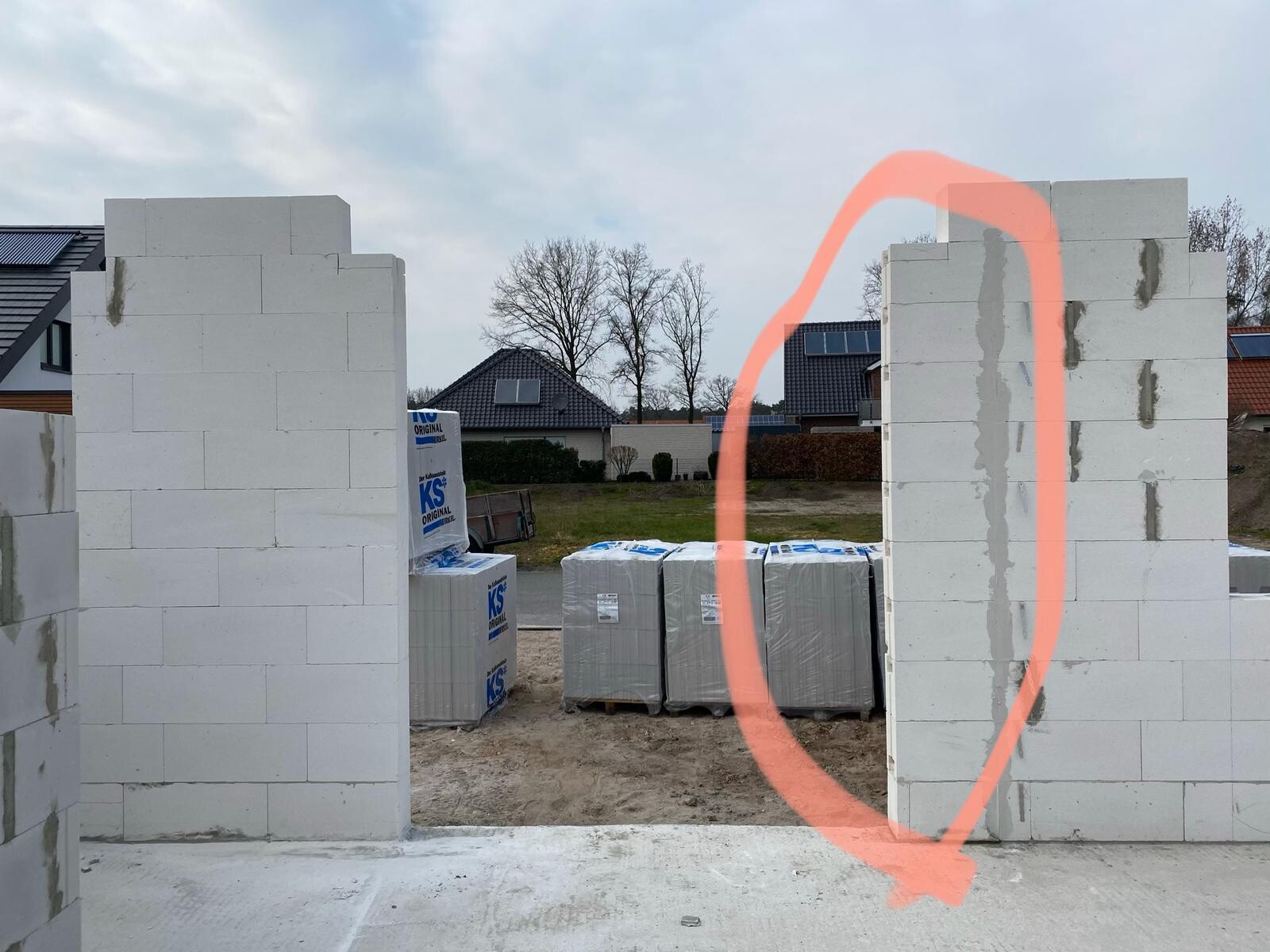
The correction now looks like this: the masons simply cut away some of the wall where too much was built, and added masonry where the distance to the window was too small. However, and here is what seems odd and wrong to us, this was done without maintaining the required overlap bonding. That means there is now a continuous vertical joint running from top to bottom in the exterior wall, right next to the front door (see photo).
We wanted this to be redone with the proper overlap bonding. Our site manager says that the wall does not need to be rebuilt because flat ties have been drilled into the aerated concrete and the joint was reinforced with expanded metal mesh to bridge cracks. Allegedly, this definitely prevents any cracking.
My father is also a site manager and thinks we should issue a formal complaint because the vibrations in the wall (caused by the frequent opening and closing of the front door later on) could indeed cause cracks.
We are now caught in the middle and don’t know what to do. Should we trust the site manager that nothing will happen, or trust my father and send a formal complaint? We actually don’t want any conflict with the construction company, as we have been very satisfied so far. What do you think about this situation?
Thank you very much for your help!!
We are currently still in the shell construction phase, and two weeks ago we noticed a masonry error. The distance between the front door and the windows on the left and right sides was supposed to be exactly the same, so it would look symmetrical. However, the wall between the door and the window on the right side was significantly wider than the wall between the door and the window on the left side. We reported this to the site manager, and he took care of the correction.
The correction now looks like this: the masons simply cut away some of the wall where too much was built, and added masonry where the distance to the window was too small. However, and here is what seems odd and wrong to us, this was done without maintaining the required overlap bonding. That means there is now a continuous vertical joint running from top to bottom in the exterior wall, right next to the front door (see photo).
We wanted this to be redone with the proper overlap bonding. Our site manager says that the wall does not need to be rebuilt because flat ties have been drilled into the aerated concrete and the joint was reinforced with expanded metal mesh to bridge cracks. Allegedly, this definitely prevents any cracking.
My father is also a site manager and thinks we should issue a formal complaint because the vibrations in the wall (caused by the frequent opening and closing of the front door later on) could indeed cause cracks.
We are now caught in the middle and don’t know what to do. Should we trust the site manager that nothing will happen, or trust my father and send a formal complaint? We actually don’t want any conflict with the construction company, as we have been very satisfied so far. What do you think about this situation?
Thank you very much for your help!!
I’m not an expert, but we had a similar situation. The mason’s plans were outdated and not current. In theory, the wall could have just been extended, but it was rebuilt instead.
I found the following information online.
Manufacturer:
It’s also possible to incorporate appropriate reinforcement mesh in the plaster later on.
The construction manager should send you the relevant standard. The minimum you should expect is an extended warranty of XY years. That way, if something does happen, it is clearly regulated.
As is often the case, I would first avoid filing a formal complaint and instead contact your construction manager directly. Point out that you couldn’t really find any information on this yourselves. Various manufacturers also don’t have instructions like his in their work guidelines. Where did he get this information? And something like “That’s how we’ve always done it. It has stood for years without cracking” isn’t a valid argument…
I found the following information online.
Manufacturer:
The masonry standard DIN EN 1996-1-1/NA regulates the overlap dimensions for masonry depending on the brick height H.
- Masonry made from H+H plan bricks:
≥ 0.4·H or ≥ 45 mm (1.8 inches)
For a brick height of 250 mm (10 inches) at least 100 mm (4 inches)- Masonry made from H+H Tempoplan and H+H multielements:
≥ 0.2·H or ≥ 125 mm (4.9 inches)
For brick heights of 375 mm (15 inches), 500 mm (20 inches), 625 mm (25 inches) at least 125 mm (4.9 inches), and for a brick height of 750 mm (30 inches) at least 150 mm (6 inches)
The overlap dimension may be reduced if this is clearly specified in the execution documents, such as the stretcher-bond or position plan, and the effects of the reduction are taken into account in the structural calculations. For H+H multielements in heights of 500 and 625 mm (20 and 25 inches) no stretcher-bond plan is required.
It’s also possible to incorporate appropriate reinforcement mesh in the plaster later on.
The construction manager should send you the relevant standard. The minimum you should expect is an extended warranty of XY years. That way, if something does happen, it is clearly regulated.
As is often the case, I would first avoid filing a formal complaint and instead contact your construction manager directly. Point out that you couldn’t really find any information on this yourselves. Various manufacturers also don’t have instructions like his in their work guidelines. Where did he get this information? And something like “That’s how we’ve always done it. It has stood for years without cracking” isn’t a valid argument…

I wouldn’t overestimate the lap joint length on this small wall section. Overall, it looks very neat and structurally sound. It’s your house, not your dad’s construction site – you should decide within the family who is responsible for having the final say on this, as there will be a number of much bigger challenges to face before the roof is on.
https://www.instagram.com/11antgmxde/
https://www.linkedin.com/company/bauen-jetzt/
https://www.instagram.com/11antgmxde/
https://www.linkedin.com/company/bauen-jetzt/
Stina0809 schrieb:
due to the frequent opening and closing of the front door later onThat is definitely an issue because a slow, gentle push won't ever fully close the door. Especially not with children! However, I’m not sure exactly how this might affect the potential for cracks forming.Zaba12 schrieb:
That’s definitely a relevant topic, because a door with a slow, slightly soft closer will never fully shut. Especially not when children are involved!There is an old educational trick called upbringing, which greatly influences whether you raise little terrorists or not. The diverse children of the patchwork family in my neighborhood even greet each other in the stairwell. Slamming doors are by no means innate; it’s a behavior learned from bad examples. In detached houses, a “penny-pincher” can even install PVC front doors *shudder*https://www.instagram.com/11antgmxde/
https://www.linkedin.com/company/bauen-jetzt/
S
Stina08091 Apr 2020 16:3511ant schrieb:
I wouldn’t overestimate the lap length for this small wall section. Overall, it looks very neat and structurally sound. It’s your house, not Dad’s construction site—you should decide within the family who is responsible for having a say on this, as there will be a lot more serious challenges ahead before the roof is on. Yes, you’re probably right. It’s just that my husband and I have absolutely no knowledge about this kind of thing and naturally rely somewhat on what my father says, since he works professionally in this field. However, he usually works on large construction sites, not single-family homes.
But because we don’t want to immediately raise a formal complaint (as my father advised us), that’s why I’m asking here now. We want to avoid unnecessary stress and continue to get along well with the site manager.
Similar topics