
Dear forum members,
We bought a plot of land last autumn and are currently deep into the floor plan design. We would like to share our current draft with you and welcome any comments and opinions.
[F]irst some preliminary information about the plot and its buildability:[/F]
Best regards
We bought a plot of land last autumn and are currently deep into the floor plan design. We would like to share our current draft with you and welcome any comments and opinions.
[F]irst some preliminary information about the plot and its buildability:[/F]
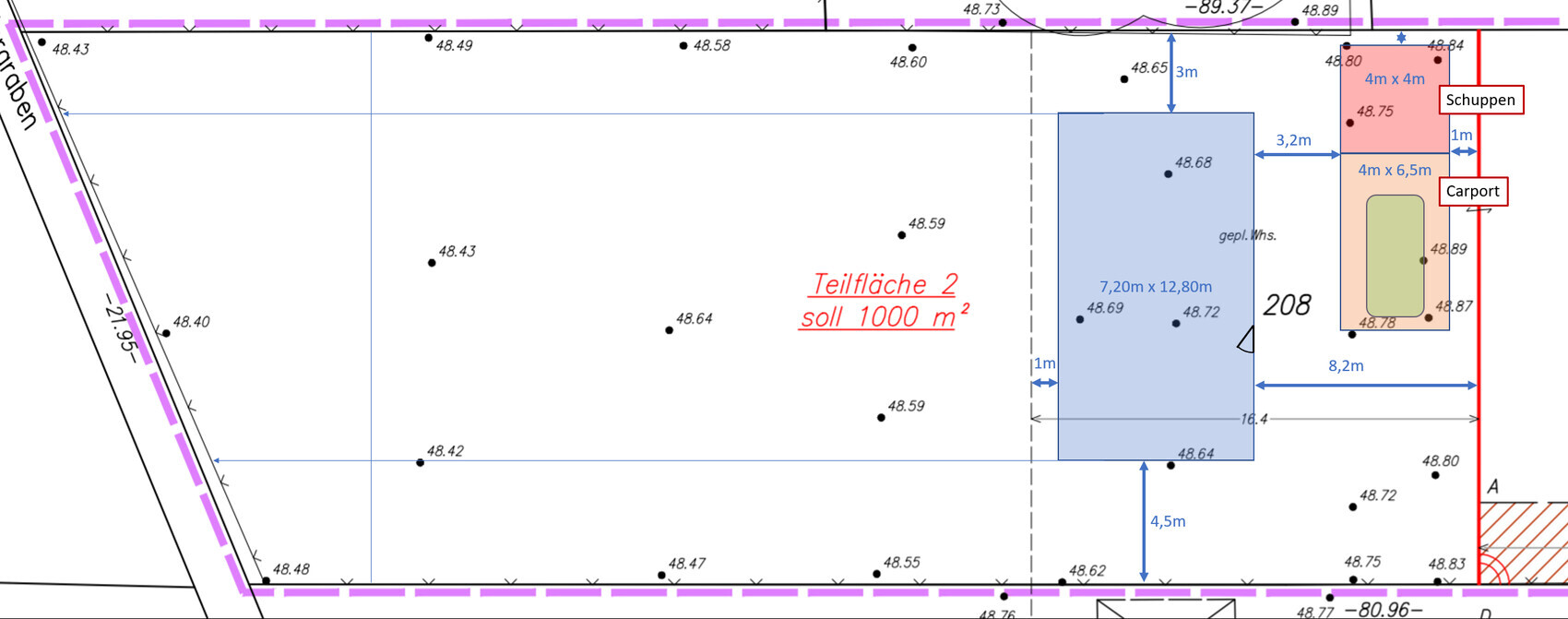
- 1000 m² (10,764 sq ft) rear plot, southwest facing (so southwest is on the left side of the site plan)
- Building boundary up to approx. 16 m (52 ft) behind the property line (up to the dashed line on the site plan)
- No zoning plan (construction according to § 34 of the Building Code)
- Groundwater at surface level and peaty soil (exact geotechnical report pending), so piled foundation required and no basement
- Affordable! (Our maximum budget for the house including foundation slab is €230,000)
- Country house style
- Bright, large windows facing south/garden
- Open living/dining/kitchen area
- Family of four, 1 bedroom and 2 children’s rooms
- Not oversized, max 150 m² (1,615 sq ft), preferably less
- Solid construction using Ytong blocks (for us the most cost-effective option, although we would have liked to build with wood as well).
- Developed ourselves after studying various floor plans (including from the book "Affordable Building with a Small Budget" by Achim Linhardt) with support from architect friends and our planner (an independent civil engineer).
- Dimensions 12.50 x 7.50 m (41 x 25 ft) (the measurements shown on the site plan are from an earlier draft).
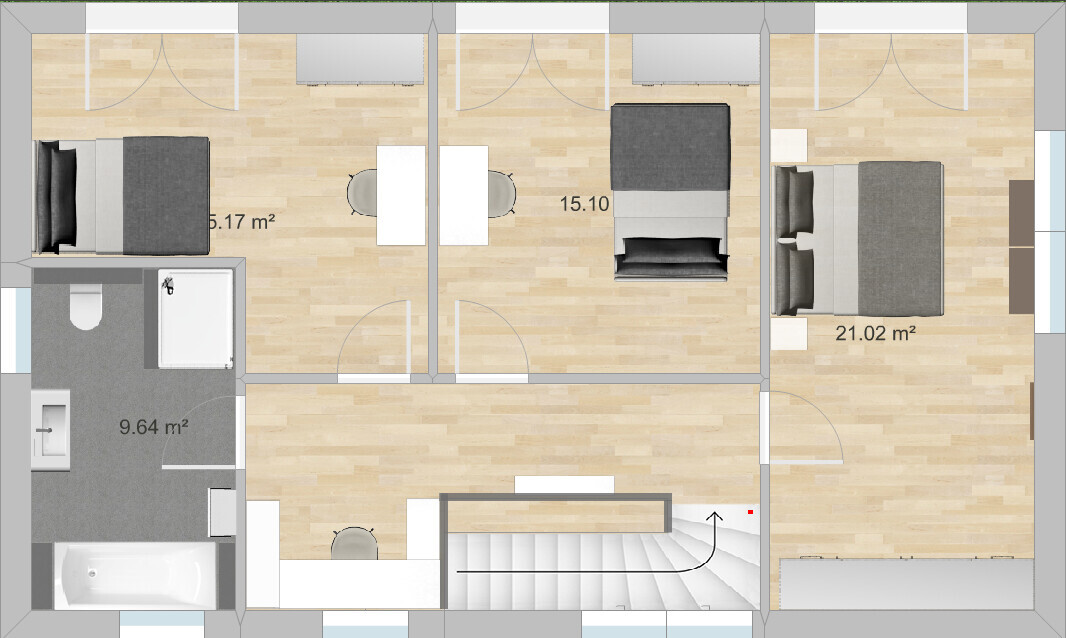
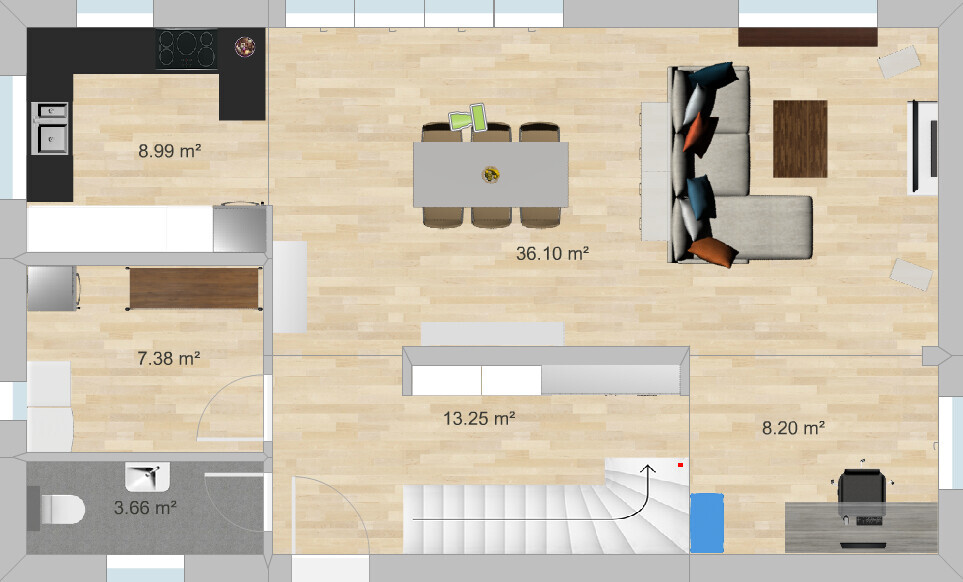
- What we like: open living area, all main rooms have large windows facing the garden, efficient size, although the children’s and bedroom could be smaller, sewing/work nook behind the stairs upstairs, plenty of wall space for large wardrobes in the upstairs bedroom and hallway on the ground floor, light shaft in the stairwell, staircase (we originally wanted a straight run staircase but it would have taken too much space; the one with three quarter turns is also fine with us).
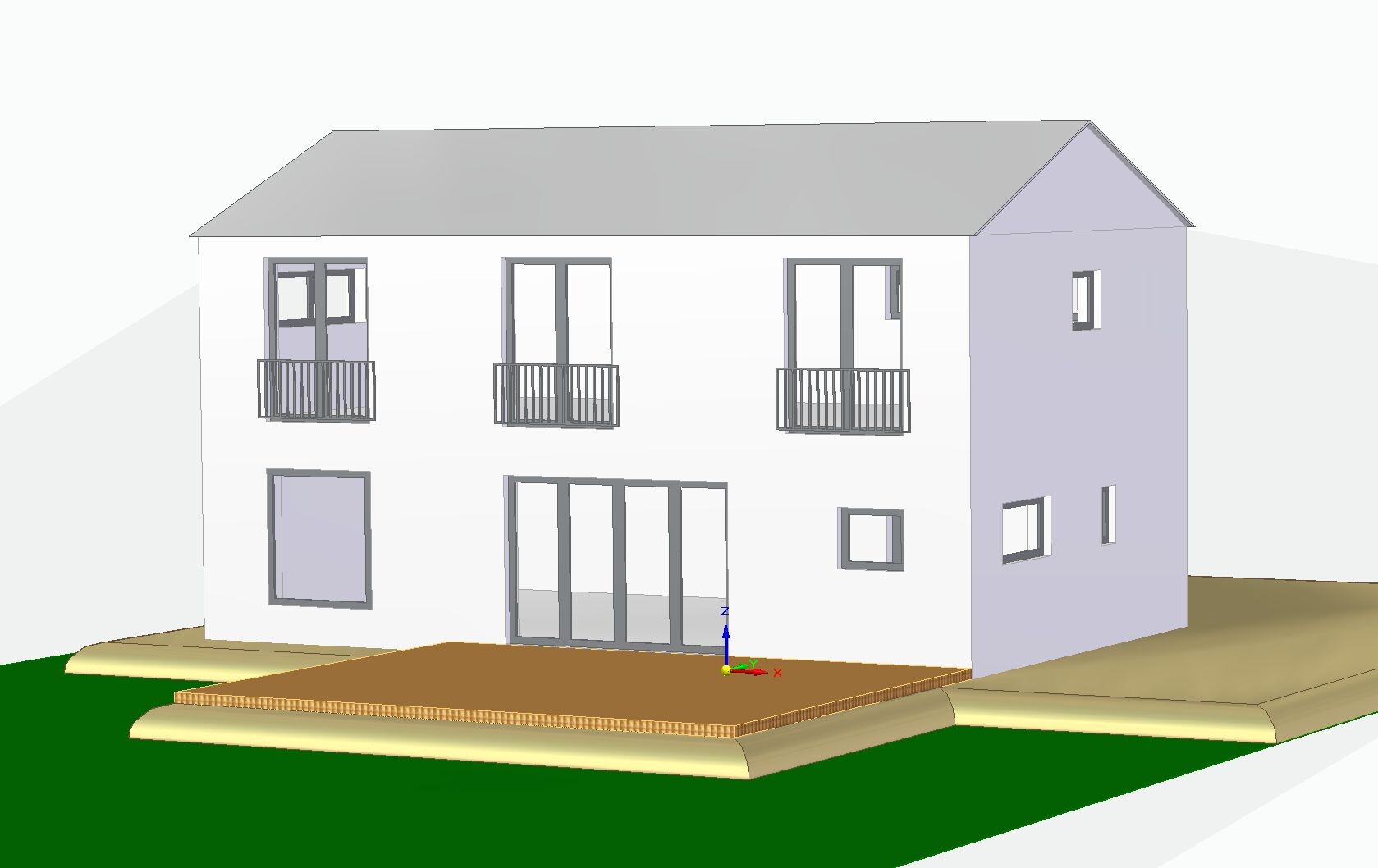
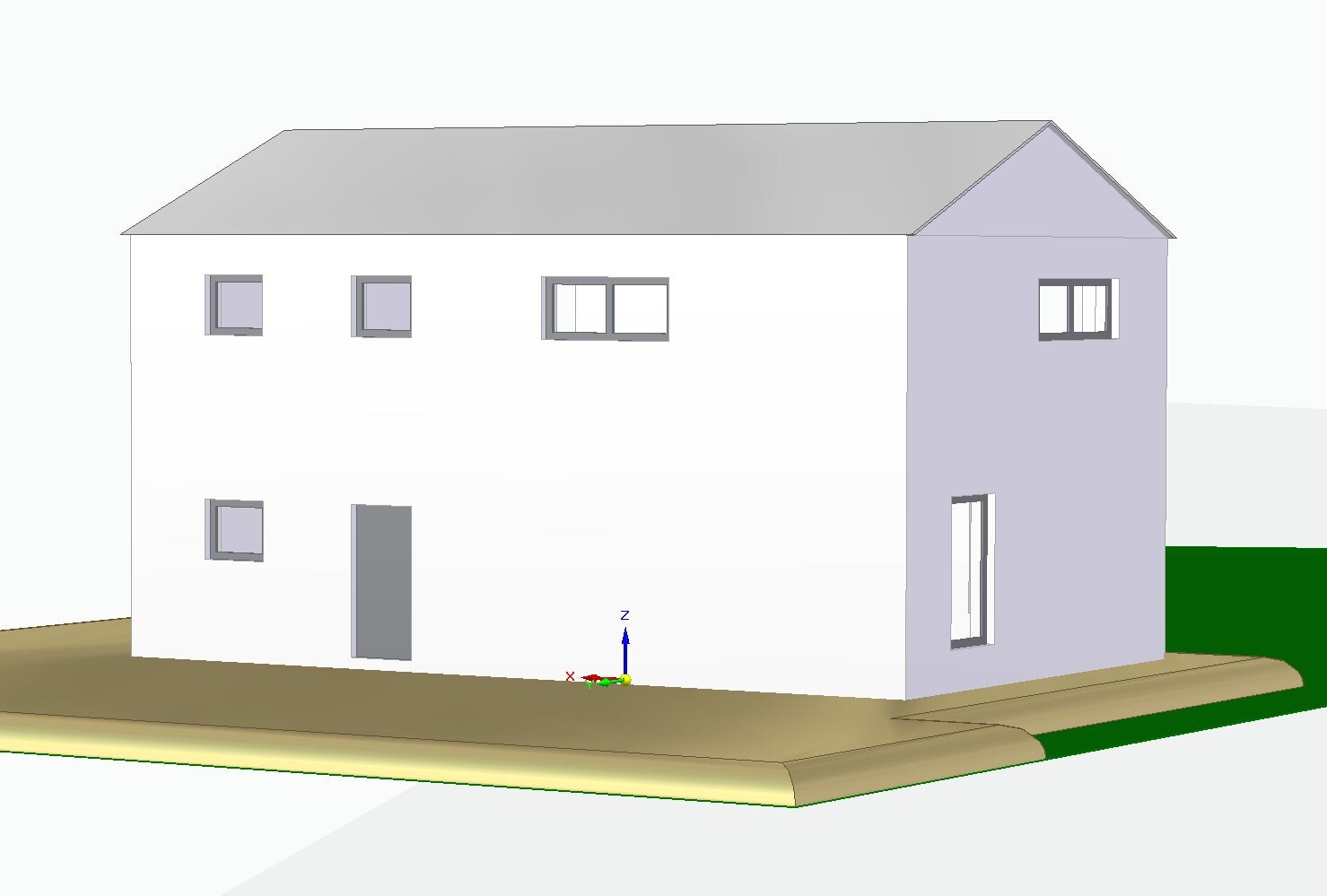
- What we don’t like 100% yet: the height of the house from the outside. It is currently planned as a two-story house with an eaves height of 6.2 m (20 ft), with the ground floor 2.84 m (9 ft 4 in) high and the upper floor 2.60 m (8 ft 6 in) high. The gable roof will be an uninsulated, unfinished cold roof, mainly because of the economical prefabricated truss construction method. This is a bit disappointing because I really like sloped ceilings and did not want the character of a townhouse. Lowering the roof with a knee wall of about 1.90 m (6 ft 3 in) and an insulated roof with open sloped ceilings would probably be more expensive due to the rafter/beam construction. We would also lose the garden view through the floor-to-ceiling bedroom windows.
- Simple: What do you think about the floor plan?
- Can you still imagine the relatively tall two-story house having a country house character? Maybe it depends on the facade design and choice of materials? Do you think it looks too “blocky,” especially from the front entrance side? Or would a lower eaves height with an attic conversion including a knee wall be preferable?
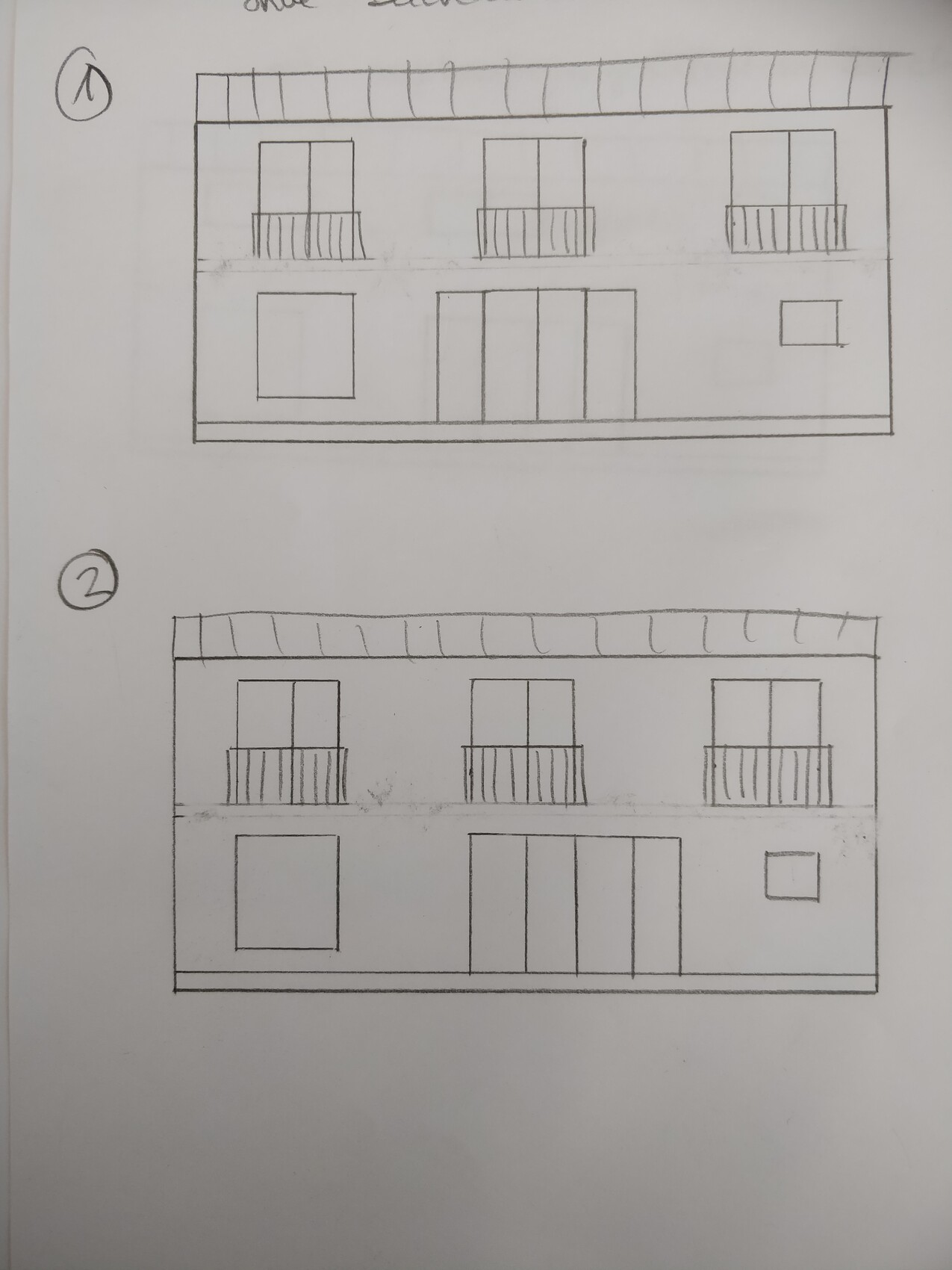
- We are still unsure how to arrange the windows on the garden side. The drawing with the elevations shows two possible versions. We actually prefer it when the upper floor window is centered over the lower window front. However, this does not align the interior line of sight from the entrance door to the garden/patio door (see ground floor plan). This represents version two; for version one, the window front would have to be shifted about one window width to the right, so that the patio door is behind the dining table. With the window front shifted left, the interior looks better to us, but from the outside it looks strange if it is offset from the upper floor window, right? What do you think?
Best regards
 la.schnute9 Mar 2020 22:56
chrisw81 schrieb:
I really like the floor plan from #123 as well! I also think the “reading nook” upstairs is very well designed — it must make a great impression when you come up the stairs! I also really like the staircase starting from the living room; it probably feels very open.
We have the staircase in the hallway, so it’s separated from the living room, which certainly has its advantages, but sometimes I wish I could just get up and go straight from the sofa to the stairs — it creates a nice connection to the upper floor.
In our home, the living area is quite separate from the rest of the house, so the other areas get used less — so you’re definitely doing it right! Thanks, @chrisw81. It’s true — on one hand, there’s the connected feeling of the living area, but on the other hand, there might be situations in the distant future where someone prefers to sneak upstairs unnoticed. Honestly, I don’t think that will happen very often. I suppose it also depends on the relationship between children and parents, but thinking back to my own youth, neither I nor my siblings ever did that. We were always quite open with each other and still have a great relationship today, where we talk to our parents about almost everything. Of course, I often wanted some privacy as a teenager, but then I would just go to my room — that’s what it’s there for.
Regarding the reading nook, which has received mixed comments: I also imagine it to be cozy. I’m not sure if it will really be a reading corner, since I haven’t gotten much time for reading in recent years , but it will be a friendly space where my partner can roll out a yoga mat or something. Also a place where the kids can play (why they would be “in the way” there, I don’t quite understand @kaho674). And I think that is especially important, even in small houses: not filling every square centimeter with practical storage cabinets, but leaving some space and light. I’m happy to give up stuff for that.
Ibdk14 schrieb:
Idea for the stair railing: instead of a railing in the upstairs hallway, we built cabinets — 95 cm (37 inches) high with a 50 cm (20 inches) depth — to store all our bedding, towels, and bathroom supplies. That saves space in the rest of the rooms. Maybe you could fit some cabinets with a 30 cm (12 inches) depth underneath. We have much more space than you do, but maybe you can still use the idea. I’ve been thinking along those lines too: some airy low cabinets under the stair railing, why not.
MayrCh schrieb:
Your optimism and enthusiasm are admirable, but you’re relying on your father-in-law for many critical trades. I hope you have a backup plan in case he no longer feels confident or is unable to contribute as planned. Mistakes with the foundation slab or the gas boiler could be disastrous. That’s true. Without our parents, this whole project would be unthinkable. My parents helped with the equity, and my father-in-law is an expert when it comes to construction. I consider errors due to lack of knowledge impossible: as mentioned, he’s a trained plumber and ran a heating and sanitary business with his brothers — so definitely a professional in the field. Of course, he’s not a roofer or mason (which is entirely correct), although he did extend and renovate his own house back in the GDR times. But the alternative is always to hire a company and dip into the contingency fund. I really hope that COVID stays away from our parents, who are already partly of retirement age.
Nordlys schrieb:
Painting and decorating a new build is a lot of work if you want a proper finish.
The steps are:
Fill all drywall (gypsum board) surfaces with joint compound using fiberglass tape. Usually three coats with sanding between layers are needed.
Sand walls to remove dust/sinter. Fill any imperfections, then fine sanding.
Fill window sills and apply acrylic sealant to the reveal edges.
For drywall ceilings, it’s recommended to glue a molding strip in the corner where ceiling meets wall to cover cracks that will almost certainly appear there.
Prime all plaster surfaces. Apply acrylic sealant at door frames.
Roll walls and ceilings twice, carefully masking windows and other elements. Protect tiled floors well. Non-tiled floors should be leveled with a smoothing compound after thorough vacuuming.
Sand the leveling compound, vacuum. Then install flooring and baseboards. Seal joints on stairs or door thresholds with MS-polymer or silicone.
In our case, we added glass fiber wall coverings in bathrooms and kitchen instead of paint, then painted the fibers with latex paint.
108 sqm (1160 sq ft) bungalow, 100 hours total for everything. K. Is that so? That sounds a lot like timber frame construction to me? We’re building solid with aerated concrete blocks / Ytong, meaning basically: aerated concrete blocks, exterior plaster, interior plaster — and that’s it.
Nordlys schrieb:
Concrete ceilings aren’t smooth enough to paint without patching, unless you want the raw industrial look. …because it’s supposed to be a bit raw industrial. We may skip fine patching and even whitewashing. But I can only decide once I see it for myself.
kaho674 schrieb:
Where do you live? My husband has 26 vacation days a year, although Christmas and New Year’s Eve are days off. I’m self-employed and almost never take time off. When you’re building, you melt butter in the sun, so to speak. We both actually have 30 vacation days exactly. And if needed, we can rely on grandmas and other relatives to watch the kids. But of course, I want to see them from time to time too, so we have to be realistic about parental leave. It will probably be slow going. Our only real time pressure comes from the loan. Once repayments start, maybe we can temporarily move in with my uncle, who lives just two streets from the plot and is rarely home (we actually wanted to buy his land, but he didn’t want to sell).
ltenzer schrieb:
As I mentioned, I’d arrange the stairs so you can enter them from the entrance area without going through the living/dining space. But if you prefer it as in your plan, then I’d turn that “reading nook” upstairs into a storage room. With such a small budget and saved square meters, I would use every corner practically, and you’ll probably need storage space somewhere.
Was attic storage not an option, or did I miss that? I first thought about turning the half-landing stairs to the side, but then the exterior dimensions wouldn’t work as well (it would have to be longer again), and the window can’t be integrated as nicely. Architecturally, I just like it less. Also, because the wardrobe on the ground floor now fits almost automatically.
A storage room upstairs — I’ve said it many times before — honestly, I wouldn’t know what to put there . I also need everything to be thematically organized, so most things stay in the rooms where they are used. Bathroom cleaning supplies and towels in the bathroom, bed linen in the wardrobe near the bed, etc. Hmm, I really have no idea what would go in there.
No attic storage is planned for now, but I do see the point for maybe an old piece of furniture or something. With studio binders it would probably be possible. However, the height under the ridge will be no more than 1.20 m (3 feet 11 inches) — so really only crawl space.
la.schnute9 Mar 2020 23:02Oh, and regarding the possibility of an extension in the distant future... this is what I had in mind. (Maybe also for the situation when our parents can no longer live alone in their house in the village).
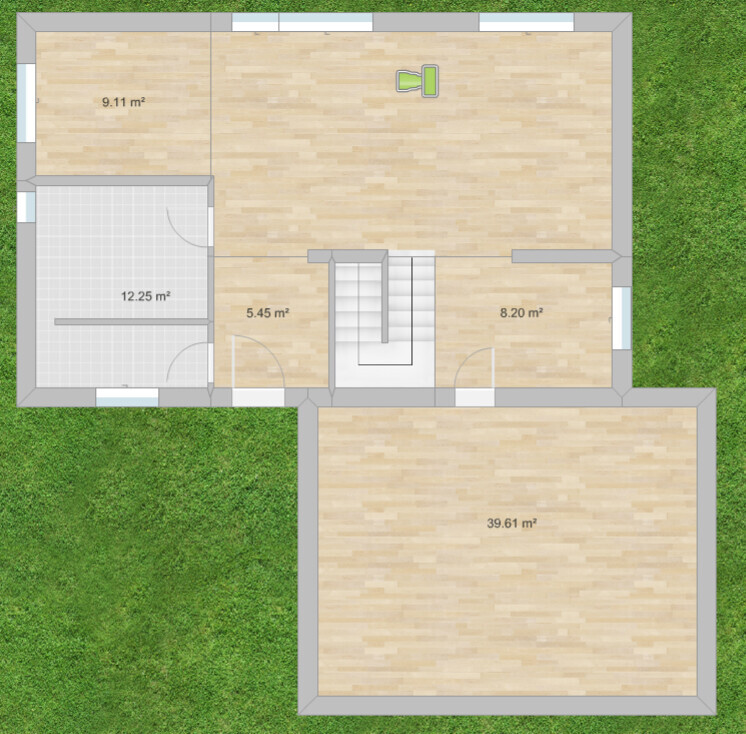

Where do you store Christmas decorations and suitcases?
I don’t want cleaning supplies or toilet paper storage (if you can even get any) in the bathroom. Habits vary so much.
Reading becomes less of a priority with a house. Somehow, it just creates more work.
The gallery would be too lively for reading or yoga. Kids come and go, and in the living room, the husband watches football. There’s always life going on in the house.
It won’t be used for playing for very long. I think as they go through elementary school, the bedrooms become increasingly important.
Take a look at Pinterest or Dwellinggawker. I think you’ll find some ideas for thinking outside the box, as Hampshire suggested.
I don’t want cleaning supplies or toilet paper storage (if you can even get any) in the bathroom. Habits vary so much.
Reading becomes less of a priority with a house. Somehow, it just creates more work.
The gallery would be too lively for reading or yoga. Kids come and go, and in the living room, the husband watches football. There’s always life going on in the house.
It won’t be used for playing for very long. I think as they go through elementary school, the bedrooms become increasingly important.
Take a look at Pinterest or Dwellinggawker. I think you’ll find some ideas for thinking outside the box, as Hampshire suggested.

ypg schrieb:
Your joke falls a bit short,You started it (with the bearded joke, equating the time off from classes with the teacher’s holidays).https://www.instagram.com/11antgmxde/
https://www.linkedin.com/company/bauen-jetzt/
Similar topics