
Dear forum members,
We bought a plot of land last autumn and are currently deep into the floor plan design. We would like to share our current draft with you and welcome any comments and opinions.
[F]irst some preliminary information about the plot and its buildability:[/F]
Best regards
We bought a plot of land last autumn and are currently deep into the floor plan design. We would like to share our current draft with you and welcome any comments and opinions.
[F]irst some preliminary information about the plot and its buildability:[/F]
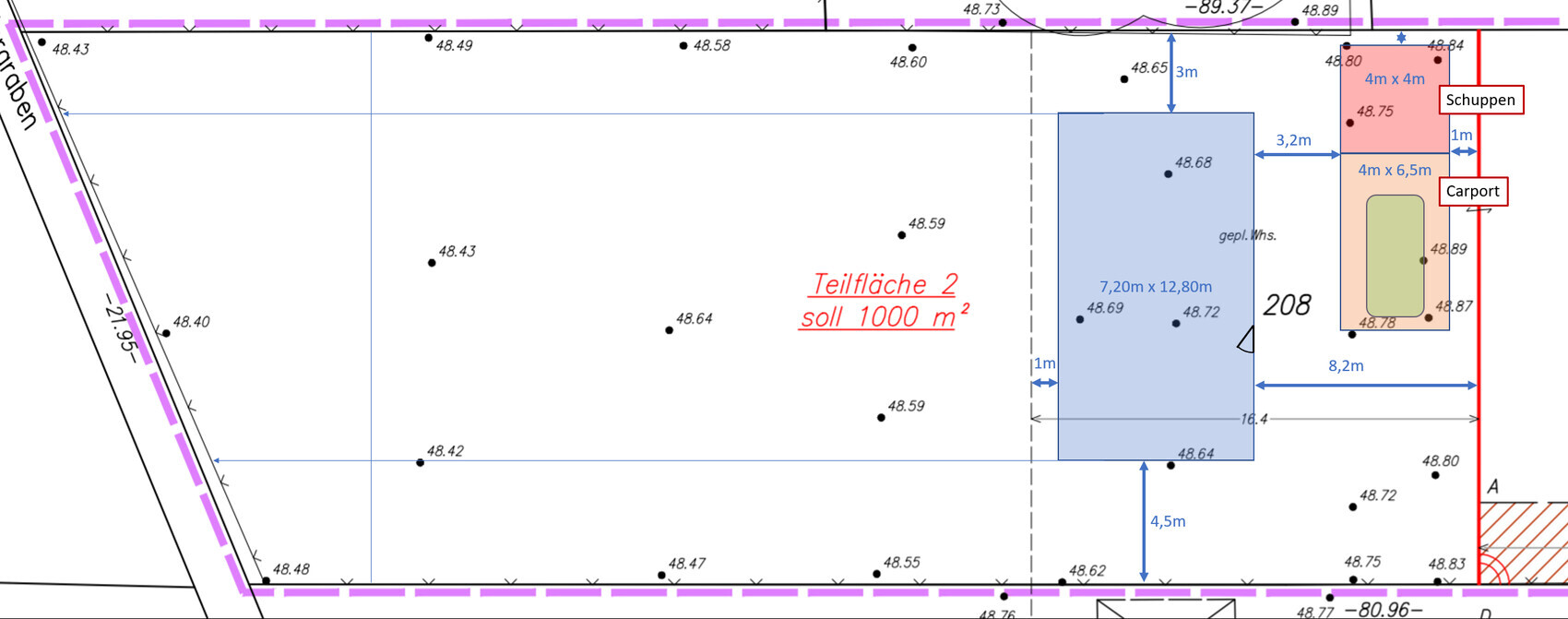
- 1000 m² (10,764 sq ft) rear plot, southwest facing (so southwest is on the left side of the site plan)
- Building boundary up to approx. 16 m (52 ft) behind the property line (up to the dashed line on the site plan)
- No zoning plan (construction according to § 34 of the Building Code)
- Groundwater at surface level and peaty soil (exact geotechnical report pending), so piled foundation required and no basement
- Affordable! (Our maximum budget for the house including foundation slab is €230,000)
- Country house style
- Bright, large windows facing south/garden
- Open living/dining/kitchen area
- Family of four, 1 bedroom and 2 children’s rooms
- Not oversized, max 150 m² (1,615 sq ft), preferably less
- Solid construction using Ytong blocks (for us the most cost-effective option, although we would have liked to build with wood as well).
- Developed ourselves after studying various floor plans (including from the book "Affordable Building with a Small Budget" by Achim Linhardt) with support from architect friends and our planner (an independent civil engineer).
- Dimensions 12.50 x 7.50 m (41 x 25 ft) (the measurements shown on the site plan are from an earlier draft).
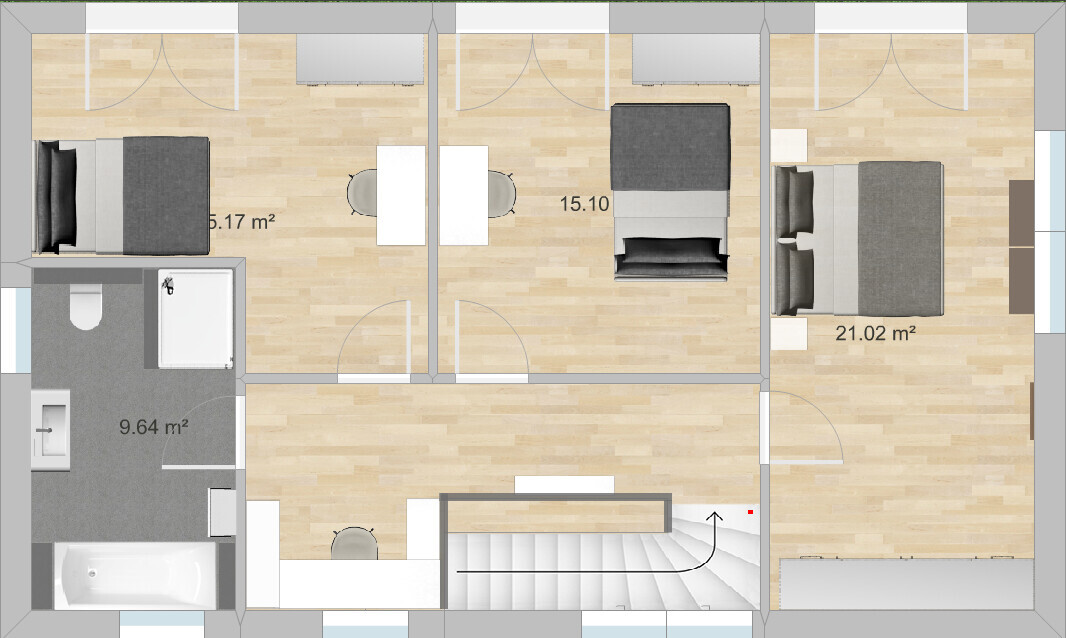
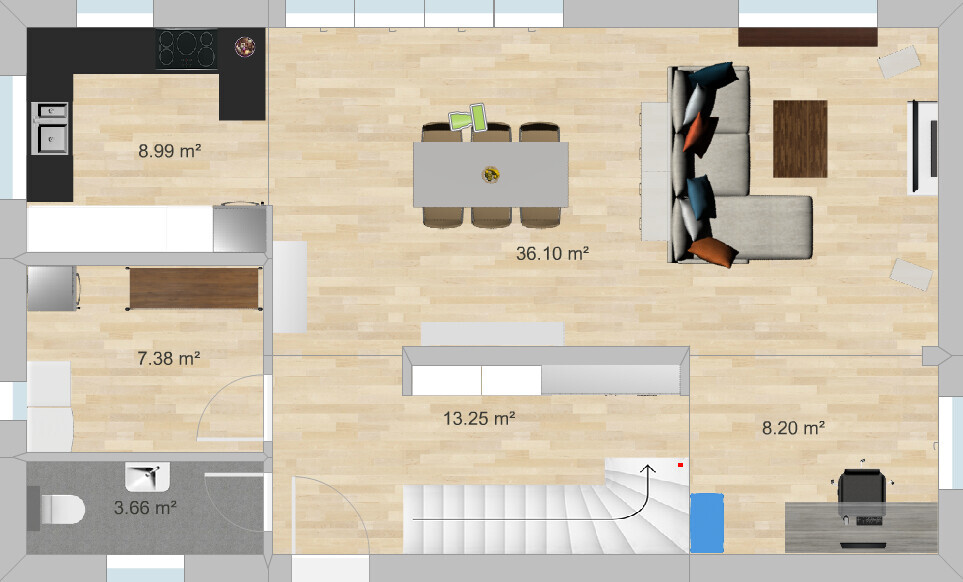
- What we like: open living area, all main rooms have large windows facing the garden, efficient size, although the children’s and bedroom could be smaller, sewing/work nook behind the stairs upstairs, plenty of wall space for large wardrobes in the upstairs bedroom and hallway on the ground floor, light shaft in the stairwell, staircase (we originally wanted a straight run staircase but it would have taken too much space; the one with three quarter turns is also fine with us).
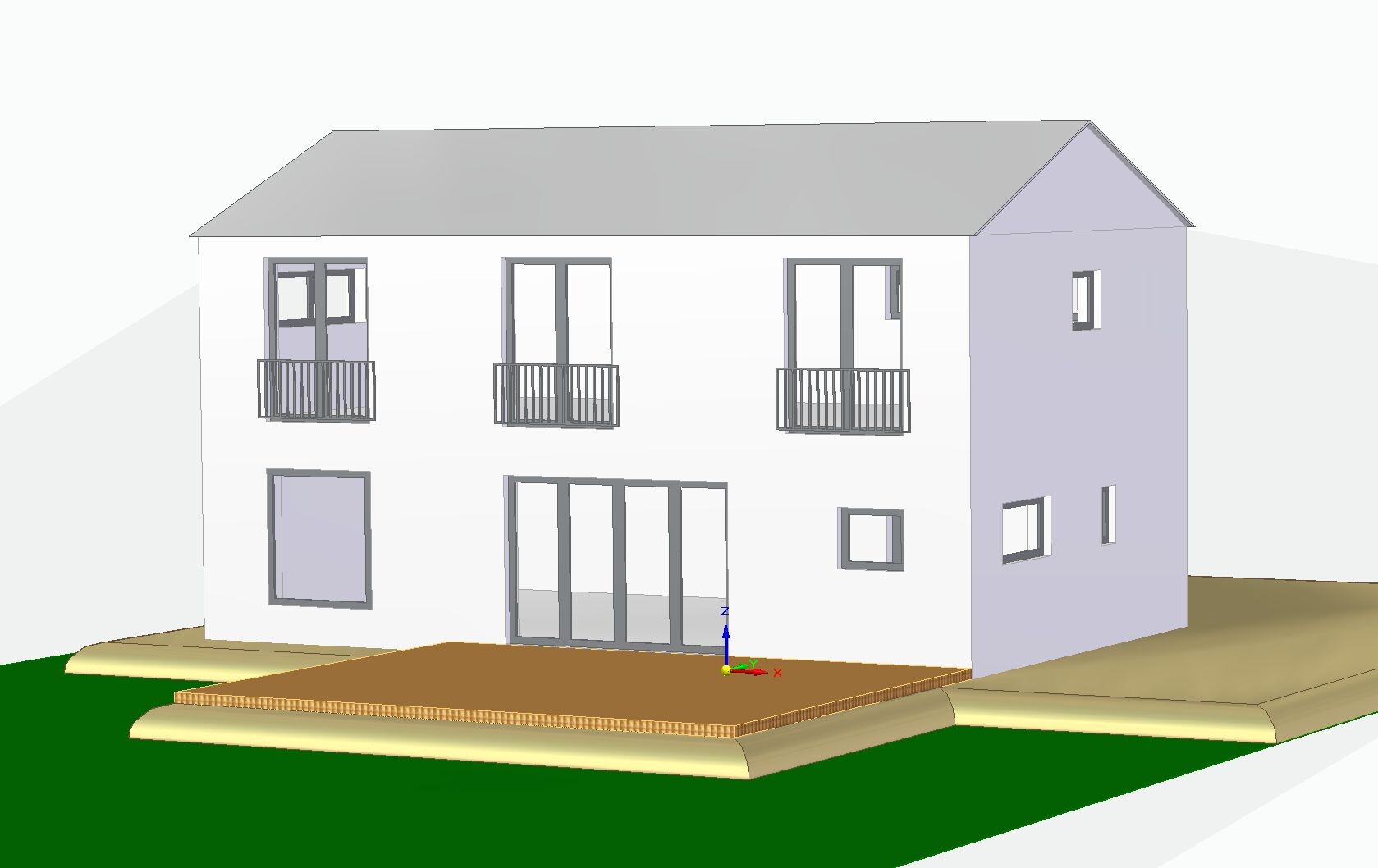
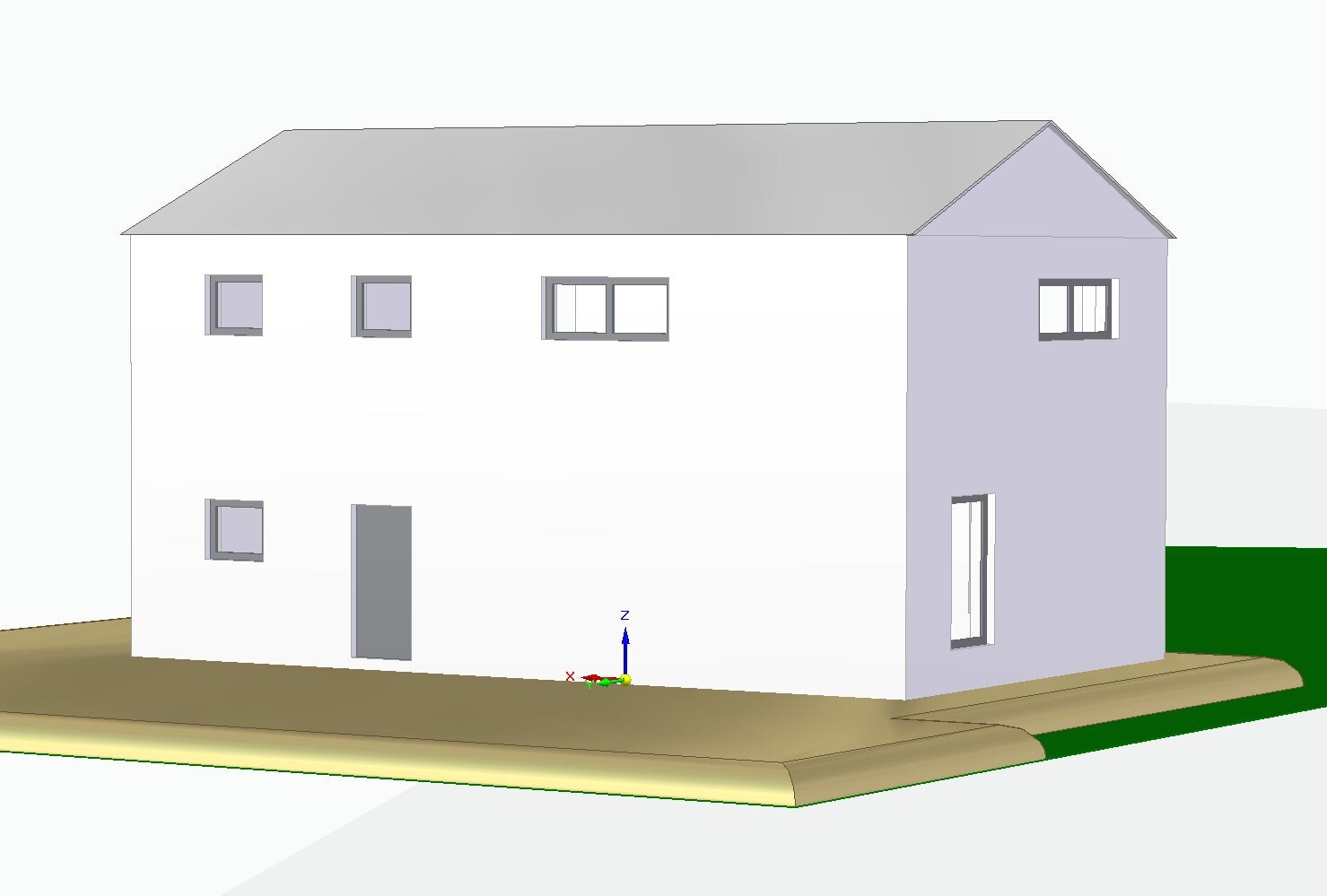
- What we don’t like 100% yet: the height of the house from the outside. It is currently planned as a two-story house with an eaves height of 6.2 m (20 ft), with the ground floor 2.84 m (9 ft 4 in) high and the upper floor 2.60 m (8 ft 6 in) high. The gable roof will be an uninsulated, unfinished cold roof, mainly because of the economical prefabricated truss construction method. This is a bit disappointing because I really like sloped ceilings and did not want the character of a townhouse. Lowering the roof with a knee wall of about 1.90 m (6 ft 3 in) and an insulated roof with open sloped ceilings would probably be more expensive due to the rafter/beam construction. We would also lose the garden view through the floor-to-ceiling bedroom windows.
- Simple: What do you think about the floor plan?
- Can you still imagine the relatively tall two-story house having a country house character? Maybe it depends on the facade design and choice of materials? Do you think it looks too “blocky,” especially from the front entrance side? Or would a lower eaves height with an attic conversion including a knee wall be preferable?
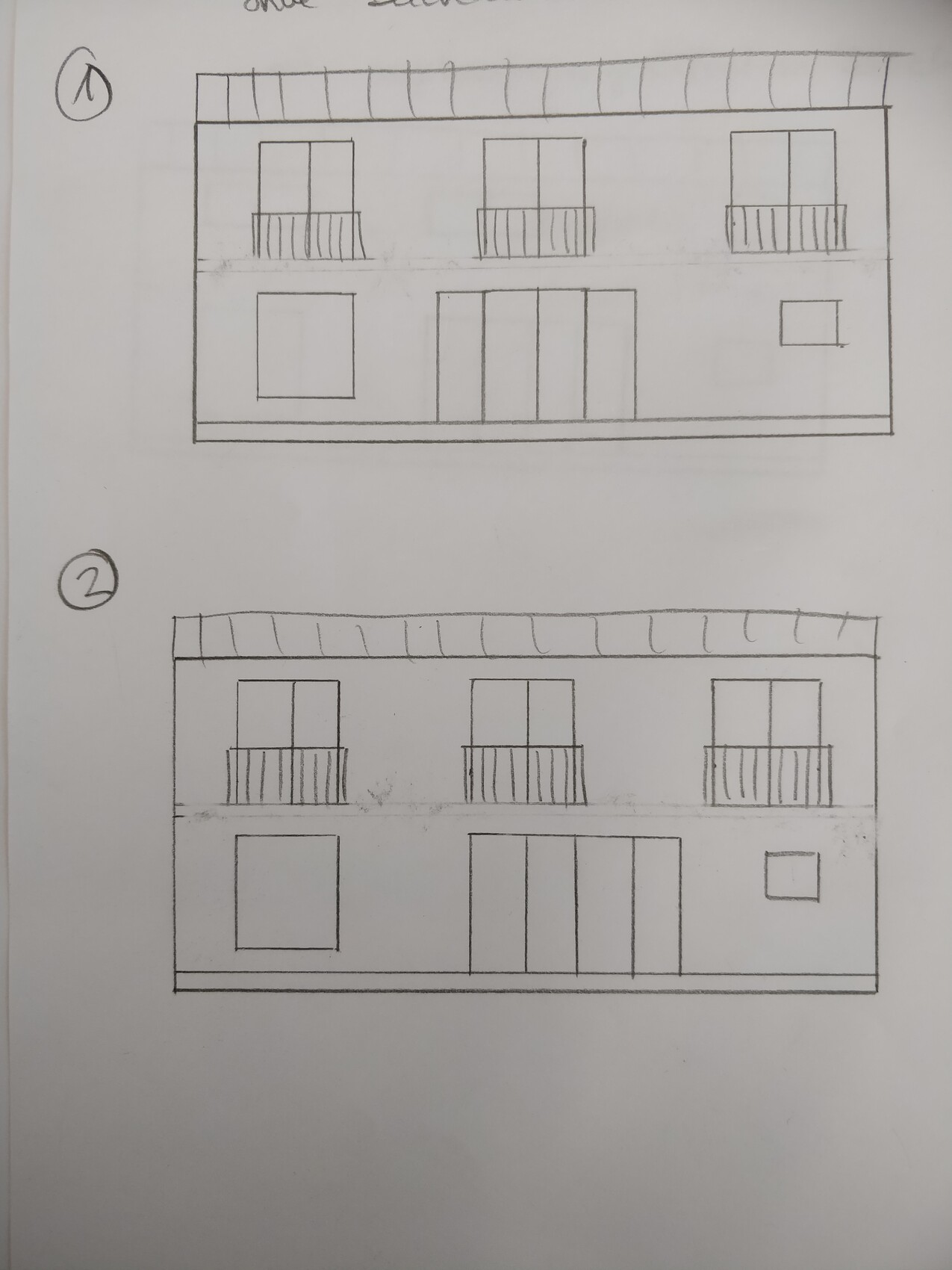
- We are still unsure how to arrange the windows on the garden side. The drawing with the elevations shows two possible versions. We actually prefer it when the upper floor window is centered over the lower window front. However, this does not align the interior line of sight from the entrance door to the garden/patio door (see ground floor plan). This represents version two; for version one, the window front would have to be shifted about one window width to the right, so that the patio door is behind the dining table. With the window front shifted left, the interior looks better to us, but from the outside it looks strange if it is offset from the upper floor window, right? What do you think?
Best regards

I just can’t warm up to the upper floor design. At the stair exit, you immediately run into a wall—ouch—that’s not ideal. On the other hand, a lot of space next to the stairs is wasted, space that’s missing in the children’s rooms. The famous reading nook definitely won’t work there, since you want quiet for reading. It’s too narrow to serve as a play hallway, and the kids would be in the way anyway. So it’s basically just wasted space, which might be fine in a villa but has no place in a compact house for four people.
 la.schnute9 Mar 2020 10:58
Altai schrieb:
I find the floor plan from #123 very well done. Compact, meets your needs (I would also find it too open). Everything fits in. Thumbs up!Thank you very much!
la.schnute schrieb:
I think it’s quite normal to frequently discard floor plans. I agree.
la.schnute schrieb:
The condensing boiler is roughly the size of a large refrigerator (shown in the utility room at the very bottom), so it should fit. Keep in mind that the boiler will not be mounted directly on the wall.
la.schnute schrieb:
That’s right, the windows in the attached floor plan are now pretty much final. The elevations are still pending; I’ll be happy to upload them once we’ve finished working on them. After a lot of back and forth, we’ve now decided on exterior dimensions of 11.7 x 7.5 m (38.4 x 24.6 ft). I also really like the floor plan from #123! I think the "reading nook" upstairs is really well designed—it must make a great impression when you come up! I also really like the staircase starting from the living room; it probably feels very open.
Our staircase is in the hallway, separated from the living room, which certainly has its advantages, but sometimes I wish I could go directly from the sofa to the stairs and go upstairs—that creates a nice connection to the upper floor.
In our case, the living area and the rest of the house are quite separated, so the rest of the house is used less frequently, meaning you definitely have it right with your design!

I also like the current floor plan best out of all your previous proposals. Whether it becomes a reading nook upstairs or a sewing area, I would decide spontaneously. My three boys loved when I turned on the sewing machine—though back then it was still in the dining room. Their excited “zoom zoom zoom” was always so cute, and everyone wanted to watch. The downside was that I had to clear the dining table every evening. Now I hardly sew at all because the boys are long past the age of wearing homemade clothes. I even have a large study now, but thanks to two PCs with accessories, a piano, and bookshelves, there’s unfortunately no space left. So, years ago I would have wished for a corner where things could be left out occasionally, and now I just carry everything back and forth to the dining table whenever I sew or mend something.
One idea regarding the stair railing: instead of a banister in our upstairs hallway, we installed cabinets—about 95cm (37 inches) high with a depth of 50cm (20 inches). They hold all the bed linens, towels, and bathroom supplies. This saves space in the other rooms. Maybe you could fit shallower cabinets about 30cm (12 inches) deep in that area. We have considerably more space than you, but perhaps you can still make use of this idea.
One idea regarding the stair railing: instead of a banister in our upstairs hallway, we installed cabinets—about 95cm (37 inches) high with a depth of 50cm (20 inches). They hold all the bed linens, towels, and bathroom supplies. This saves space in the other rooms. Maybe you could fit shallower cabinets about 30cm (12 inches) deep in that area. We have considerably more space than you, but perhaps you can still make use of this idea.
H
hampshire9 Mar 2020 12:10Altai schrieb:
When the budget is tight, tips regarding "custom furniture" and such can only help to a limited extent.Here again, it comes down to creativity. If you go to a carpenter for "custom furniture," you’re paying different rates than at Ikea.However, furniture like cabinets, dressers, and shelves can also be built by yourself or even more easily installed (since there seems to be some craftsmanship skill available).
Furthermore, different countries have different standards and measurements. Looking beyond your usual scope offers more options than the "same old" furniture from the "same familiar" manufacturers in the "almost identical" furniture stores. For example, with upholstered furniture.
Some ready-made furniture can be adjusted in size with a manageable amount of effort. I have, among other things, reduced the width of Pax wardrobes. No one notices.
Those who have ideas, tools, and either their own or access to craftsmanship skills also have access to individual, suitable, and cost-effective solutions.
Similar topics