
Dear forum members,
We bought a plot of land last autumn and are currently deep into the floor plan design. We would like to share our current draft with you and welcome any comments and opinions.
[F]irst some preliminary information about the plot and its buildability:[/F]
Best regards
We bought a plot of land last autumn and are currently deep into the floor plan design. We would like to share our current draft with you and welcome any comments and opinions.
[F]irst some preliminary information about the plot and its buildability:[/F]
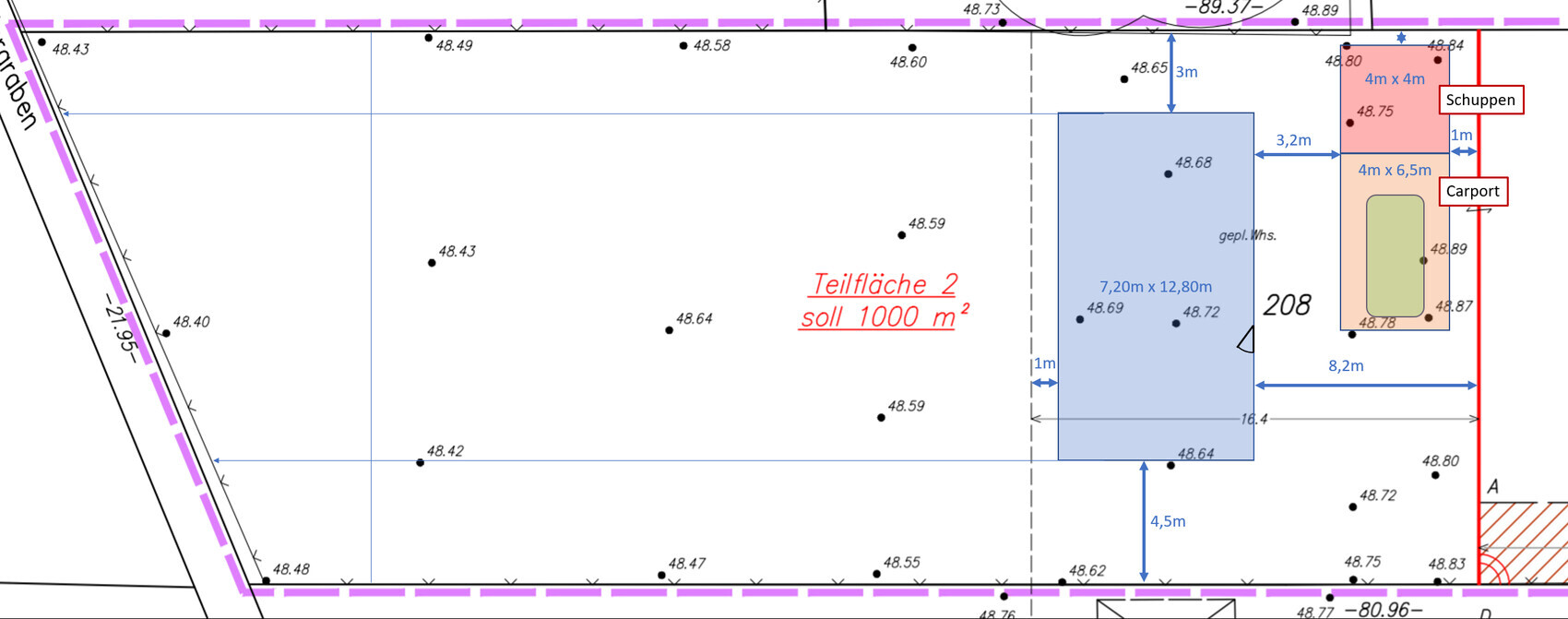
- 1000 m² (10,764 sq ft) rear plot, southwest facing (so southwest is on the left side of the site plan)
- Building boundary up to approx. 16 m (52 ft) behind the property line (up to the dashed line on the site plan)
- No zoning plan (construction according to § 34 of the Building Code)
- Groundwater at surface level and peaty soil (exact geotechnical report pending), so piled foundation required and no basement
- Affordable! (Our maximum budget for the house including foundation slab is €230,000)
- Country house style
- Bright, large windows facing south/garden
- Open living/dining/kitchen area
- Family of four, 1 bedroom and 2 children’s rooms
- Not oversized, max 150 m² (1,615 sq ft), preferably less
- Solid construction using Ytong blocks (for us the most cost-effective option, although we would have liked to build with wood as well).
- Developed ourselves after studying various floor plans (including from the book "Affordable Building with a Small Budget" by Achim Linhardt) with support from architect friends and our planner (an independent civil engineer).
- Dimensions 12.50 x 7.50 m (41 x 25 ft) (the measurements shown on the site plan are from an earlier draft).
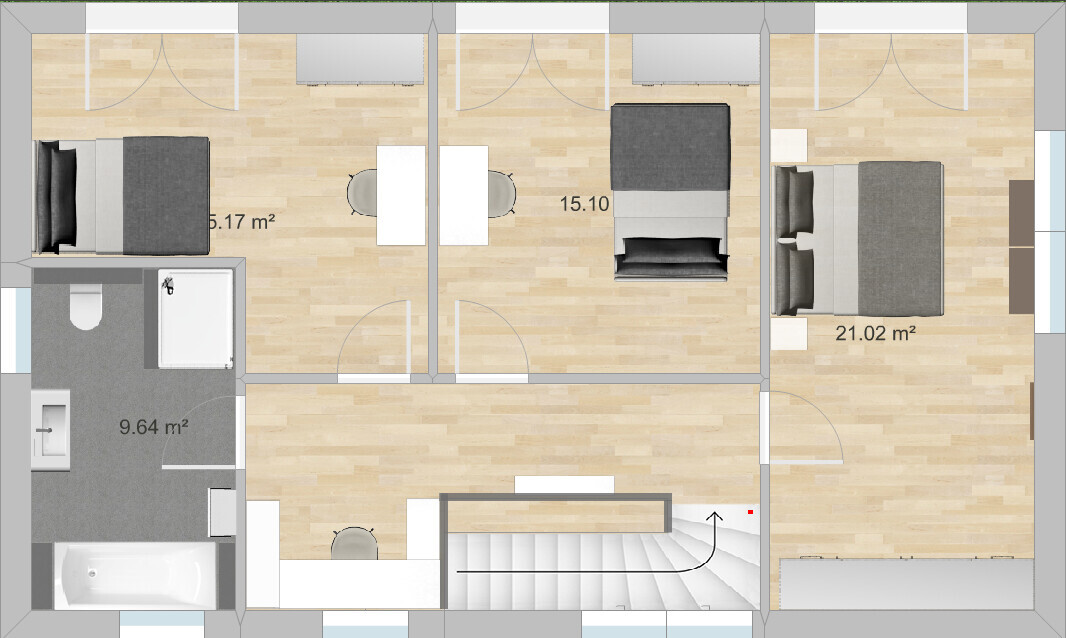
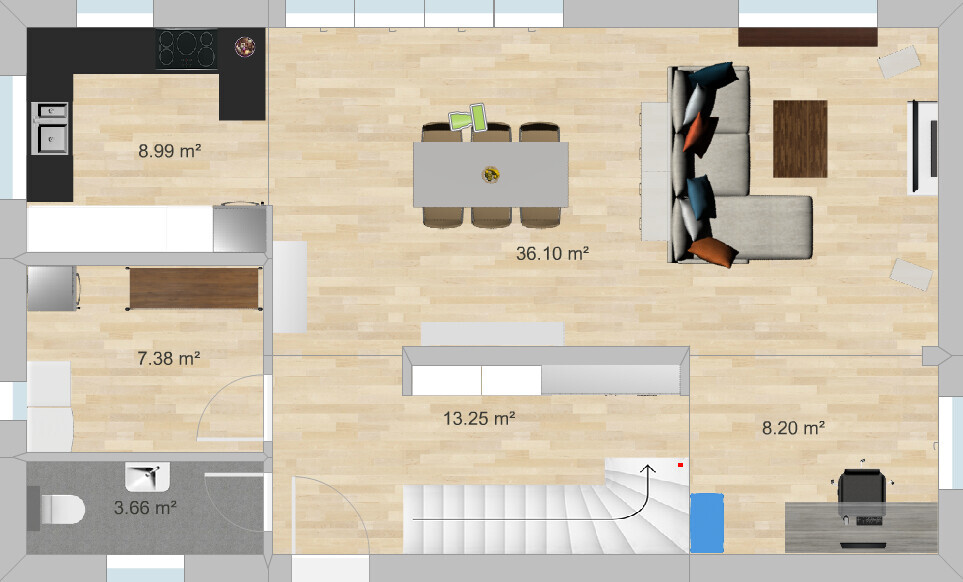
- What we like: open living area, all main rooms have large windows facing the garden, efficient size, although the children’s and bedroom could be smaller, sewing/work nook behind the stairs upstairs, plenty of wall space for large wardrobes in the upstairs bedroom and hallway on the ground floor, light shaft in the stairwell, staircase (we originally wanted a straight run staircase but it would have taken too much space; the one with three quarter turns is also fine with us).
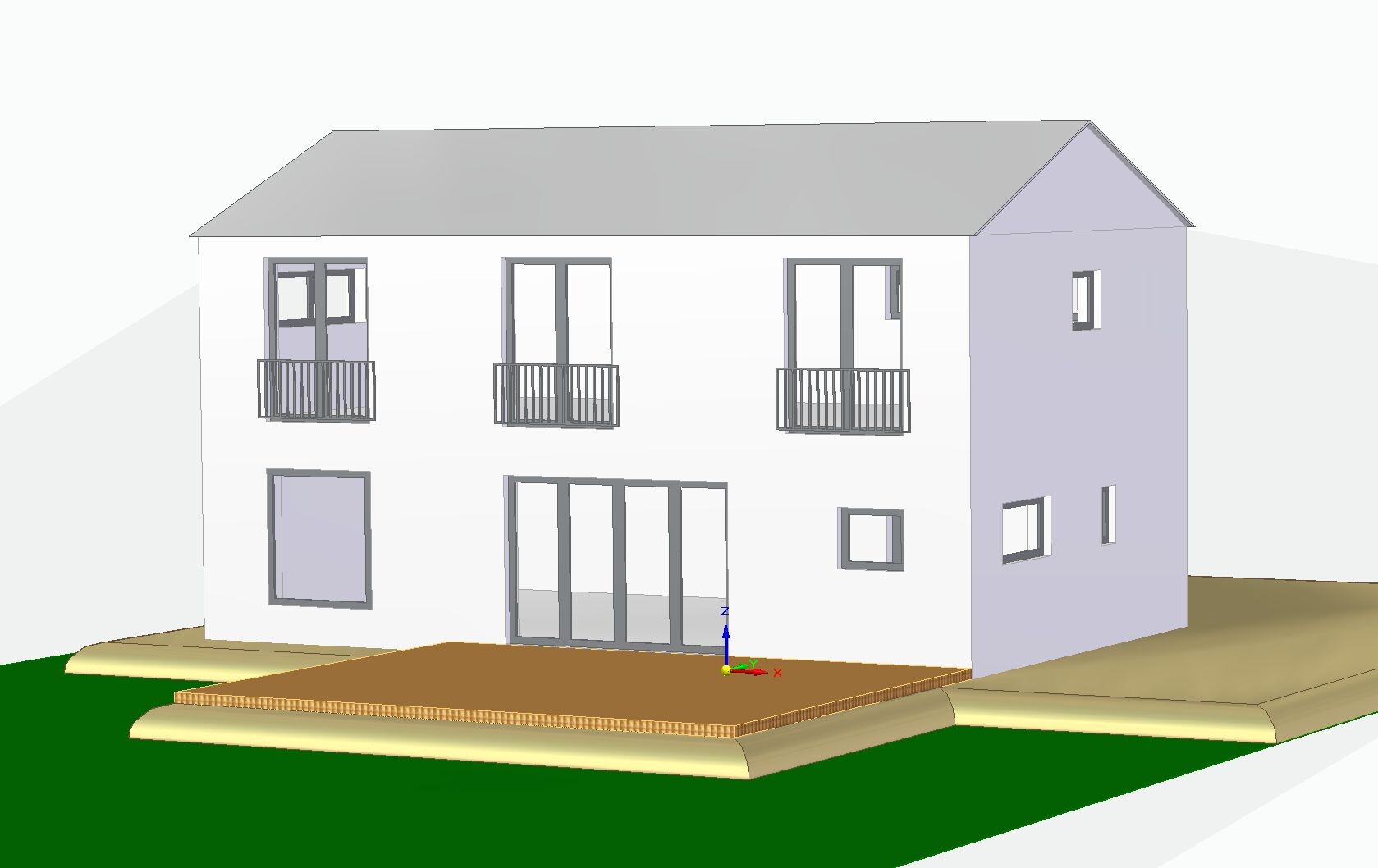
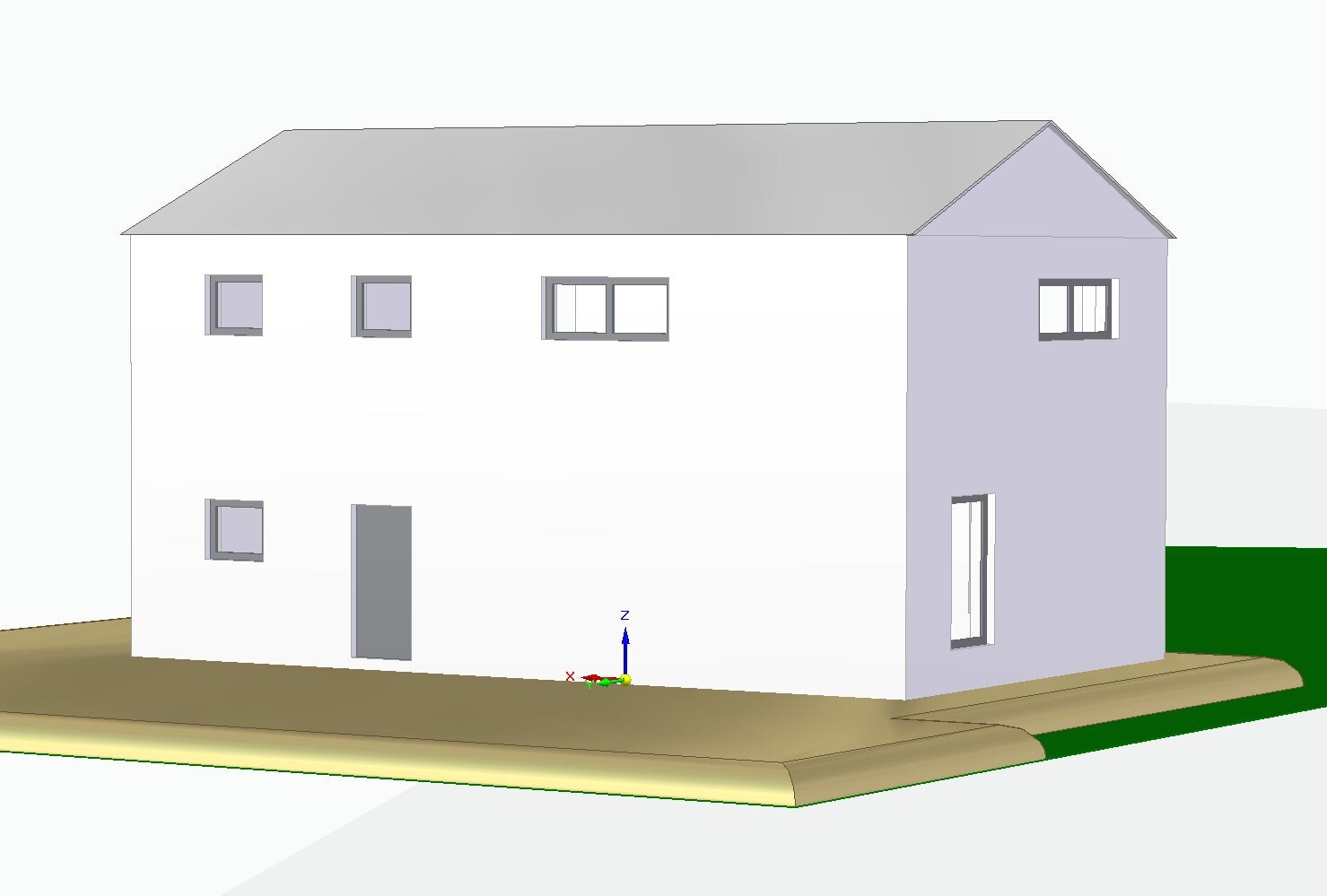
- What we don’t like 100% yet: the height of the house from the outside. It is currently planned as a two-story house with an eaves height of 6.2 m (20 ft), with the ground floor 2.84 m (9 ft 4 in) high and the upper floor 2.60 m (8 ft 6 in) high. The gable roof will be an uninsulated, unfinished cold roof, mainly because of the economical prefabricated truss construction method. This is a bit disappointing because I really like sloped ceilings and did not want the character of a townhouse. Lowering the roof with a knee wall of about 1.90 m (6 ft 3 in) and an insulated roof with open sloped ceilings would probably be more expensive due to the rafter/beam construction. We would also lose the garden view through the floor-to-ceiling bedroom windows.
- Simple: What do you think about the floor plan?
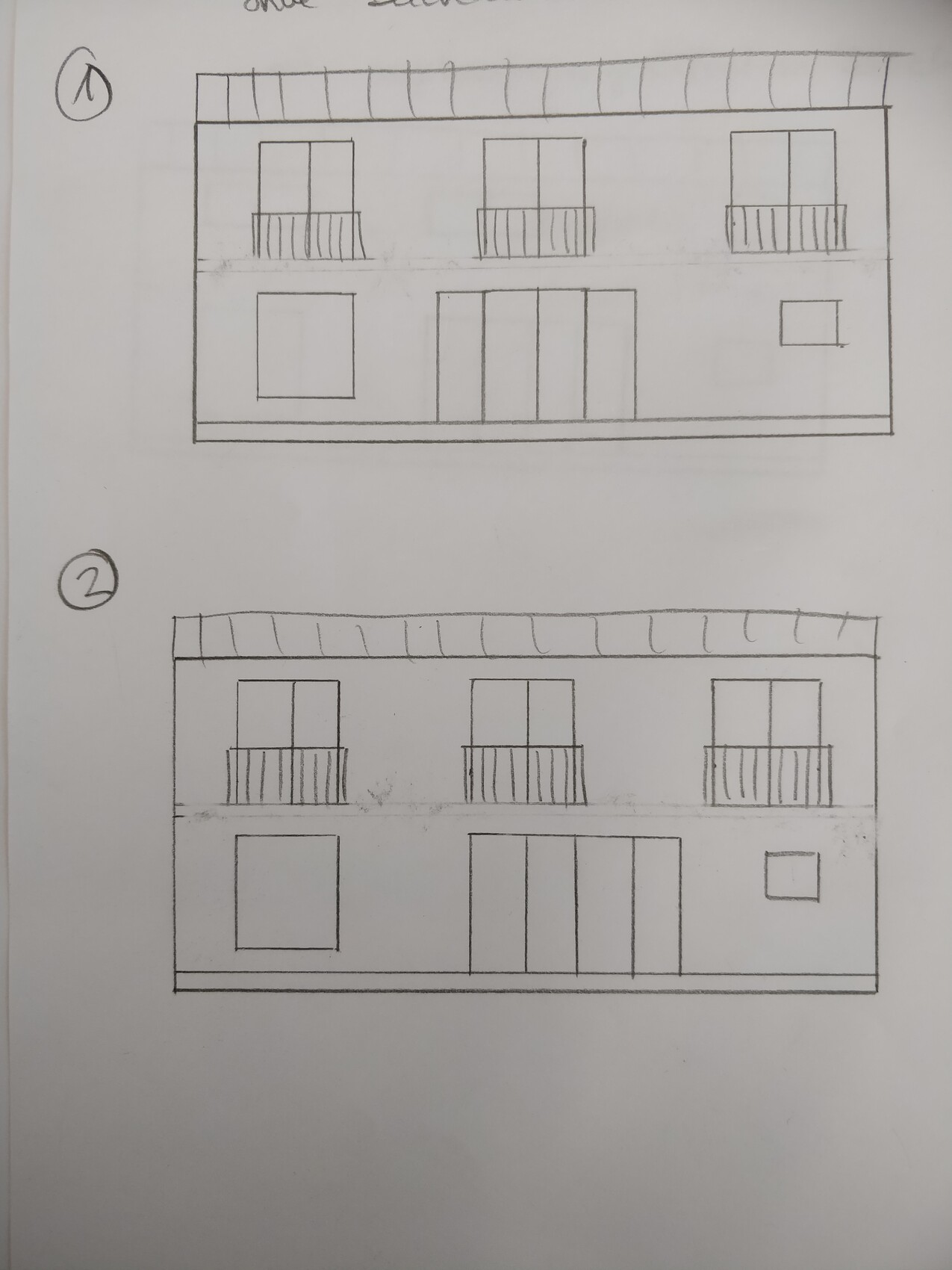
- Can you still imagine the relatively tall two-story house having a country house character? Maybe it depends on the facade design and choice of materials? Do you think it looks too “blocky,” especially from the front entrance side? Or would a lower eaves height with an attic conversion including a knee wall be preferable?
- We are still unsure how to arrange the windows on the garden side. The drawing with the elevations shows two possible versions. We actually prefer it when the upper floor window is centered over the lower window front. However, this does not align the interior line of sight from the entrance door to the garden/patio door (see ground floor plan). This represents version two; for version one, the window front would have to be shifted about one window width to the right, so that the patio door is behind the dining table. With the window front shifted left, the interior looks better to us, but from the outside it looks strange if it is offset from the upper floor window, right? What do you think?
Best regards
For me, none of the floor plans work because the hallway upstairs is larger than most of the rooms, and the bathroom is rather small.
A pile of shoes at the entrance ruins any spacious floor plan. With just two pairs of shoes per person, that’s eight pairs.
The house won’t be a villa, so some compromises will have to be made. I would reduce the number of rooms and use custom-made furniture. For example, a staircase cupboard, office cabinet, and sewing cabinet. There are nice examples on Pinterest. A large sliding door between the dining and living areas allows for creating two separate rooms when needed.
On the ground floor: cloakroom, utility room, staircase, and a multi-purpose room that can be separated by a sliding door, with at least one additional function like sewing.
Upstairs: two children’s bedrooms, master bedroom with possibly two additional functions, bathroom, possibly with washer/dryer.
Take a look at the Fingerhaus in Langenhagen/Hannover. It’s too big, but the entrance, stairs, kitchen, and dining area form almost one unit. It feels very open and inviting, and the living room offers a retreat space without being closed off.
A pile of shoes at the entrance ruins any spacious floor plan. With just two pairs of shoes per person, that’s eight pairs.
The house won’t be a villa, so some compromises will have to be made. I would reduce the number of rooms and use custom-made furniture. For example, a staircase cupboard, office cabinet, and sewing cabinet. There are nice examples on Pinterest. A large sliding door between the dining and living areas allows for creating two separate rooms when needed.
On the ground floor: cloakroom, utility room, staircase, and a multi-purpose room that can be separated by a sliding door, with at least one additional function like sewing.
Upstairs: two children’s bedrooms, master bedroom with possibly two additional functions, bathroom, possibly with washer/dryer.
Take a look at the Fingerhaus in Langenhagen/Hannover. It’s too big, but the entrance, stairs, kitchen, and dining area form almost one unit. It feels very open and inviting, and the living room offers a retreat space without being closed off.
 la.schnute7 Mar 2020 15:44
11ant schrieb:
Not here, the house is too small for that. I would switch the direction where you planned the landing.Yes, that’s something to consider. Replacing the stair with landing by a half-turn stair creates a bit more space around the staircase without significantly changing the character or layout of the room. By the way, here’s an excerpt from my handy low-budget building book about stairs. Including circulation areas, the quarter-turn stair actually takes up more space than the landing stair if you don’t fully cover the ceiling opening (which you certainly could do), so the graphic probably only tells half the story.
hampshire schrieb:
Yes, the coat area is really tight. A straight stair definitely takes up a lot of space. If you rotate it and access it from the living room, then there’s room for a coat area. But that changes the floor plan much more radically. The long distances upstairs remain, and the distance to the front door will be further, too.Oh yes, good idea. I’ve seen that sometimes as well. I find it somehow cozy when the staircase is connected to the living area, so I’ll definitely try it! Coat area then under the staircase.
ypg schrieb:
Using a staircase here as a focal point is a mistake. You’re not creating an environment where your children can become independent and contribute to family life as a shared experience, but rather develop their own dynamic. They should feel a sense of personality within the house, too.Um, well, I think my children’s personality development is influenced much more by genetics, our parenting, and socialization through friends, school, etc., than by the orientation of the staircase in our house . But maybe I didn’t quite understand you correctly?
ypg schrieb:
Sometimes a 30 cm (12 inch) cupboard is enough for you, sometimes not. If you only have two jackets per person, that’s enough.…I’ve planned more than 2 meters (6.5 feet) of wardrobe with 40 cm (16 inch) depth in every floor plan. Part of it as a shoe bench (80–100 cm / 31–39 inches), the remaining length as tall cabinets. Only in the floor plan with the straight stair is there no coat area because I simply didn’t know where to put it. Just placing it next to the stair looks odd… but rotating the stair is definitely an idea!
ypg schrieb:
I don’t want to talk you out of it completely, but if you want a generously airy feel in a compact space, you need storage space to keep things out of sight and avoid clutter. Airiness doesn’t help if everything is messy everywhere. A free wall gives more breathing room than a free corner stacked full of junk!!!
My list (@kaho674 )
But what do I want to get at? The everyday essentials.
And that’s why living in a house requires storage for:
Brooms, mop with bucket, vacuum cleaner, handheld vacuum, window cleaner, drying rack for wool/sport/hand wash, laundry baskets (some have three!), space for ironing board + iron and basket with clean laundry, washing machine, dryer (can be stacked), cleaning supplies, small kitchen appliances (fondue set, roaster, deep fryer, baking pans, clay pot, champagne cooler), empty + filled canning jars, freezer or beverage cooler, shoe cleaning supplies, recycling bags, beverage bottles (cases of water, beer, and juice), a few staples like onions and potatoes, bags and sacks for shopping or gift wrapping, decoration stuff (2 boxes Christmas decor, 1 box Easter, 1 box general), gift wrap, office binders, stationery, kids’ craft supplies (window paint, acrylic paint, brushes, paint jars), heat lamp, medicines, photo equipment, hobby stuff (badminton set, fishing rod, etc. stay outside), hand tools, drill, cordless screwdriver, a few paint cans, white paint, brushes and rollers, electrical supplies, lightbulbs, batteries, vases, spare cutlery and dishes, picnic basket, small/large step ladder, 2-3 flower pots and fertilizer, empties, dog food, cat litter box, 15 liters (4 gallons) of emergency water, sewing machine, fabric scraps, sewing kit, plant spray bottle, suitcases, travel and sports bags, cooler bag, leftover carpet and tile pieces, etc.
You can probably remove 2-3 items, but I’m sure I forgot some things.
Coat area:
Man: work jacket, safety jacket, sports jacket, garden jacket, common jackets for all seasons (biker jacket, all-weather jacket, blouson, winter jacket, leather jacket), various shoes, headwear (caps, etc.)
Child: fewer jackets but rubber boots, outdoor boots, sports shoes, indoor shoes, two pairs of change shoes, sandals, ballerinas...
Woman: winter jacket, winter coat, transitional jacket, summer blazer, summer coat, cardigan, fleece and garden jacket, going-out jacket, etc. (no need to start talking shoes here...)
Seasonal items like scarves and hats for everyone
Bags: see storage list, additionally sports bags for everyone, backpacks, work bags, shopping bags, and women’s handbags...
So I think we just have very different opinions about storage and openness, which is totally fine. To each their own. I’m actually quite fascinated how different lifestyles are regarding this. I don’t know how many of you who prioritize storage have ever lived in city apartments, which usually have much less space and yet everything fits. From the list above, we don’t own some things and probably never will (champagne cooler, deep fryer? emergency water? spare cutlery and dishes?), the rest is mentally planned and distributed in the floor plans. I’ve said before, currently all our cleaning supplies, used and returnable glass bottles, shopping bags, flower pots, tools, cordless drill, sander, goulash pot, bike accessories including floor pump, electric grill, cat litter and supplies fit in a built-in closet measuring 1.40 x 2.20 m (4.6 x 7.2 feet). All camping gear including three sleeping bags, two tents, two sleeping pads, dishes, and stove fit in a bed drawer. Our travel bags lie flat on the top shelves of the wardrobes. So yes, you can store quite a lot neatly . And of course I also want it tidy. I believe that in a Marie Kondo style you can combine both: don’t accumulate useless stuff, declutter regularly, and organize well.
As an example, I’ve attached the floor plan of my architect friend’s house in Lokstedt and two photos of the stairs. It’s about 140 m² (1507 sq ft), depending on whether calculated by DIN or WoFV standards. So it’s definitely possible. And we’re not the only ones managing with less storage.
Pinky0301 schrieb:
Since the desired house is going to be rather long: how about sprucing up a semi-detached house floor plan a bit?Yes, I’ve thought about that, too. But in most semi-detached houses, the garden side is the short side, whereas for us it’s the long side. So most floor plans aren’t easily transferable.
haydee schrieb:
None of the floor plans would work for me, as the upstairs hallway is bigger than most rooms, and the bathroom is quite small.
A pile of shoes at the entrance ruins even the most generous floor plan.
Just two pairs of shoes per person means eight pairs.
This house won’t be a villa, so some compromises must be made. I would reduce the number of rooms and use custom furniture.
For example, stair cupboard, office cabinet, and sewing cabinet. There are great examples on Pinterest.
Large sliding door between dining and living rooms so two rooms can be created if needed.
Ground floor: coat area, utility room, staircase, multi-purpose room with sliding door separating it. At least one extra function like sewing.
Upstairs: two kids’ rooms, master bedroom with maybe two extra functions, bathroom, possibly with washing machine/dryer.
Check out the Fingerhaus in Langenhagen/Hanover. It’s too big, but the entrance, stairs, kitchen, and dining areas form almost one unit. It feels very open, inviting, and the living room offers retreat without being closed off.The Fingerhaus really has a nice floor plan; I like it a lot. But it’s way too big. I don’t know if it could be scaled down by 30 m² (320 sq ft). We’d also like to avoid indentations or projections in the façade due to higher costs.
The upstairs hallway is indeed quite large, and I’d like to reduce it in favor of the rooms. But I can’t figure out how to do it while still keeping the door access from the hallway intact… maybe I’m missing something obvious. A large bathroom is also not very important for us; it’s rather a functional room that should still be pleasant to be in with nice materials. The large landing upstairs does offer some free space for a potted plant and my partner’s yoga mat .
But exactly, if anyone has concrete suggestions on where to cleverly integrate storage or move walls without losing the open character, I’d be very grateful. I would really appreciate if no further comments come like “you have way too little storage” or “I wouldn’t want to live so openly.” I’ve already said several times that we want to keep the character like this. Maybe someone who also likes an open living style could give us some tips?
At the moment we are tending strongly toward the floor plan with the stair and landing next to the front door (attached once more). My partner prefers not having anything behind him, as the sound system in the living room bothers him otherwise.

la.schnute schrieb:
In duplex houses, the garden side is usually the shorter side, but in our case, it is the longer side.Moving the terrace to a different location is not a problem. Also, most floor plans are suboptimal in this respect, with the terrace attached to the living room rather than the kitchen. In that sense, the floor plan could even be improved by doing so.Measure the space between the staircase and the kitchen island. It might be a bit tight.
It’s a pity you can’t visit Hanse Haus in Oberleichtersbach.
At this passive house, they have added a vestibule. Stylish, bright, spacious, and a storage miracle. They also have another model home there that features a lot of built-in cupboards.
I mentioned that the Fingerhaus is too large. But the area around the entrance, stairs, dining, and kitchen is open and was meant as a suggestion. The living room is set a bit apart as well. It’s open yet can still serve as a retreat.
It’s a pity you can’t visit Hanse Haus in Oberleichtersbach.
At this passive house, they have added a vestibule. Stylish, bright, spacious, and a storage miracle. They also have another model home there that features a lot of built-in cupboards.
I mentioned that the Fingerhaus is too large. But the area around the entrance, stairs, dining, and kitchen is open and was meant as a suggestion. The living room is set a bit apart as well. It’s open yet can still serve as a retreat.
la.schnute schrieb:
Yes, that’s definitely something to consider. Replacing the landing staircase with a half-turn staircase creates a bit more space around the stairs without significantly changing the character or the layout of the room. By the way, here’s an excerpt from my handy book on low-budget construction about stairs. Including circulation areas, the quarter-turn staircase interestingly takes up even more space than the landing staircase if the ceiling opening isn’t completely covered (which of course you could do, so perhaps the diagram only tells part of the story).
Oh yes, good idea. I’ve seen that sometimes as well. I find it somehow cozy when the staircase is connected to the living space, so I’ll definitely try that out! The wardrobe then goes under the stairs.
Um, well, I think my children’s personality development is influenced far more by genetics, our upbringing, and further socialization through friends, school, etc. than by the orientation of the staircase in our house . But maybe I didn’t quite understand you correctly?
In all the floor plans, I planned wardrobes over 2 m (6.5 feet) long with a depth of 40 cm (15.5 inches). Part of it as a shoe bench (80–100 cm (31–39 inches)), the rest as tall cabinets. Only in the plan with the straight staircase is there no wardrobe at all, because I simply didn’t know where to put it. Just placing it next to the stairs looks awkward... but rotating the staircase would definitely be an idea!
So, I think we just have very, very different opinions about storage and openness. That’s perfectly fine, to each their own. I’m almost fascinated by how different lifestyles are. I don’t know how many of you who prioritize storage space have lived in city apartments. Usually, there’s much less space there, and yet everything fits in. From the list above, we don’t have some things and will never have them (champagne cooler, deep fryer? Emergency water? Spare cutlery and dishes?), everything else is of course mentally planned for and distributed through the floor plans. I’ve said it before: right now, all our cleaning supplies, recycling glass, shopping bags, flower pots, tools, cordless drill, sander, stew pot, bike accessories including a floor pump, electric grill, cat litter and accessories fit in a built-in closet measuring 1.40 x 2.20 m (4.6 x 7.2 feet). All camping gear including 3 sleeping bags, 2 tents, 2 sleeping pads, dishes, and stove fits in a under-bed drawer. Our travel bags lie flat on the top shelves of the wardrobes. So you can actually store quite a lot neatly. And of course, I want it tidy as well. I believe in the style of Marie Kondo, both can be combined: not accumulating useless stuff, regular decluttering, and good organization.
I’ve just added the floor plan of my architect friend’s house in Lokstedt as an example, plus two photos of the staircase. It’s about 140 m² (1,507 sq ft), depending on whether calculated by DIN or WoFV standards. So it’s definitely doable. And we’re not the only ones who manage with less storage.
Yes, I’ve thought about that too. For duplexes, the garden side is usually the short side, but in our case, it’s the long one. So most floor plans aren’t easily transferable.
Fingerhaus really has a nice floor plan, I like it a lot. But it’s way too big. I don’t know if it could be reduced by 30 m² (320 sq ft). We’d also prefer to avoid recesses at the front or back due to higher costs.
The hallway upstairs is indeed very large, and I’d like to reduce it in favor of the rooms. However, I haven’t managed to figure that out without messing up door access from the hallway... maybe I’m missing something obvious. A large bathroom isn’t very important to us either. For us, it’s more a functional space that should still feel comfortable with nice materials. With the big hallway, there’s at least some extra space for a potted plant and my partner’s yoga mat .
But yes, if anyone has concrete suggestions on where to cleverly integrate storage and adjust walls without losing the open layout, I’d be very grateful. However, I would really appreciate if there aren’t further comments like “you have way too little storage” or “I wouldn’t want to live so openly.” I’ve explained several times that this is the character we want. Maybe someone who also likes a more open living style can give us some tips?
At the moment, we’re strongly leaning towards the floor plan with a landing staircase next to the front door (attached again). My partner doesn’t want anything behind his back; apparently, it interferes with the sound system in the living room.The staircase is really beautiful, but remembering prices for flat-stringer stairs (in standard constructions from Stadler), the price for a staircase like the one shown in the photo starts at around €15,000 (about $16,000) upward.la.schnute7 Mar 2020 23:00Ah, good point. I didn’t realize that the different staircase designs vary so much in cost, but I will do some more research on that.
Similar topics