
ᐅ Mixed materials construction without a basement, with a foundation or plinth, and moisture-resistant insulation
Created on: 23 Sep 2012 12:10
R
rocksack
Hello!
I am planning a timber frame house (without a basement) as an extension to an existing building.
To avoid steps at the transition between the new and existing structures, I need to build at the same level as the existing building. This means the top edge of the new foundation slab will be exactly at ground level!
According to the structural engineer and carpenter, however, the timber frame should not be placed directly on the ground. It needs to have a certain clearance above the ground level (I believe this is even required by regulations – 15 or 30 cm (6 or 12 inches)).
Since the slab is basically at zero level, I could build a solid base wall on top of which the timber frame would be set. That means I would first lay an additional course of bricks or blocks at the outside edge (where the external walls will be), so the timber frame has the desired clearance (15 or 30 cm (6 or 12 inches)?) above ground.
Something like this:

Questions:
Is this a common practice, or are there other options (for example, sealing the timber frame and placing it directly on the ground)?
If the solid base wall is an option, what material is typically used for it? Since I need the wall thickness to remain the same in the end (around 30 cm (12 inches)), how does this "material mix" affect the U-value (which will probably be different) and moisture behavior?
Thanks!
Best regards,
Mike
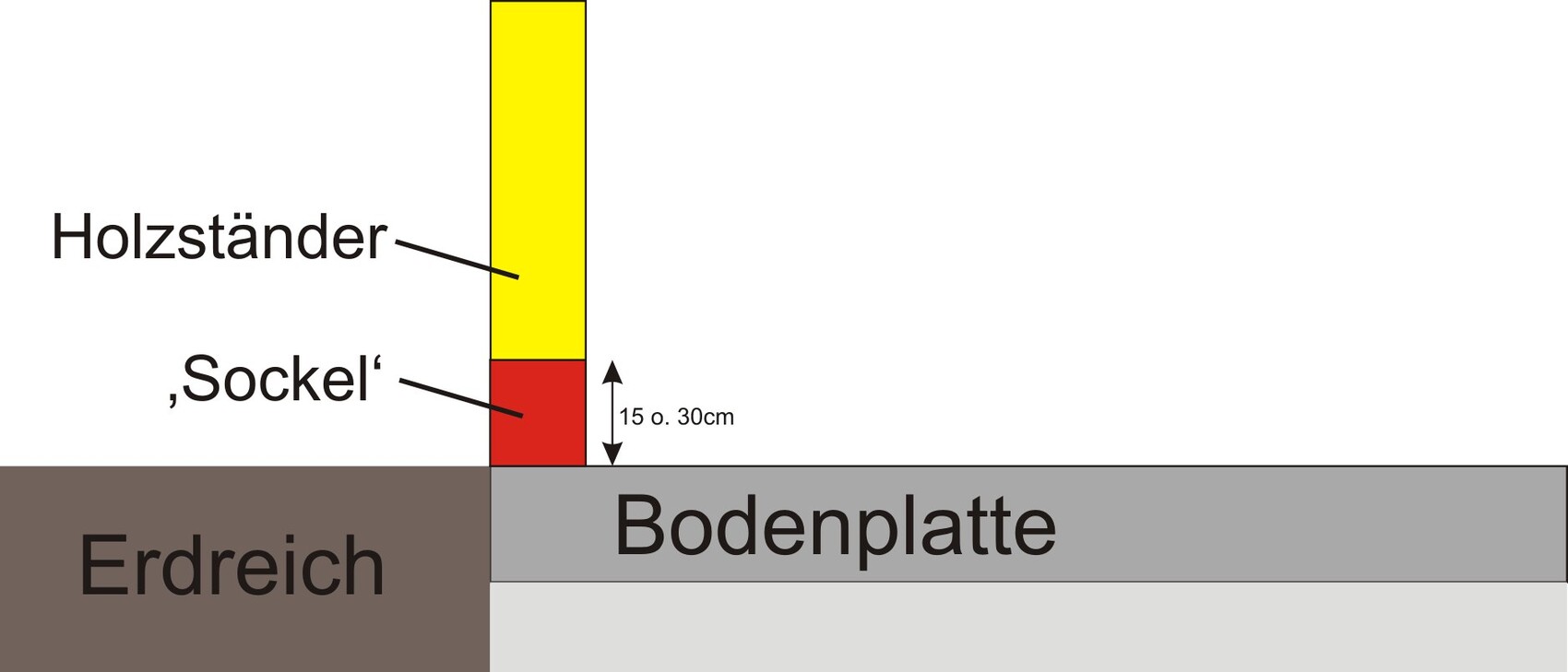
I am planning a timber frame house (without a basement) as an extension to an existing building.
To avoid steps at the transition between the new and existing structures, I need to build at the same level as the existing building. This means the top edge of the new foundation slab will be exactly at ground level!
According to the structural engineer and carpenter, however, the timber frame should not be placed directly on the ground. It needs to have a certain clearance above the ground level (I believe this is even required by regulations – 15 or 30 cm (6 or 12 inches)).
Since the slab is basically at zero level, I could build a solid base wall on top of which the timber frame would be set. That means I would first lay an additional course of bricks or blocks at the outside edge (where the external walls will be), so the timber frame has the desired clearance (15 or 30 cm (6 or 12 inches)?) above ground.
Something like this:
Questions:
Is this a common practice, or are there other options (for example, sealing the timber frame and placing it directly on the ground)?
If the solid base wall is an option, what material is typically used for it? Since I need the wall thickness to remain the same in the end (around 30 cm (12 inches)), how does this "material mix" affect the U-value (which will probably be different) and moisture behavior?
Thanks!
Best regards,
Mike
Hello,
if the top edge of the concrete slab is level with the ground, you don’t need to build a foundation wall. This can be resolved in detail. Your architect should consider this carefully.
It’s important that the wooden components are protected from moisture. This should be achieved by including a base element (not masonry, but integrated into the facade).
Otherwise, you can safely place your timber frame directly on the slab, since it is not standing in “dirt.”
Best regards
if the top edge of the concrete slab is level with the ground, you don’t need to build a foundation wall. This can be resolved in detail. Your architect should consider this carefully.
It’s important that the wooden components are protected from moisture. This should be achieved by including a base element (not masonry, but integrated into the facade).
Otherwise, you can safely place your timber frame directly on the slab, since it is not standing in “dirt.”
Best regards
Hello,
I was able to speak again today with my planner/structural engineer. He said that a row of concrete blocks about 25cm (10 inches) high is built on top of the slab foundation (with openings for the doors of course). The concrete blocks are then filled with concrete and receive appropriate external insulation and waterproofing (I believe it was 12cm (5 inches) of XPS).
The timber frame (with the wood fiber board on the outside) is then placed flush on this base. This way, the plaster can be applied in one continuous layer, and the base is practically invisible from the outside.
I tried to sketch it as I understood it:

What do you think about this?
Thanks!
Best regards,
Mike
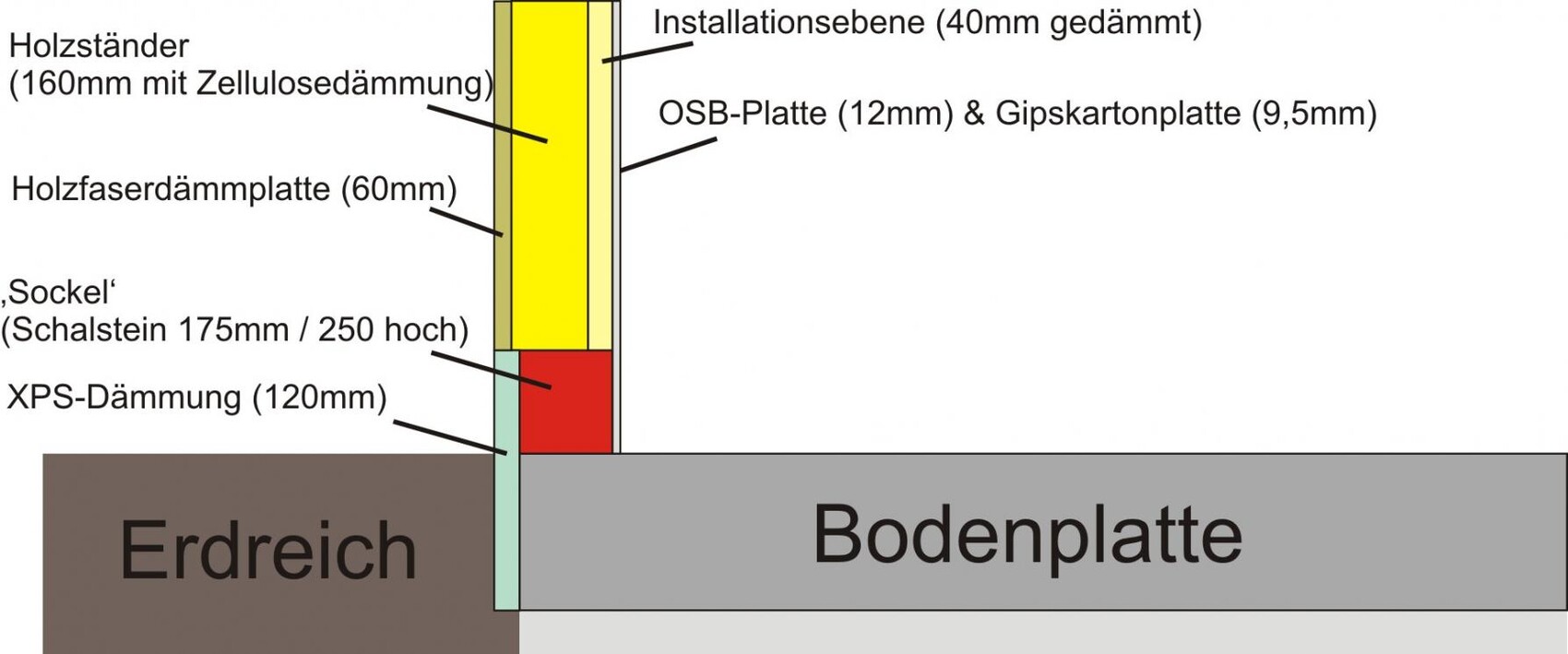
I was able to speak again today with my planner/structural engineer. He said that a row of concrete blocks about 25cm (10 inches) high is built on top of the slab foundation (with openings for the doors of course). The concrete blocks are then filled with concrete and receive appropriate external insulation and waterproofing (I believe it was 12cm (5 inches) of XPS).
The timber frame (with the wood fiber board on the outside) is then placed flush on this base. This way, the plaster can be applied in one continuous layer, and the base is practically invisible from the outside.
I tried to sketch it as I understood it:
What do you think about this?
Thanks!
Best regards,
Mike
Of course... this is really just a conceptual sketch and not to scale or anything like that.
According to the structural engineer (as mentioned above), the issue is that the timber frame, for example, can become wet or damp if exposed to standing moisture (or snow, etc.). The wall construction is vapor-permeable, and from the outside, after the render, there is a wood fiber insulation board followed by the timber frame filled with cellulose... so all materials that are not exactly ‘waterproof’...
And as I said, there is supposed to be a guideline or regulation stating that the timber frame must have a minimum clearance of 15cm (or 30cm - I’m not sure) from the top edge of the floor (does anyone know?).
According to the structural engineer (as mentioned above), the issue is that the timber frame, for example, can become wet or damp if exposed to standing moisture (or snow, etc.). The wall construction is vapor-permeable, and from the outside, after the render, there is a wood fiber insulation board followed by the timber frame filled with cellulose... so all materials that are not exactly ‘waterproof’...
And as I said, there is supposed to be a guideline or regulation stating that the timber frame must have a minimum clearance of 15cm (or 30cm - I’m not sure) from the top edge of the floor (does anyone know?).
I just did some more research online, but since linking (even to independent, ad-free sources) here results in an immediate warning without prior notice, I’ll refrain from doing so...
Here is a quote focusing solely on the topic of splash water:
There is similar information regarding standing water (like puddles), snow, and so on.
Unfortunately, there are very few technical guidelines on how to address this issue. One measure is, for example, the installation of a permeable strip (essentially a 'moat' of gravel around the house) to allow water infiltration.
However, I am more interested in technical solutions directly related to the building structure itself.
Here is a quote focusing solely on the topic of splash water:
Due to its proximity to the ground, rainwater splashing back from the soil also poses a risk to the base area. Therefore, adequate distance between the wooden elements and the ground must be ensured. Reliable protection is provided by keeping the lowest wooden parts at least 30 cm (12 inches) above ground level.
There is similar information regarding standing water (like puddles), snow, and so on.
Unfortunately, there are very few technical guidelines on how to address this issue. One measure is, for example, the installation of a permeable strip (essentially a 'moat' of gravel around the house) to allow water infiltration.
However, I am more interested in technical solutions directly related to the building structure itself.
rocksack schrieb:
According to the structural engineer (as mentioned above), the framework can become wet or damp, for example, when exposed to standing moisture (or snow, etc.). This does not apply if the waterproofing is properly designed and implemented.
As I said, you can include the base if it makes you feel more comfortable. However, it is not necessary. You can protect the structure from the outside.
rocksack schrieb:
And as mentioned, there is supposedly even a guideline or regulation stating that the framework must have a minimum distance of 15cm (or 30cm - I don’t know) from the top edge of the ground (does anyone know?).Your planner or structural engineer should know that.
Similar topics