
ᐅ Mixed materials construction without a basement, with a foundation or plinth, and moisture-resistant insulation
Created on: 23 Sep 2012 12:10
R
rocksackHello!
I am planning a timber frame house (without a basement) as an extension to an existing building.
To avoid steps at the transition between the new and existing structures, I need to build at the same level as the existing building. This means the top edge of the new foundation slab will be exactly at ground level!
According to the structural engineer and carpenter, however, the timber frame should not be placed directly on the ground. It needs to have a certain clearance above the ground level (I believe this is even required by regulations – 15 or 30 cm (6 or 12 inches)).
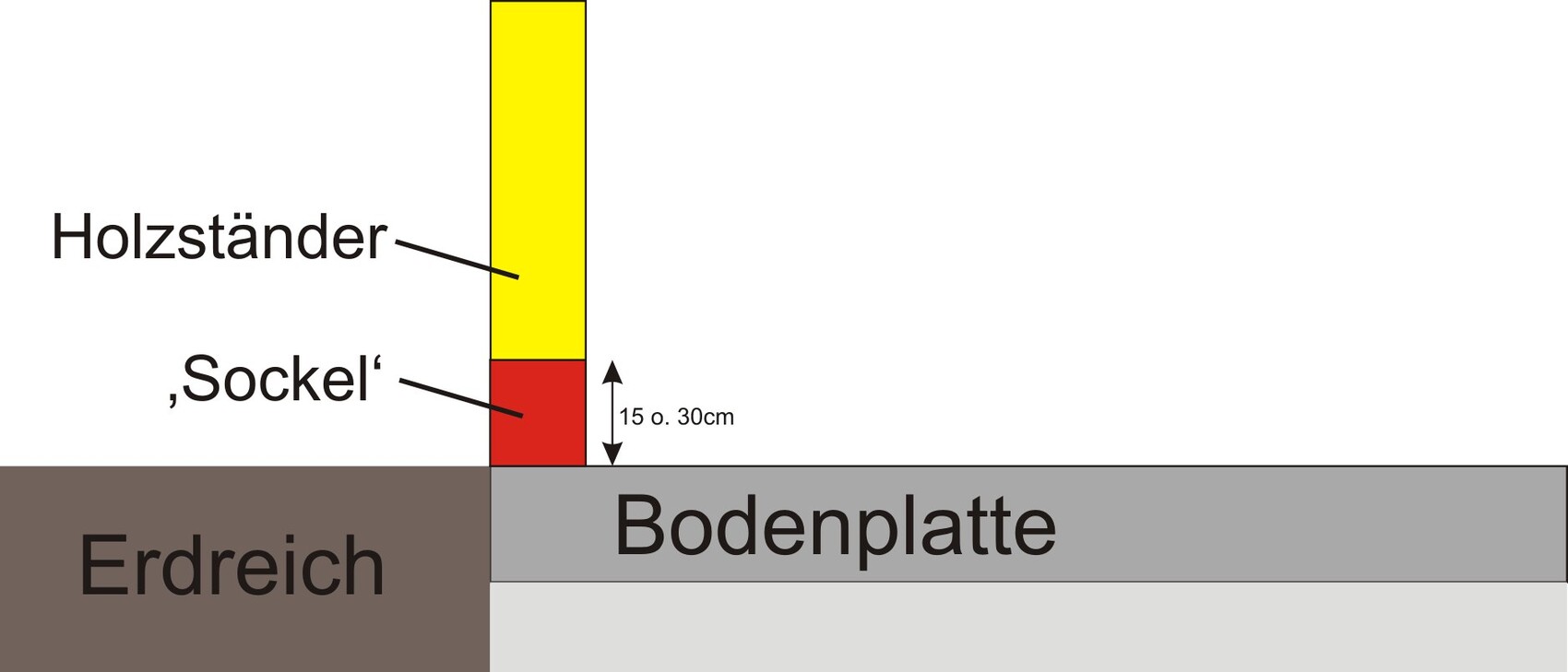
Since the slab is basically at zero level, I could build a solid base wall on top of which the timber frame would be set. That means I would first lay an additional course of bricks or blocks at the outside edge (where the external walls will be), so the timber frame has the desired clearance (15 or 30 cm (6 or 12 inches)?) above ground.
Something like this:

Questions:
Is this a common practice, or are there other options (for example, sealing the timber frame and placing it directly on the ground)?
If the solid base wall is an option, what material is typically used for it? Since I need the wall thickness to remain the same in the end (around 30 cm (12 inches)), how does this "material mix" affect the U-value (which will probably be different) and moisture behavior?
Thanks!
Best regards,
Mike
I am planning a timber frame house (without a basement) as an extension to an existing building.
To avoid steps at the transition between the new and existing structures, I need to build at the same level as the existing building. This means the top edge of the new foundation slab will be exactly at ground level!
According to the structural engineer and carpenter, however, the timber frame should not be placed directly on the ground. It needs to have a certain clearance above the ground level (I believe this is even required by regulations – 15 or 30 cm (6 or 12 inches)).
Since the slab is basically at zero level, I could build a solid base wall on top of which the timber frame would be set. That means I would first lay an additional course of bricks or blocks at the outside edge (where the external walls will be), so the timber frame has the desired clearance (15 or 30 cm (6 or 12 inches)?) above ground.
Something like this:
Questions:
Is this a common practice, or are there other options (for example, sealing the timber frame and placing it directly on the ground)?
If the solid base wall is an option, what material is typically used for it? Since I need the wall thickness to remain the same in the end (around 30 cm (12 inches)), how does this "material mix" affect the U-value (which will probably be different) and moisture behavior?
Thanks!
Best regards,
Mike
rocksack schrieb:
...I am planning a timber frame house (without a basement) as an extension to an existing building. If you are the designer, you should be able to handle even the most basic things! Best regards
€uro schrieb:
If you are the planner, you should master even the most basic things!
Regards. No... I am planning to build something like this. So, I am the client, not the planner (architect/structural engineer).
The suggestion to construct such a base/ground beam came from the structural engineer (who is currently on vacation). What I’m interested in now is how this is done in practice and whether there could be any issues (moisture, thermal bridges, etc.), and of course whether there are alternatives (since it will cost extra).
Thanks!
Best regards, Mike
Of course, I will have a facade. However, the structural engineer stated that the timber frame must have a minimum distance (I don’t remember if it was 15 or 30cm (6 or 12 inches)) from the ground.
Normally, this is automatically achieved when the top edge of the slab is above ground level (the slab basically rests on the ground, and I therefore have 1-2 steps to enter the house). In my case, however, I have to ‘lower’ the slab (meaning the top edge of the slab equals the ground level), so I cannot maintain this minimum distance. As a result, the timber frame is basically ‘in the dirt’ and can apparently absorb moisture from standing water or snow in winter, which makes sense to me.
As I understand it, I have two options:
Either the lower part of the timber frame must be waterproofed (which is necessary anyway around the terrace and entrance door areas)
and/or
the moisture-sensitive timber frame starts higher up—placed on a more moisture-resistant ‘plinth’ or base (see sketch above).
As described, I’m puzzled about how exactly the plinth should be constructed to avoid further problems (which type of block or stone, different materials, possibly other insulation of the plinth, or other wall thickness, U-value, etc.).
I’m interested in how this is handled in practice and whether there are any alternatives to using a plinth?
I hope I explained myself more clearly now!?
Thanks in advance!
Best regards, Mike
Normally, this is automatically achieved when the top edge of the slab is above ground level (the slab basically rests on the ground, and I therefore have 1-2 steps to enter the house). In my case, however, I have to ‘lower’ the slab (meaning the top edge of the slab equals the ground level), so I cannot maintain this minimum distance. As a result, the timber frame is basically ‘in the dirt’ and can apparently absorb moisture from standing water or snow in winter, which makes sense to me.
As I understand it, I have two options:
Either the lower part of the timber frame must be waterproofed (which is necessary anyway around the terrace and entrance door areas)
and/or
the moisture-sensitive timber frame starts higher up—placed on a more moisture-resistant ‘plinth’ or base (see sketch above).
As described, I’m puzzled about how exactly the plinth should be constructed to avoid further problems (which type of block or stone, different materials, possibly other insulation of the plinth, or other wall thickness, U-value, etc.).
I’m interested in how this is handled in practice and whether there are any alternatives to using a plinth?
I hope I explained myself more clearly now!?
Thanks in advance!
Best regards, Mike
Similar topics