
Hello garden enthusiasts,
Last year, I spent time preparing a poor grassland area. About 40m² (430 ft²) was fully dug up, edging stones were installed, and mixed with sand. Now, I want to place an insect hotel in the middle. Unfortunately, I have no experience with this yet. I know there are ready-made hotels available, but some are built completely incorrectly and therefore not used by the insects.
Has anyone here dealt with this before and can share some advice? Or are there websites where especially good information can be found?
Since I’m just starting, I am wondering, for example:
- What is the best orientation to the sun?
- Should I design separate compartments for each type of insect (such as bee section, beetle section, lacewing section, etc.)?
- Can wild bees be housed together with other species? Or do some always need their own separate “home”?
- Where can I order "building materials" affordably?
I appreciate any advice!
Last year, I spent time preparing a poor grassland area. About 40m² (430 ft²) was fully dug up, edging stones were installed, and mixed with sand. Now, I want to place an insect hotel in the middle. Unfortunately, I have no experience with this yet. I know there are ready-made hotels available, but some are built completely incorrectly and therefore not used by the insects.
Has anyone here dealt with this before and can share some advice? Or are there websites where especially good information can be found?
Since I’m just starting, I am wondering, for example:
- What is the best orientation to the sun?
- Should I design separate compartments for each type of insect (such as bee section, beetle section, lacewing section, etc.)?
- Can wild bees be housed together with other species? Or do some always need their own separate “home”?
- Where can I order "building materials" affordably?
I appreciate any advice!
H
hampshire19 Feb 2020 14:45On Saturday, we attended a lecture by a bee scientist. Some species like to nest in steep walls made of clay. Therefore, including a clay area could be beneficial. She also advised against drilling into heartwood, which is often done. The wood tends to crack, become leaky, and turn into a death trap. Deburring is very important—I noted that only really sharp drill bits should be used. One participant mentioned that he installed a small wire fence in front of his bee hotel; before that, his bee hotel was more like a feeding station for wasps.
However, the most crucial factor for a functional bee hotel is that the bees find suitable food sources nearby—there should be appropriate flowering plants around it.
However, the most crucial factor for a functional bee hotel is that the bees find suitable food sources nearby—there should be appropriate flowering plants around it.
How large is the house overall now?
Butterflies: Almost no species overwinter here – small tortoiseshell, peacock butterfly, and brimstone butterfly are the most well-known. Many survive the winter as caterpillars or pupae, or migrate to warmer places. This could change with climate change. But those that stay rest on branches or in leaf piles.
Ladybugs: Gather in groups in wall cracks, leaf piles, roof beams, etc.
Please DO NOT!!
There are species that build their tubes early in the year and others that do so later. If you put such a block in the oven, you become a killer. Well, at least the work and good intentions were for nothing.
Small boxes/blocks can be placed in early spring inside a carton or a box with an exit hole. Then all larvae can hatch, but it won’t be recolonized. Once empty, the container can be cleaned.
You can also mark the occupied tubes with colors to see next year where something emerged and what died.
Please remember to provide an escape aid for animals that fall in. Alternatively, put in a shallow floating island so insects can reach the water without drowning.
Me too, show a photo of how it looks.
kaho674 schrieb:
There are still ladybugs or butterflies left – I haven’t read any information about those yet.
Butterflies: Almost no species overwinter here – small tortoiseshell, peacock butterfly, and brimstone butterfly are the most well-known. Many survive the winter as caterpillars or pupae, or migrate to warmer places. This could change with climate change. But those that stay rest on branches or in leaf piles.
Ladybugs: Gather in groups in wall cracks, leaf piles, roof beams, etc.
For the bees, it’s important to be able to change the tubes regularly to avoid ongoing mite infestation. So the wooden blocks should be oven-safe once a year or you can use cardboard tubes that you then dispose of. That’s why oven-friendly sizes are made.
Please DO NOT!!
There are species that build their tubes early in the year and others that do so later. If you put such a block in the oven, you become a killer. Well, at least the work and good intentions were for nothing.
Small boxes/blocks can be placed in early spring inside a carton or a box with an exit hole. Then all larvae can hatch, but it won’t be recolonized. Once empty, the container can be cleaned.
You can also mark the occupied tubes with colors to see next year where something emerged and what died.
There is a water source in the form of an old wine barrel nearby. It stands directly on the cistern where a hand pump is planned.
Please remember to provide an escape aid for animals that fall in. Alternatively, put in a shallow floating island so insects can reach the water without drowning.
Well, what do I do with the other two floors? I’m still a bit unsure. ops:
Me too, show a photo of how it looks.

So, the hotel is 1.80 m high (5 feet 11 inches) – simply because the beams were that long and we didn’t want to cut anything off unnecessarily. I’ll take some photos as soon as we set it up and I have time. Sorry, that might take a little while, one anniversary follows another at the moment.
Okay, I’ll be careful with the wasps so that none get killed.
Of course, there are stones and branches inside the barrel. It’s only a quarter of a barrel, so not very tall, allowing quick access to the surface.
We often have the blue carpenter bee around in the summer. I read that they chew 30 cm (12 inches) long, finger-thick holes in wood and then nest there. That would be amazing if one of these big bees moved in with us.
Okay, I’ll be careful with the wasps so that none get killed.
Of course, there are stones and branches inside the barrel. It’s only a quarter of a barrel, so not very tall, allowing quick access to the surface.
We often have the blue carpenter bee around in the summer. I read that they chew 30 cm (12 inches) long, finger-thick holes in wood and then nest there. That would be amazing if one of these big bees moved in with us.
 Vicky Pedia20 Feb 2020 00:34
kaho674 schrieb:
We often have the blue carpenter bee around in summer. I read that they chew holes about 30cm (12 inches) in diameter, roughly as thick as a finger, into wood and then nest there. It would be quite something if one of these big bees moved in at our place. I’m keeping my fingers crossed for you, although the 30cm (12 inches) might be a bit of an exaggeration!
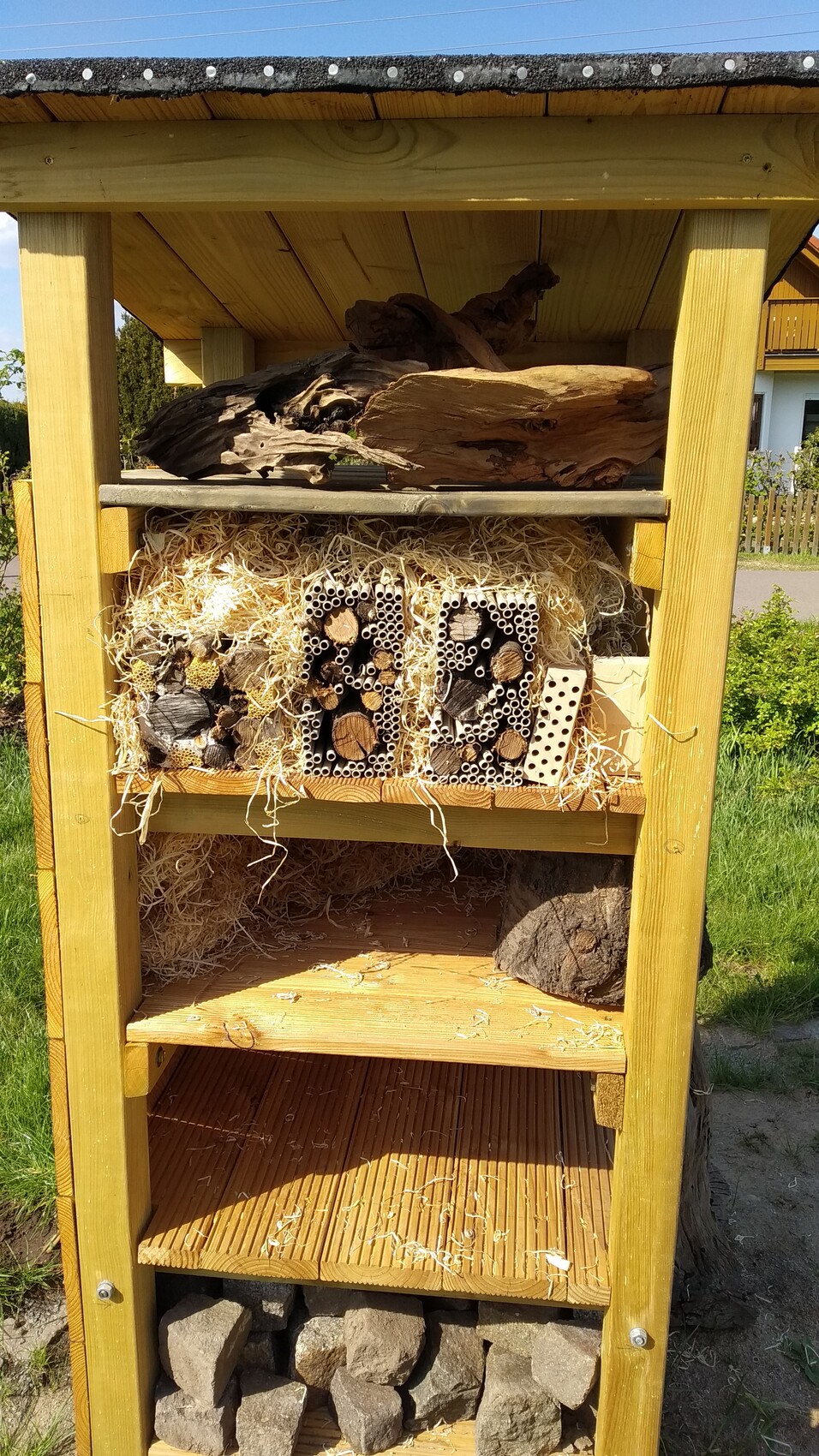
I’ve started inserting the first tubes. They are made of cardboard and coated with plaster on the back. The wood wool is meant to further block drafts from behind and to make it look a bit nicer. I mixed in some branches in between to add some texture and to help the bees find their "holes" more easily. As you can see, it’s just a beginning. The drilling is already in progress (phew!) – so there will be some cherry wood logs added as well. I also ordered a lot of bamboo sticks, which I’d like to add. They’re actually a bit too big, but maybe I can attract the blue carpenter bee. It was already checking things out yesterday... almost "flew me over." That would be cool.
Similar topics